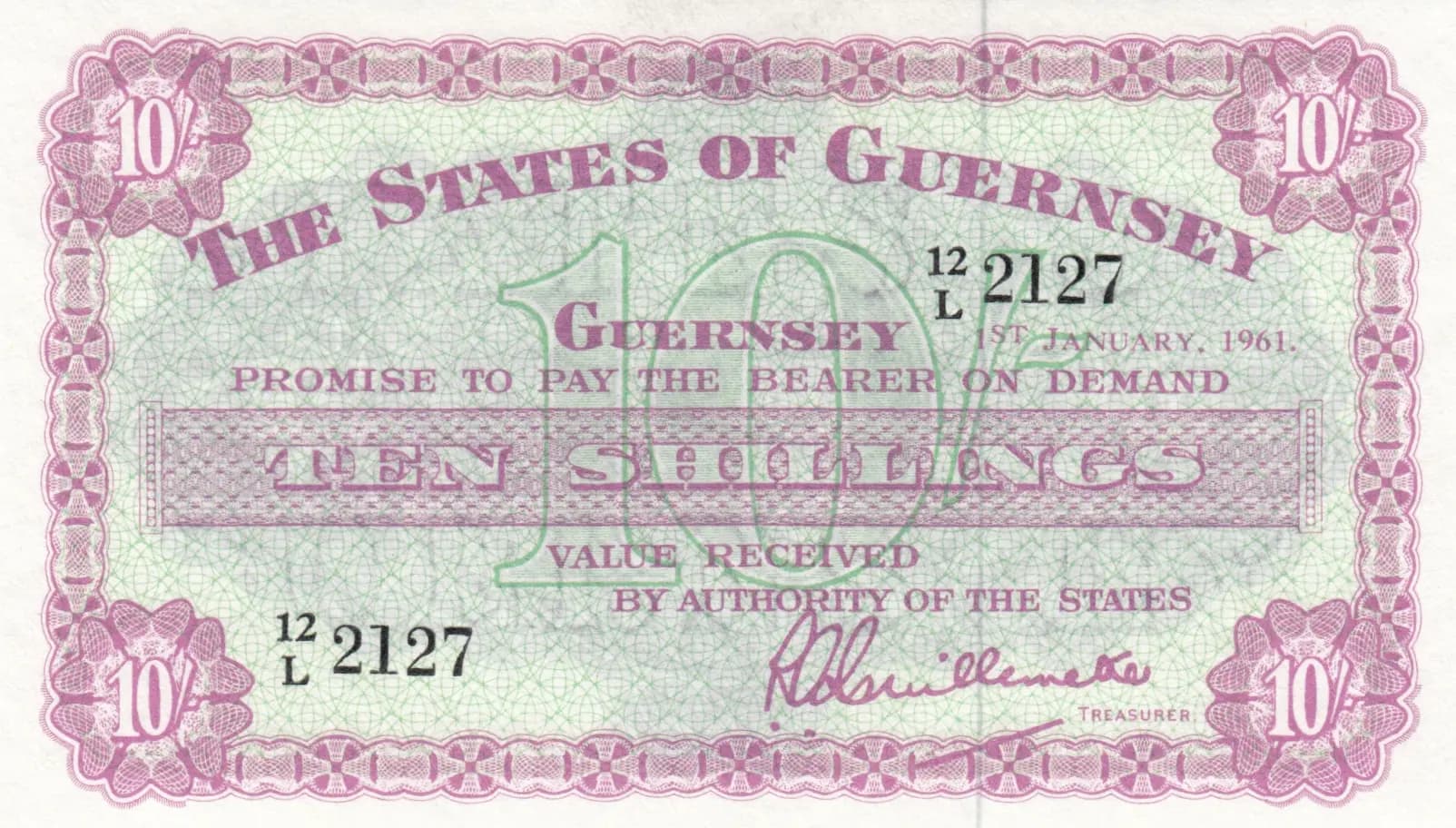
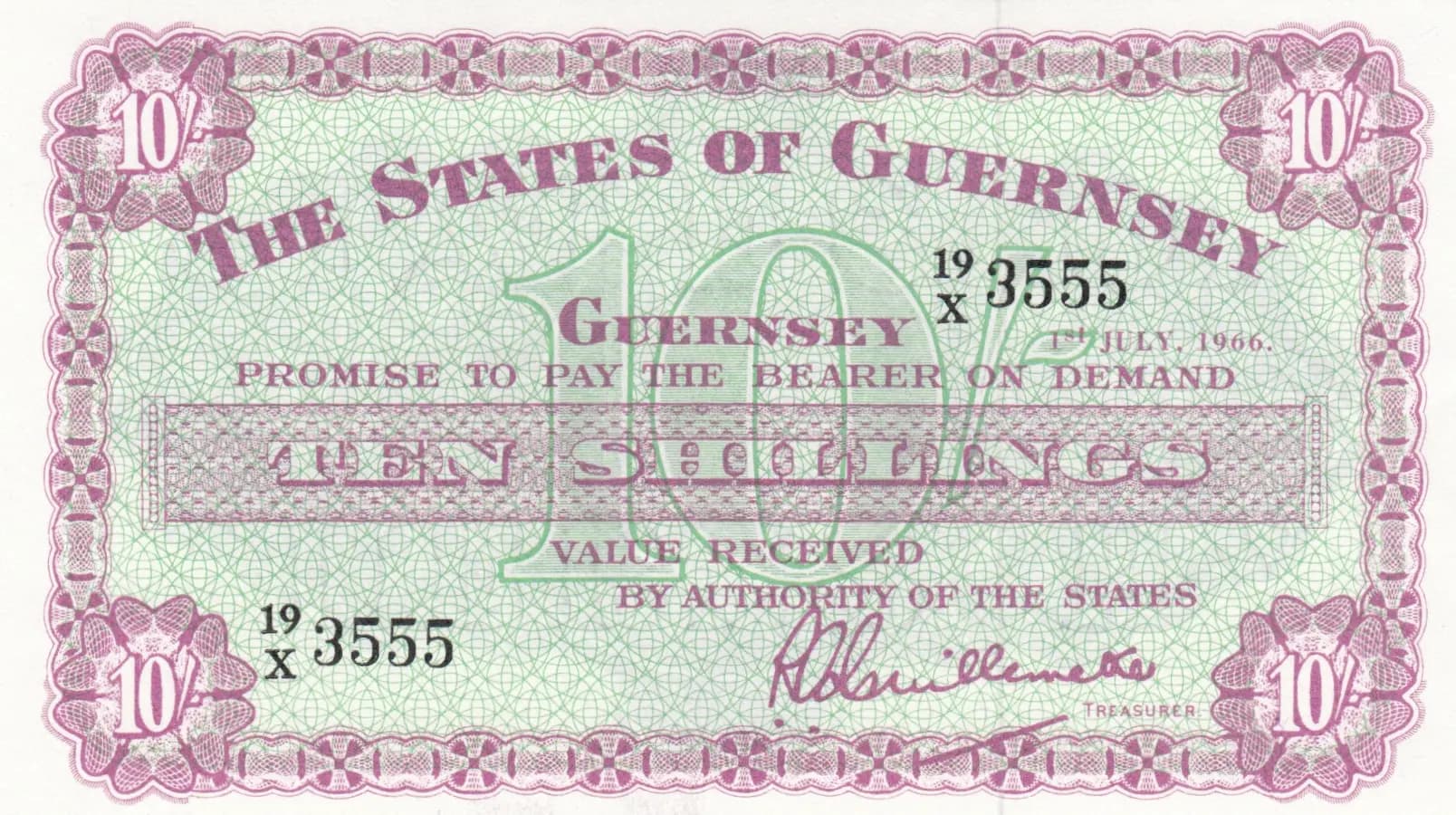
10 shillings 1966
Market Prices
20 salesAbout This Note
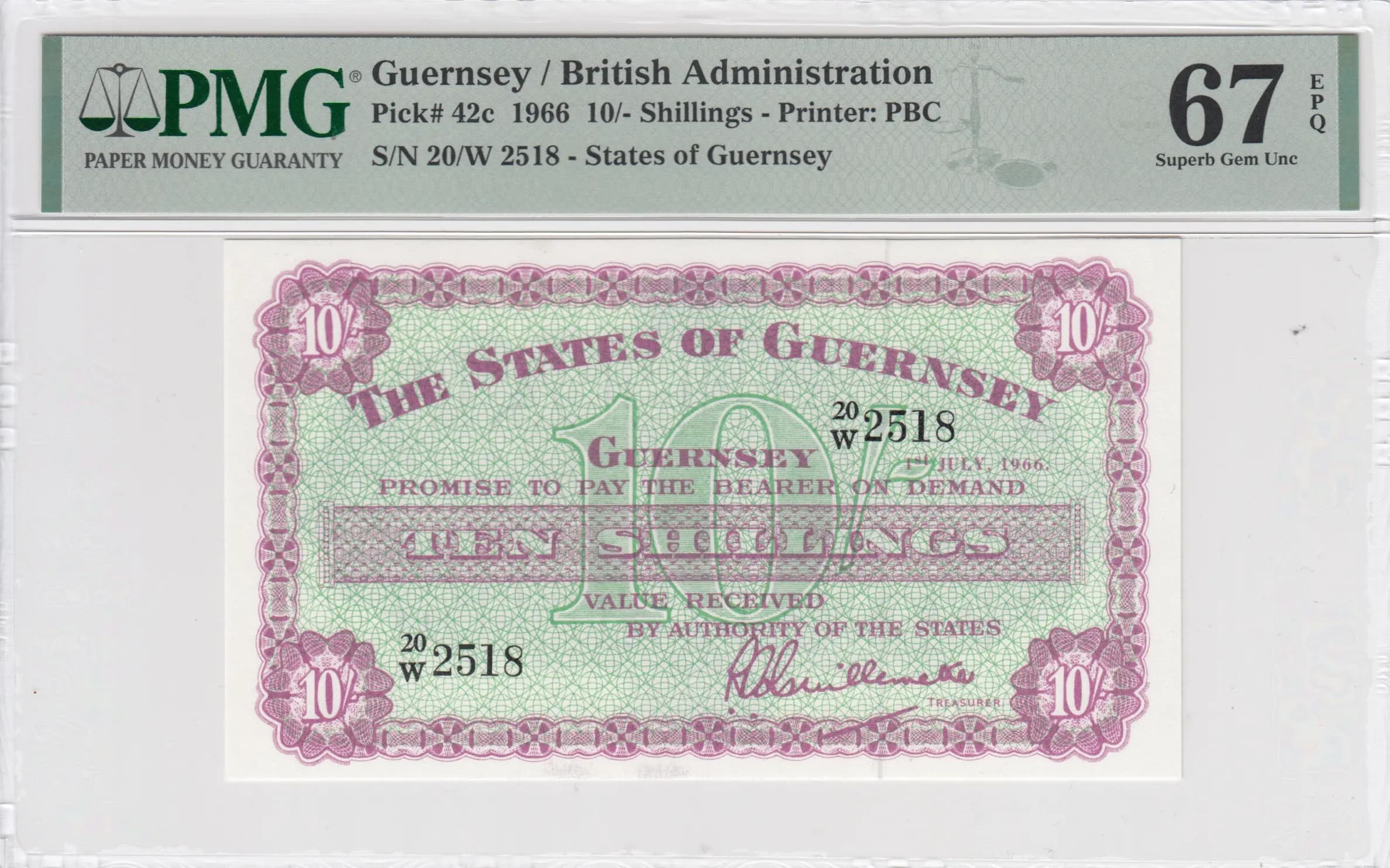
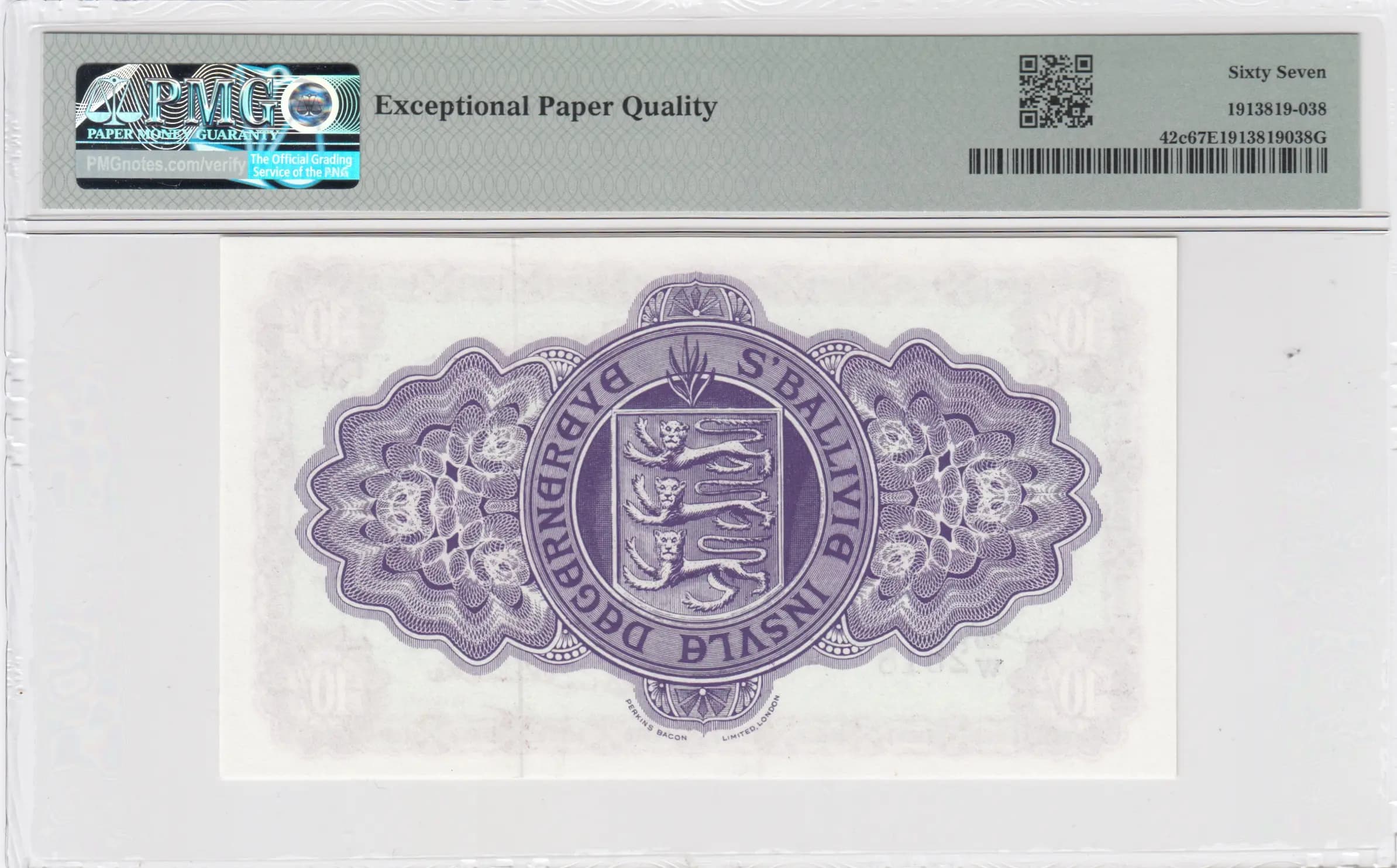
This Guernsey 10 Shillings note from July 1966 represents a scarce early post-war issue from the Channel Islands, graded PMG 67 EPQ. The note displays exceptional preservation with crisp, sharp impressions throughout, featuring a distinctive pink/magenta and green color scheme on the obverse with an ornate central oval vignette, and the reverse showcasing a detailed heraldic coat of arms in purple. The exceptional condition grade and historical significance as part of Guernsey's early currency series make this a desirable example for collectors of Channel Islands currency.
Common. While this is an early Guernsey issue from 1966, the 10 Shillings denomination appears regularly in the secondary market with eBay price data spanning 2009-2025 showing consistent availability. Market prices for this Pick number range from approximately $3.95 (Fine condition, 2020) to $202.51 (UNC, 2015), with PMG 67 examples averaging $75-$146. The consistent supply across multiple grades and years indicates reasonable print runs and ongoing collector circulation. This is not a scarce or rare note, though PMG 67 EPQ represents an exceptionally preserved example that commands premium pricing within the normal market range.
This note was issued in July 1966 by The States of Guernsey during the post-war period, when the Channel Islands were asserting greater financial autonomy within the British Commonwealth. The heraldic coat of arms displayed on the reverse, featuring the three lions of England integrated with Guernsey's own heraldic symbols, reflects the island's status as a self-governing dependency with deep historical ties to the British Crown. The 10 Shillings denomination places this within the pre-decimal currency system still in use at the time, before the 1971 conversion to decimal currency.
The obverse features a sophisticated design with a prominent ornate border in pink/magenta enclosing a white field accented with green typography and security elements. The central design includes a large oval vignette in green, likely containing heraldic or decorative symbolism of Guernsey, surrounded by complex geometric crosshatch patterns providing anti-counterfeiting protection. The denomination "10" appears in all four corners in green. The reverse displays the official coat of arms of the Bailiwick of Guernsey in a circular seal—a heraldic composition featuring three lions and ornamental flanking flourishes—executed in purple/violet ink on a white background. This heraldic seal represents Guernsey's sovereignty and historical connection to Norman heraldic traditions. The overall design reflects the formal, traditional aesthetic typical of Commonwealth currency circa 1966.
{"obverse":{"inscriptions":[{"original":"THE STATES OF GUERNSEY","translation":"The States of Guernsey (issuing authority)"},{"original":"GUERNSEY","translation":"Guernsey (country/territory)"},{"original":"PROMISE TO PAY THE BEARER ON DEMAND","translation":"Promise to pay the bearer on demand (legal tender promise)"},{"original":"TEN SHILLINGS","translation":"Ten Shillings (denomination)"},{"original":"VALUE RECEIVED","translation":"Value received (accounting/legal notation)"},{"original":"BY AUTHORITY OF THE STATES","translation":"By authority of the states (issuing mandate)"},{"original":"20 W 2518","translation":"Serial number identifier"},{"original":"JULY 1966","translation":"July 1966 (issue date)"},{"original":"TREASURER","translation":"Treasurer (issuing official title)"}]},"reverse":{"inscriptions":[{"original":"BAILIWICK OF GUERNSEY","translation":"Bailiwick of Guernsey (official territorial designation)"},{"original":"F. BACON","translation":"F. Bacon (engraver/printer attribution, Perkins Bacon, London)"}]}}
This note was printed by Perkins Bacon, Limited of London, using intaglio engraving techniques typical of security printing of the period. The fine line work visible in the heraldic imagery, geometric security patterns, and ornamental borders are characteristic of traditional steel plate engraving. The registration and crisp impression of the multicolor design (pink/magenta, green on obverse; purple on reverse) indicates the use of separate engraved plates and careful offset lithography or multi-pass intaglio printing to achieve the color separation. The absence of modern security features is consistent with 1960s printing standards.
This note is cataloged as Pick 42c, indicating it is one of three recognized varieties of the Guernsey 10 Shillings 1966 issue. All three varieties (P-42a, P-42b, P-42c) share the same printer (Perkins Bacon, London) and nominal specifications. The P-42c designation likely corresponds to a specific print batch or signature variant, though detailed differentiating characteristics between the three varieties are not definitively documented in standard references. The serial number visible on this specimen (20 W 2518) and the July 1966 date are consistent with the documented issue parameters. Collectors should note specific signature combinations and date variations to distinguish between varieties when acquiring examples for a complete series.