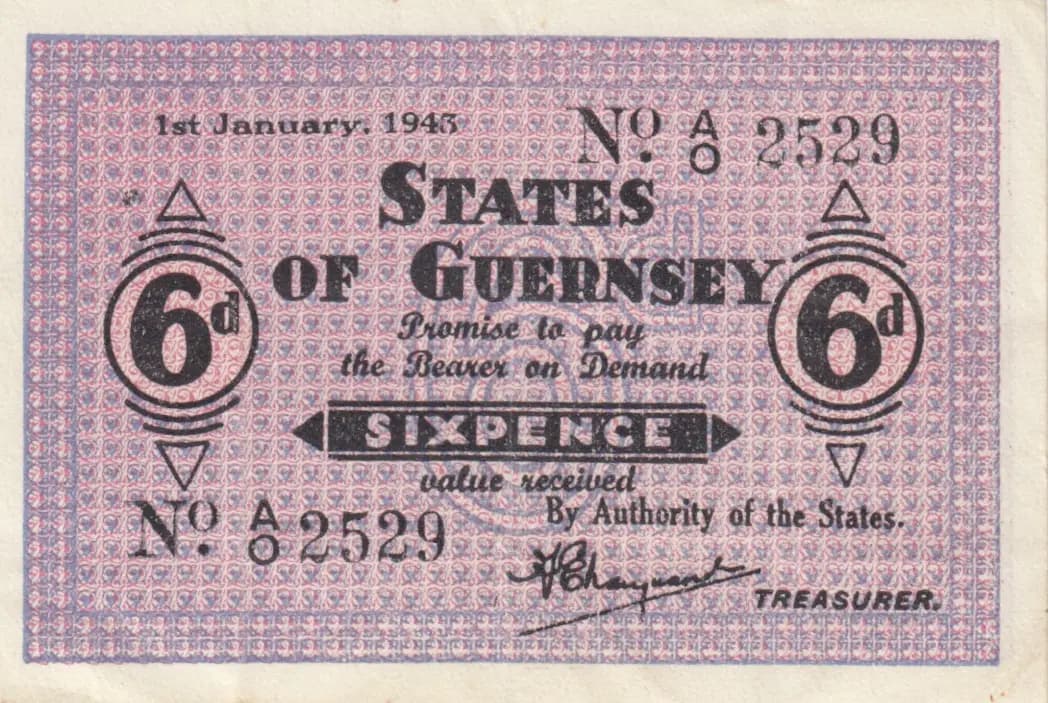
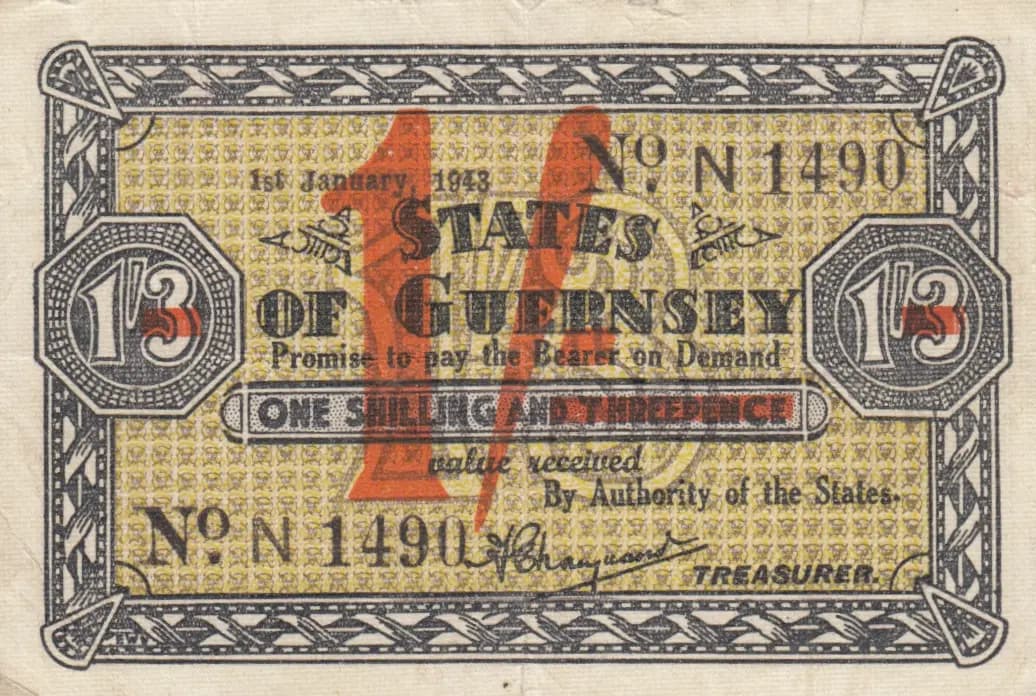
1 shilling 3 pence 1941
Market Prices
2 salesAbout This Note
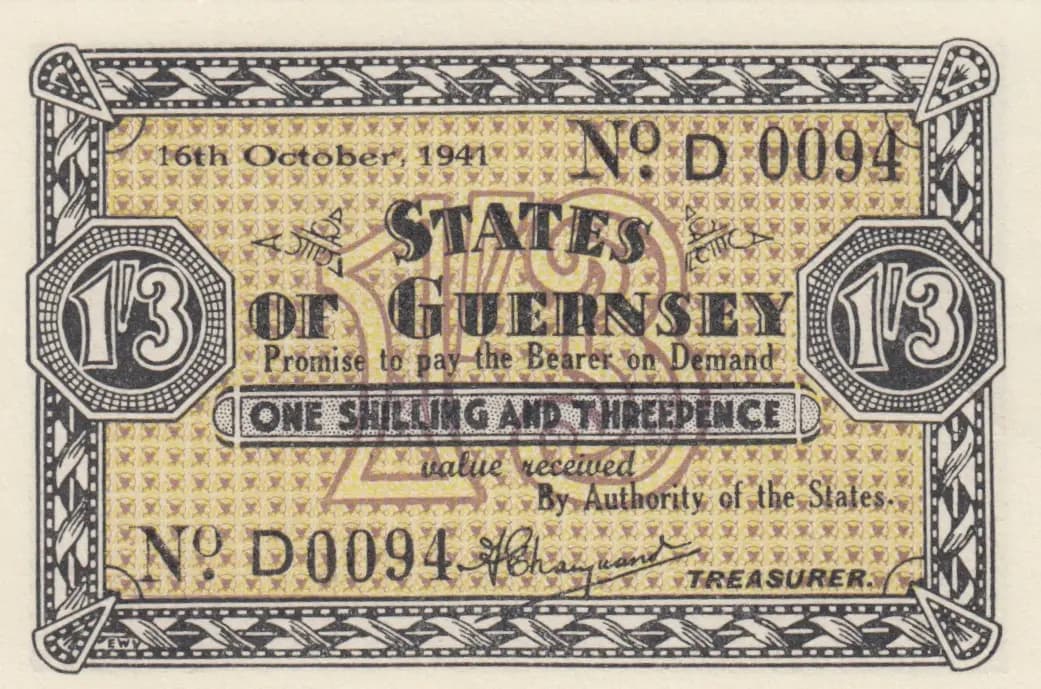
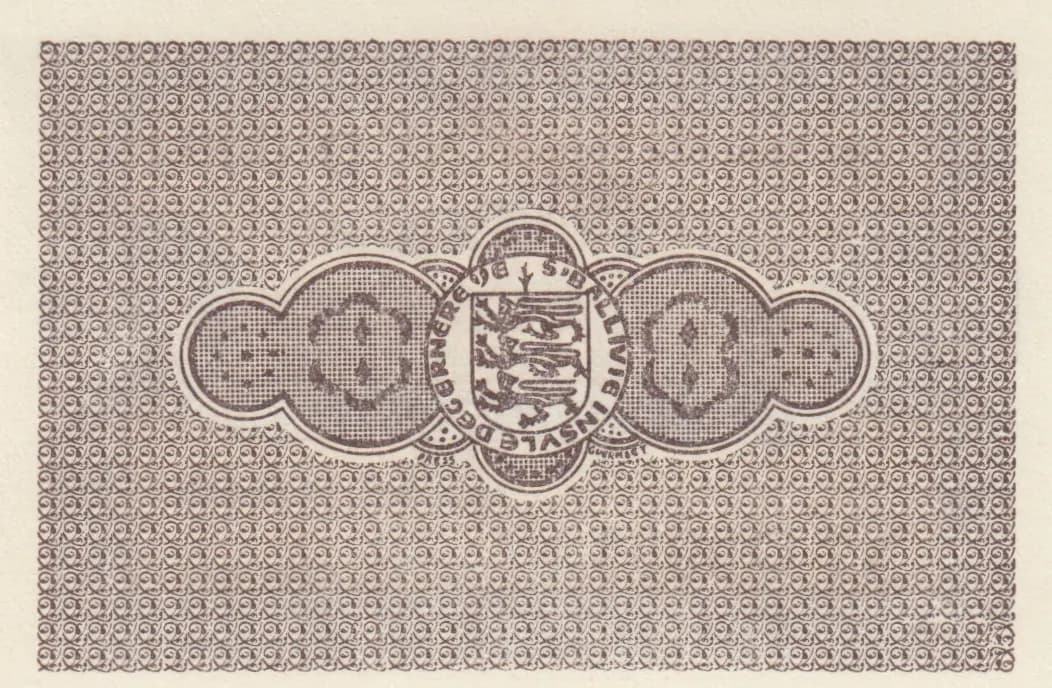
This is a States of Guernsey 1 Shilling 3 Pence note dated 16th October 1941, representing an early wartime issue from the Channel Islands. The obverse displays an elegant cream and black design with intricate geometric borders and denomination in octagonal frames, while the reverse showcases the Guernsey coat of arms with heraldic lions and a crowned shield against a dense repeating background pattern. In UNC condition, this note exhibits minimal wear consistent with careful handling, though age-related foxing and patina are visible, typical of emergency currency from this era.
Common. Although this is a wartime occupation-era note with historical significance, the Pick catalog lists only one variant, and eBay market data shows regular circulation sales in the $35-$475 range depending on condition grade (2018 data). The existence of professionally graded examples (PMG 65 at $470.89) indicates sufficient surviving examples in higher grades. Print runs for Guernsey occupation currency were substantial enough to support active collector trading without scarcity premiums.
This banknote was issued during World War II when Guernsey, under German occupation (1940-1945), required emergency currency distinct from British sterling. The States of Guernsey commissioned these notes as occupation currency, with the coat of arms prominently featured on the reverse serving as an assertion of local governmental authority and Guernsey identity during wartime. The formal 'Promise to pay the Bearer on Demand' and 'By Authority of the States' inscriptions reflect the extraordinary legal and administrative circumstances of the Channel Islands occupation.
The obverse features a symmetrical design dominated by a cream or tan-colored central panel framed by black decorative borders with interlocking geometric patterns and ornamental corner flourishes. The denomination appears in two octagonal frames containing the numerals. The reverse displays the coat of arms of Guernsey as its central heraldic element—featuring lions passant guardant and a crowned shield—rendered in brown and sepia tones against a dense, repeating background pattern (likely a security tint or geometric motif). The overall color scheme comprises cream, tan, black, and brown, creating a formal, austere aesthetic appropriate to wartime emergency currency. This design eschews portraiture in favor of institutional and heraldic symbolism.
FRONT: 'STATES OF GUERNSEY' (issuing authority); 'Promise to pay the Bearer on Demand' (traditional note obligation); 'ONE SHILLING AND THREEPENCE' (denomination in words); 'By Authority of the States' (legal authorization); 'TREASURER' (authorized signatory); '16th October, 1941' (issue date); Serial number 'N.D.0094' appears twice (top right and bottom left). BACK: Large denomination numerals '10' (shillings) and '13' (pence) in decorative circular frames; no additional text inscriptions visible, heraldic design serves as primary reverse element.
Letterpress and line engraving, characteristic of British security printers of the period. The intricate border patterns, fine line work in the heraldic arms, and clear impression of serial numbers are consistent with traditional intaglio security printing methods employed by Thomas De La Rue or similar Crown security printers authorized by the British government for Commonwealth and Channel Islands issues.
This example is identified as serial number N.D.0094 with the signature block of the Treasurer visible. The 'N.D.' prefix likely indicates a specific batch or administrative series. PMG population records indicate a single base variety for P-23, suggesting no major signature or date varieties are cataloged for this denomination. Specific signature varieties or overprint states may exist but are not distinguished in the major catalog systems; collector variation studies would be needed to identify subsidiary varieties.