10 shillings 1966
Market Prices
20 salesAbout This Note
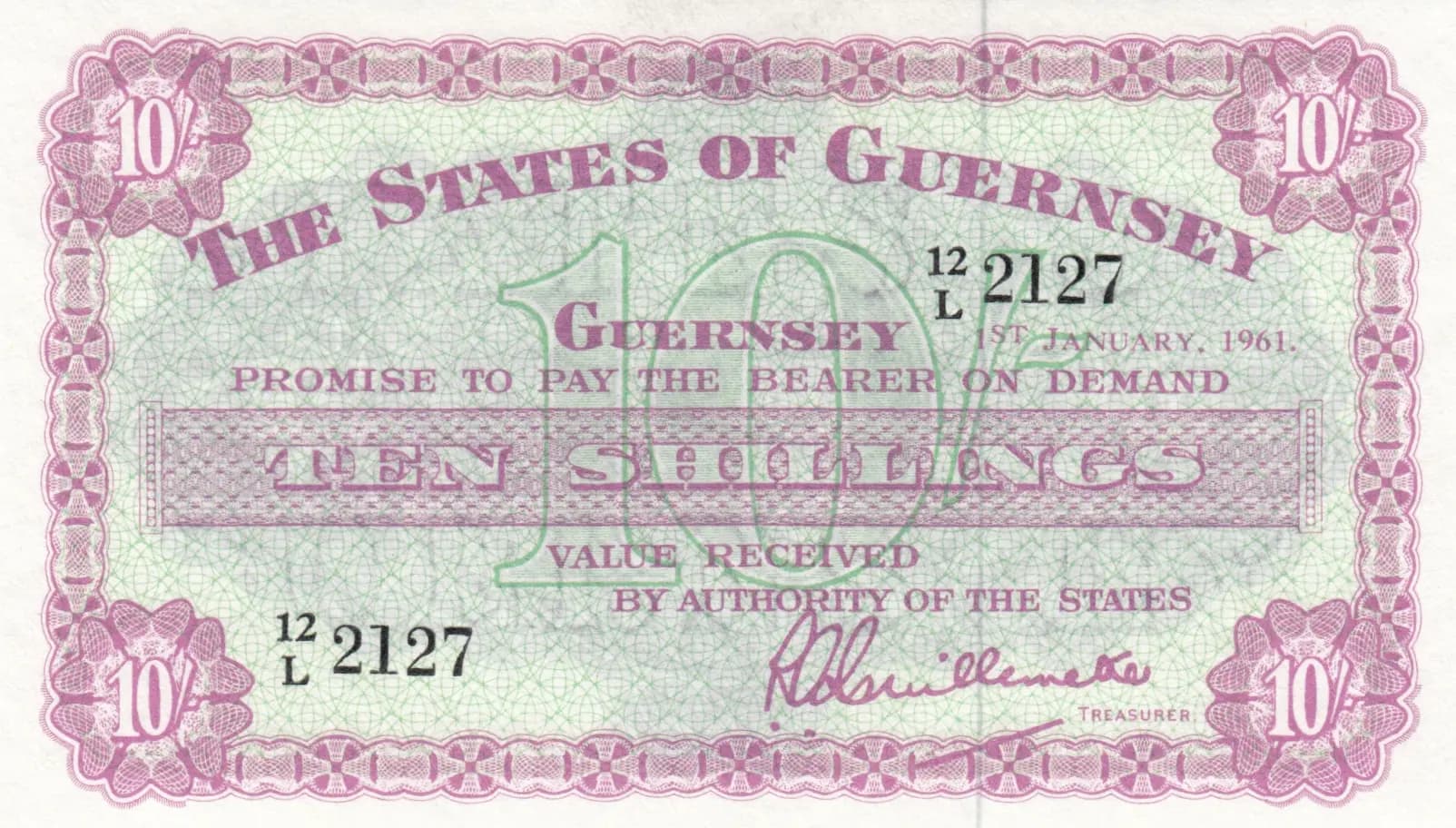
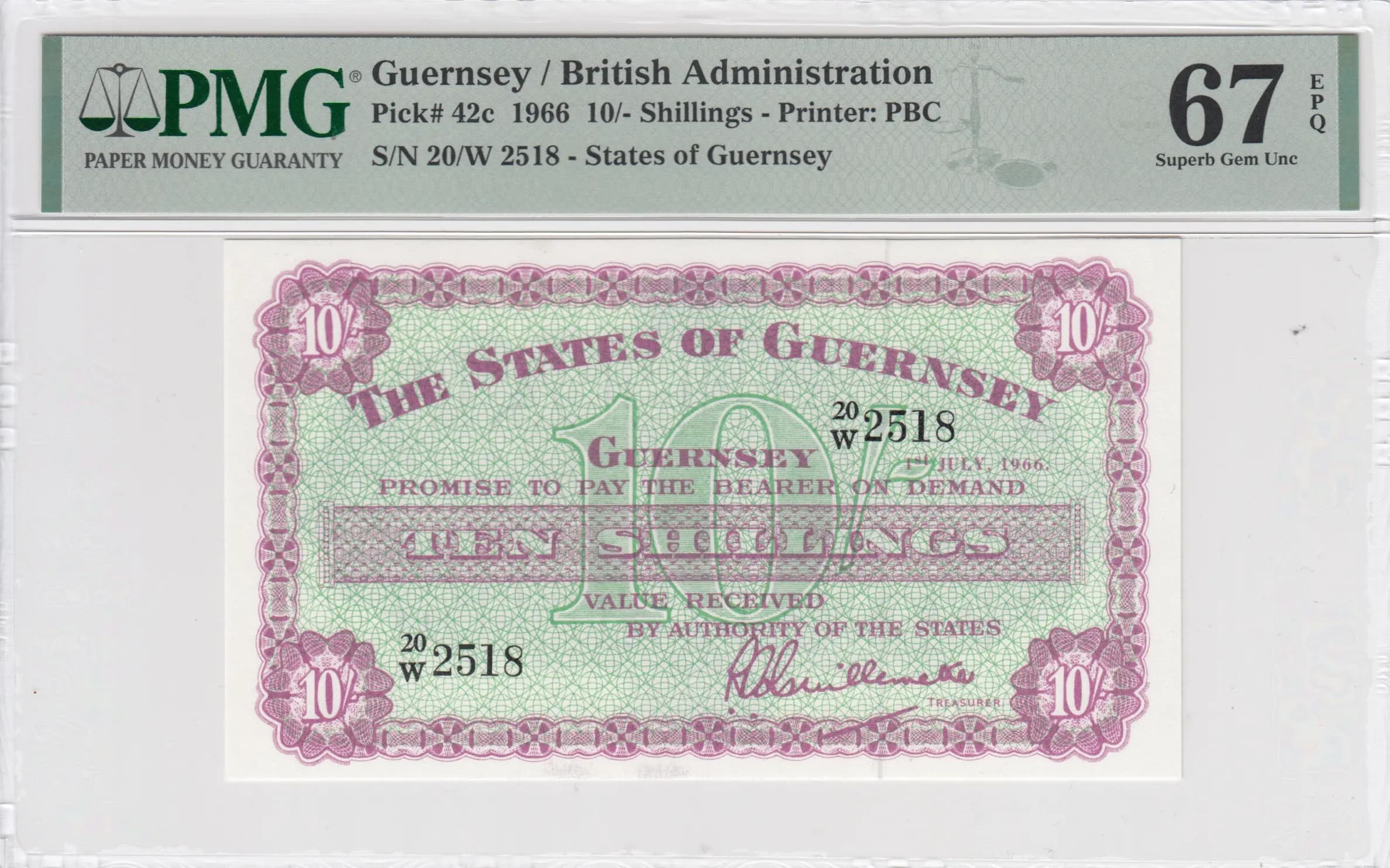
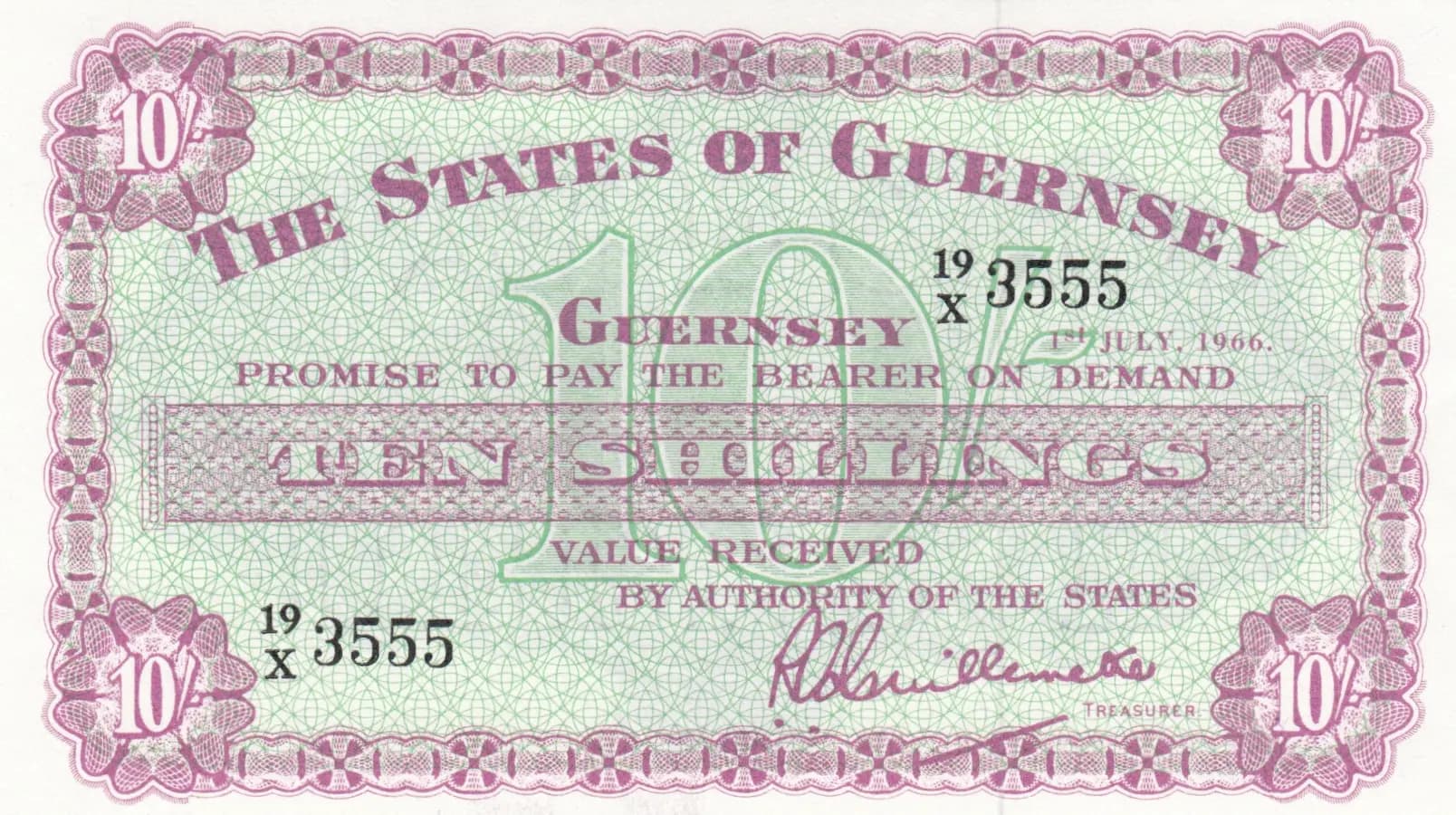
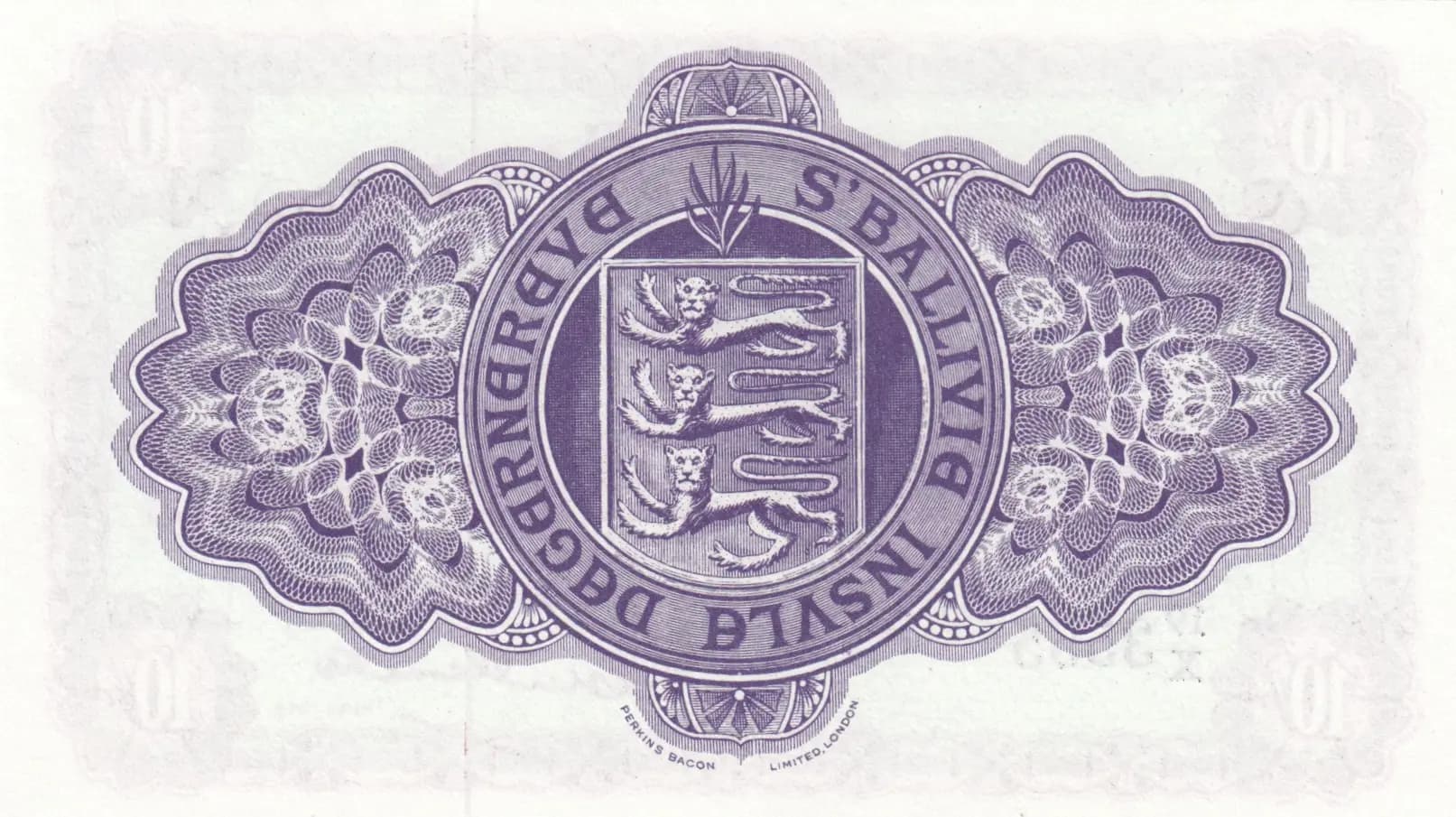
This is a Guernsey 10 Shillings note from 1st July 1966, issued by The States of Guernsey and printed by Perkins Bacon of London. The note presents in UNC condition with a striking pink/magenta and green color scheme on the obverse featuring ornate cross-hatch decorative borders and a prominent green '10' numeral, while the reverse displays a purple coat of arms with the Guernsey Bailiwick seal flanked by scallop shell ornaments. This is a historically significant early issue from Guernsey's post-war currency period, with well-preserved fine line engraving and minimal wear characteristic of uncirculated specimens.
Common. While this is an early Guernsey issue from 1966, the eBay market data demonstrates consistent availability with notes regularly selling in the $50–$150 range for UNC specimens across the past 15 years, with 2019 catalogue valuations of $125 for UNC grade. The regular appearance of these notes in auctions (with 20+ bid auctions documented), combined with multiple graded examples in PMG records and consistent pricing, indicates healthy supply and collector demand without scarcity premium. Print run and circulation patterns for Guernsey's early issues were substantial, and this denomination did not undergo emergency recall or limited distribution.
This 1966 10 Shillings note represents a critical period in Guernsey's financial autonomy, issued shortly after the territory began establishing its own currency identity post-World War II. The central coat of arms on the reverse—featuring three lions stacked vertically within the Guernsey Bailiwick seal—reflects the Bailiwick's historical heraldic traditions and its status as a Crown dependency with distinct legal and financial authority. The prominent date of 1st July 1966 and the authority statement 'BY AUTHORITY OF THE STATES' underscore Guernsey's assertion of monetary control during a period of gradual devolution from sterling-based currency systems.
The obverse features a classical banknote layout with 'GUERNSEY' in large green lettering as the dominant central element, accompanied by a large green '10' denomination numeral. The note is framed by ornate decorative borders composed of repeating geometric cross-hatch patterns typical of fine-line security engraving, rendered in pink/magenta and green inks on a white base. The reverse presents the centerpiece—a formal circular coat of arms seal of the Bailiwick of Guernsey, featuring three lions stacked vertically within a heraldic shield, rendered in purple/blue ink. This seal is flanked symmetrically by decorative scallop shell or fan-like ornamental patterns, reinforcing the formal, ceremonial nature of the design. Serial numbers appear in the corners of the obverse, and the Treasurer's signature (Albwillimms) provides legal authentication. The design reflects the traditional engraved aesthetic of mid-20th century Commonwealth currency, emphasizing heraldic authority and security through fine-line detail work.
OBVERSE: 'THE STATES OF GUERNSEY' — The issuing authority; 'GUERNSEY' — Country name; 'PROMISE TO PAY THE BEARER ON DEMAND' — Standard bearer clause; 'TEN SHILLINGS' — Denomination in words; 'VALUE RECEIVED' — Accounting phrase; 'BY AUTHORITY OF THE STATES' — Legal authorization statement; '1ST JULY, 1966' — Issue date; '19 X 3555' — Serial number; 'TREASURER' — Official title of signatory; 'Albwillimms' — Treasurer's signature. REVERSE: 'GUERNSEY BAILIWICK' and 'BAILIWICK OF GUERNSEY' — Territorial designation; 'PERRIER BACON LIMITED LONDON' — Printer credit (Note: Visual analysis shows 'PERRIER BACON' though standard records list 'Perkins Bacon'; this may reflect printing house nomenclature of the period).
Intaglio (engraved line) printing, the predominant security printing method for banknotes of this era. The visual evidence includes fine cross-hatching, detailed stippling, and ornate border designs characteristic of steel-plate engraving. The printer is identified in the note itself as Perkins Bacon (also shown as 'Perrier Bacon' in the visual inscription) of London, one of the world's foremost banknote security printers. The multi-color application (pink/magenta, green, purple, blue) was achieved through successive plate passes typical of traditional intaglio production.
This specimen is identified as Pick catalog number P-42c, indicating it is one of three recognized varieties of the 10 Shillings 1966 issue (P-42a, P-42b, and P-42c all printed by PBC—Perkins Bacon). The distinguishing characteristics among these varieties likely relate to signature variants, date variations, or sequential printing runs, though specific differentiation criteria between P-42a, P-42b, and P-42c are not fully detailed in standard references. The signature visible on this example reads 'Albwillimms,' which should be noted in detailed cataloguing to establish which variety variant this represents. Serial number prefix '19 X' and the '1st July 1966' date are consistent with standard P-42c characteristics.