50 centavos 1982
Market Prices
41 salesAbout This Note
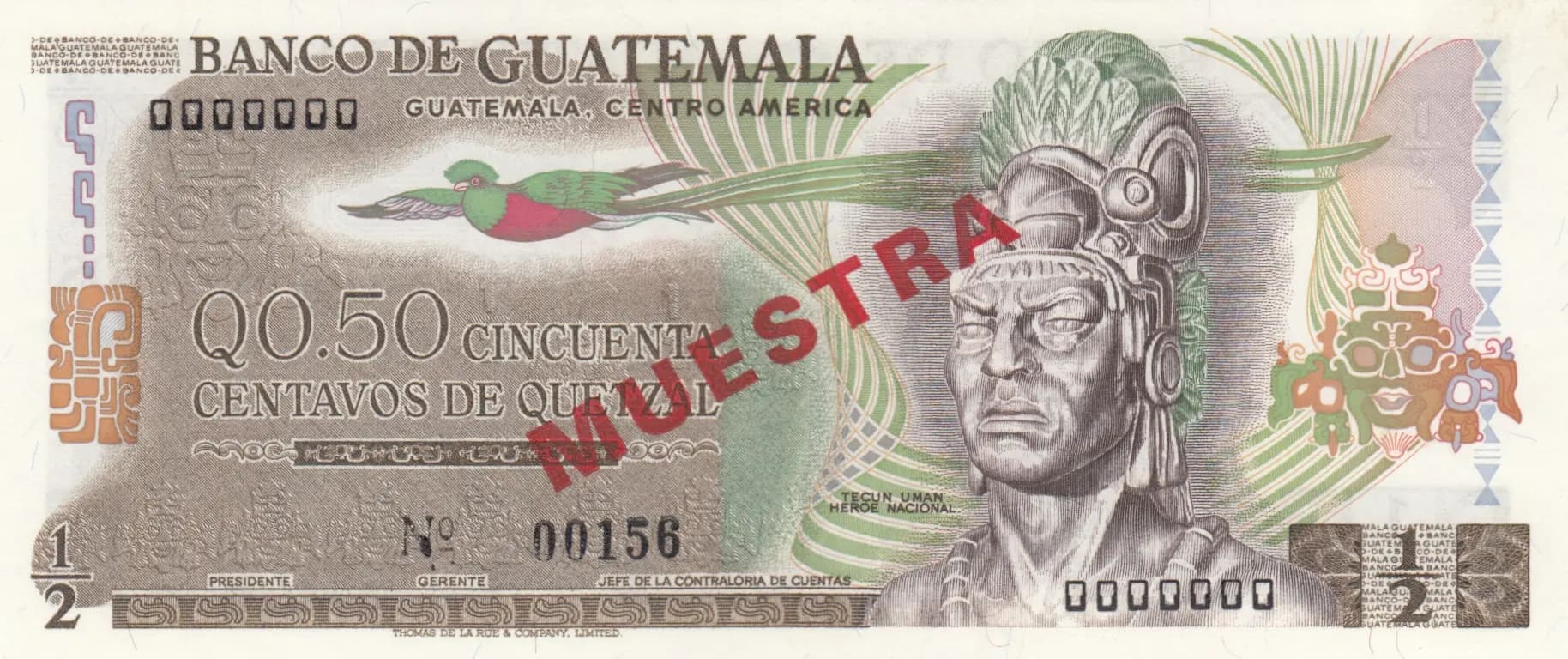
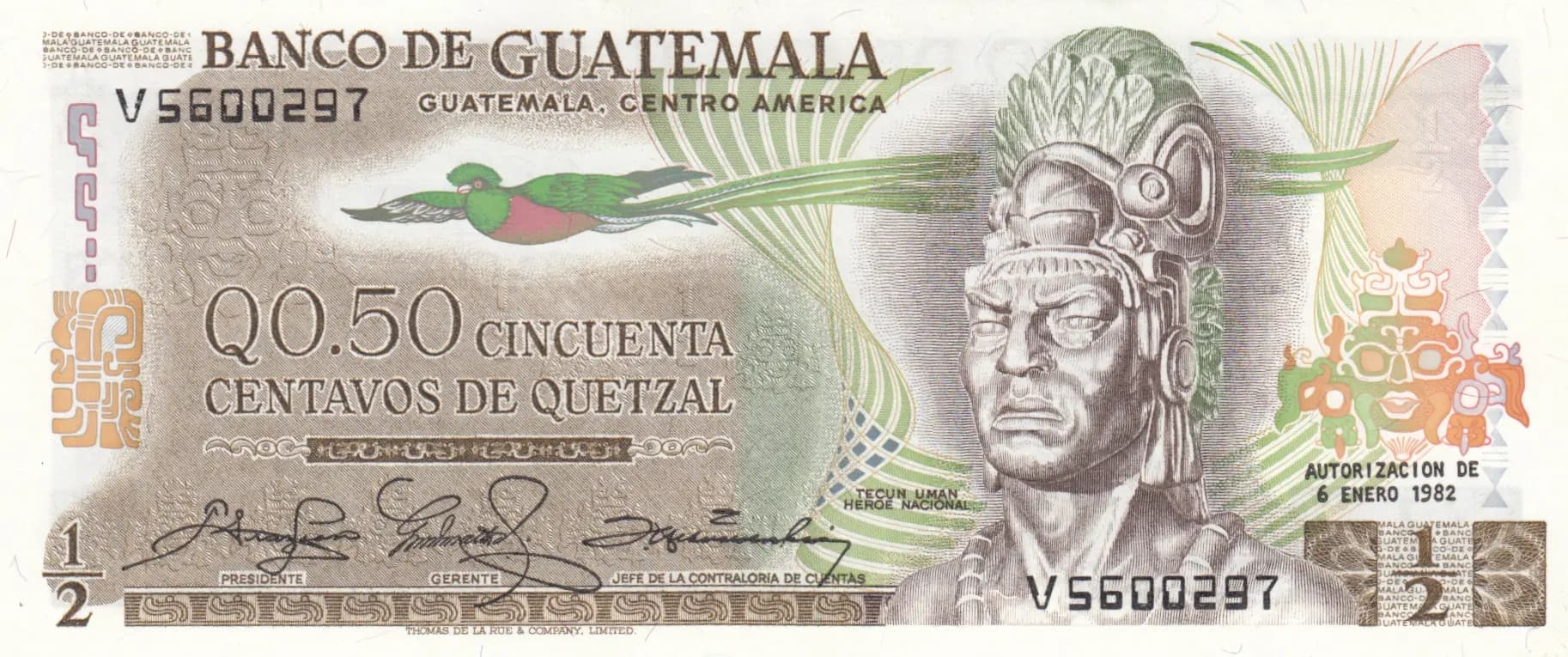
This is a striking UNC example of Guatemala's 1982 50 centavos note (Pick P-58c), printed by Thomas de la Rue and featuring the national hero Tecun Uman in full Mayan regalia on the obverse. The note displays excellent preservation with sharp intaglio printing, vibrant multicolored underprinting (beige, green, pink, and brown), and the iconic quetzal bird symbol rendered in green and red. This denomination represents an important part of Guatemala's mid-20th century currency evolution and remains highly collectible, with recent UNC examples selling in the $5-18 range on the secondary market.
Common. This is a regular-issue note from a long production run (1978-1983 date range noted in catalog references) with substantial circulation. The recent eBay price data demonstrates consistent UNC sales in the $5-18 range with multiple transactions annually, indicating healthy collector supply. The catalog value listed at $14 UNC (2019 reference) further confirms common status. No evidence of limited mintage, recall, or scarcity factors.
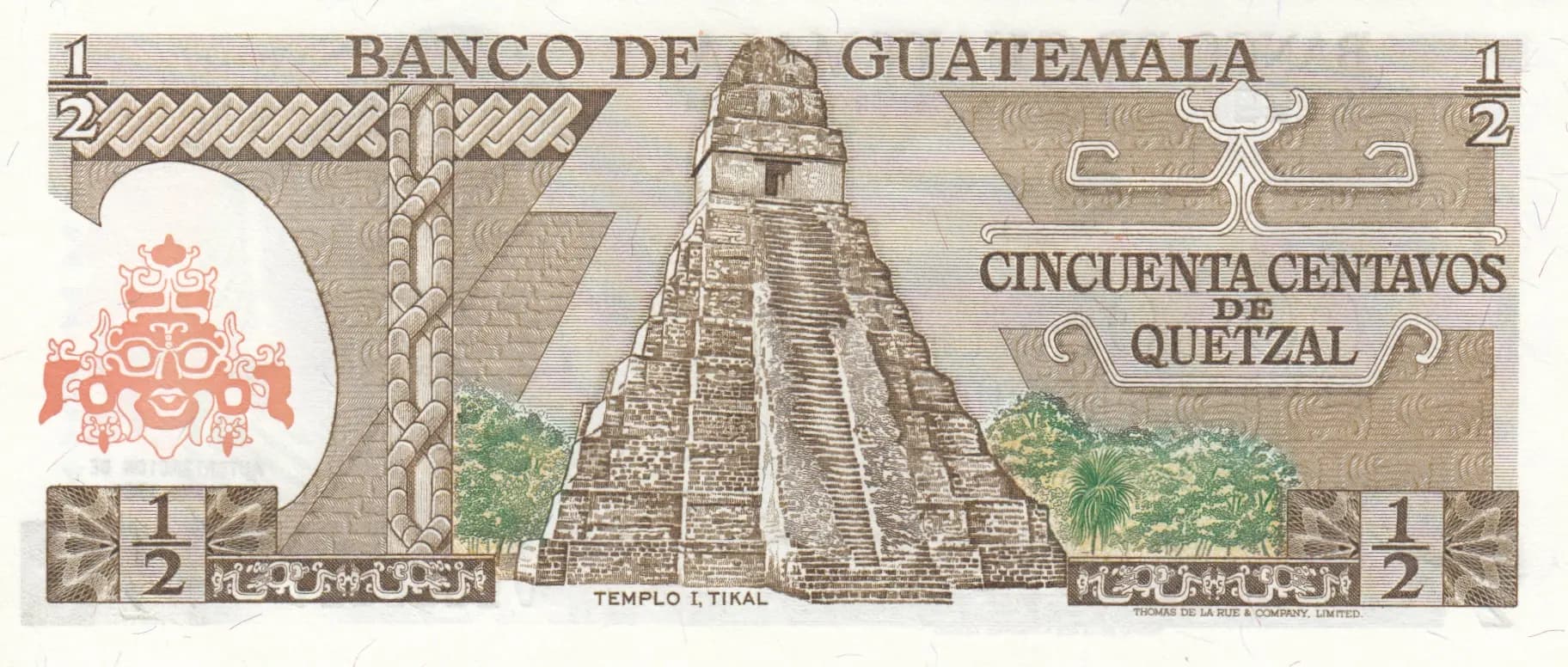
Issued during Guatemala's military government period under General Efraín Ríos Montt, this 50 centavos note commemorates Tecun Uman, a legendary K'iche' Maya warrior and national hero who died resisting Spanish conquest in 1524. The reverse's depiction of Temple IV at Tikal emphasizes Guatemala's pre-Columbian heritage and archaeological significance, reflecting the nation's cultural identity during a period of economic adjustment and significant political turbulence in Central America.
The obverse features a detailed intaglio portrait of Tecun Uman, the K'iche' Maya warrior and national hero, rendered in profile at right with elaborate traditional headdress and ear ornaments characteristic of pre-Columbian Mayan nobility. The upper left displays the quetzal bird (Pharomachrus mocinno), Guatemala's national symbol, in naturalistic green and red plumage amid stylized palm fronds. The left margin contains vertical Mayan-inspired geometric patterns and glyphs, while the right side incorporates additional decorative Mayan motifs. The reverse depicts Temple IV (mislabeled as 'Templo I' on the note) at Tikal, one of Guatemala's most important archaeological sites, rendered as a monumental stepped pyramid in brown and gray tones with surrounding jungle vegetation in green. Mayan geometric border patterns frame both sides, and a heraldic emblem appears in red/orange on the reverse left. The overall design synthesis emphasizes Guatemala's indigenous cultural heritage and pre-Columbian greatness.
FRONT SIDE: 'BANCO DE GUATEMALA' (Bank of Guatemala), 'GUATEMALA, CENTRO AMERICA' (Guatemala, Central America), 'Q0.50' (0.50 Quetzals), 'CINCUENTA CENTAVOS DE QUETZAL' (Fifty Centavos of Quetzal), 'TECUN UMAN HEROE NACIONAL' (Tecun Uman National Hero), 'AUTORIZACION DE 6 ENERO 1982' (Authorization of January 6, 1982), with signature lines labeled 'PRESIDENTE' (President), 'GERENTE' (Manager), and 'JEFE DE LA CONTRALORIA DE CUENTAS' (Chief of the Court of Accounts). BACK SIDE: 'BANCO DE GUATEMALA' (Bank of Guatemala), 'CINCUENTA CENTAVOS DE QUETZAL' (Fifty Centavos of Quetzal), 'TEMPLO I, TIKAL' (Temple I, Tikal), 'THOMAS DE LA RUE & COMPANY, LIMITED' (printer identification).
Intaglio engraving and printing by Thomas de la Rue & Company, Limited, London, as credited on the reverse. The visual analysis confirms sophisticated multi-color intaglio printing with fine line engraving evident throughout, particularly in the portrait detailing of Tecun Uman and the architectural precision of the Tikal temple. Multicolor underprinting was applied to create the characteristic beige, cream, green, and pink color palette. Security features include fine-line engraving work throughout and signature lines for three government officials. The note incorporates a watermark of Tecun Uman and fluorescent security imprinting on the reverse, as typical for late-period TDLR Guatemala notes.
This example is identifiable as the 1982 printing variant (Pick P-58c) based on the authorization date 'AUTORIZACION DE 6 ENERO 1982' visible on the obverse. The note exhibits the standard signature and serial number format for this period. The series number V5600297 indicates mid-range production from the printing run. No overprints or special varieties are evident. The PMG population report indicates only one variant catalogued for this Pick base number, suggesting consistent design standards across the 1978-1983 issue period.