1 peso 1914
Market Prices
1 saleAbout This Note
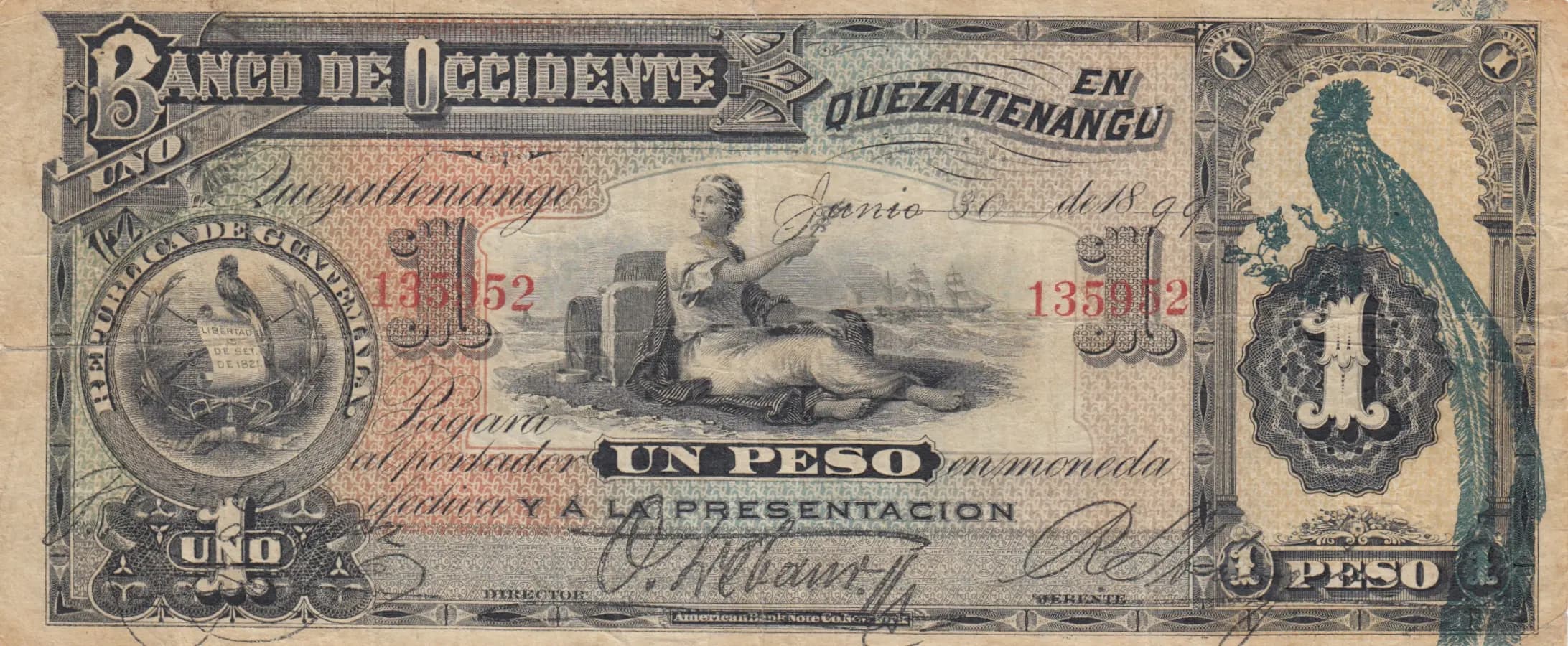
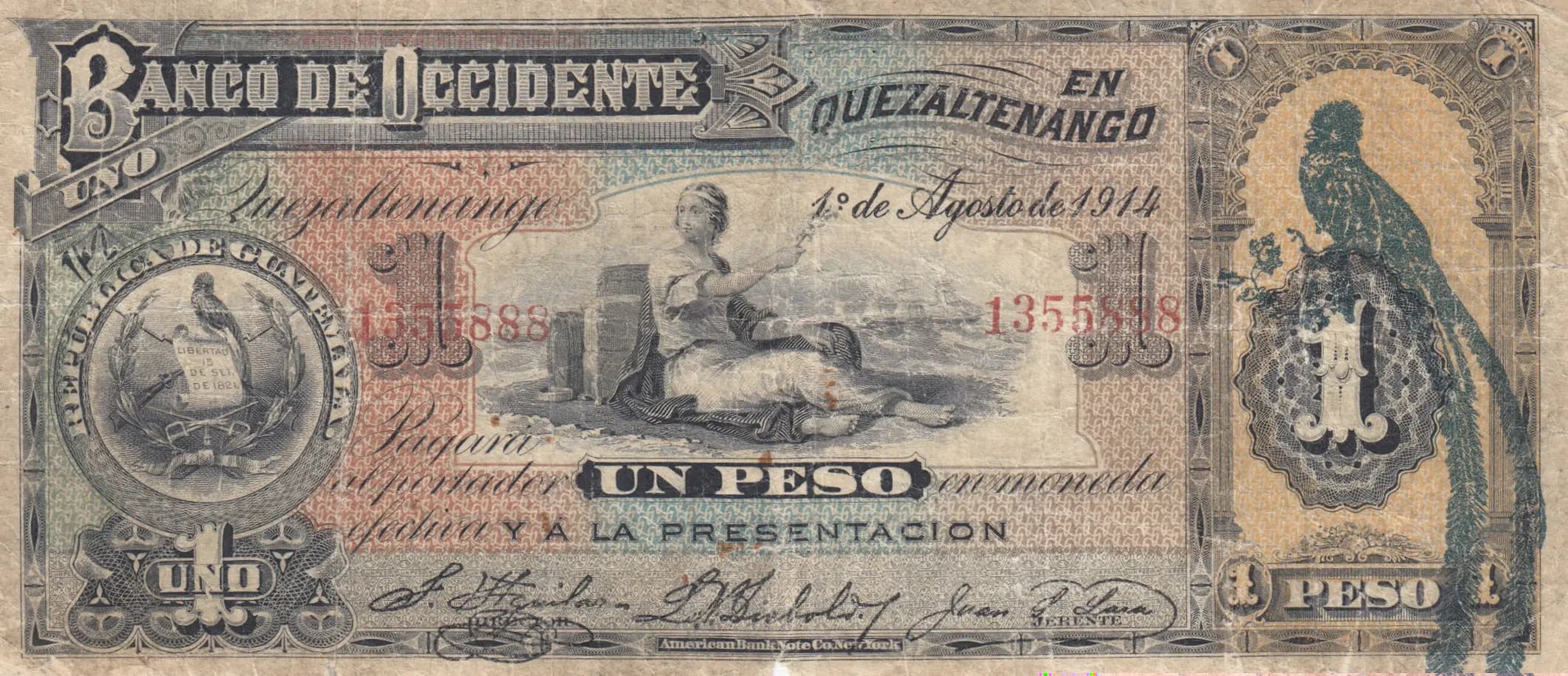
This 1 Peso note from Banco de Occidente (1914) exemplifies early 20th-century Guatemalan provincial banking currency, featuring an allegorical 'Commerce' figure seated centrally alongside the national quetzal bird. The note shows extensive circulation wear with significant foxing, creasing, and color fading consistent with VG condition, presenting an authentic snapshot of a century-old regional bank's currency in honest, well-used condition.
Common. This is a regular issue from a provincial Guatemalan bank with no documented short print run or recall status. The eBay market data shows a VF specimen selling for $51 in October 2025 (a modest price indicating common circulation status), and PMG's cataloging of multiple variants suggests adequate surviving populations. Early 20th-century regional bank notes from minor issuers are typically common unless specific historical scarcity factors apply, which are absent here.
Issued by Banco de Occidente in Quetzaltenango on August 1, 1914, this note reflects Guatemala's early financial decentralization when regional banks maintained note-issuing privileges. The allegorical 'Commerce' figure and quetzal symbolism underscore the bank's attempt to associate regional trade with national identity during a period of competing provincial currencies, before Guatemala's central banking consolidation.
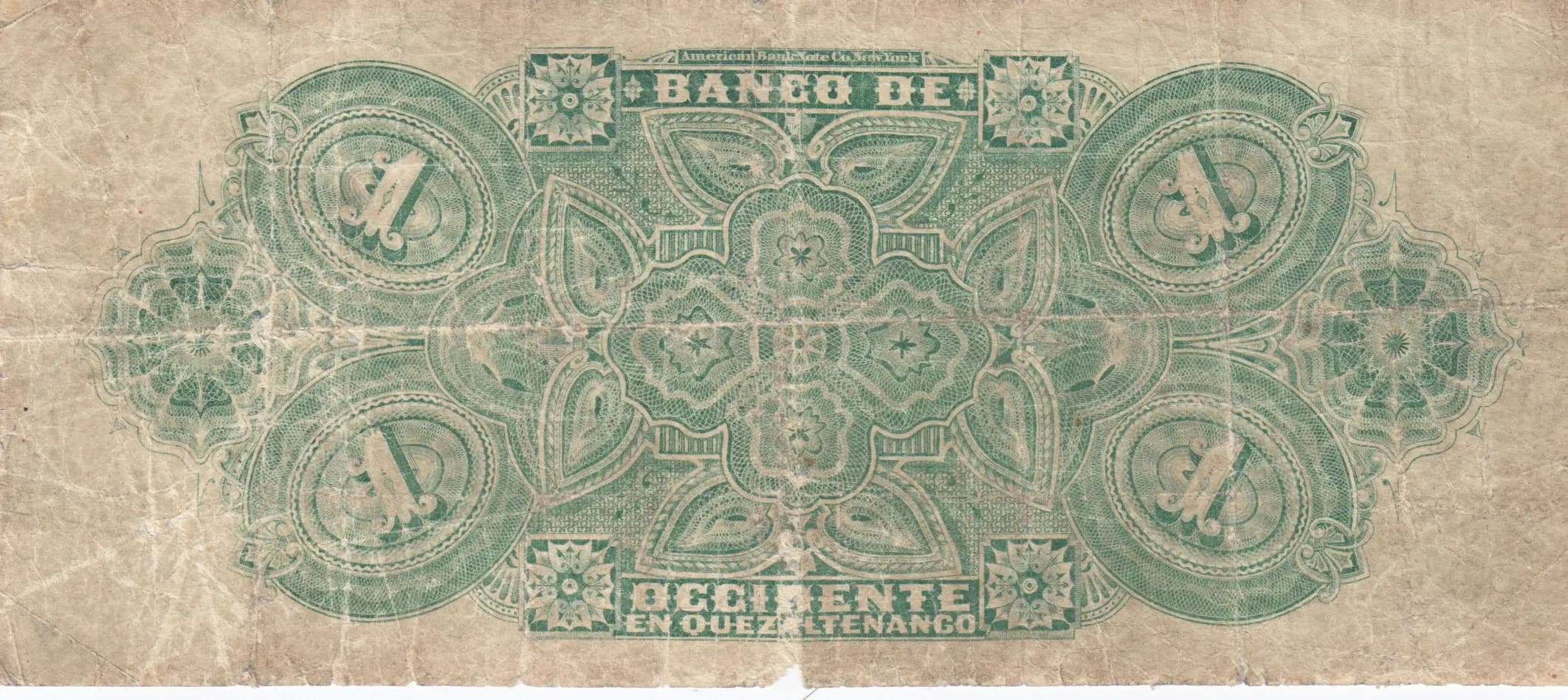
The obverse features Guatemala's national coat of arms (circular seal with bird and shield) positioned at left, with the central allegorical figure of Commerce seated among bales and a caduceus (Mercury's staff, symbol of commerce and trade). The right side displays the national bird, the quetzal, within an ornamental frame. Extensive classical decorative borders with geometric patterns, ornamental wreaths, and floral designs frame all elements. The reverse showcases a symmetrical green composition with four circular heraldic medallions arranged around a central ornamental rosette, filled with elaborate leafwork and geometric detailing throughout. The design reflects ABNC's sophisticated engraving standards of the Edwardian era.
Front: 'BANCO DE OCCIDENTE' (Bank of the Occident/Western Bank), 'EN QUETZALTENANGO' (In Quetzaltenango), '1º de Agosto de 1914' (1st of August 1914), 'UN PESO' (One Peso), 'A LA PRESENTACION' (At Presentation), 'UNO' (One), 'GERENTE' (Manager), 'American Bank Note Co., New York', with plate numbers '1355' and '3888'. Back: 'BANCO DE OCCIDENTE' (Bank of the Occident), 'EN QUETZALTENANGO' (In Quetzaltenango), 'American Bank Note Co., New York'.
Steel-plate engraving (intaglio) executed by American Bank Note Company (ABNC), New York. Multiple color printing (black primary with green, red, blue, brown, and orange underprints on obverse; green on reverse) demonstrates advanced chromatic separation and registration techniques. The intricate fine-line work, geometric patterns, and ornamental details are characteristic of high-security banknote production of the 1910s era.
Pick catalog number P-S173c identifies this as variant 'c' of the 1 Peso Banco de Occidente issue. The note displays the printed date of August 1, 1914, with plate numbers 1355 and 3888 visible. PMG population data indicates at least two other variants (P-S173bp and P-S173fp) exist for this base Pick number, suggesting differences in signatures, dates, or serial configurations. The specific variety designation 'c' likely correlates to signature combinations or date varieties typical of provincial Guatemalan bank notes of this period.