5 pounds 1937
Market Prices
3 salesAbout This Note
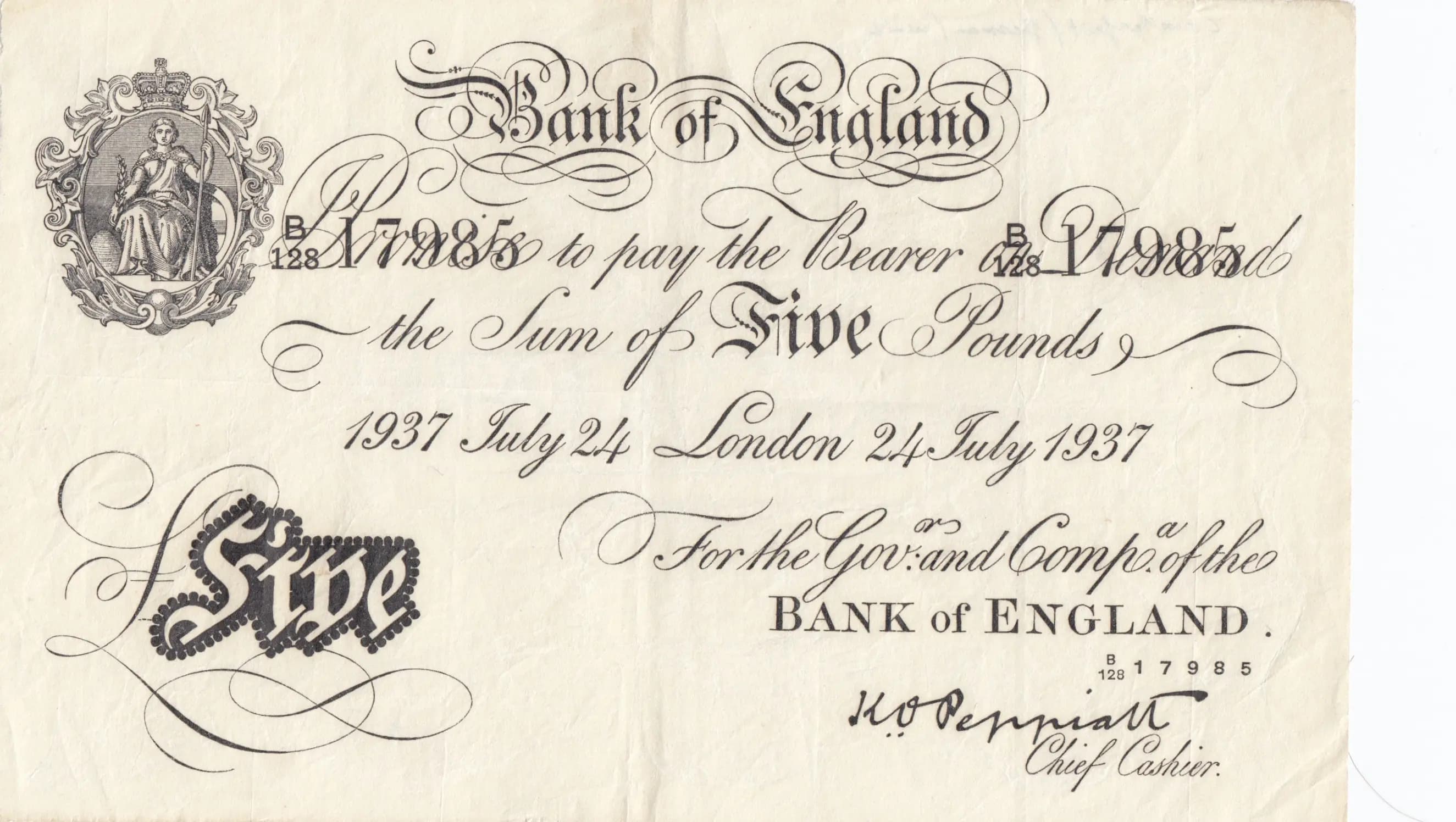
This is a Bank of England 5 Pound note from 1937, issued during the reign of King George VI, presented in Very Fine condition with moderate aging characteristics. The note exhibits the classic design of the 1934-1944 series featuring Britannia and ornate Bank of England heraldry, with visible creasing, light foxing, and age-appropriate patination consistent with an 80+ year old circulated note. Signed by Chief Cashier H.O Peppinall and dated 24 July 1937, this example represents a collectible piece of mid-20th century British currency with strong eye appeal despite moderate wear.
Common. This is a regular issue from the lengthy 1934-1944 Bank of England 5 Pound series with substantial total circulation. The eBay market data provided shows consistent sales activity in the $40-85 range for VF specimens, with a 2024 VF sale at $67 demonstrating steady demand at modest prices typical of common notes. The catalog value of $85 for G grade and $185 for F grade (from 2016) reflects adequate supply in the market. Notes from this series with this denomination and condition grade circulate regularly through dealers and auctions without premium scarcity indicators. Only extremely high grades (EF at $450 catalog value) or rare signature varieties command significant premiums.
This 5 Pound note was issued during a pivotal period in British history, shortly before the abdication crisis and during the early reign of King George VI. The Britannia figure depicted in the Bank of England coat of arms on the obverse represents the personification of Britain itself, a symbolic choice reflecting national identity during the interwar period. The ornate calligraphic design and classical heraldic imagery reflect the conservative aesthetic standards of the Bank of England during this era, emphasizing stability and tradition as Britain navigated economic and political uncertainties of the 1930s.
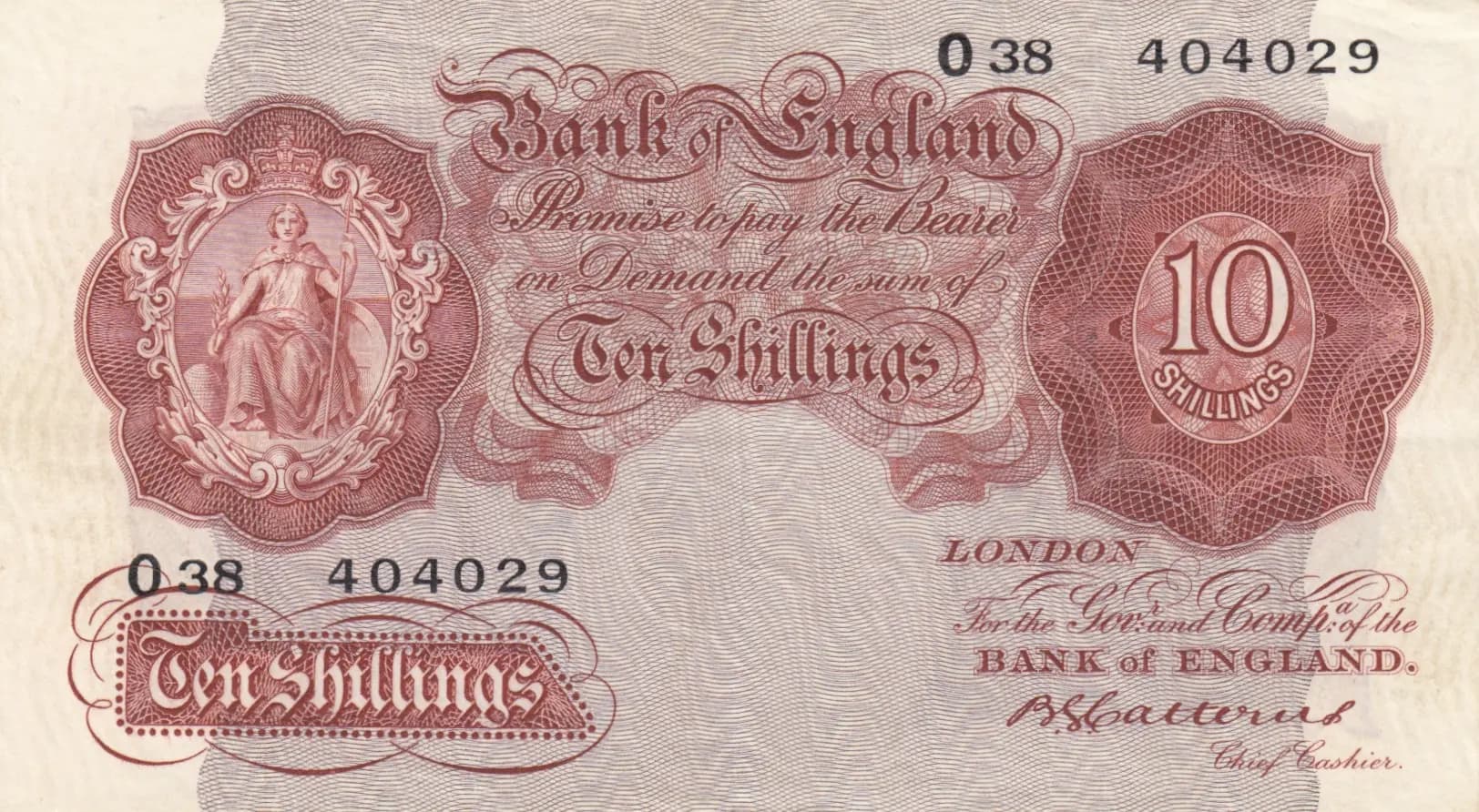
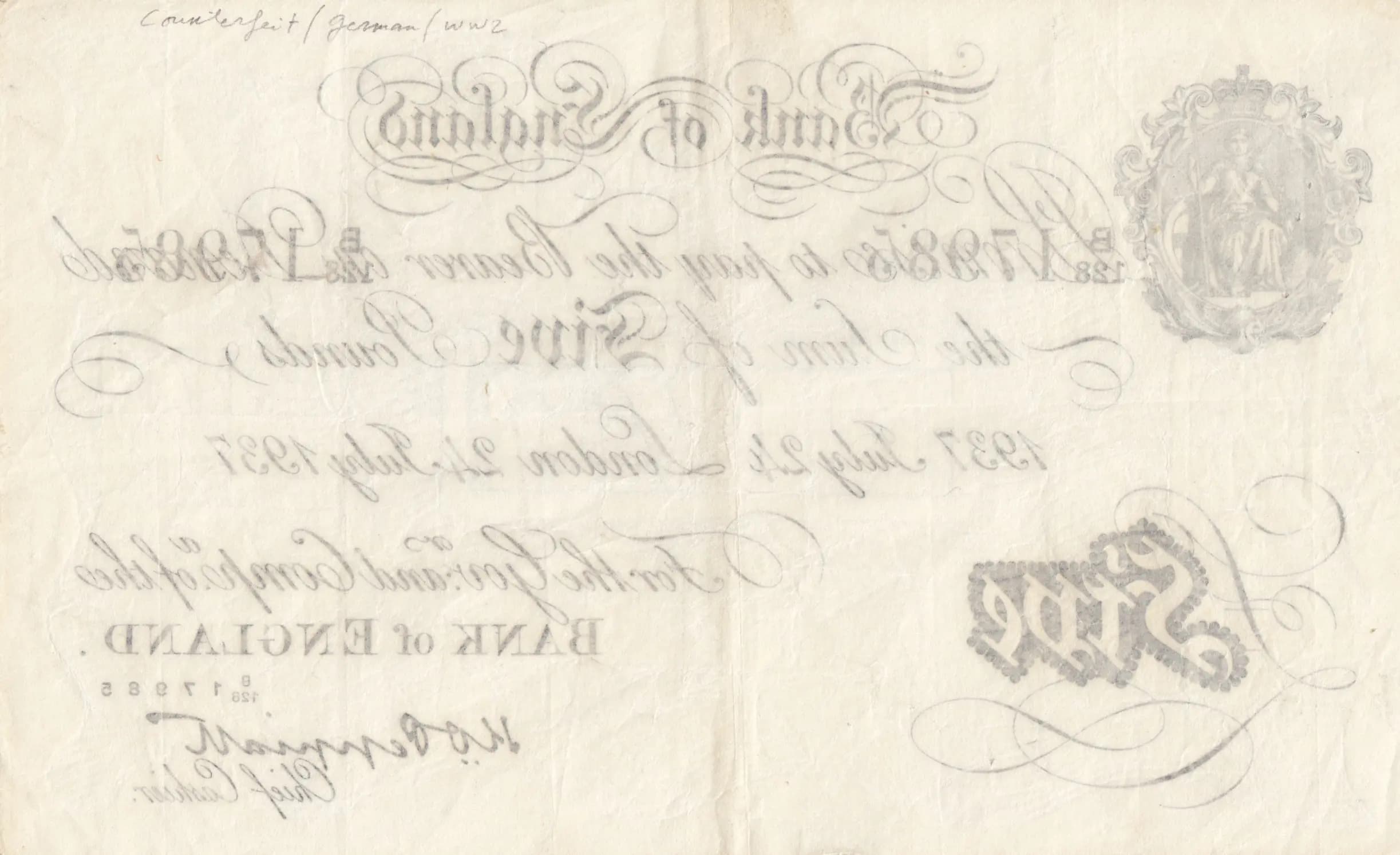
The obverse features a formal composition with the Bank of England coat of arms prominently displayed on the left side within an ornamental Baroque shield, surmounted by a royal crown. The central design presents Britannia as a crowned female figure representing the nation, rendered in classical style within the heraldic achievement. The note is dominated by elaborate calligraphic script arranged across the face, with fine decorative borders of scrollwork and floral motifs characteristic of high-security banknote engraving. The denomination '5' appears in large decorative numerals on the lower left. The reverse continues the formal aesthetic with additional heraldic elements, including a lion emblem, and maintains the same calligraphic header presentation, though significantly faded in this example. The color scheme employs black engraved ink on cream-toned paper, creating strong contrast for security and visibility.
FRONT SIDE: 'Bank of England' — official issuing authority; 'I Promise to pay the Bearer on Demand the Sum of Five Pounds' — the traditional promise-to-pay clause standard on British currency of this period; 'For the Governor and Company of the BANK of ENGLAND' — formal institutional attribution; '1937 July 24 London 24 July 1937' — issue date; 'H.O Peppinall' and 'Chief Cashier' — signature and title of authorizing official; 'B 128' and 'P 17985' and 'B 129 17985' — serial number references; 'Five' — denomination marking. BACK SIDE: 'FIVE POUNDS' — denomination; Handwritten notation 'Coudesfurt Germen WWZ' and 'London to Angra' — archival or cataloguing annotations, heavily faded; Additional calligraphic text — largely illegible due to deterioration.
This note was produced using intaglio engraving, the standard security printing method for Bank of England currency of this period. The fine line work, intricate calligraphic typography, and detailed heraldic rendering visible in both the visual analysis and the note's physical characteristics are hallmarks of intaglio printing, which creates raised printing surfaces that produce characteristic embossed effects and deep, rich ink saturation. The printer for Bank of England notes of the 1934-1944 series was typically Waterlow & Sons or similar authorized security printers contracted to the Bank. The presence of multiple security features including the coat of arms, complex typography, and serial number placement reflects the anti-counterfeiting standards of the era.
This specific example is identified by: (1) Signature variety: H.O Peppinall as Chief Cashier, indicating issue during his tenure (1936-1949); (2) Date variety: 24 July 1937 issue date, placing it mid-series within the 1934-1944 emission period; (3) Serial number prefix 'B 128/B 129' indicating the specific printing batch; (4) Pick catalog designation P-335ax specifies this as a variant within the broader P-335 classification. The notation on the reverse ('Coudesfurt Germen WWZ' and 'London to Angra') appears to be archival or collector's cataloguing information rather than a printing variety. No evidence of overprints or special markings indicating a rare or commemorative sub-variety is present.