10 shillings 1940
Market Prices
32 salesAbout This Note
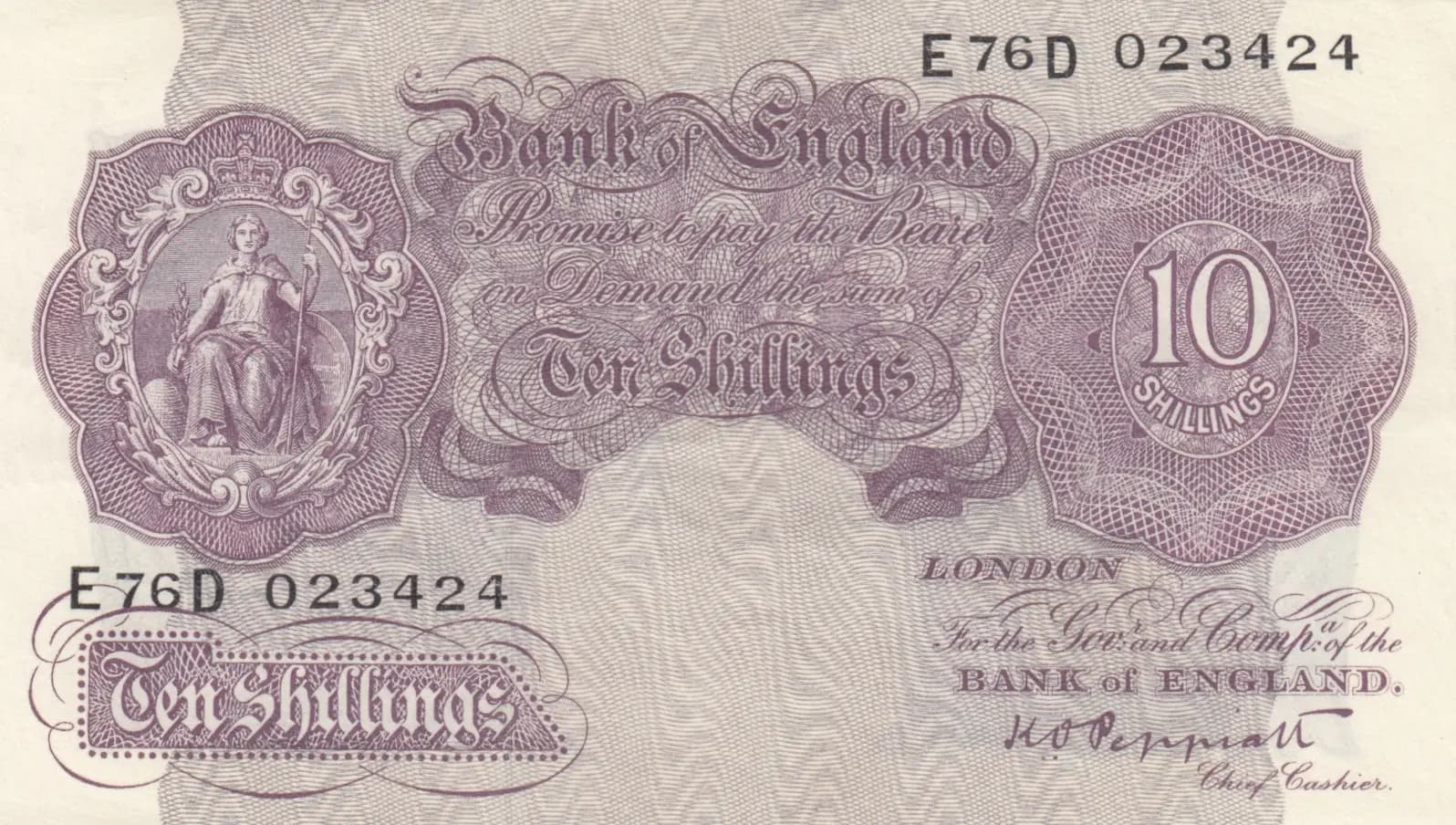
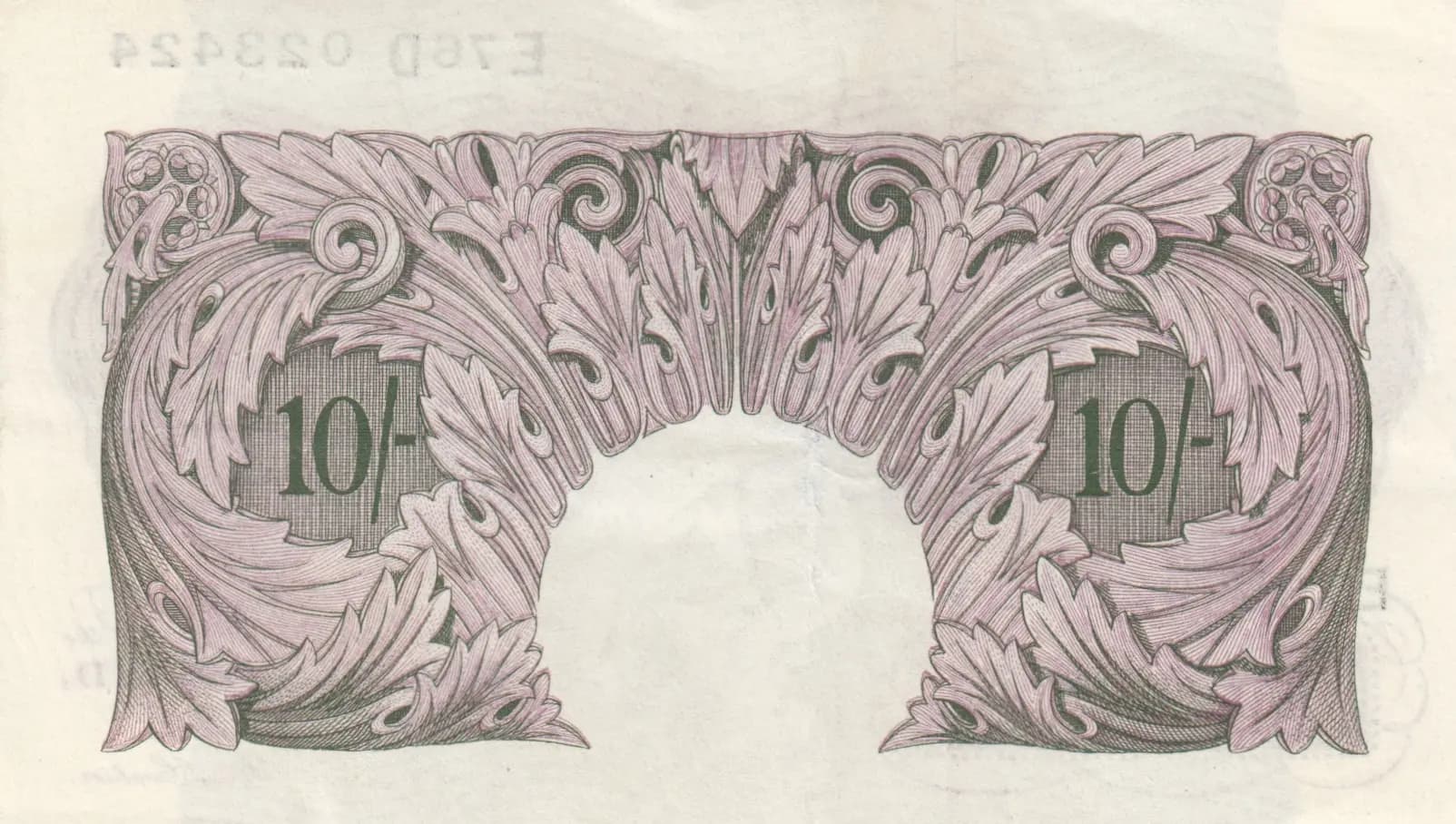
This is a Bank of England 10 Shillings note from 1940 (Pick-366) in Very Fine condition, displaying the classic mauve/purple coloring characteristic of this issue. The note features an elegant classical design with Britannia as the central seated figure on the obverse, surrounded by intricate baroque scrollwork and security engraving. The crisp printing and minimal wear visible in both obverse and reverse imagery suggest light circulation, making this a desirable example for collectors of pre-decimal British currency.
Common. This is a standard-issue note from the 1940-1948 series with a large print run typical of wartime currency production. eBay market data shows consistent sales across multiple grades (F through EF) with prices ranging from $2-$28 depending on condition and bidding activity, and 2016 catalogue values showing VF examples at $40. These price points and consistent availability indicate this is a frequently encountered note in the collector market.
Issued during World War II (1940-1948 series), this 10 Shillings note represents the Bank of England's standard currency during a pivotal period in British history. The classical imagery of Britannia—shown seated with what appears to be a staff or scepter—reflects traditional British iconography meant to project stability and confidence during wartime. The ornate baroque design with acanthus leaf scrollwork and elaborate security features demonstrates the high-quality engraving standards maintained by the Bank of England even during the demands of wartime production.
The obverse features Britannia, the female personification of Britain, rendered in classical style and seated within an ornamental circular frame on the left portion of the note. She is depicted holding what appears to be a staff or scepter, symbolizing authority and sovereignty. The denomination '10 SHILLINGS' is prominently displayed on the right side in large numerals. The reverse presents an elaborate symmetrical design composed entirely of baroque-style ornamental scrollwork and acanthus leaf foliate patterns in purple and green, with denomination numerals '10' positioned in ornamental frames in the upper corners. Throughout both sides, fine-line engraving and complex crosshatching create the security pattern typical of Bank of England notes of this era.
Front side: 'Bank of England' | 'Promise to pay the Bearer on Demand the sum of' | 'Ten Shillings' | '10 SHILLINGS' (denomination) | 'LONDON' (place of issue) | 'For the Governor and Company of the Bank of England' | 'Chief Cashier' with signature of H.O Peppinall | Serial number: E76D 023424. Back side: '10' (denomination numerals in ornamental frames, upper corners) | Ornamental text elements integrated into the decorative design.
Intaglio engraving (line engraving), the standard security printing method for Bank of England banknotes of this period. The intricate scrollwork, fine parallel lines, and complex crosshatching patterns visible throughout both sides are characteristic of high-security intaglio work. The notes were produced by the Bank of England's security printing operations; during this era, De La Rue was a primary security printer for Bank of England notes, though the Bank maintained significant in-house engraving capabilities.
This specific example bears the signature of H.O Peppinall as Chief Cashier (visible as 'H.O Peppinall' on the note) and carries the serial number E76D 023424. The 'E76D' prefix indicates the series and print batch. Peppinall served as Chief Cashier during the 1940s, so this signature variety is consistent with the stated 1940 date. No rare overprints or special designations are evident. The mauve color paper with security thread is standard for this Pick-366 designation.