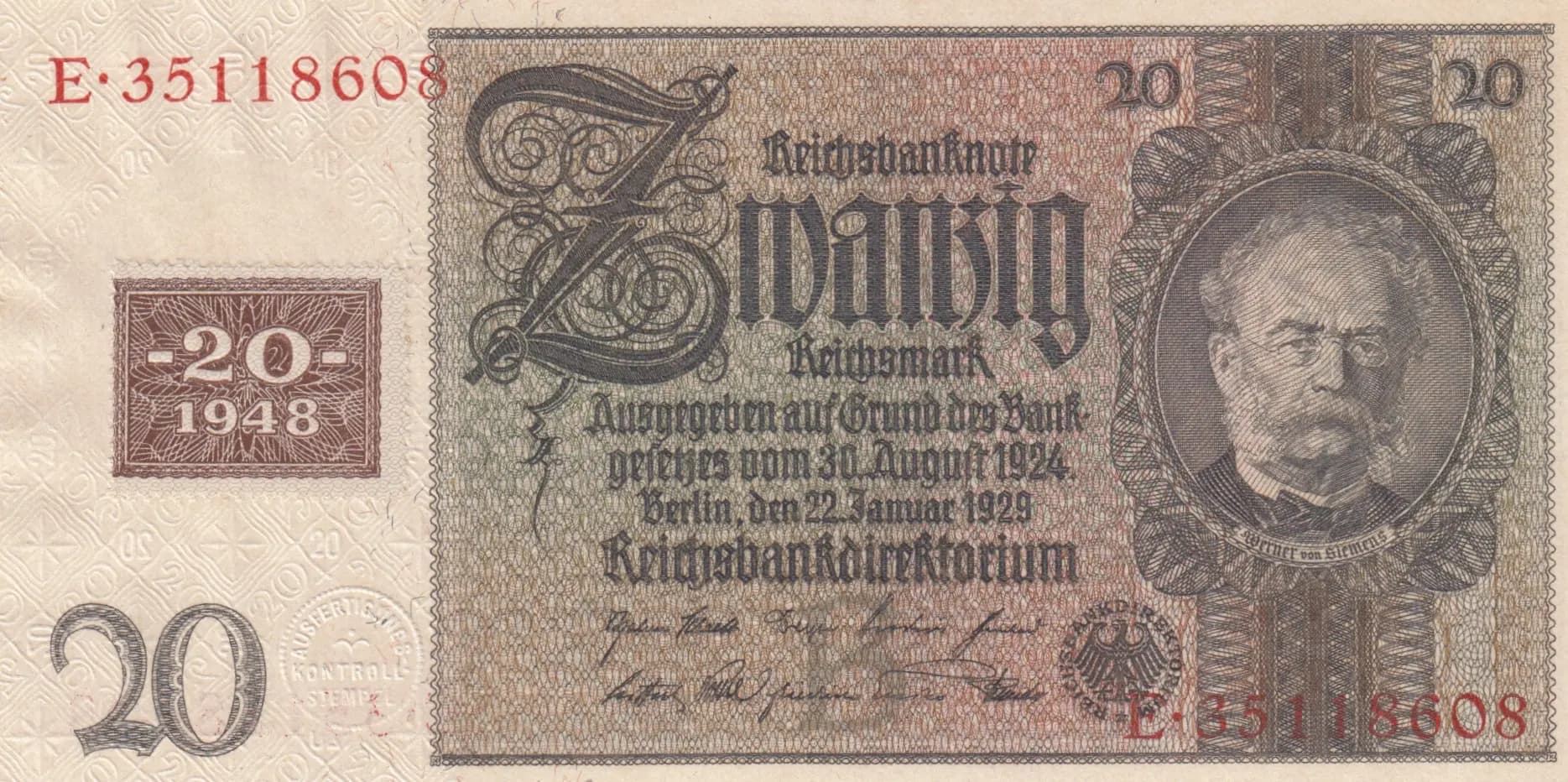
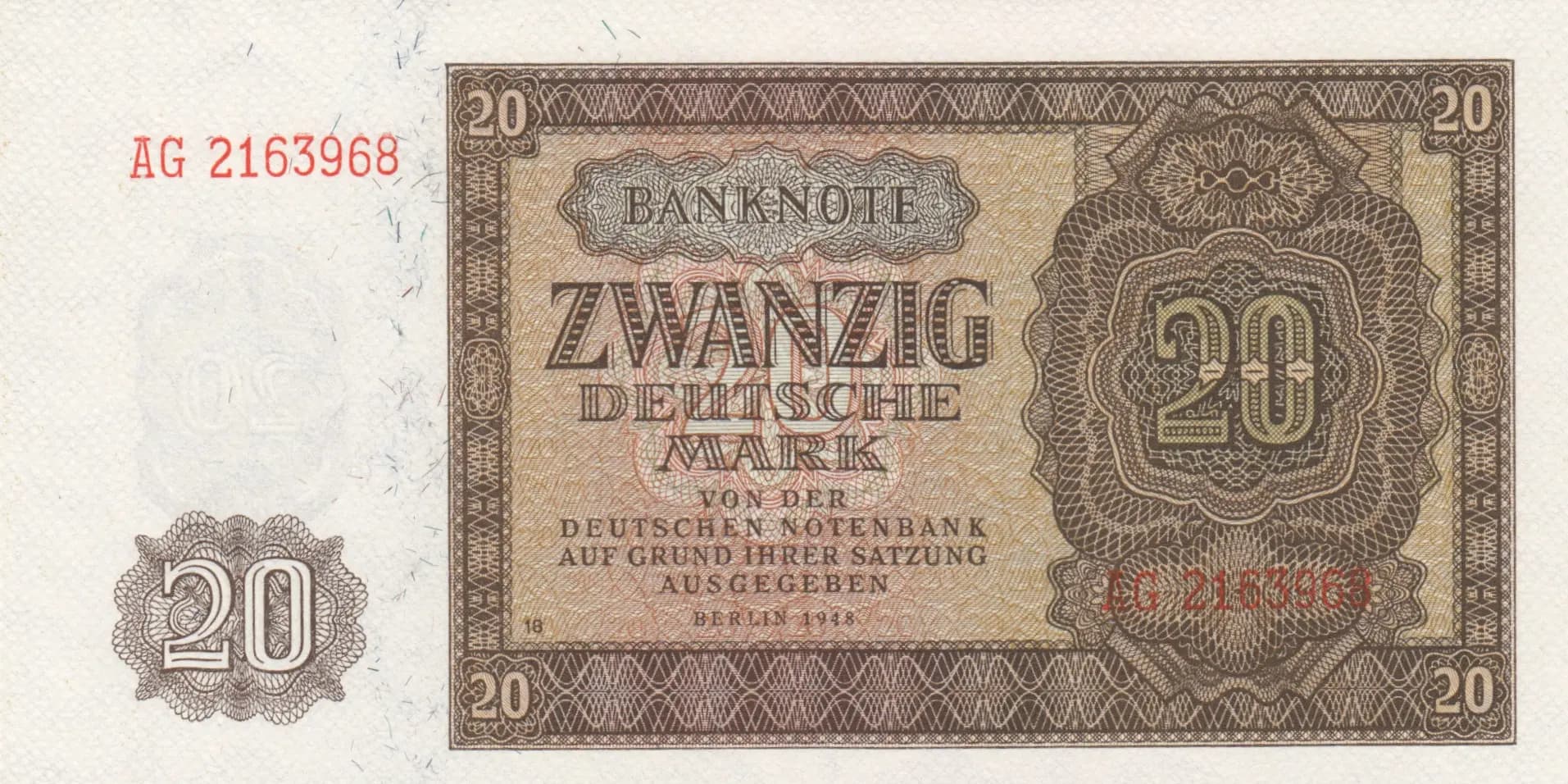
20 mark 1948
About This Note
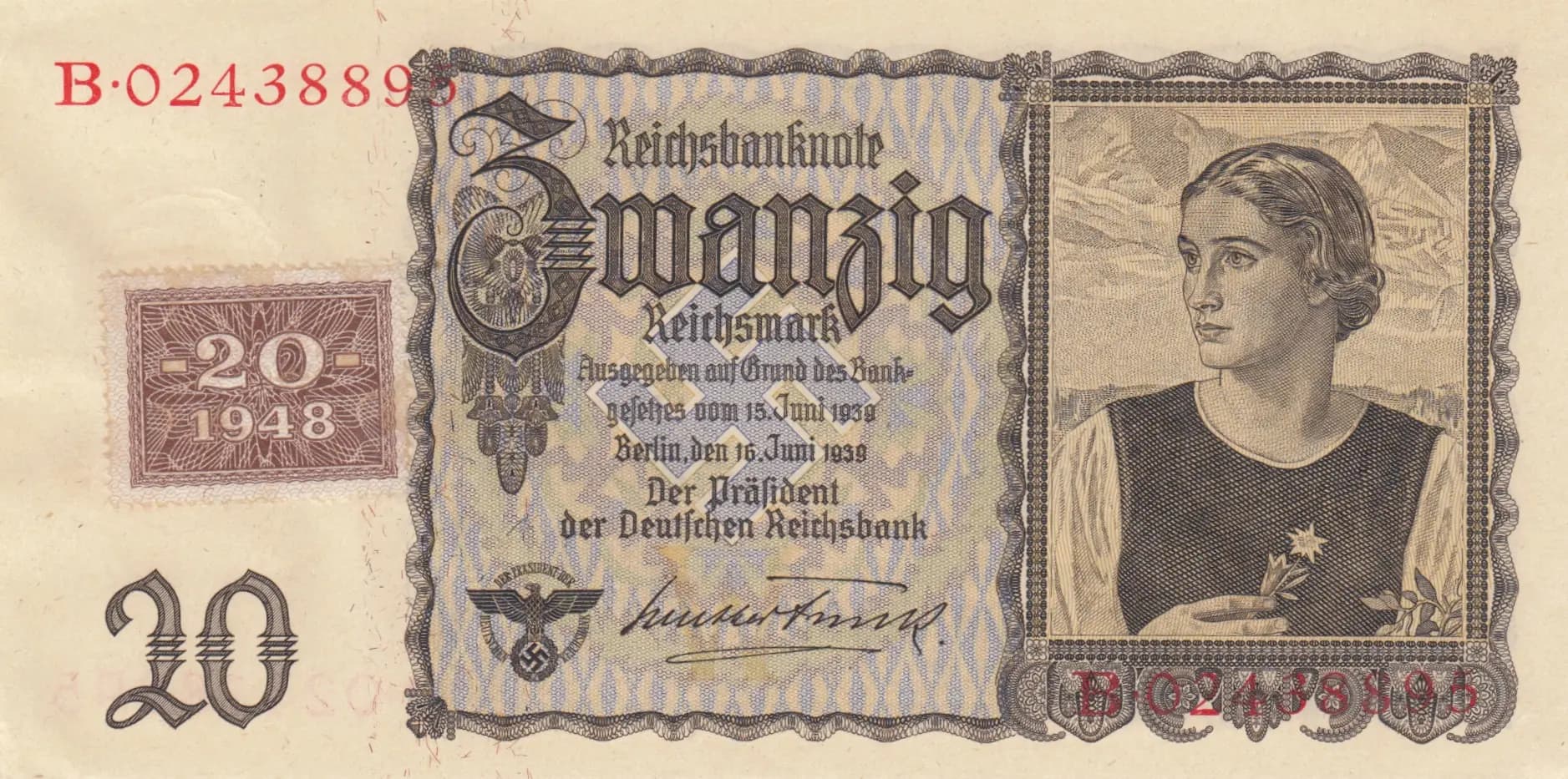
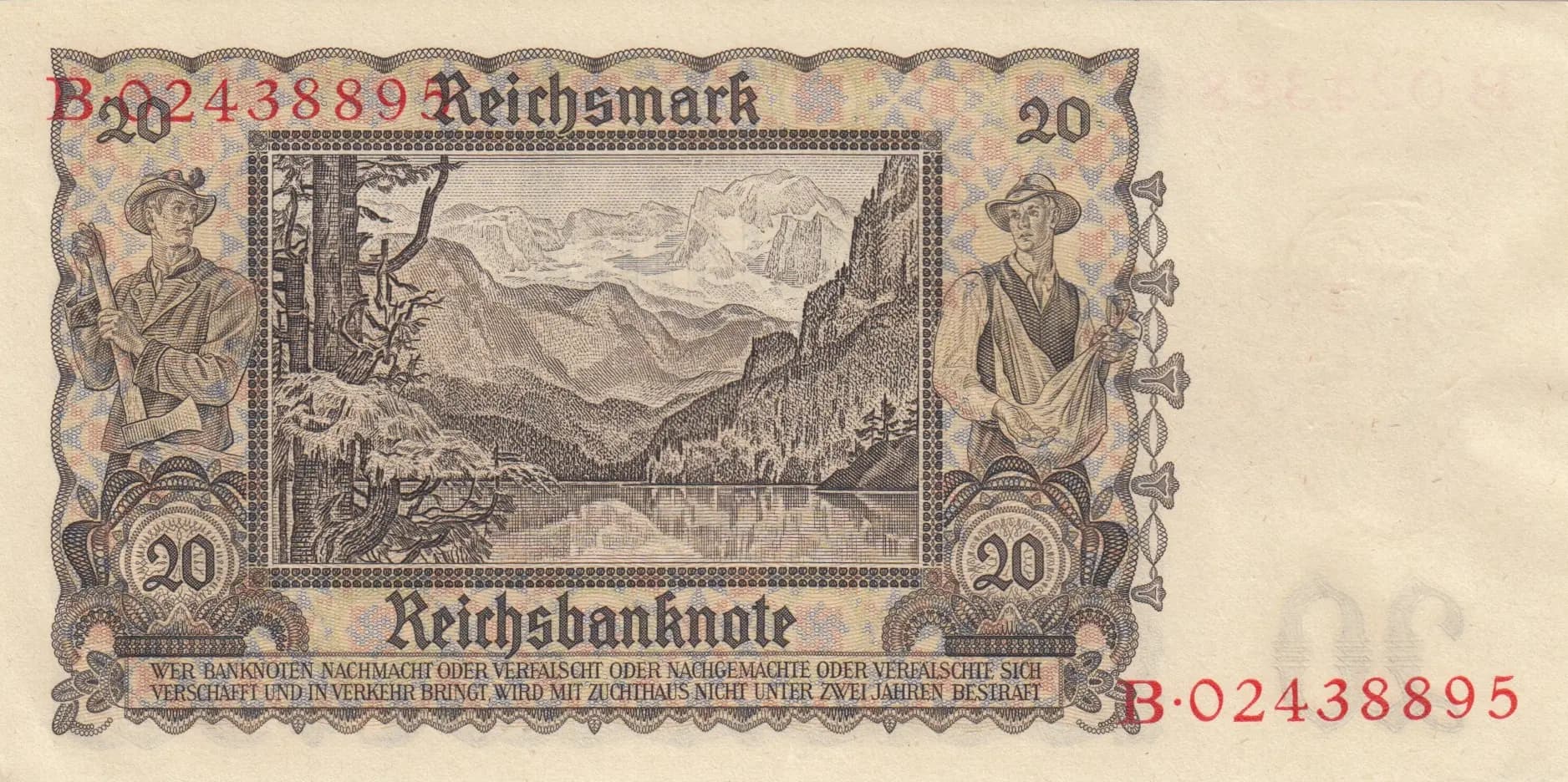
This is a 20 Reichsmark note from 1948, issued during the Soviet occupation zone of Germany (Pick P-5A). The note features a portrait of a young woman on the obverse and an Alpine landscape with two male figures in traditional German folk costume on the reverse, printed in blue-gray and brown tones. The example presented is in UNC condition with only light aging and minimal foxing, displaying the intricate engraved security details characteristic of Reichsbank currency.
Common. The 20 Mark P-5A from 1948 was issued in substantial quantities during the Soviet occupation zone currency operations. Notes from this series and denomination circulated widely and survive in reasonable quantities today. UNC examples are less common than circulated specimens, but the denomination and issuing authority were not subject to recall or severe supply constraints that would create scarcity. The denomination is standard and neither the print run nor survival rate suggests rarity.
This note represents a transitional period in German currency history, issued in 1948 during Soviet military administration following World War II. The retention of Reichsbank imagery and the 1938-1939 Banking Law references reflect the complex political situation where pre-war currency designs remained in use despite the Reich's collapse. The Alpine landscape and folk costume imagery on the reverse connect to traditional German national identity, elements that pre-dated Nazi manipulation of such symbolism.
The obverse features a portrait of a young woman in right profile wearing a dark sleeveless garment with light-colored sleeves, her styled hair adorned with a floral element. The left side contains large decorative numerals '20' within ornamental frames. The center displays 'Reichsbanknote' and 'Zwanzig Reichsmark' in Gothic script with a German eagle emblem (featuring a swastika, reflecting the pre-war design origin). The reverse depicts an Alpine mountain landscape with a valley, forest of evergreen trees, and a body of water, flanked by two male figures in traditional Bavarian/Alpine folk costume (Trachten) wearing characteristic hats and holding flowers or plants. Ornamental circular frames containing '20' appear at the bottom corners. The color scheme employs cream/beige paper with blue-gray and brown printing, creating a two-tone effect typical of mid-20th century German currency.
FRONT SIDE: 'Reichsbanknote' (Reichsbank note) / 'Zwanzig Reichsmark' (Twenty Reichsmark) / 'Ausgegeben auf Grund des Bankgesetzes vom 15.Juni 1939' (Issued on the basis of the Banking Law of June 15, 1939) / 'Berlin, den 16.Juni 1938' (Berlin, June 16, 1938) / 'Der Präsident der Deutschen Reichsbank' (The President of the German Reichsbank) / Serial number: B·02438895 / BACK SIDE: 'Reichsbanknote' (Reichsbank note) / 'Reichsmark' (Reichsmark) / 'WER BANKNOTEN NACHMACHT ODER VERFÄLSCHT ODER NACHGEMACHTE ODER VERFÄLSCHTE SICH VERSCHAFFT UND VERBREITET ODER MIT ZUCHTHAUS NICHT UNTER ZWEI JAHREN BESTRAFT' (Whoever counterfeits banknotes or falsifies them or procures and distributes counterfeit or falsified banknotes will be punished with imprisonment of not less than two years) / Serial number: B·02438895
Intaglio engraving (recess printing) on multi-color base, employing fine line work and intricate border patterns characteristic of security printing. The note displays the hallmarks of Reichsbank-era engraved currency: precise detail work in portraiture and landscape elements, sophisticated ornamental scrollwork, and layered color printing with brown and blue-gray inks on cream stock. The watermark area is visible in the background, indicating the use of specialized security paper. This represents the continuation of pre-war Reichsbank printing standards maintained during the Soviet occupation period.
This example bears the serial number B·02438895, with the 'B' prefix indicating Soviet zone origin. The note retains the original 1938 Berlin date ('16.Juni 1938') and reference to the June 15, 1939 Banking Law, which appear unchanged on 1948-dated examples. No overprints or modifications are visible. The signature on the note is in illegible cursive, consistent with examples from this series. No specific known varieties with substantive differences are documented for Pick P-5A in standard references, though minor printing variations in shade and serial number prefixes may exist across the production run.