500 mark 1922
About This Note
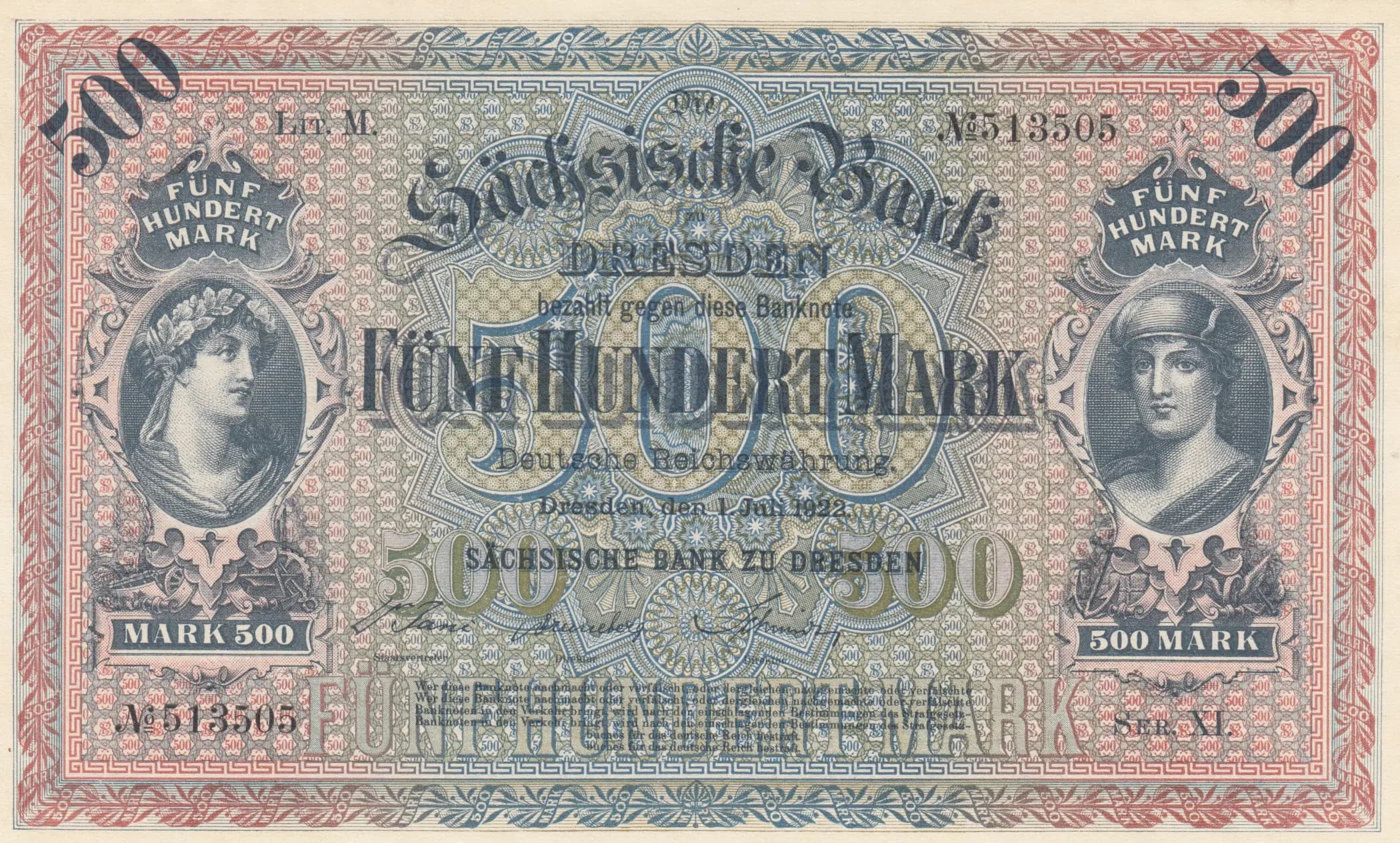
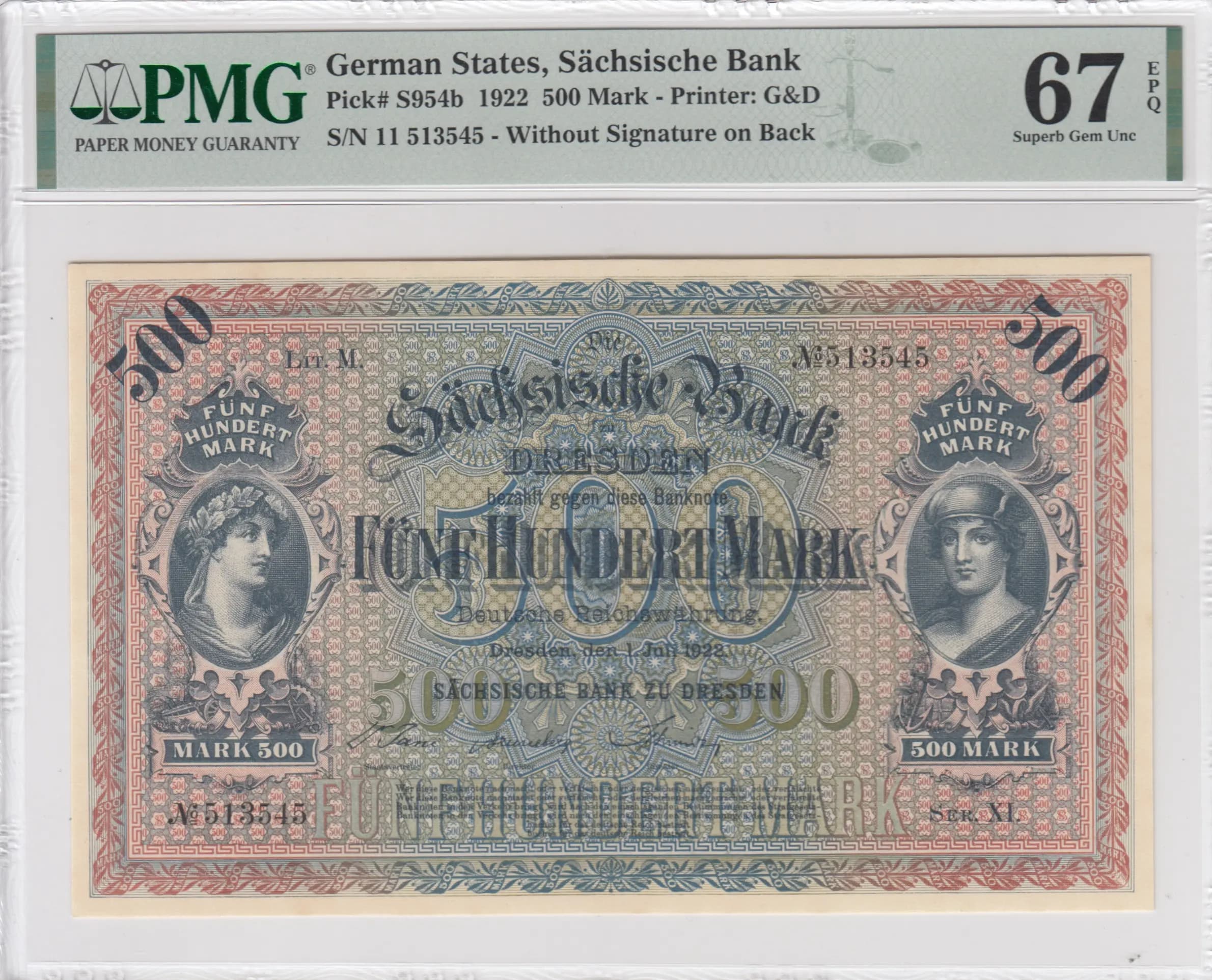
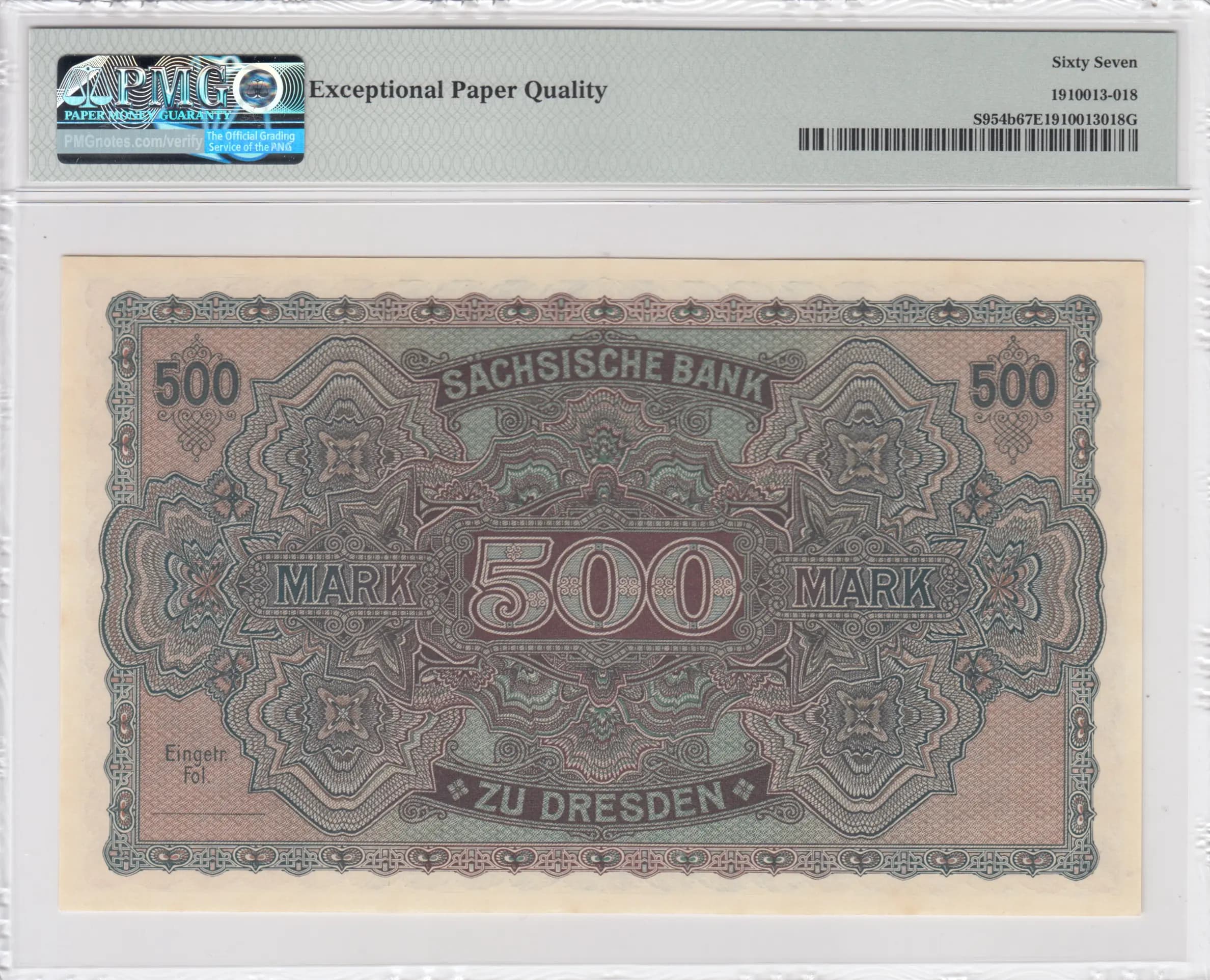
This is a 500 Mark banknote issued by the Sächsische Bank zu Dresden in 1922, graded PMG 67 EPQ, representing a notable example from Germany's hyperinflation period. The note features an elegant design with red and blue ornamental borders, dual female portrait medallions, and prominent denomination displays. The front exhibits visible handling marks and period wear consistent with circulation during the turbulent Weimar era, while the reverse displays crisp printing with austere symmetrical ornamentation, making this a visually interesting specimen of German regional banking currency.
Common. The 500 Mark denomination from the Sächsische Bank zu Dresden in 1922 was issued in substantial quantities during the hyperinflation period when multiple denominations were needed for everyday transactions. Regional bank notes of this era, while collectable, were produced in large print runs and survive in moderate quantities. The PMG 67 EPQ grade indicates a above-average specimen, but the base note type itself is widely available to collectors at modest prices.
Issued during 1922, this banknote emerged during the early stages of German hyperinflation that would devastate the Weimar Republic's economy. The Sächsische Bank zu Dresden, a regional Saxon banking institution, issued this note as purchasing power rapidly eroded, requiring ever-higher denominations to be printed. The ornate classical design reflects pre-war banking aesthetics, even as the currency itself became increasingly worthless—by late 1923, such notes required trillions of marks to equal a single American dollar.
The front displays a classically ornate design typical of early 20th-century German regional bank currency. Two female portrait medallions flank the central denomination '500', rendered in ornamental frames with elaborate scrollwork. The design employs red and blue decorative borders with fine line work and intricate detailing throughout, creating visual security through artistic complexity. The back presents a more austere, formally symmetrical composition centered on a large '500' within an ornate rectangular frame, with 'SÄCHSISCHE BANK' at the top and 'ZU DRESDEN' at the bottom, surrounded by geometric and scrollwork patterns in gray and red. The portraits appear to be allegorical female figures representing commerce or civic virtue, consistent with Weimar-era banking iconography. No specific named historical figures are depicted.
FRONT SIDE: 'Sächsische Bank' (Saxon Bank), 'FÜNFHUNDERT MARK' (Five Hundred Mark), 'MARK 500' (Mark 500), '500' (denomination numeral), '11 513545' (serial number), 'DER STADT' (Of the City). BACK SIDE: 'SÄCHSISCHE BANK' (Saxon Bank), 'ZU DRESDEN' (At Dresden), '500' (denomination), 'MARK' (Mark), 'Eingetr. Fol.' (Registered Folio).
Engraved intaglio printing, executed by Giesecke & Devrient (G&D), the prominent German security printer. The fine line work, complex ornamental patterns, and sharp detail visible in both the front and reverse designs are characteristic of high-quality intaglio engraving. The multiple layers of ornamentation served both aesthetic and security purposes, creating complexity difficult to counterfeit with period technology.
This note is cataloged as Pick P-S954b, representing one of two documented variants for this base Pick number (P-S954a and P-S954b). Both variants are attributed to printer G&D (Giesecke & Devrient). The serial number visible on the front is '11 513545', which may help distinguish printing batches. No significant overprints, date variations, or signature varieties are apparent from the visual analysis that would further subdivide this variety.