500 mark 1922
About This Note
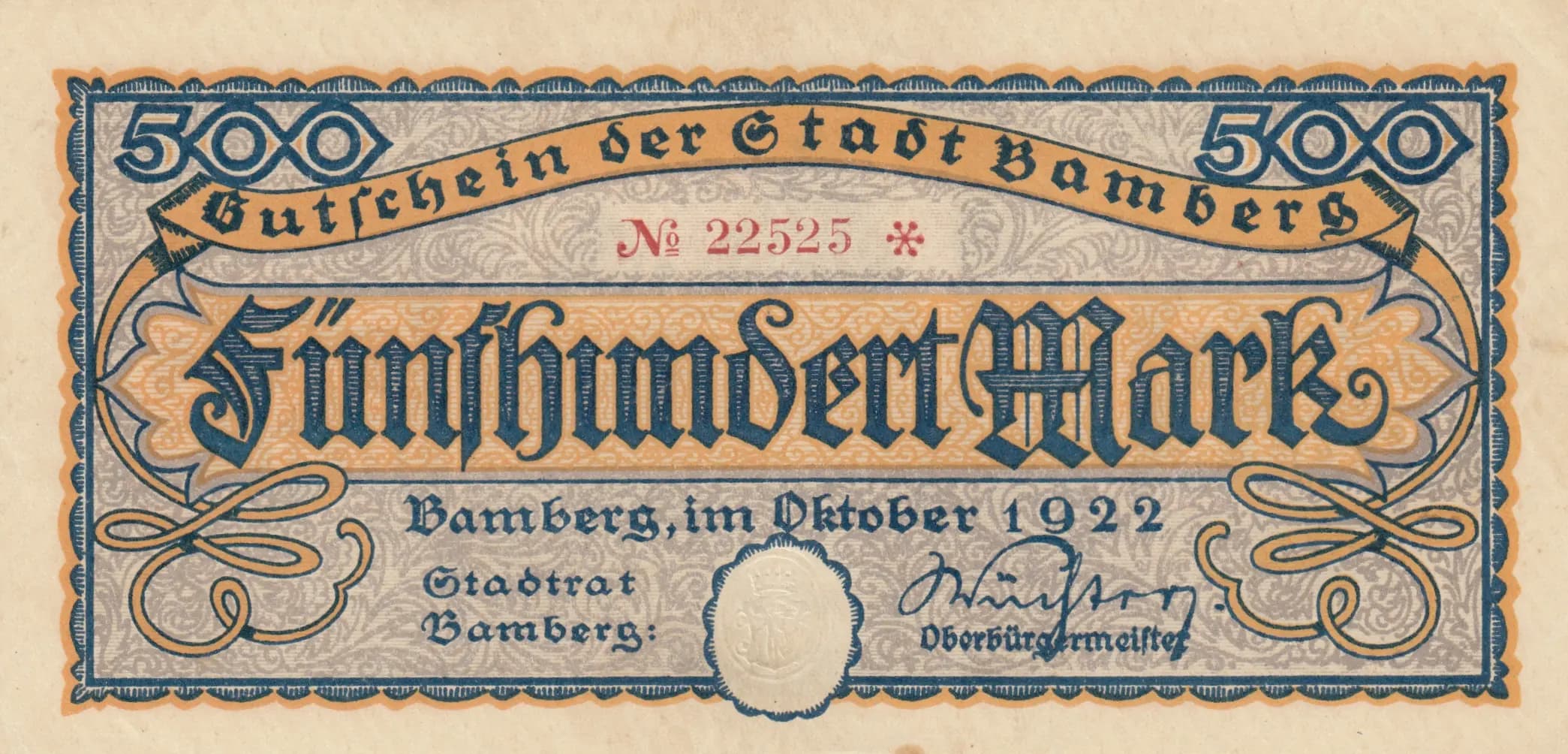
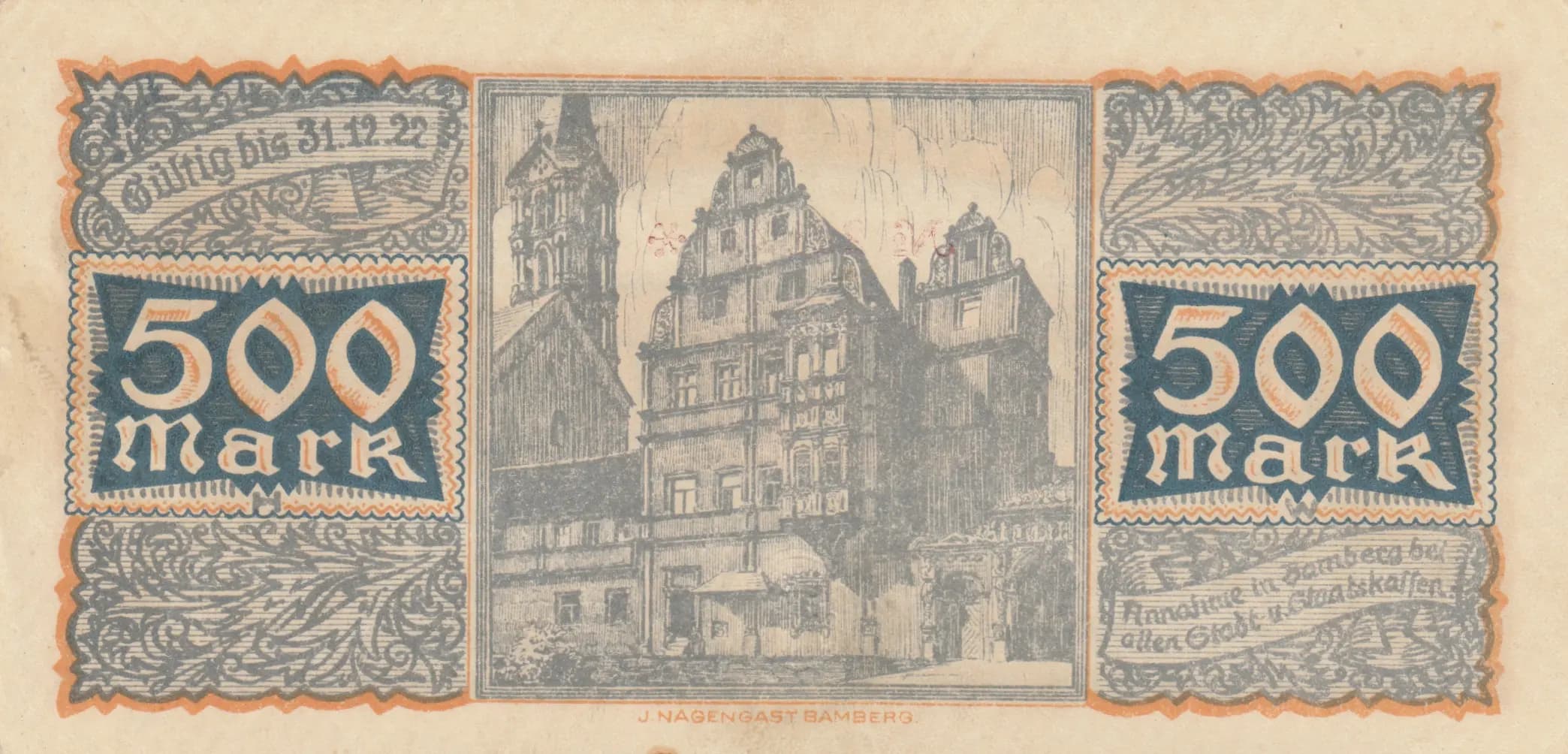
A scarce Weimar-era emergency currency issued by the City of Bamberg in October 1922, denominated 5000 Mark on the front and 500 Mark on the back—a dual denomination format reflecting the hyperinflation crisis of the period. The note exhibits excellent condition (AU) with crisp ornate borders in orange and blue, clear Gothic lettering, and a detailed engraved reverse featuring a prominent Gothic cathedral. This city-issued Gutschein (voucher) represents a fascinating artifact of Germany's municipal response to monetary collapse, valid only until December 31, 1922.
Uncommon. This is a city-issued Notgeld (emergency currency) from a specific period (October 1922) and issuer (Bamberg municipality) with limited original circulation. The Pick catalog lists it as unlisted, suggesting it falls outside the standard philatelic reference framework but remains documented. The AU condition grade enhances its collectibility, as most surviving examples show greater wear. However, German Notgeld from major cities like Bamberg was produced in moderate quantities and has not appreciated dramatically on the secondary market, placing it in the 'uncommon' rather than 'rare' category.
Issued during the catastrophic hyperinflation of 1922, this Bamberg city voucher exemplifies the emergency currency measures undertaken by German municipalities when the Reichsbank's output could not keep pace with demand. The note's dual denomination (5000/500 Mark) and short validity period (October–December 1922) reflect the currency's rapidly deteriorating value during this turbulent final quarter. The central engraved Gothic cathedral symbolizes Bamberg's civic identity and heritage, lending legitimacy to the municipality's financial instrument during a period of monetary chaos.
An ornate emergency currency voucher employing classical municipal heraldic design elements. The obverse features elaborate Art Nouveau-style decorative borders in orange and blue framing the denomination text in bold Gothic lettering ('FünftausendMark'), with the issuer identified as the City Council (Stadtrat) of Bamberg. The reverse displays a detailed engraved illustration of Bamberg Cathedral (the Dom St. Martin), identifiable by its distinctive twin spires and late-Gothic architectural detailing, flanked by ornamental panels bearing the secondary denomination '500 Mark.' Floral and vine motifs ornament all four corners. The design reflects early-20th-century Central European municipal aesthetics, with security enhanced through engraved architectural imagery and printer attribution to J. Nagengast of Bamberg.
FRONT: '5000' (denomination in numerals); 'FünftausendMark' (Five Thousand Mark in Gothic script); 'Gutschein der Stadt Bamberg' (Voucher of the City of Bamberg); 'Bamberg, im Oktober 1922' (Bamberg, in October 1922); 'Stadtrat Bamberg' (City Council of Bamberg); 'Oberbürgermeister' (Mayor); 'No 22525 *' (serial number). BACK: '500 Mark' (denomination on left and right panels); 'J. NAGENGAST BAMBERG' (printer attribution); '(Gültig bis 31.12.22)' (Valid until December 31, 1922); 'Amtl. Bekanntmachung allen Geldschein betreffende Bestimmungen' (Official announcement regarding all monetary note provisions).
Combination of letterpress for the denomination text and borders (orange and blue), with engraved intaglio for the cathedral illustration on the reverse. The printer J. Nagengast of Bamberg (a known regional printer of the period) produced the note. Security features include the ornate engraved building vignette and decorative borders typical of Weimar-era municipal Notgeld (emergency currency), rather than modern anti-counterfeiting measures.
This note exhibits a dual-denomination format (5000 Mark obverse / 500 Mark reverse), which may represent a single variety or could indicate multiple denominations within the same series. The serial number 'No 22525' suggests this is from the early production run of the issue. No signature varieties or known overprints are apparent from the visual analysis. The specific validity date of October 1922 and the redemption cutoff of December 31, 1922 are characteristic of this emergency currency series.