500 mark 1922
About This Note
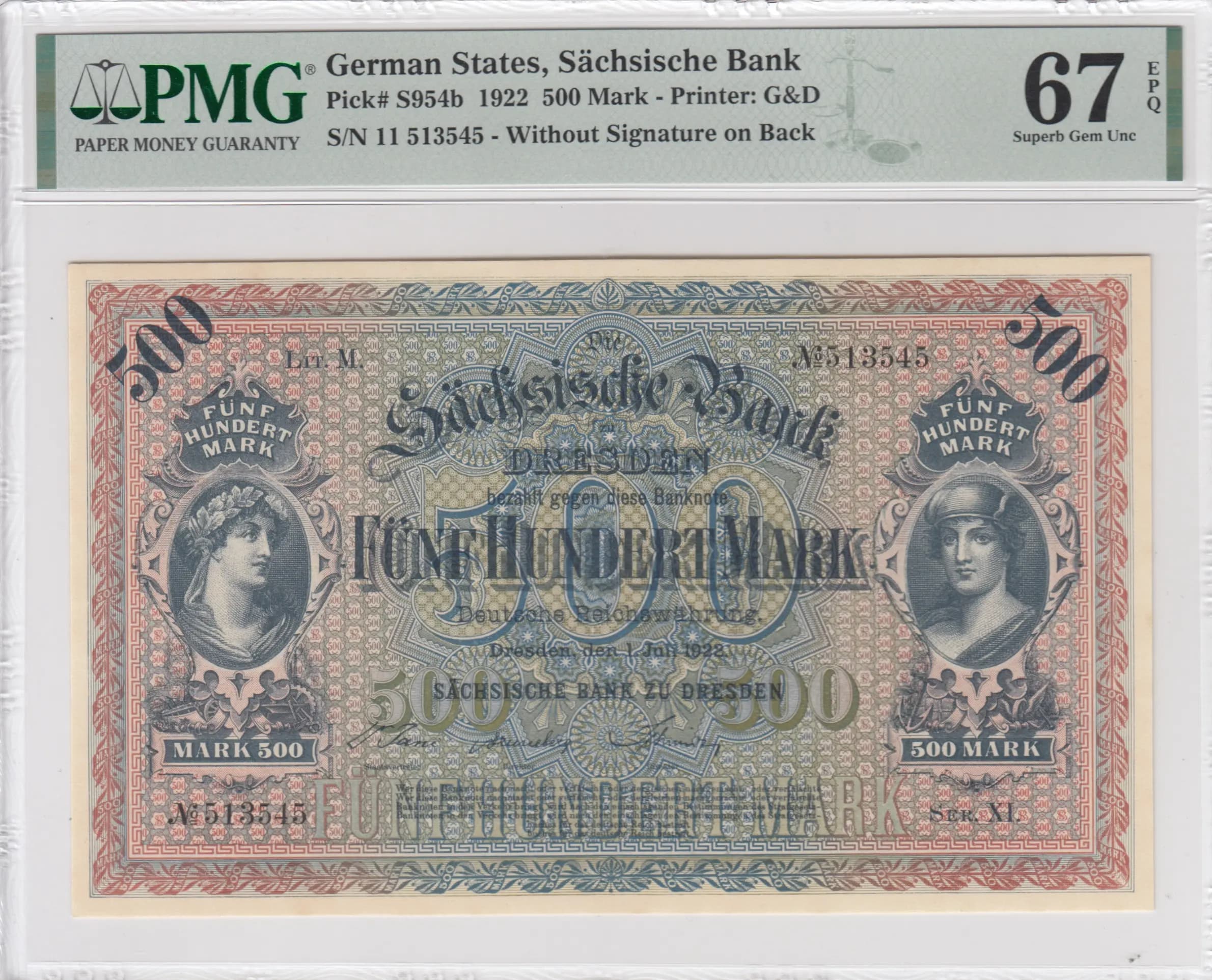
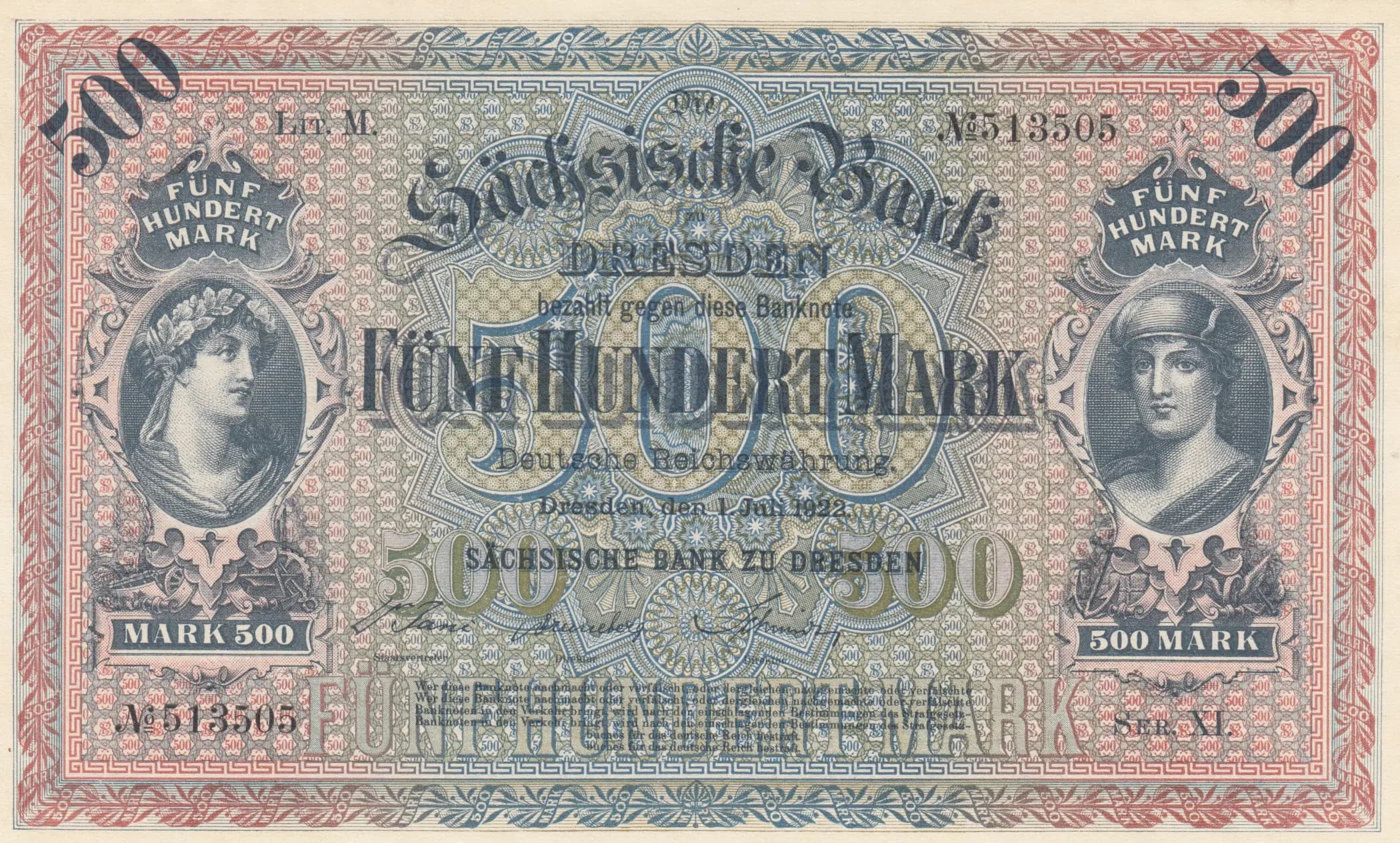
This 500 Mark banknote from the Sächsische Bank zu Dresden (1922) represents a striking example of Weimar-era German provincial banking currency during the hyperinflation period. The note displays exceptional artistry with ornate red and blue decorative borders, dual female portrait medallions, and elaborate heraldic design work, and appears in uncirculated condition with only minor processing marks visible on the obverse. The intricate guilloche patterns and multi-color printing demonstrate the security printing sophistication of G&D (Giesecke & Devrient), making this an important artifact of both numismatic design and German financial history.
Common. While the Sächsische Bank zu Dresden was a legitimate regional issuer during the hyperinflation crisis, 500 Mark notes from 1922 were produced in substantial quantities to meet emergency currency demands. The Pick catalog lists this denomination under two printer variants (P-S954a and P-S954b), indicating multiple printings. These notes are widely available in the collector market, particularly in circulated grades, and even UNC examples command modest valuations typical of common Weimar hyperinflation-era banknotes.
Issued in 1922 by the Sächsische Bank zu Dresden (Saxon Bank of Dresden), this note emerged during the catastrophic German hyperinflation crisis, when denominations escalated dramatically to cope with currency devaluation. The heraldic imagery and coat of arms reflect Saxon regional identity and authority, while the dual female portrait medallions—likely representing allegorical figures of commerce or prosperity—echo classical design traditions of pre-war German banking currency. The Deutsche Reichsbank reference acknowledges the central government's oversight, even as regional banks like this Dresden institution issued their own high-denomination notes as emergency currency measures.
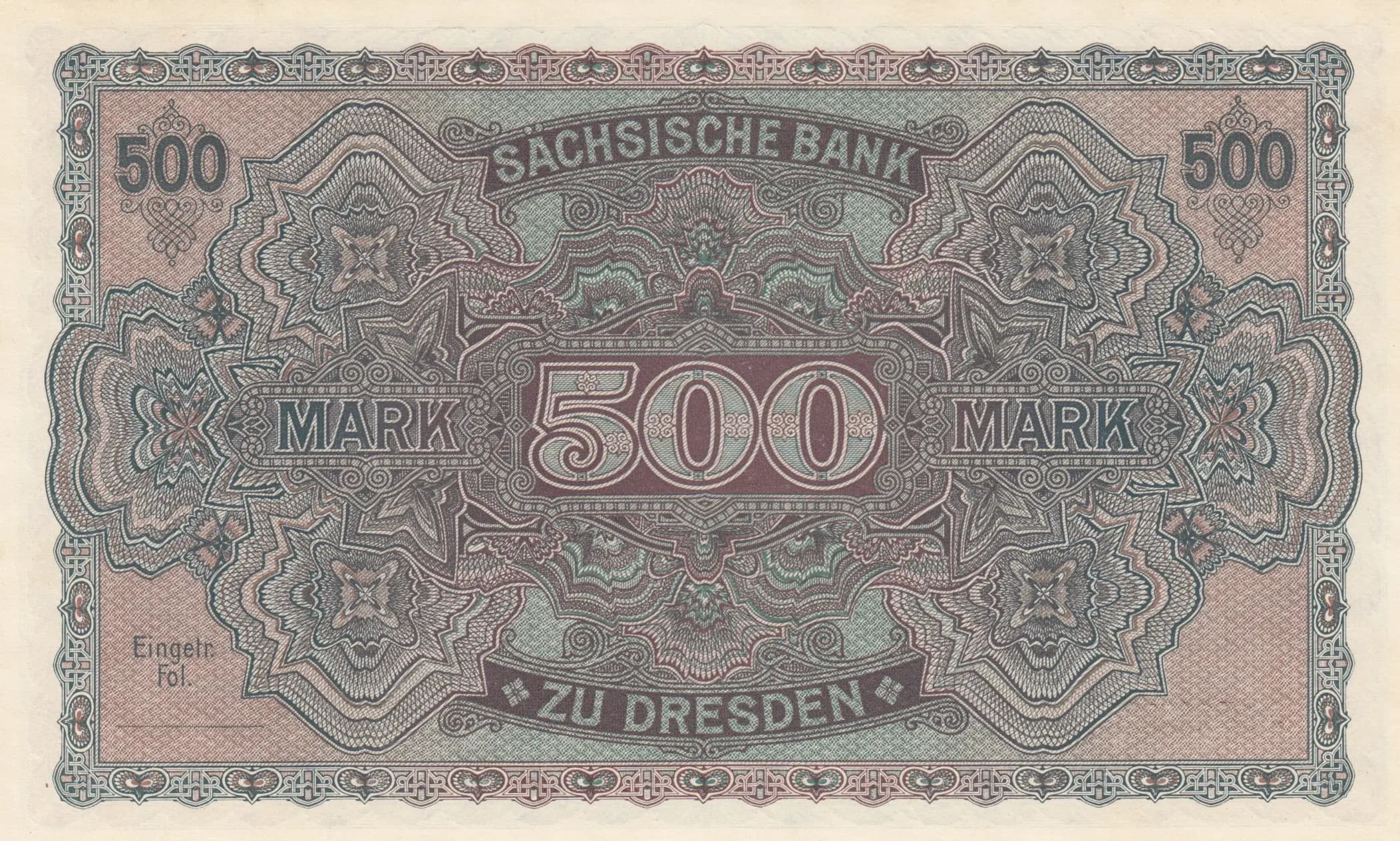
The obverse features an elaborate classical design with prominent red and blue ornamental borders framing the composition. Two female profile portrait medallions in baroque medallion frames flank a central heraldic achievement—a multi-quartered coat of arms topped by a crown and adorned with a double-headed eagle or similar heraldic beast. The left portrait depicts a woman facing left wearing a laurel wreath (symbolizing victory or achievement), while the right portrait shows a woman with curled hair facing right. The denomination 'FÜNFHUNDERT MARK' appears in large Gothic lettering across the center, with '500' numerals positioned prominently in all four corners. The reverse presents a symmetrical design dominated by a large '500' within an ornamental rectangular frame, flanked by baroque winged cherub or allegorical figures rendered in mauve and green tones. Elaborate scrollwork, rosettes, and geometric Greek key patterns provide sophisticated anti-counterfeiting ornamentation throughout both sides.
Front Side: 'FÜNFHUNDERT MARK' (Five Hundred Mark) - primary denomination text in Gothic script; 'MARK 500' (Mark 500) - repeated denomination; 'Lit. M' (Literature M, or printer's mark); 'No 513505' (Serial number); 'Dresden' (city of issue); 'Sächsische Banknote' (Saxon Banknote); 'Deutsche Reichsbank' (German Imperial/Central Bank); 'Dresdener Bank' (Dresden Bank). Back Side: 'SÄCHSISCHE BANK' (Saxon Bank); 'ZU DRESDEN' (of Dresden); '500' and 'MARK' (denomination repeated); 'Eingefolt.' (Filed/Registered - archival notation).
Multicolor intaglio engraving/copperplate printing executed by Giesecke & Devrient (G&D), the premier German security printer. The note exhibits characteristic fine-line guilloche work, precision color separation with red, blue, green, and mauve inks, and intricate background pattern fills typical of high-security banknote production of the early 1920s. The sharp definition of fine engraved lines, crisp color boundaries, and elaborate decorative elements indicate traditional intaglio methods without photographic or lithographic processes.
This note is cataloged as P-S954b, the Giesecke & Devrient (G&D) printer variant. The serial number visible (No 513505) and the 'Lit. M' printer designation confirm this variant assignment. The 'Eingefolt.' notation on the reverse appears as a standard archival or administrative marking rather than a distinctive variety marker. No significant varieties regarding signatures, dates, or overprints are apparent in this example, which displays a standard production printing without the additional overprinting sometimes seen on later emergency issues.