50 reichsmark 1929
Market Prices
27 salesAbout This Note
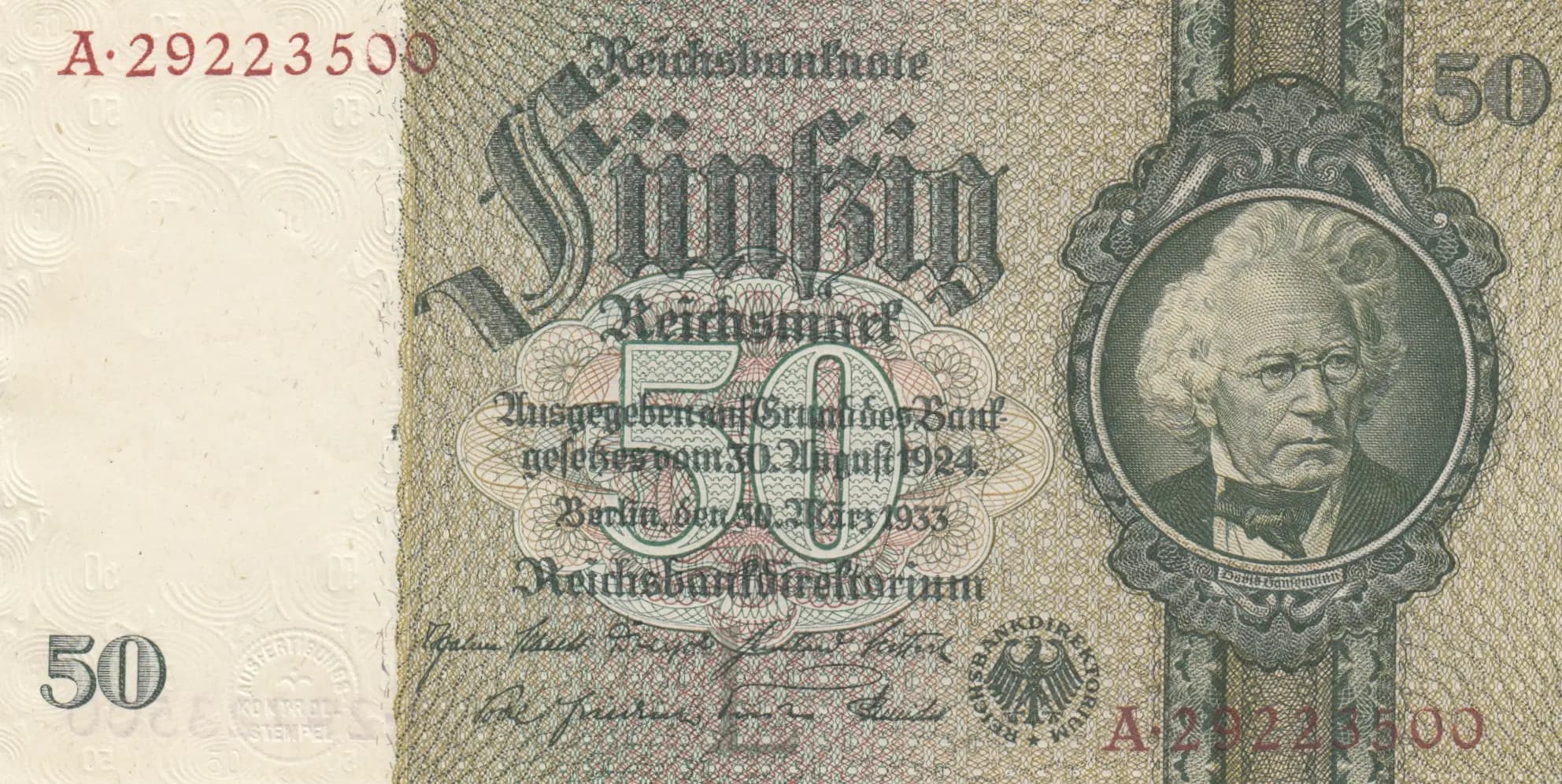
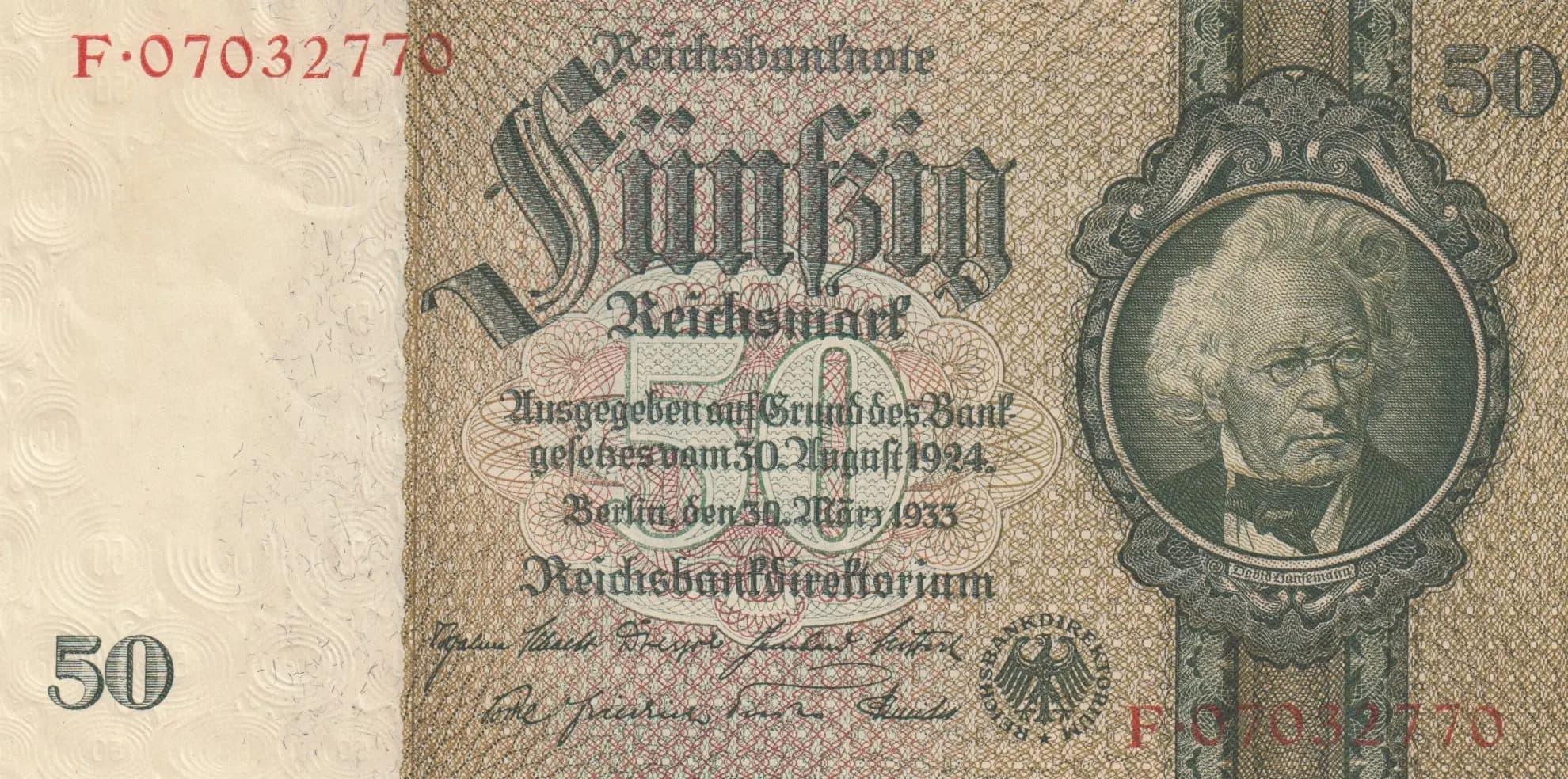
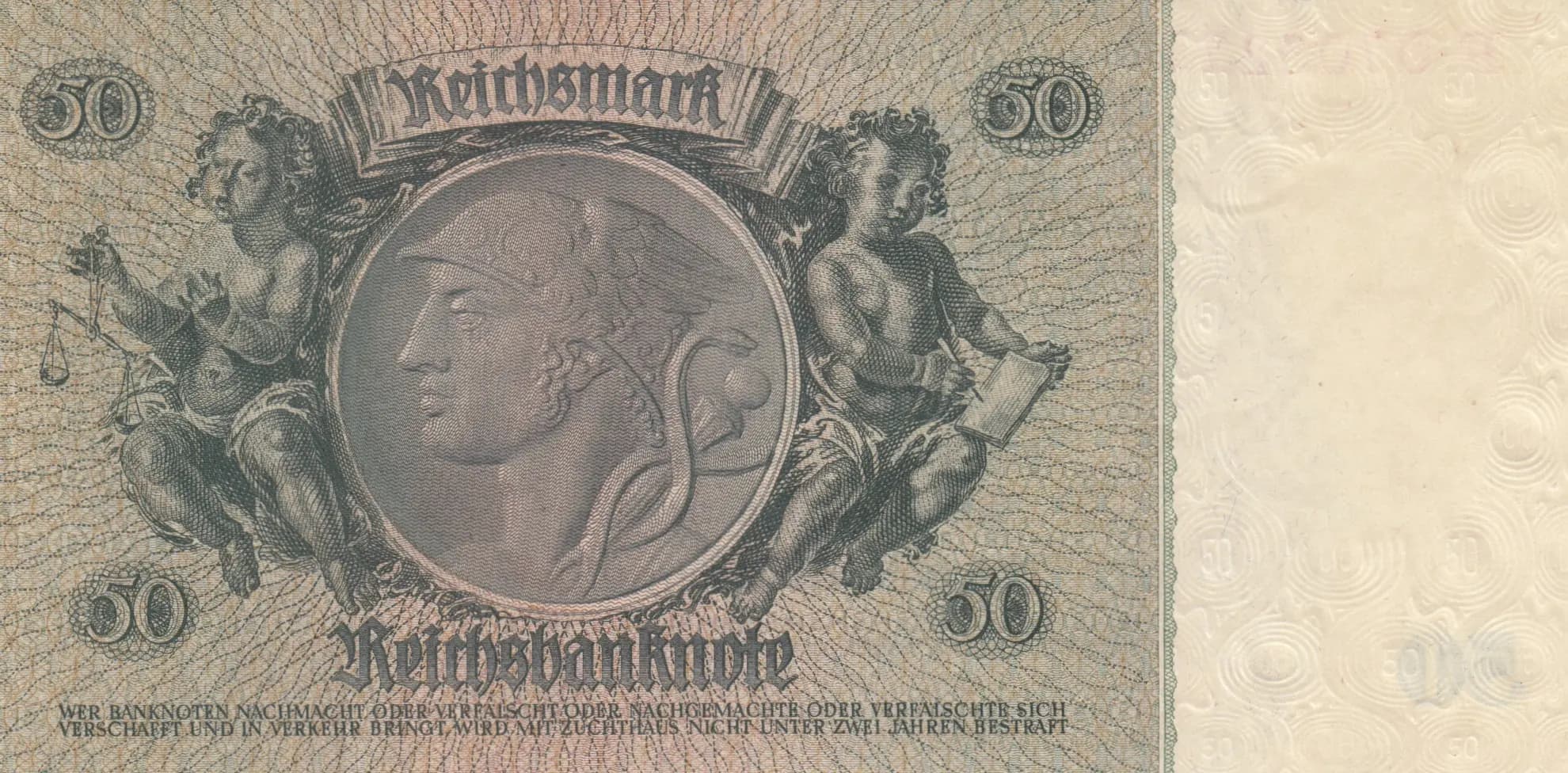
This is a 50 Reichsmark note from the Reichsbank dated March 30, 1933 (Pick P-182b), featuring the portrait of David Hansemann on the obverse and classical allegorical figures representing Law and Literature on the reverse. The note exhibits visible signs of age and handling with creasing, light discoloration, and some oxidation of the red ink, placing it in circulated condition rather than the UNC grade assigned in the catalog data—a discrepancy worth noting for collectors. The intricate guilloché background work and multi-color printing (red, green, and black on tan) showcase the sophisticated security printing techniques of the Weimar-era Reichsbank.
Common. The eBay price data provided shows consistent sales across multiple condition grades (VF to PMG 66) with typical realized prices ranging from $20–$85 for higher grades, with numerous sales of circulated examples at $1–$10. Print runs for the 1929–1933 series of 50 Reichsmark notes were substantial, and no specific scarcity markers (special prefixes, overprints, or recall status) are evident from the catalog or visual data. The Pick P-182b designation represents a standard, regularly issued variety without known print run restrictions.
This note was issued during the transitional period between the Weimar Republic and the Nazi regime, just weeks after Hitler's appointment as Chancellor in January 1933. The classical allegorical imagery—including the female profile representing German virtue and the cherubs symbolizing justice (balance) and law (tablet)—reflects the traditional values the Reichsbank sought to project during an era of profound political upheaval. The formal banking authority inscriptions and the stern counterfeiting warning underscore the state's effort to maintain financial stability and confidence amid the constitutional crisis and consolidation of Nazi power.
The obverse features a right-facing profile portrait of David Hansemann (1790–1864), a prominent Prussian banker and politician, rendered within an ornate baroque-style circular medallion frame. The German Imperial Eagle (Reichsadler) appears in the lower right. The reverse displays a classical female allegorical profile (likely representing Germania or German virtue) in a central circular medallion, flanked by two putti (cherub figures): the left cherub holds a balance or scale symbolizing justice and law, while the right cherub holds a tablet or book symbolizing knowledge, literature, and legal authority. Both sides employ fine guilloché background patterns and multi-color printing to enhance security and aesthetic appeal. The denomination '50' appears in all corners of the reverse.
FRONT SIDE: Serial number 'F·07032770' / 'Deutschnote' (German note) / '50' (denomination) / 'Reichsmark' / 'Ausgesprochen und Gültig der Bankgesetzgeben 30 August 1924 Berlin, den 30. März 1933' (Issued and valid according to the Banking Law of August 30, 1924, Berlin, March 30, 1933) / 'Reichsbankpräsidium' (Reichsbank Presidency) / Plate marking 'F19D 2730'. BACK SIDE: '50' (appears in all four corners) / 'Reichsmark' / 'Reichsbankbund' (Reichsbank Board) / 'WER BANKNOTEN NACHMACHT ODER VERFÄLSCHT ODER NACHGEMACHTE ODER VERFÄLSCHTE SICH VERSCHAFFT UND IN VERKEHR BRINGT, WIRD MIT ZUCHTHAUS NICHT UNTER ZWEI JAHREN BESTRAFT' (Anyone who counterfeits or forges banknotes or obtains counterfeit or forged notes and puts them into circulation will be punished with imprisonment of not less than two years).
This note was produced using classical intaglio (engraving) printing combined with multi-color lithographic underprinting. The visual analysis confirms the use of the 'Kreuz-Iris' printing technique (referenced in the catalog data), a specialized color transition method that creates subtle gradations in the underprint and is difficult to reproduce photographically. The fine-line engraved borders, detailed baroque ornamentation, and complex guilloché patterns are characteristic of high-security intaglio work. The Reichsbank contracted with specialist security printers of the era; this note's technical sophistication reflects the standards of German banknote production in the early 1930s.
The serial number prefix 'F' and the style of printing (with 'Kreuz-Iris' technique) place this within the standard 1929–1933 issue series. The catalog reference notes that both 'Kreuz-Iris' and non-'Kreuz-Iris' printing variants are known for this series, though both are readily collectable and not difficult for inexperienced collectors to distinguish. The 8-digit serial number format (as visible: F·07032770) is consistent with the standard issue type. No overprints, date variations, or signature varieties appear to distinguish this note as a notable sub-variety; it represents the regular issue.