5 000 000 000 mark 1923
Market Prices
2 salesAbout This Note
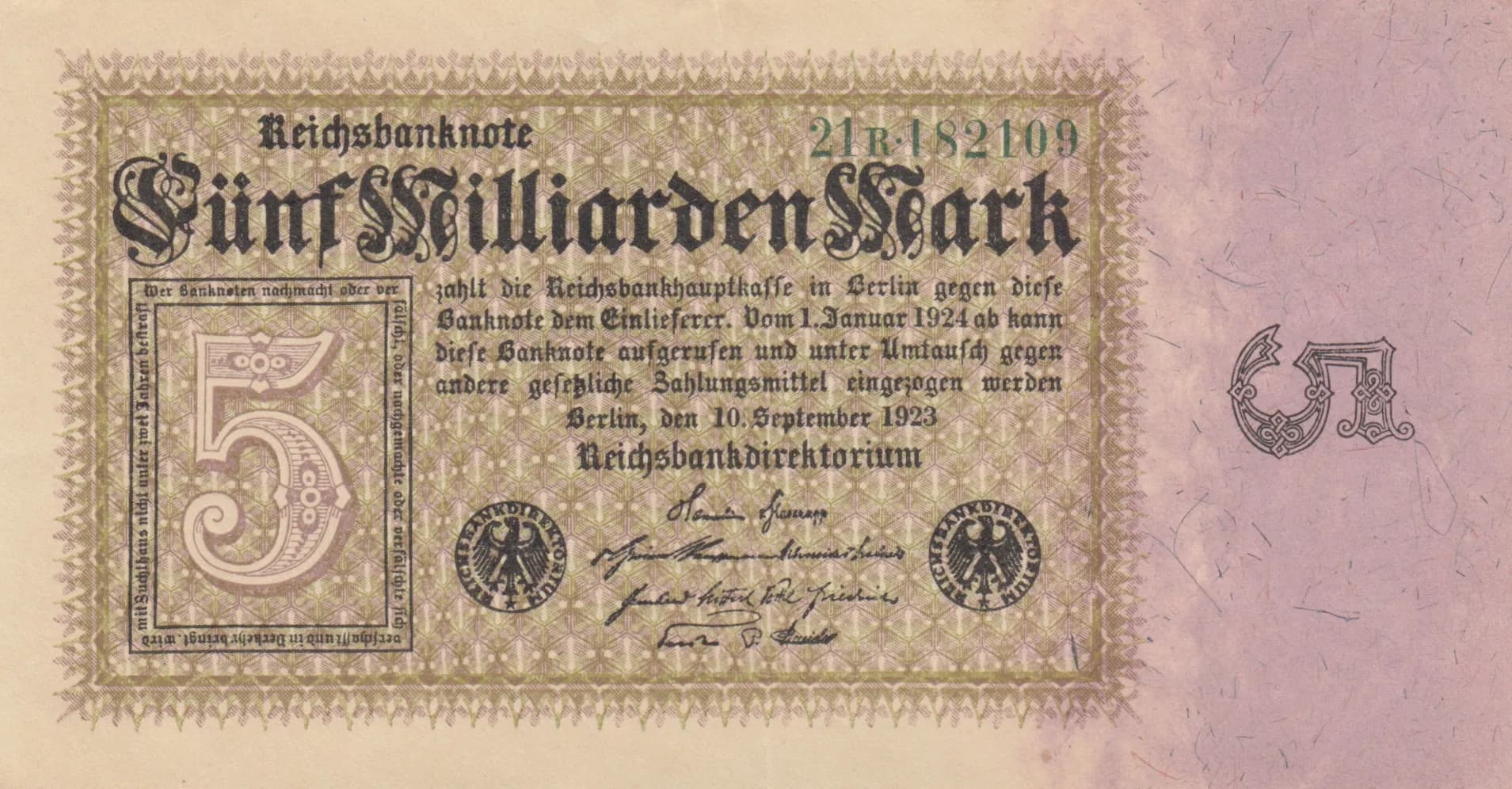
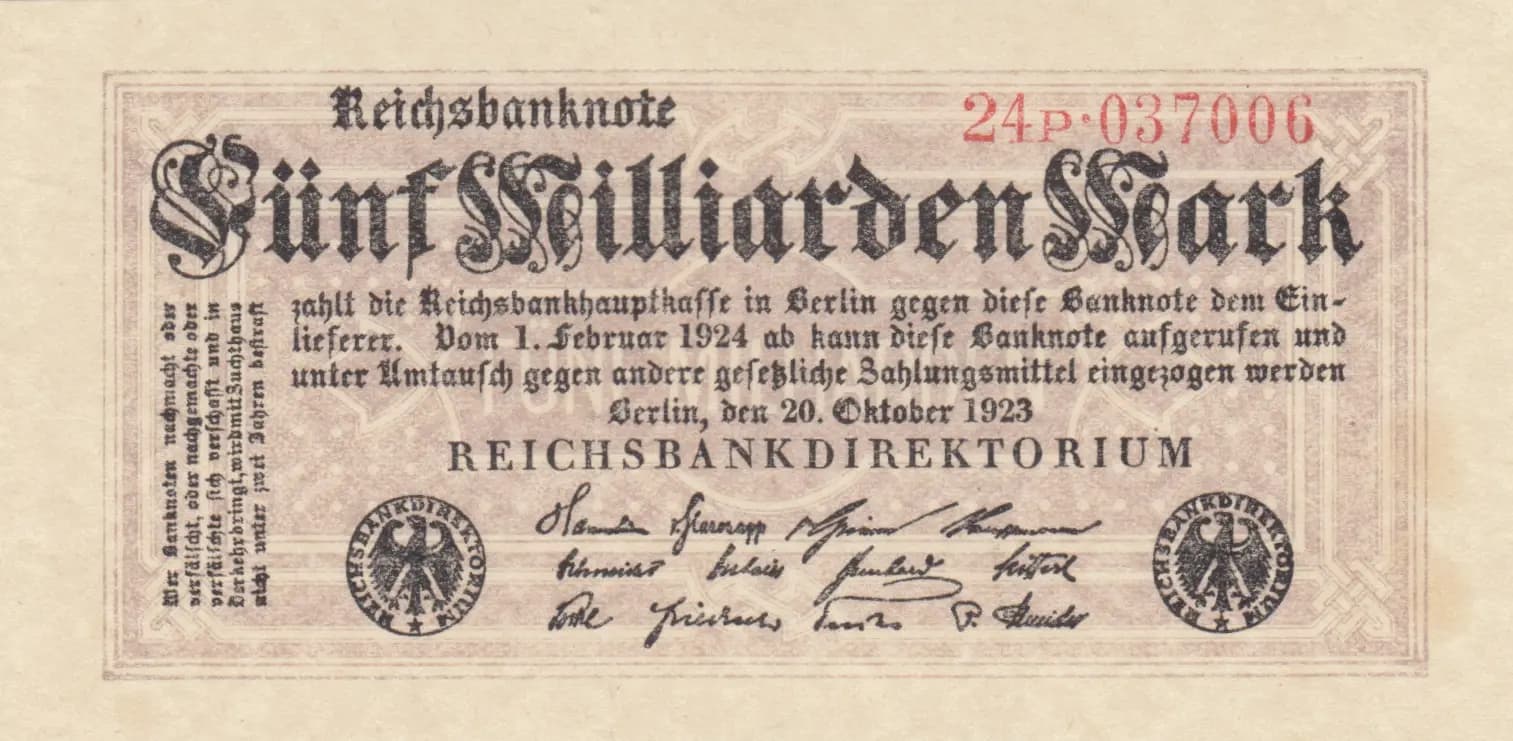
This is a German Reichsbank 5 Milliarden Mark (5 billion mark) note from October 20, 1923, representing the peak of the Weimar hyperinflation crisis. The note exhibits an AU (About Uncirculated) condition grade with minimal wear, light age-related yellowing, and no significant tears or creases—typical of a note that saw minimal circulation before the currency reform of 1924. The ornate Gothic typography, dual Reichsbankdirektorium seals with Imperial German eagles, and red serial number (24F.037006) are all clearly visible and well-preserved, making this an excellent example of late hyperinflation-era currency.
common. This note is common in the numismatic market. eBay transaction data provided above shows recent VF examples selling for approximately $3 and catalogued values ranging from $10–$30 depending on condition, with even PMG-certified examples (PMG 58) trading below $11. These low market prices and the existence of multiple comparable sales indicate a substantial surviving population. While hyperinflation notes have collector interest, the 5 billion mark denomination was printed in large quantities during October 1923 as the Reichsbank attempted to manage the currency crisis, and many examples survived the 1924 currency reform and subsequent decades. The AU grade of this specific specimen does not elevate it above common status.
Issued during the final months of the Weimar hyperinflation period, this banknote exemplifies the desperate fiscal measures taken by the Reichsbank as the mark's value collapsed. The October 20, 1923 date places it just weeks before the introduction of the Rentenmark stabilization currency in November 1923, and the note itself includes a redemption deadline of February 1, 1924, indicating the Reichsbank's awareness that this denomination would soon become obsolete. The dual circular seals with the Imperial German eagle symbol reflect the institutional authority the Reichsbank attempted to project even as hyperinflation rendered such denominations nearly worthless in daily transactions.
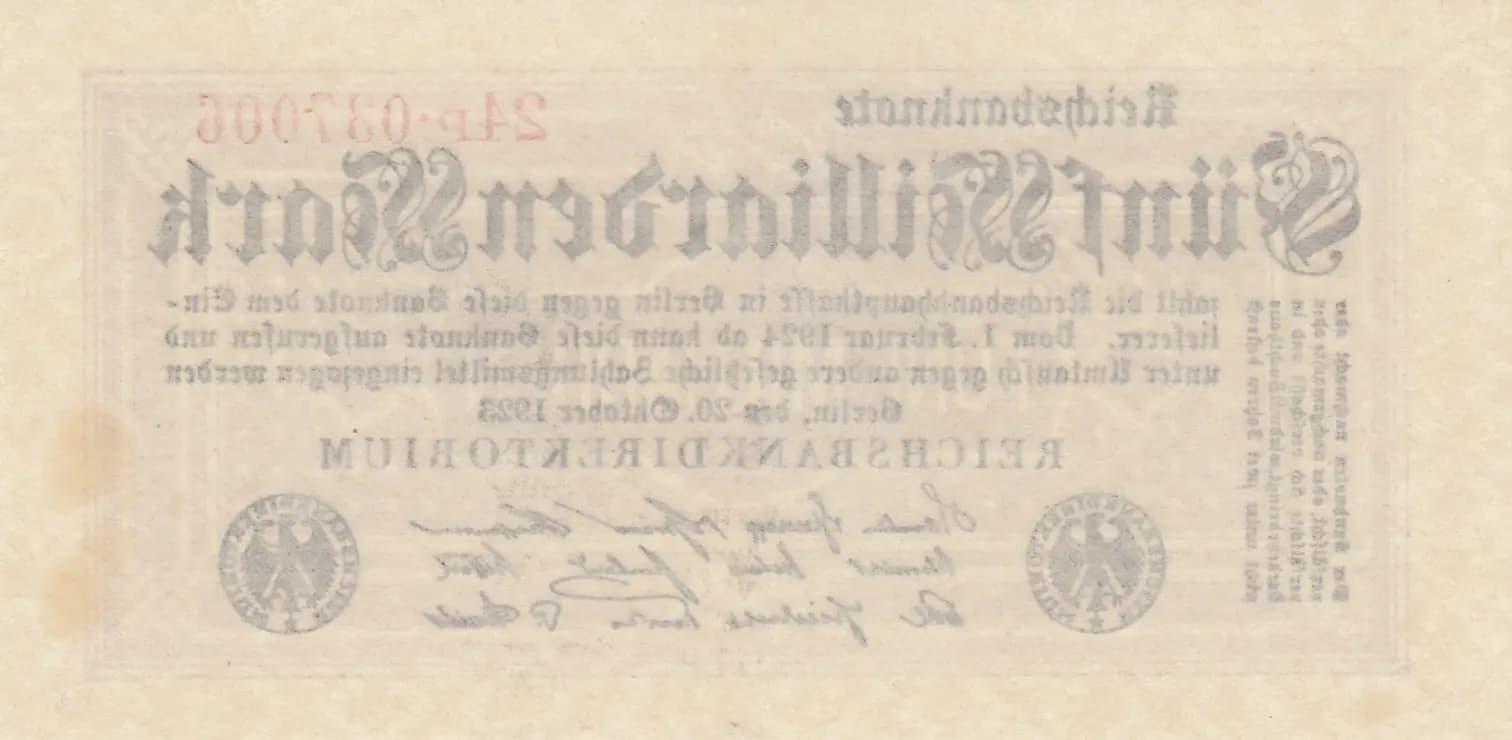
This uniface banknote features a striking beige/cream field with black and gray printing, characterized by ornate Gothic Revival typography typical of early 20th-century German currency design. The front displays 'Fünf Milliarden Mark' in large decorative Gothic lettering at the top, with 'Reichsbanknote' above it. The central vignette area contains the official redemption text in smaller Gothic print, dated Berlin, October 20, 1923. Two circular seals of the Reichsbankdirektorium (Reichsbank Directorate) are positioned symmetrically in the lower portion of each side, each seal containing the Imperial German eagle (Reichsadler) as the central heraldic symbol—representing the authority of the German Reich and its central banking institution. Multiple signature lines in formal cursive script occupy the center area, with the serial number '24F.037006' printed in red ink in the upper right corner of the obverse. Fine print text runs vertically along both margins (left on front, right on back), containing legal disclaimers and regulatory information. The reverse mirrors the front design with the denomination prominently repeated, maintaining bilateral symmetry consistent with Weimar-era security printing standards. No portraits or architectural landmarks are depicted; the design relies entirely on typography, heraldic symbols, and ornamental borders for visual impact.
{"front":{"header":"Reichsbanknote / Fünf Milliarden Mark = Reichsbank Note / Five Billion Mark","issuerText":"REICHSBANKDIREKTORIUM = Reichsbank Directorate","dateAndPlace":"Berlin, den 20. Oktober 1923 = Berlin, October 20, 1923","paymentClause":"zahlt die Reichebankhauptkasse in Berlin gegen diese Banknote dem Einlieferer. Vom 1. Februar 1924 ab kann diese Banknote aufgerufen und unter Umtausch gegen andere gesetzliche Zahlungsmittel eingezogen werden = The Reichsbank main office in Berlin pays the bearer of this banknote. From February 1, 1924 onwards this banknote can be called in and exchanged for other legal tender","serialNumber":"24F.037006 = Serial number 24F.037006","leftMarginFineprint":"Various redemption and legal regulatory information (partially legible)"},"back":{"denomination":"Fünf Milliarden Mark = Five Billion Mark","issuerText":"REICHSBANKDIREKTORIUM = Reichsbank Directorate","signatures":"Multiple signature lines for bank officials","rightMarginFineprint":"Various regulatory and legal information (reversed/mirrored on back)"}}
This note was produced using letterpress (relief) printing, the standard technique for German Reichsbank currency of the 1923 period. The crisp, well-defined Gothic typefaces, sharp serifs, and clear impression of the circular seals indicate high-quality letterpress production. The red serial number was applied in a separate pass, also via letterpress. The fine detail work and ornamental borders suggest professional security printing, likely produced by one of the established German security printers contracted by the Reichsbank (such as Giesecke & Devrient or similar firms), though the specific printer attribution for Pick P-123 is not definitively documented in standard references.
The observed serial number 24F.037006 indicates this note belongs to the series with the '24F' prefix, a common variety identifier for October 1923 emissions. The visual analysis reveals signatures in cursive script on both sides, though the exact names are not fully legible in the provided images; variations in signatory combinations exist across the print run of this denomination. The date 20. Oktober 1923 is consistent with the standard Pick P-123 issue. No overprints, color variations, or other secondary printings are visible in the AU condition grade. For this denomination and date, no major recognized varieties (such as different printer variants, date errors, or significant signature changes) are documented in standard catalogs, making this a straightforward example of the regular October 1923 issue.