20 reichsmark 1939
Market Prices
80 salesAbout This Note
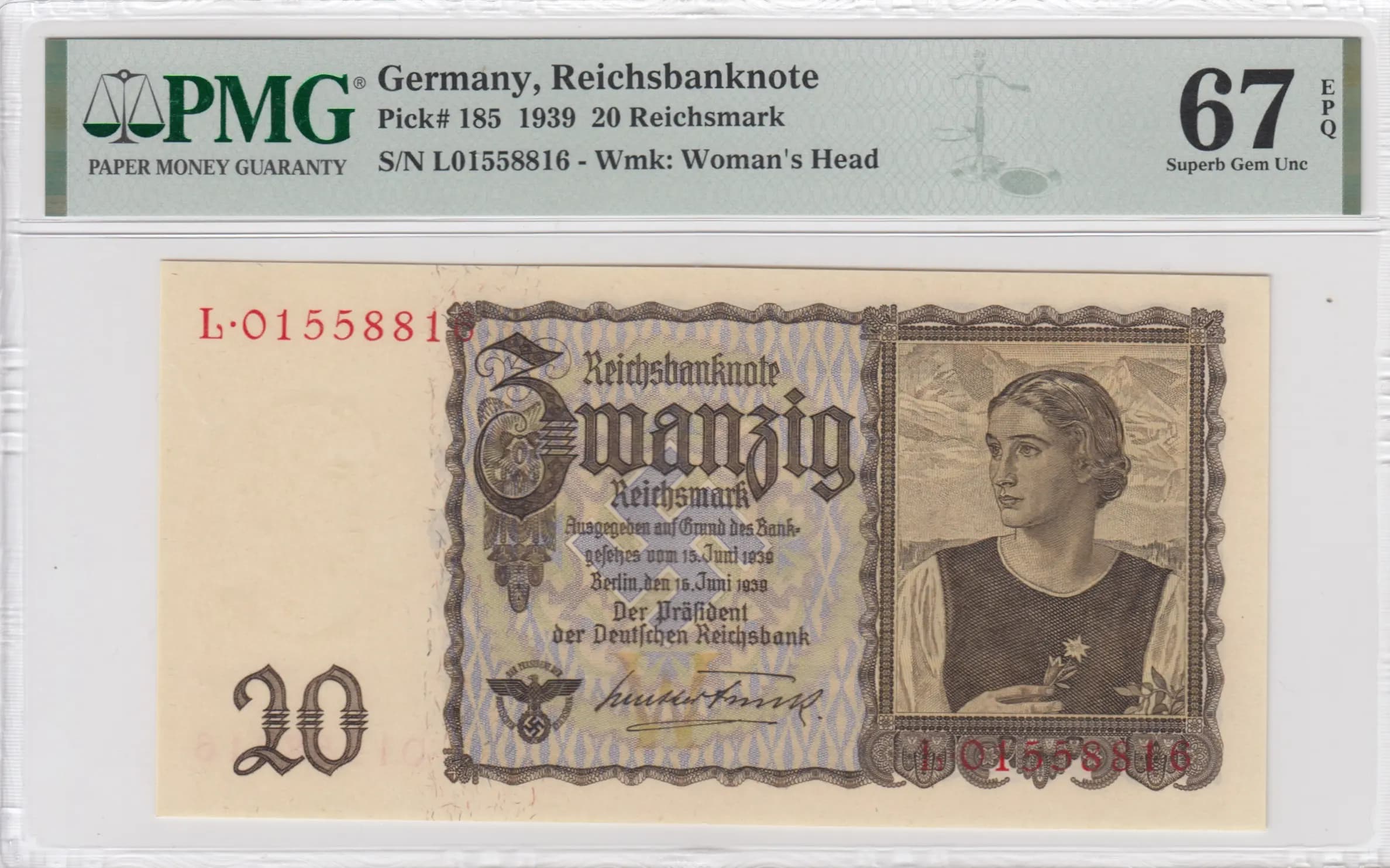
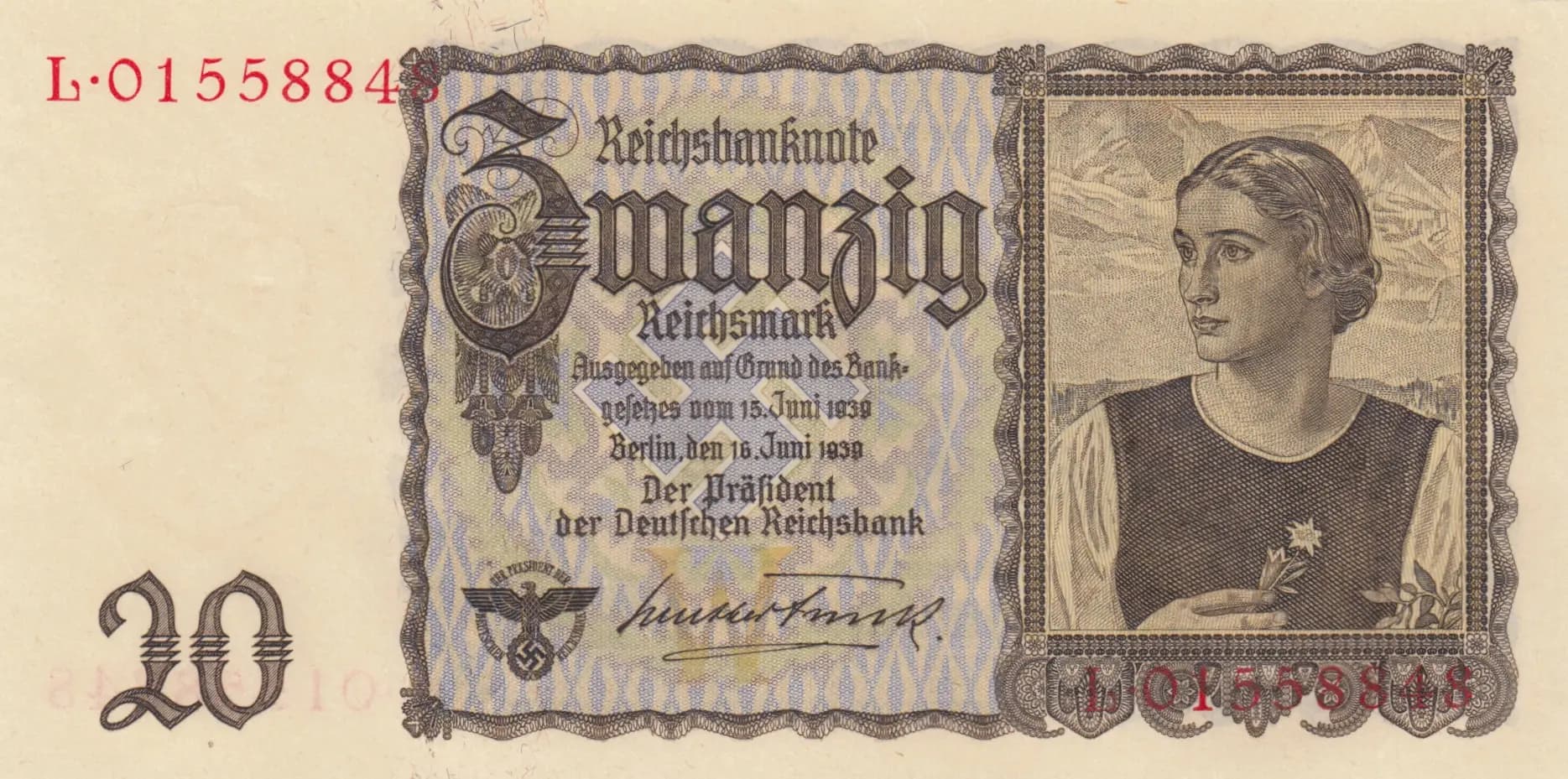
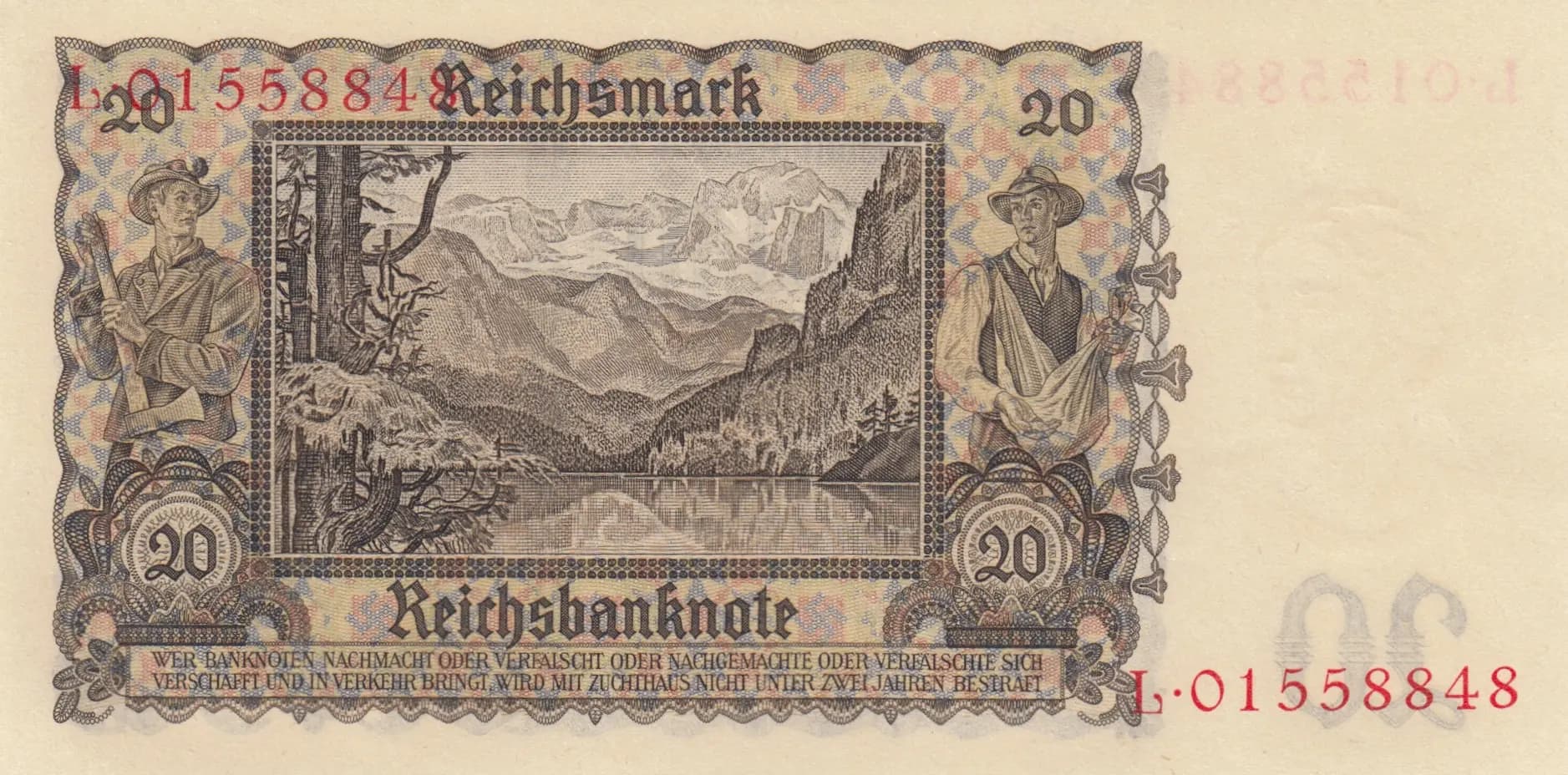
This is a pristine example of the German 20 Reichsmark note (Pick P-185) issued on June 16, 1939, graded as Uncirculated. The note displays exceptional condition with sharp, clear printing throughout and no visible wear, creases, or stains. The obverse features an elegant portrait of an Austrian woman holding edelweiss in classical dress, while the reverse showcases an Alpine landscape with Lake Gosau and two allegorical male figures—a design notably based on an unrealized Austrian 100 Schilling note from 1936, making this piece historically significant as it represents a cross-national aesthetic bridge during the Nazi period.
Common. The eBay price history provided shows consistent sales of this note across all condition grades from 2010–2025, with numerous transactions at relatively modest prices ($5–$40 for circulated grades, $26–$86 for UNC/PMG-graded examples). The median price for UNC examples hovers around $30–$40, and the note appears regularly in the secondary market. Print runs for 1939 German Reichsmark denominations were substantial, and this specific issue was not recalled or limited. While this particular specimen in UNC condition commands moderate collector interest, the denomination and issue are fundamentally common in numismatic terms.
Issued by the Reichsbank on June 16, 1939, this note exemplifies the Third Reich's monetary system in its final pre-war months, with official authorization referenced in the Bank Law of June 15, 1939. The imagery celebrating Austrian Alpine landscapes and edelweiss—combined with the classical male figures in regional attire—reflects the Nazi regime's incorporation of Austria following the Anschluss in March 1939, subtly asserting cultural and political dominance through numismatic design. The presence of the Reichsadler with swastika and Hjalmar Schacht's signature anchors the note firmly within the Nazi economic apparatus.
The obverse features a three-quarter profile portrait of a young Austrian woman facing left, wearing classical draped clothing with characteristic regional styling, holding a stem of edelweiss (Leontopodium nivale), the famous Alpine flower and national symbol of Austria. The reverse depicts Lake Gosau (Gosausee) nestled in the Dachstein massif of the Austrian Alps, rendered in detailed landscape engraving with coniferous forest, alpine peaks, and serene water. Flanking the landscape are two allegorical male figures in classical/regional Germanic attire: on the left, a standing male holding a ceremonial staff topped with a shield symbol; on the right, a mirror composition. Both sides employ ornate guilloche borders with geometric patterns, elaborate scrollwork, and decorative corner designs containing the denomination. The color scheme is cream/beige with black/dark brown engraving and blue-purple security tinting. Imperial German heraldry (Reichsadler with swastika) appears on the obverse.
FRONT SIDE: 'Reichsbanknote' (Reich Bank Note) / '20 Zwanzig Reichsmark' (20 Twenty Reichsmark) / 'Ausgegeben auf Grund des Bankgesetzes vom 15. Juni 1939' (Issued pursuant to the Bank Law of June 15, 1939) / 'Berlin, den 16. Juni 1939' (Berlin, June 16, 1939) / 'Der Präsident der Deutschen Reichsbank' (The President of the German Reichsbank) / Serial number: L·0155884. BACK SIDE: 'Reichsbanknote' (Reich Bank Note) / 'Reichsmark' (Reichsmark) / 'WER BANKNOTEN NACHMAKER ODER VERFALSCHT ODER NACHGEMACHTE ODER VERFALSCHEN SICH VERSCHAFFT UND IN VERKEHR BRINGT WIRD MIT ZUCHTHAUS NICHT UNTER ZWEI JAHREN BESTRAFT' (Whoever counterfeits bank notes or forges them or procures counterfeit or forged ones and puts them into circulation will be punished with hard labor for no less than two years) / Serial number: L·0155884 (matching front).
Intaglio engraving (copperplate/steel-plate) printing, evident from the exceptional detail in fine-line work, minute geometric patterns (guilloche), and the three-dimensional quality of the portrait and landscape. The sharp clarity of all engraved elements and consistent ink application across the pristine surface confirm professional security printing. The blue-purple security tinting appears to be applied as part of the multi-pass intaglio process. This note was produced by the Reichsbank's official security printer; German Reichsmark notes of this period were typically produced by the Reichsdruckerei or contracted state security printers.
Serial number prefix 'L' indicates a standard-issue note from the 1939 printing. The signature visible on the obverse corresponds to Hjalmar Schacht, President of the Reichsbank in June 1939 (he was removed from office in January 1939 but his signature continued to appear on notes issued under authorization of the June 15, 1939 decree). No overprints, special markings, or variant signatures are evident on this specimen. The design is consistent with the primary type of Pick P-185; no known major varieties (such as different portrait renderings or reverse landscape variations) are documented for this issue.