1000 mark 1918
Market Prices
10 salesAbout This Note
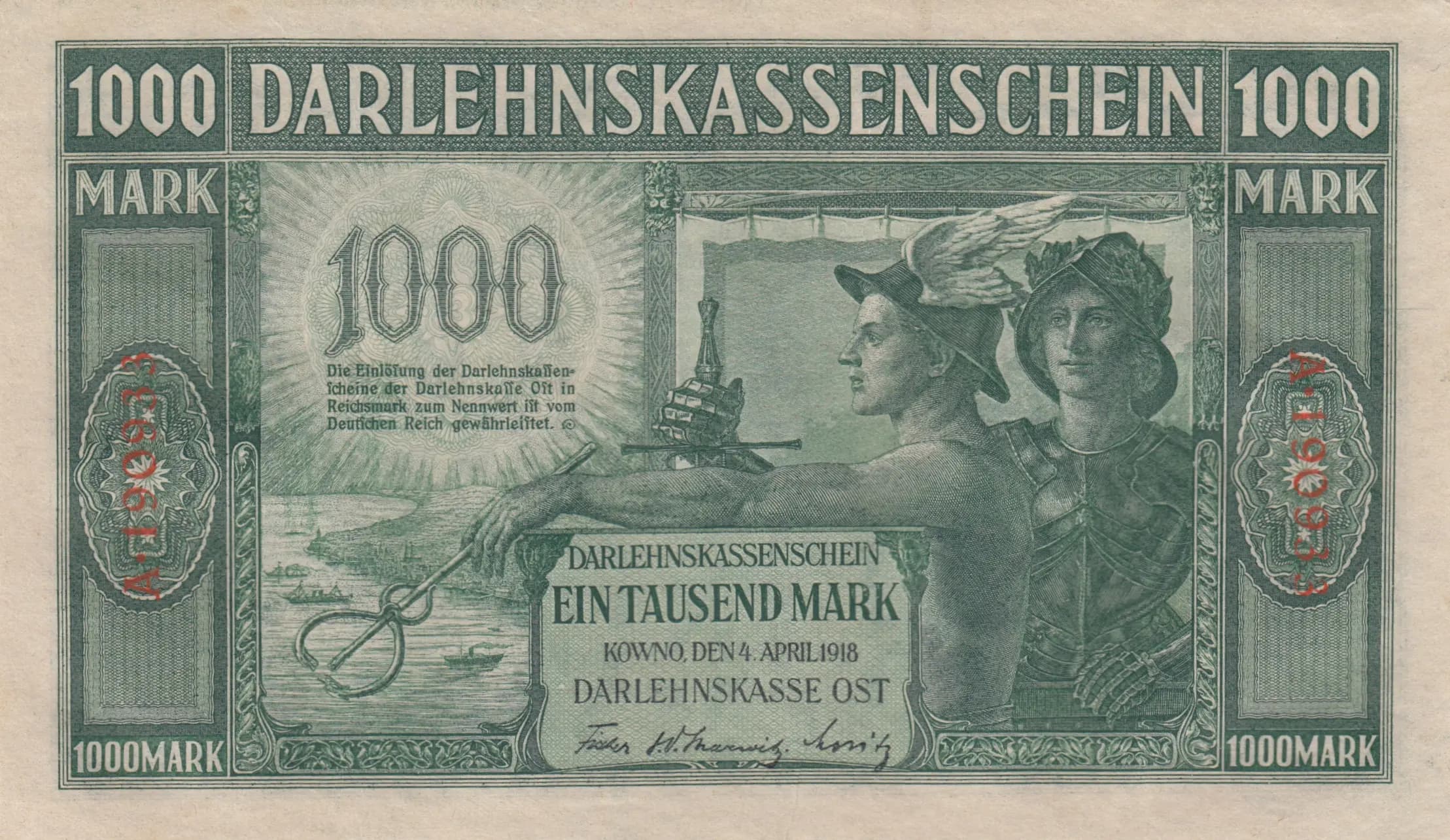
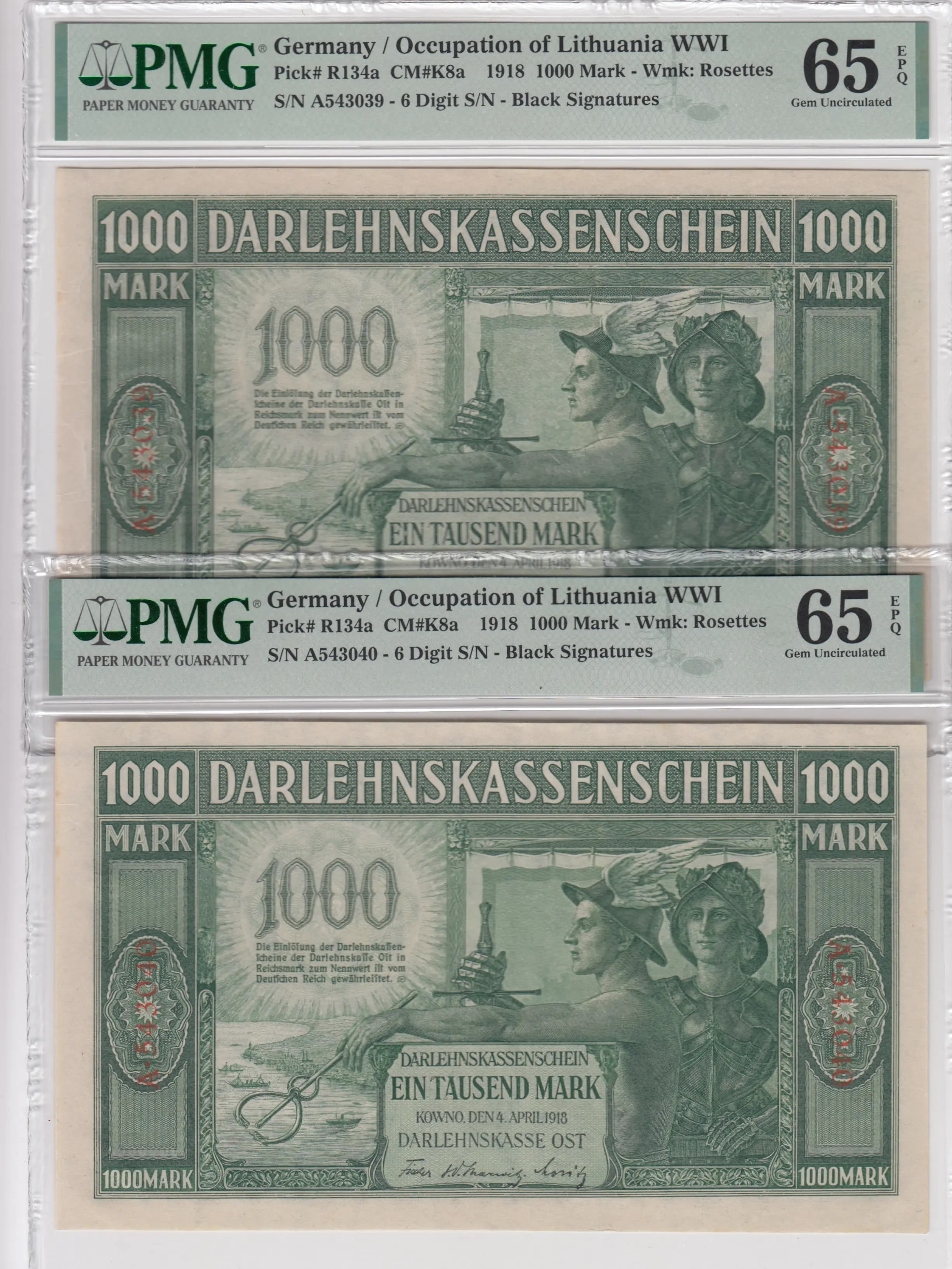
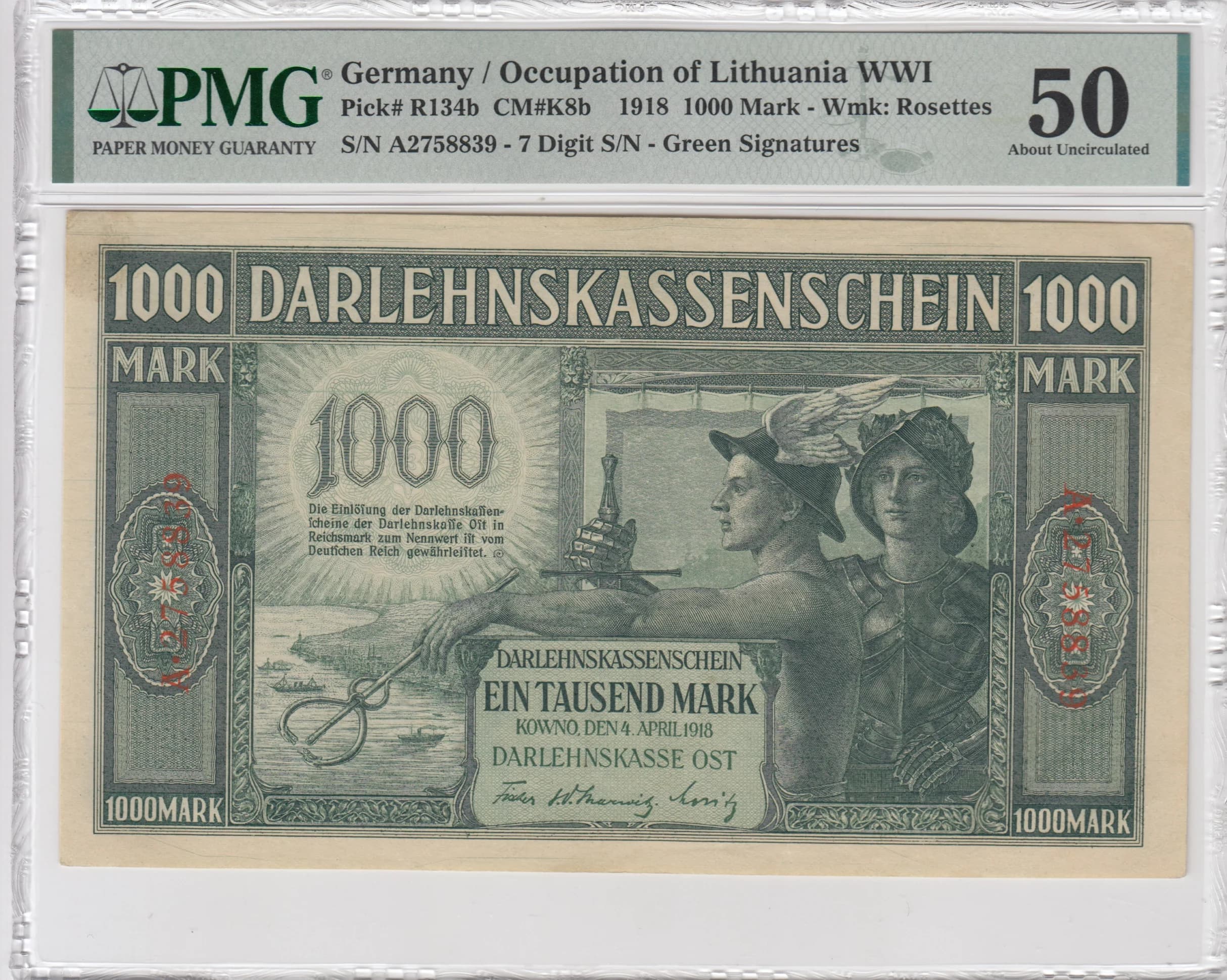
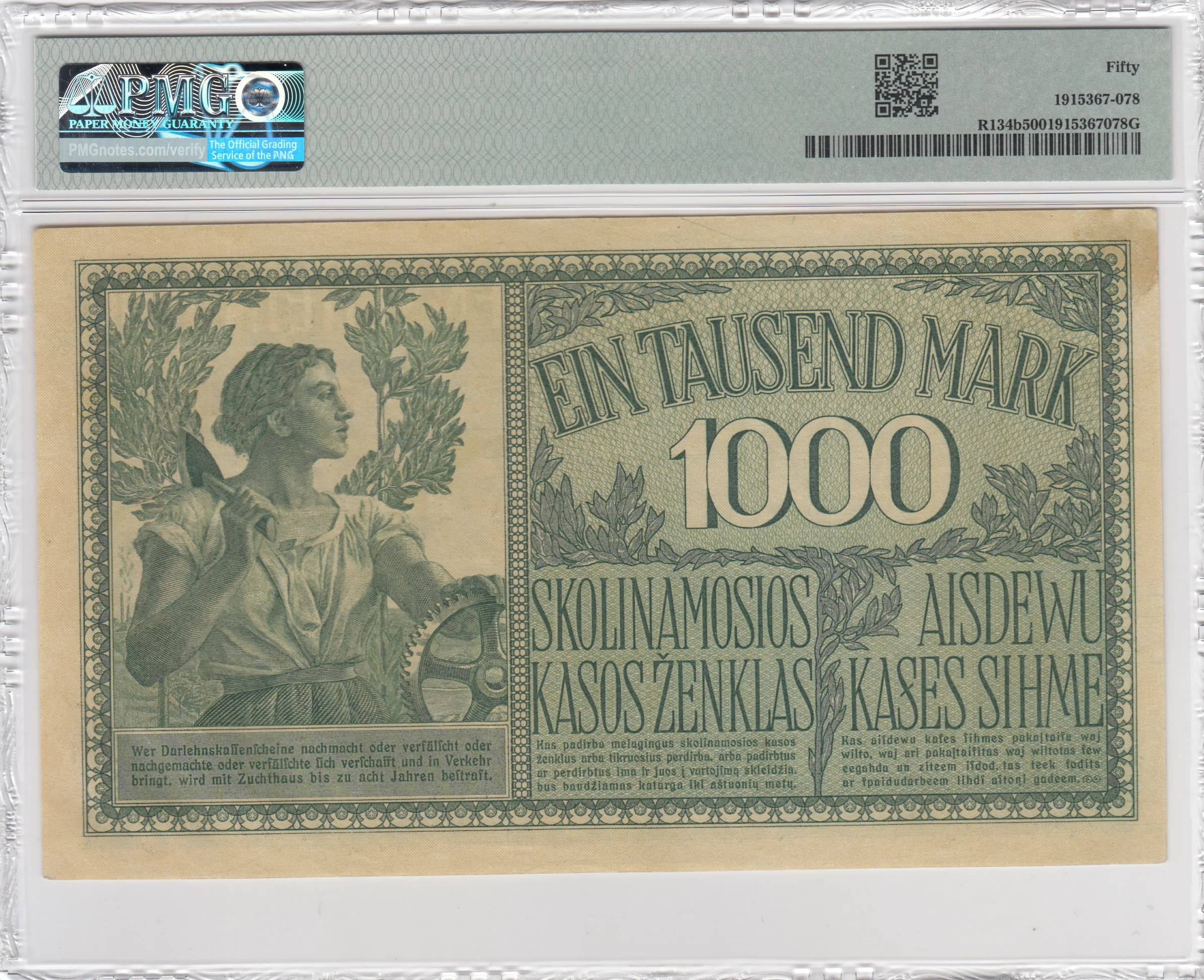
This is a PMG 50 (About Uncirculated) example of the 1000 Mark Darlehnskassenschein issued by Darlehnskasse Ost in Kaunas on April 4, 1918. The note features exceptionally crisp engraving with a classical allegorical female figure in a winged helmet on the obverse and a laureate female portrait on the reverse, both rendered in grey-green tones on cream paper. The pristine condition with minimal circulation wear and clean margins makes this an attractive specimen of this regional German war loan certificate, backed by the guarantee of the German Reich.
Common. eBay price history shows examples in Fine condition consistently selling between $10–$52, with one PMG 55 specimen reaching $124.50 in 2019. However, PMG 50 examples (About Uncirculated) are rarer than circulated grades. The 2008 catalog value of $150 for VF specimens aligns with the $124.50 realized for PMG 55 in 2019. The note was issued in substantial quantities by a major German occupation bank and, while no longer in circulation, remains readily available in the collector market. The current market valuation suggests this grade (PMG 50) would likely realize $100–$150 in auction, representing a moderately collectible but fundamentally common regional German note.
The Darlehnskasse Ost (East Loan Bank) was established by German military occupation authorities in Lithuania during World War I to finance operations in the eastern theater. The note's imagery—featuring Valkyrie-like figures, ships' wheels, and sailing vessels—reflects German imperial symbolism and the maritime/commercial importance of the Baltic region. Issued in Kowno (Kaunas, Lithuania) just days before the Treaty of Brest-Litovsk, this certificate represents the final phase of German wartime financial activity in occupied Eastern Europe, guaranteed by the Reich but rendered worthless within months of Germany's November 1918 defeat.
The obverse depicts a classical allegorical female figure styled as a Valkyrie or Germania-type personification, wearing an ornate winged helmet and classical robes, positioned on the right side of the note. She holds a ship's wheel or compass, symbolizing navigation and commercial enterprise. A sailing ship is depicted in the lower left, reinforcing maritime themes. The reverse features another allegorical female portrait in profile, presented within a laurel wreath—a symbol of honor and victory. Both sides feature elaborate ornamental borders with red floral and geometric motifs, characteristic of Prussian security printing. The denomination 1000 is displayed with a radiating sunburst pattern. The bilingual German-Lithuanian text reflects the occupation context, with German legal guarantees and Lithuanian translations acknowledging the local population. The overall design was executed in fine-line engraving technique with sophisticated anti-counterfeiting border work.
{"front":{"german":[{"text":"DARLEHNSSKASSENSCHEIN","translation":"Loan Certificate"},{"text":"DARLEHNSKASSE OST","translation":"East Loan Bank"},{"text":"EIN TAUSEND MARK","translation":"One Thousand Mark"},{"text":"KOWNO, DEN 4. APRIL 1918","translation":"Kaunas, April 4, 1918"},{"text":"Die Einlösung der Darlehnskassenscheine der Darlehnskasse Ost in Reichsmark zum Nennwert ist vom Deutschen Reich gewährleistet.","translation":"The redemption of the loan bank certificates of the Darlehnskasse Ost in Reichsmark at face value is guaranteed by the German Reich."}],"serialNumber":"A2758839"},"back":{"german":[{"text":"EIN TAUSEND MARK / EINTAUSEND MARK","translation":"One Thousand Mark"},{"text":"Wer Darlehnskassenscheine nachmacht oder verfälscht oder nachgemachte oder verfälschte sich verschafft und in Verkehr bringt, wird mit Zuchthaus bis zu zehn Jahren bestraft.","translation":"Whoever counterfeits or forges loan bank certificates, or procures and puts into circulation counterfeit or forged ones, shall be punished with imprisonment up to ten years."}],"lithuanian":[{"text":"SKOLINAMOSIOS KASOS ZENKLAS","translation":"Loan Bank Certificate"},{"text":"[Additional Lithuanian legal text regarding counterfeiting penalties]","translation":"Counterfeiting penalties clause in Lithuanian"}]}}
Intaglio engraving (line engraving/copperplate), characteristic of high-security German banknote printing of the World War I era. The fine linework, ornamental borders, and detailed portrait rendering are consistent with production by a German security printer, likely one of the major firms such as Giesecke+Devrient or similar establishment contracted for military occupation currency. The watermark (rosettes) indicates laid paper security measures. Complex geometric and floral border patterns served as anti-counterfeiting devices.
Pick catalog P-R134b specifies the variant with Rosettes watermark. Serial number A2758839 is visible on this example. The note is dated 4 April 1918, consistent with the official issue date for this series. PMG population report indicates only one variant exists for this base Pick number. The bilingual German-Lithuanian text is standard for this issue, reflecting its origin in occupied Lithuania. No signature varieties or unusual overprints are evident on this specimen.