1000 mark 1918
Market Prices
10 salesAbout This Note
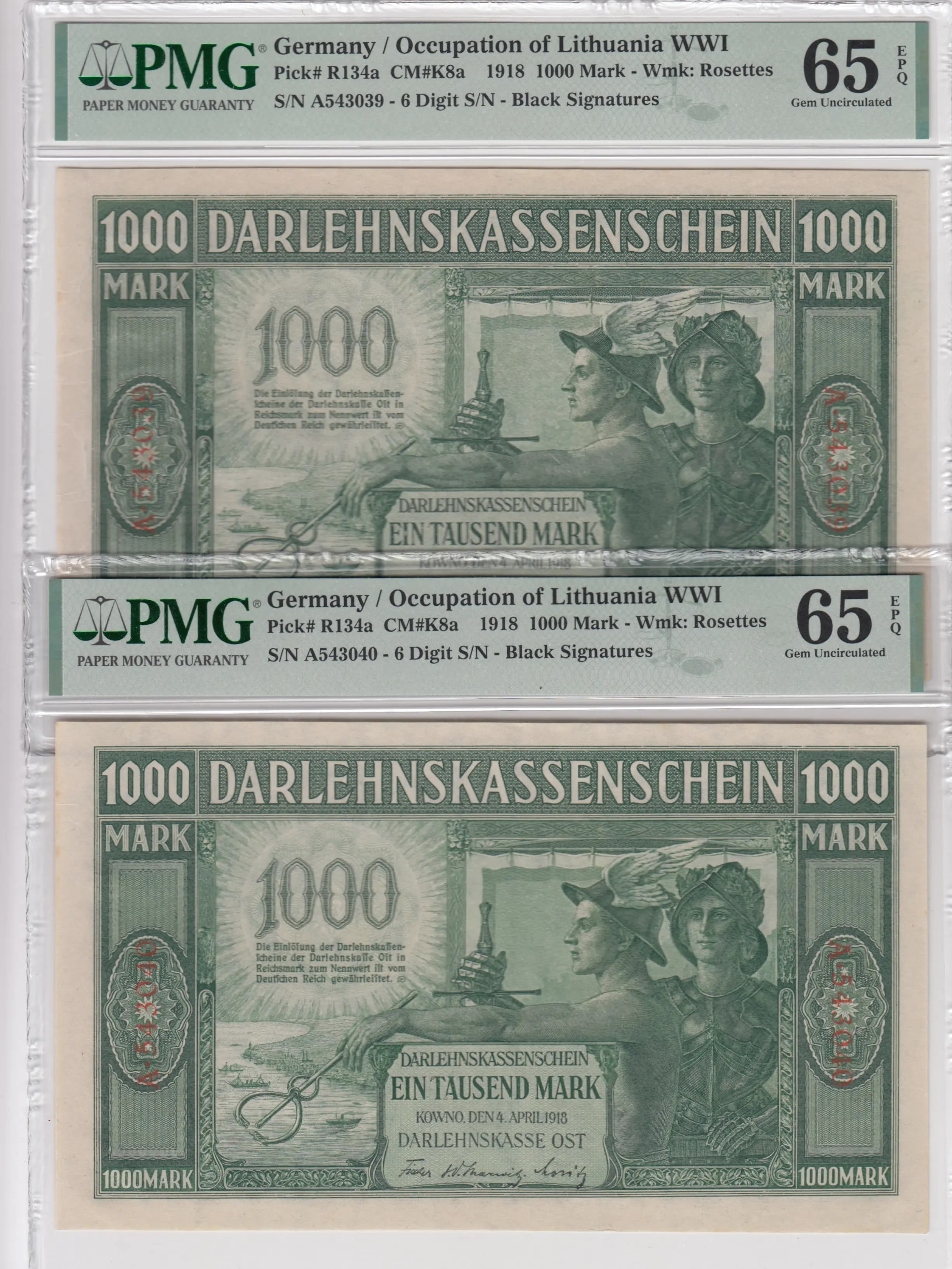
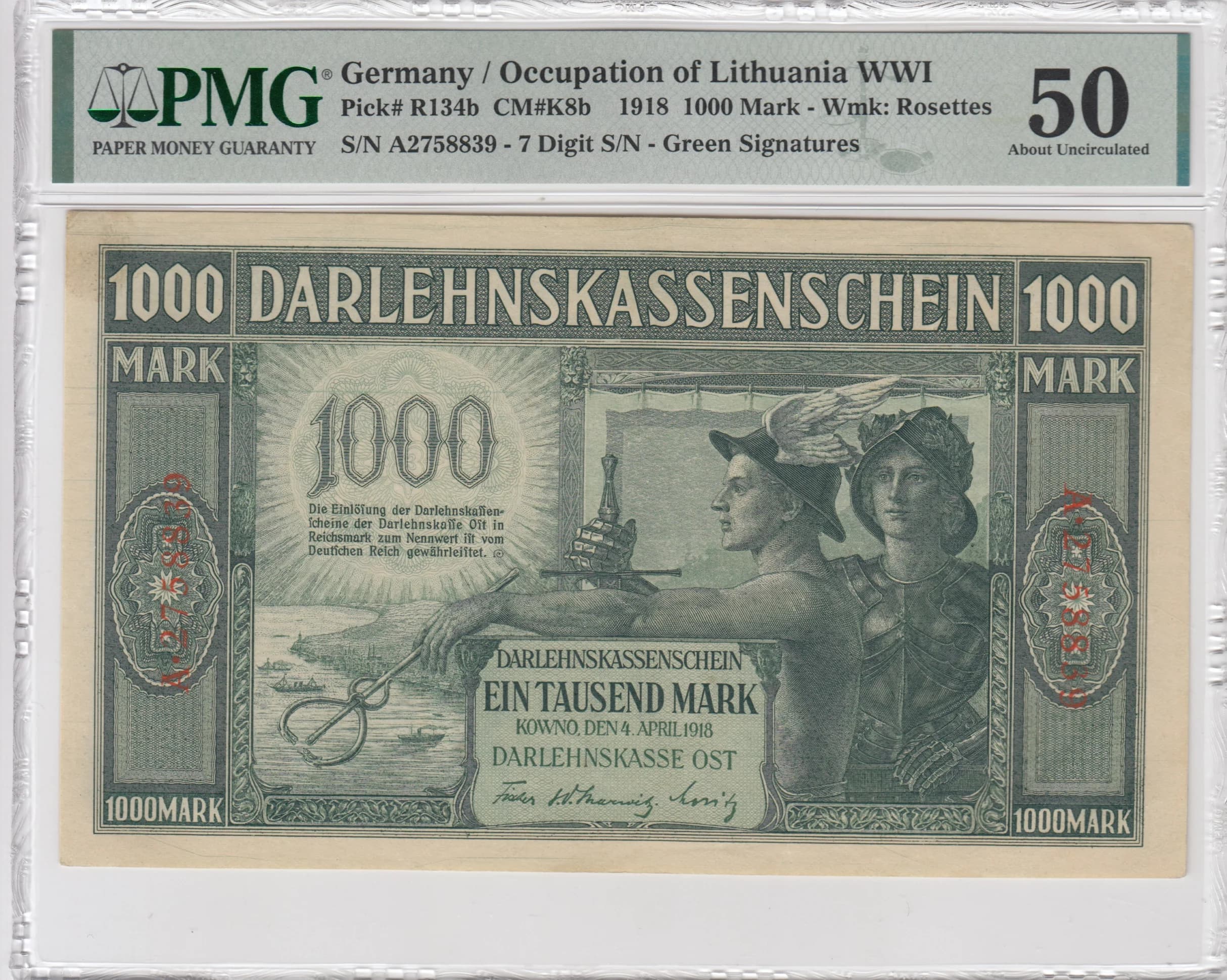
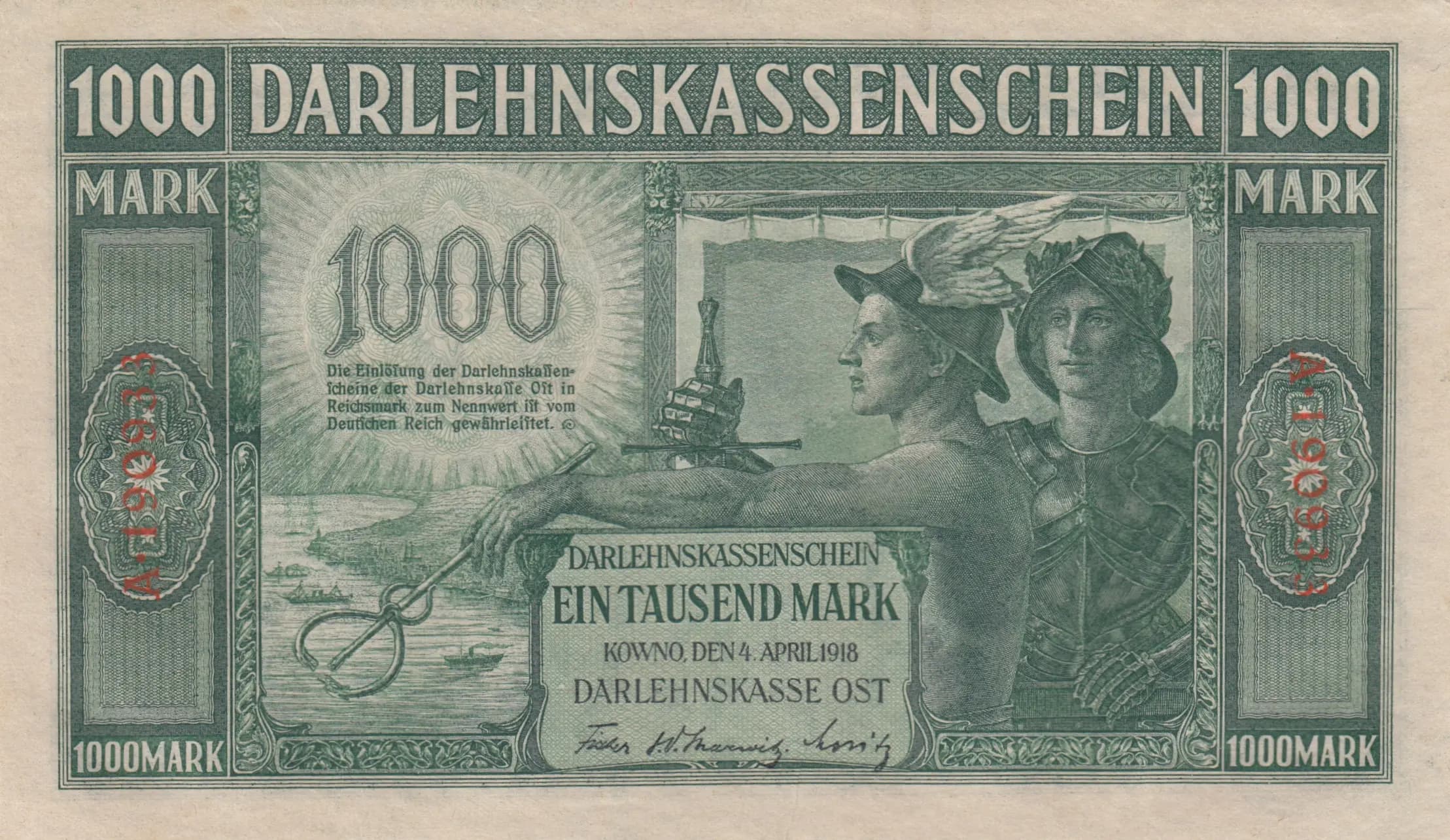
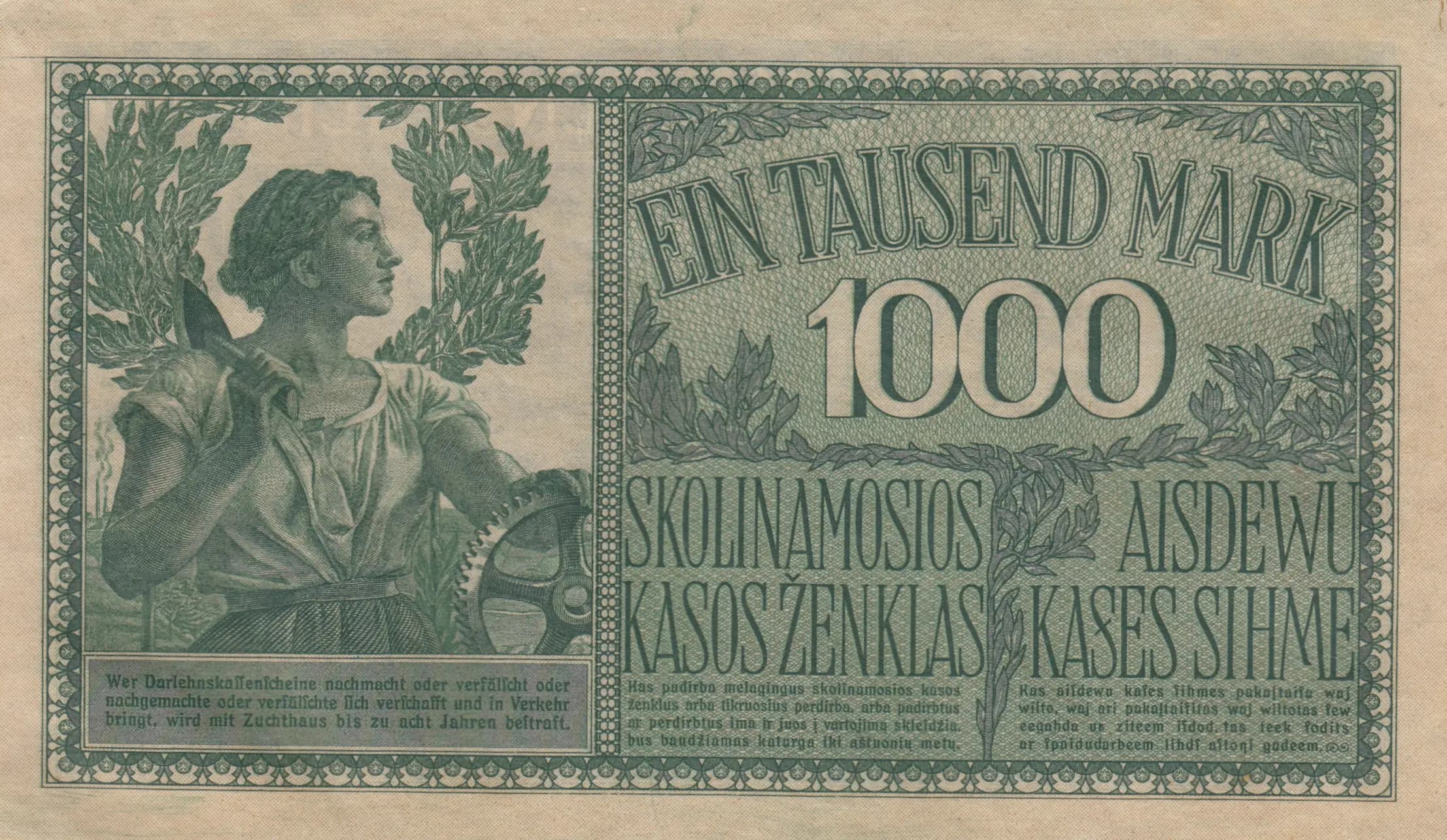
This 1000 Mark note from the Darlehnskasse Ost (East Loan Bank) issued in Kovno on April 4, 1918, exemplifies the regional emergency currency of occupied Lithuania during World War I. The note presents in AU condition with crisp, sharp printing throughout and no visible signs of circulation, wear, or handling. The elaborate allegorical design featuring winged and crowned female figures alongside classical maritime imagery, combined with bilingual German-Lithuanian text, makes this an historically significant document of the brief German occupation period.
Common. The eBay price history demonstrates consistent market availability with regular sales across multiple condition grades (F, VF, AU, UNC) over an 8-year period. Prices for this note in lower grades (F-VF) consistently sell for $24-$70, and even AU-UNC examples typically realize $200-$400. These trading patterns indicate a stable supply of examples in the collector market. While Darlehnskasse Ost notes are regionally interesting, this denomination and type appear to have been produced in sufficient quantities that examples remain accessible. The Pick catalog listing (P-R134a) and documented variants suggest this was not a short-run issue.
The Darlehnskasse Ost was established by German occupation authorities in Lithuania (then known as Kowno/Kaunas) during World War I to finance military operations and occupation administration. The presence of both German and Lithuanian inscriptions reflects the occupied territory's dual administrative structure, while the classical allegorical imagery—including the winged figure (Mercury, symbolizing commerce) and crowned female (representing sovereignty or prosperity)—conveys themes of order and economic stability intended to legitimize the occupation regime. This note was issued under German Reich guarantee, making it a direct instrument of imperial economic control in the Eastern territories.
The obverse features a classical allegorical composition with two female figures—on the left a winged figure (Mercury, representing commerce and trade) and on the right a crowned female (Britannia or a sovereignty figure), separated by a merchant vessel symbolizing maritime commerce and economic activity. Both figures are rendered in classical style with flowing drapery. Ornate oval emblems with red heraldic or floral designs frame the composition on both sides. The reverse presents a left-profile portrait of a crowned allegorical female figure, heavily draped in classical garments and surrounded by a laurel wreath denoting honor and victory. The design employs symmetrical ornamental borders with intricate scrollwork and geometric patterns executed in green and cream inks. The multiple representations of the denomination (1000 appears in at least four locations) served both as a security feature and for visual emphasis.
FRONT SIDE: '1000 DARLEHNSKASSENSCHEIN 1000' = '1000 Loan Bank Note 1000'; 'MARK' = 'Mark'; 'EINTAUSEND MARK' = 'One Thousand Mark'; 'DARLEHNSKASSE OST' = 'East Loan Bank'; 'KOWNO, DEN 4. APRIL 1918' = 'Kovno, April 4, 1918'; 'Die Einlösung der Darlehnskassen-scheine der Darlehnskasse Ost in Reichsmark zum Nennwert ist vom Deutschen Reich gewährleistet' = 'The redemption of the Loan Bank notes from the East Loan Bank in Reichsmark at par value is guaranteed by the German Reich.' BACK SIDE: 'EINTAUSEND MARK' = 'One Thousand Mark'; 'Wer Darlehnskassenscheine nachmacht oder verfälscht oder nachgemachte oder verfälschte Scheine verrichaft und in Verkehr bringt wird mit Zuchthaus bis zu zehn Jahren bestraft' = 'Whoever counterfeits or forges Loan Bank notes or brings counterfeit or forged notes into circulation is punished with imprisonment for up to ten years'; Lithuanian text includes parallel counterfeiting penalties and legal warnings in the Lithuanian language.
Intaglio engraving (line engraving and/or steel plate engraving), characteristic of German security printing of the period. The crisp detail preservation visible in the allegorical figures, fine border lines, and ornamental flourishes, combined with the high-quality impression, indicates work by a major German security printer, likely Reichsdruckerei or a contracted security printing firm. The two-color printing (green and cream) was achieved through successive plate passes, typical of Darlehnskasse currency production during WWI.
This note is cataloged as Pick P-R134a. The PMG population report indicates a variant P-R134b exists with watermark rosettes, suggesting this example (P-R134a) may have different watermark characteristics or lack watermarking. The specific variety would depend on watermark examination, which cannot be conclusively determined from the visual images alone. The date of issue (4. APRIL 1918) and location (KOWNO) appear consistent across examples of this type. Handwritten signature areas visible on the front would indicate hand-signed authorization by bank officials, a feature typical of all Darlehnskasse notes of this period.