100 reichsmark 1935
Market Prices
81 salesAbout This Note
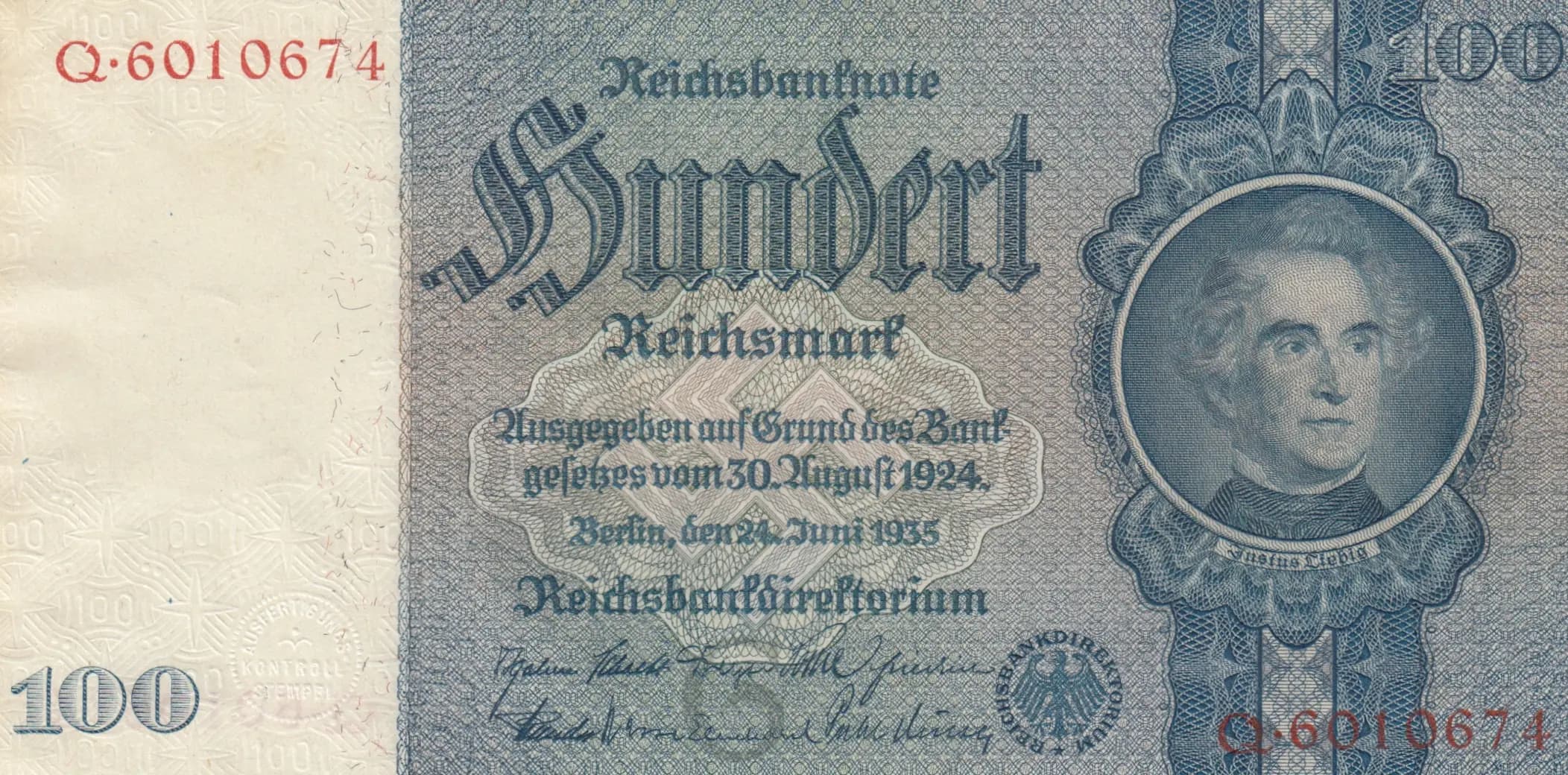
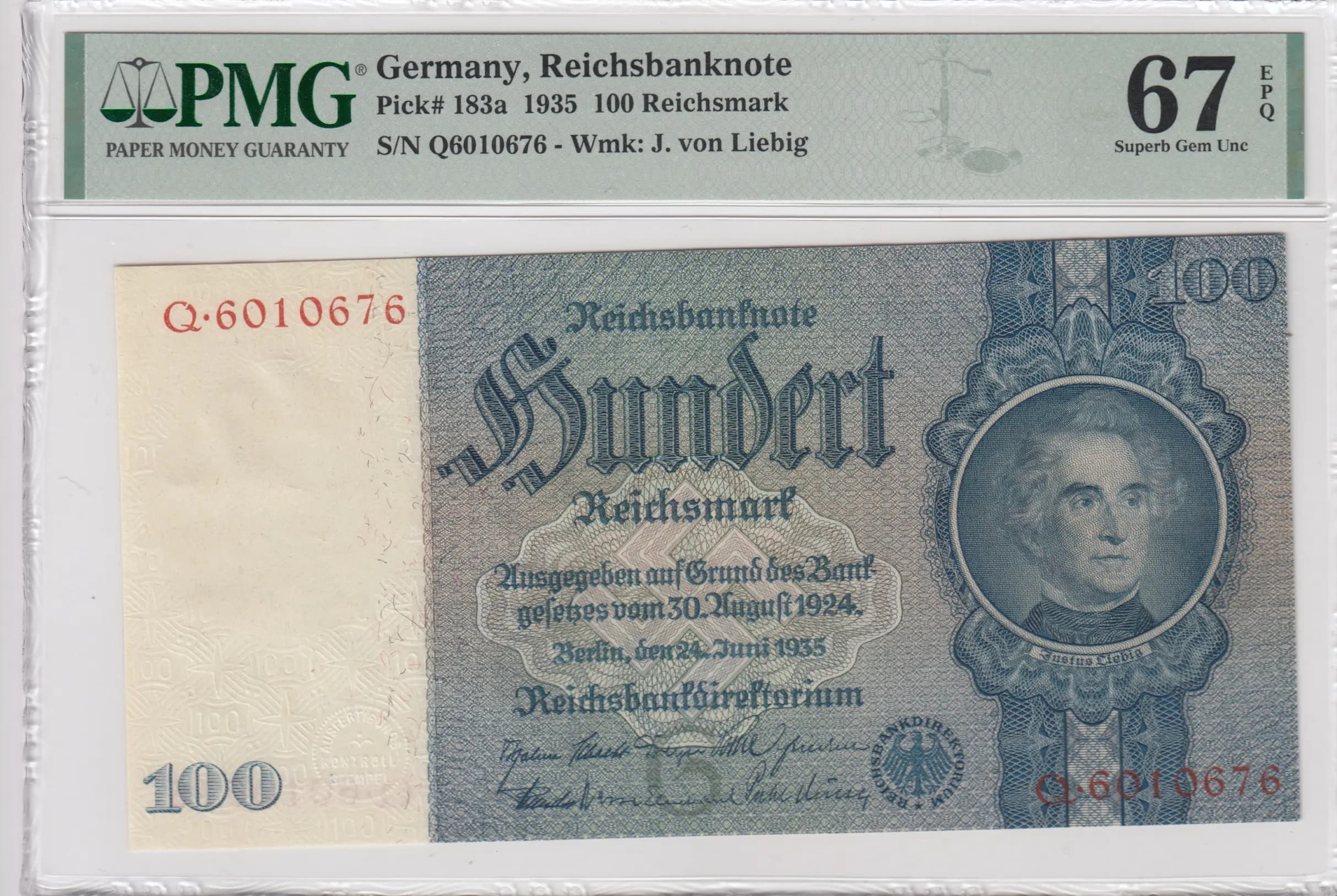
This PMG 67 EPQ example of the 1935 German 100 Reichsmark note represents an exceptionally well-preserved specimen of this classic Weimar/early Nazi-era currency. The note exhibits brilliant color contrast between its dominant blue-gray tones and cream margins, with sharp, crisp paper stock showing no signs of circulation wear, creasing, or foxing. The exceptional technical quality of the engraving—particularly visible in the fine line work and portrait rendering—combined with the superior preservation, makes this a premium example highly desirable to both German currency specialists and general collectors.
Common. This is a regular-issue Reichsmark note from a major European central bank with substantial print runs. Market data from realbanknotes.com shows consistent sales across all grade levels, with PMG 65-67 examples selling in the $50-$305 range historically, indicating adequate supply in the numismatic market. The 2016 catalogue value of $40 for Uncirculated examples, combined with numerous eBay transactions across multiple years and grades, confirms this as a standard, widely-available note rather than a scarce variety. The excellent condition (PMG 67 EPQ) commands a premium relative to lower grades, but the underlying note itself is not rare.
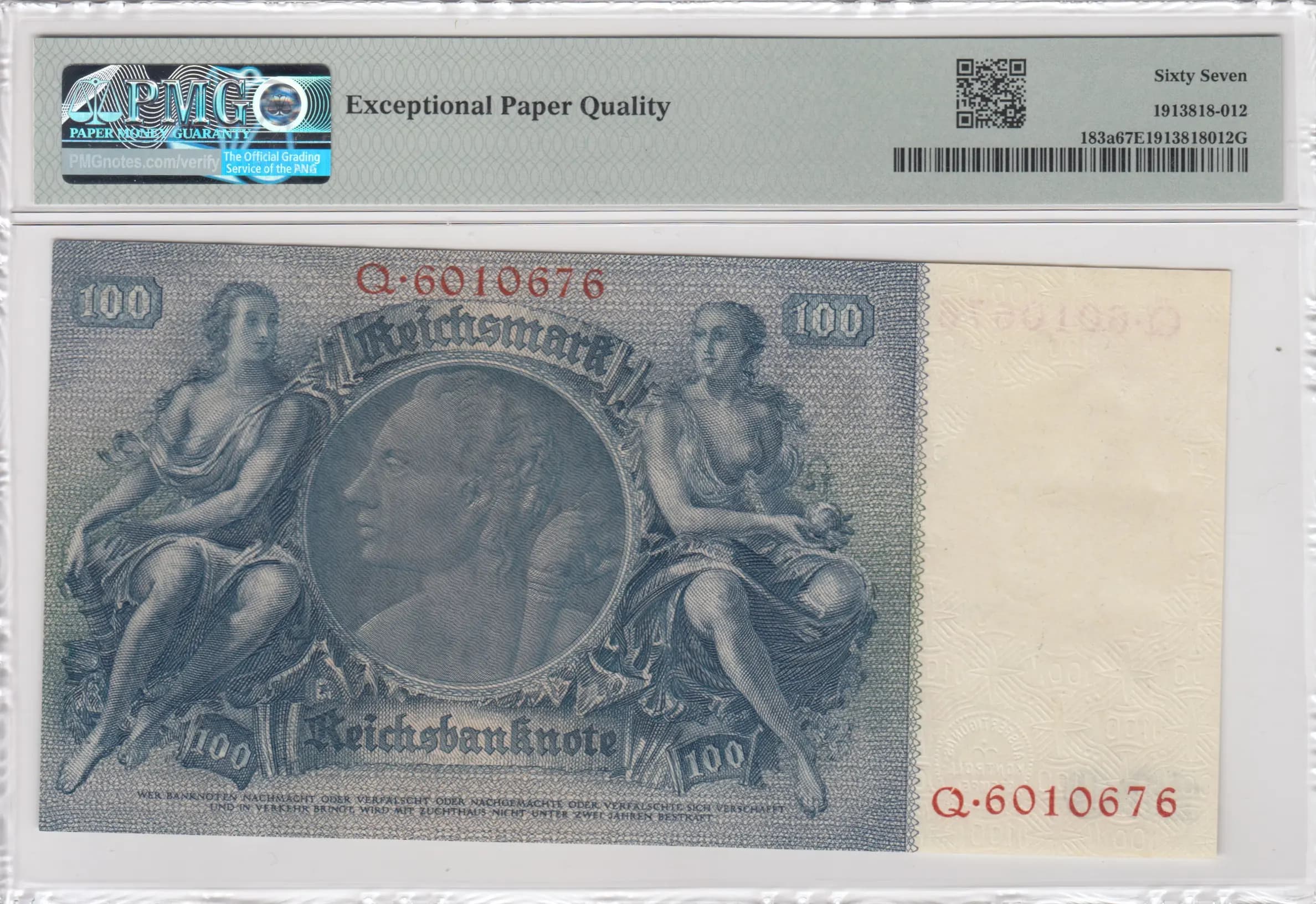
Issued on June 24, 1935, under the authority of the Reichsbank (the central bank of Nazi Germany), this note represents currency from the period following Hitler's rise to power and rearmament policies. The Imperial Eagle emblem (Reichsadler) visible on the obverse, combined with the note's classical allegorical imagery and the Justus von Liebig portrait, reflects the regime's attempt to balance nationalist symbolism with Weimar-era institutional continuity. The security warning printed on the reverse—threatening punishment for counterfeiting under criminal law—was a standard anti-counterfeiting measure of the period.
The obverse features a portrait of Justus von Liebig (the celebrated 19th-century chemist and philosopher) positioned within an ornate oval frame on the right side of the note, facing frontward in three-quarter profile. His image is surrounded by the Reichsadler (Imperial Eagle emblem) and decorative classical typography. The left margin displays a large '100' denomination marking in a light cream-colored frame, with the serial number Q.6010676 printed in red on both left and right sides. The reverse presents an allegorical composition with two classical female figures (representing virtues such as Justice and Commerce) flanking a large central oval frame containing a profile portrait. Large '100' denominations appear symmetrically in all four corners. Both sides employ fine cross-hatching and detailed engraved line work characteristic of high-security banknote production. The overall color scheme combines blue-gray with cream/beige margins and red serial numbers.
FRONT: 'Reichsbanknote' (Reichsbank Note); 'Hundert Reichsmark' (One Hundred Reichsmarks); 'Ausgegeben auf Grund des Bankgesetzes vom 30.August 1924' (Issued under the Bank Law of August 30, 1924); 'Berlin, den 24. Juni 1935' (Berlin, June 24, 1935); 'Reichsbankdirektorium' (Reichsbank Board of Directors); Serial number: Q.6010676. BACK: 'Reichsbanknote' (Reichsbank Note); '100' (denominations in all corners); Serial number: Q.6010676; 'WER BANKNOTEN NACHAHMT ODER VERFÄLSCHT ODER NACHGEAHMTE ODER VERFÄLSCHTE BANKNOTEN IN UMLAUF SETZT IST NACH DEN STRAFGESETZEN STRAFBAR' (Whoever counterfeits banknotes or forges them, or puts counterfeit or forged banknotes into circulation, is punishable under the criminal laws).
Intaglio/steel engraving with multicolor printing. The note exhibits characteristics consistent with Kreuz-Iris printing technique (as noted in the external reference), a specialized color transition method employed by the Reichsbank on notes from this series until approximately 1940/1941. This technique creates subtle gradient transitions in the underprint that are difficult to reproduce photographically. The fine line work, detailed cross-hatching, and sharp portrait rendering are hallmarks of master engraving typical of Reichsbank currency production in the 1930s.
This example is catalogued as Pick P-183a, the standard variant. PMG records indicate two variants for the base Pick number (P-183a and P-183b), though the distinction between these variants is not definitively specified in the provided data. The serial number Q.6010676 is a 7-digit number with prefix letter Q, consistent with standard 1935 Reichsbank issue patterns. No special overprints, signatures variations, or noted printing anomalies are apparent in this example. The Kreuz-Iris printing technique may or may not be present (as noted in the external reference, both printed and non-printed versions are known and typically indistinguishable to the collector).