1 rupee 1915
“serie B2”
About This Note
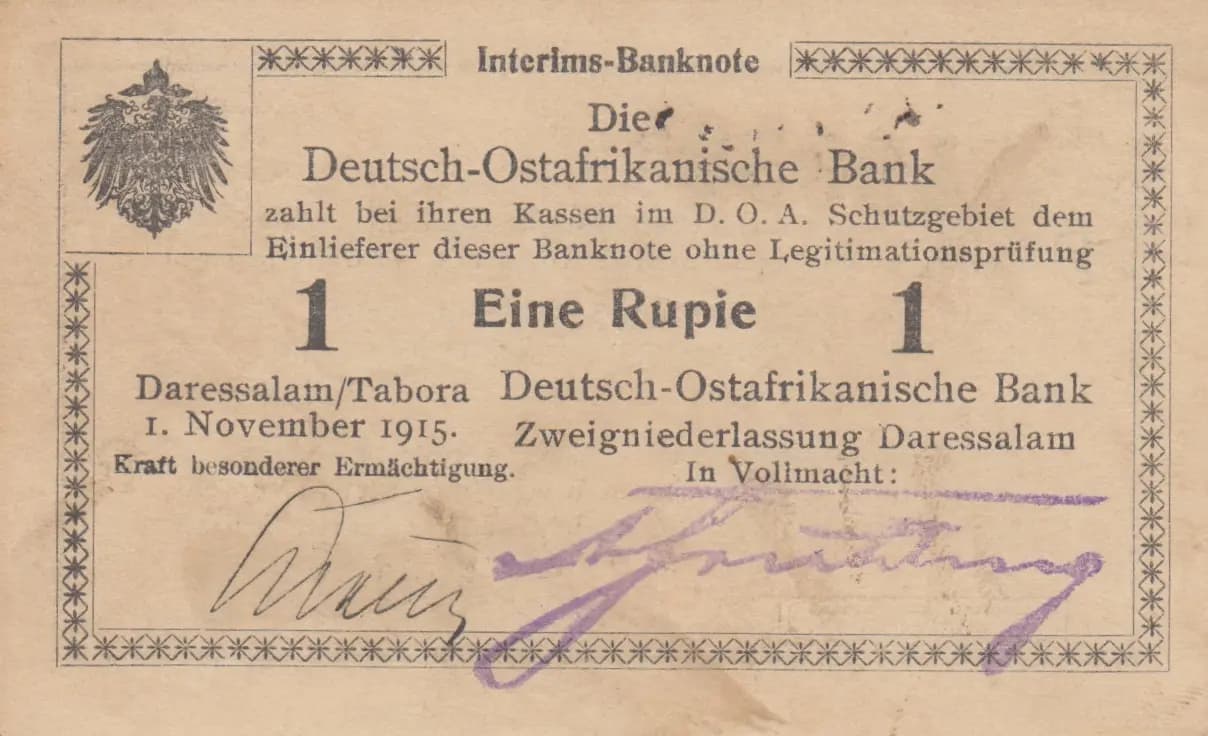
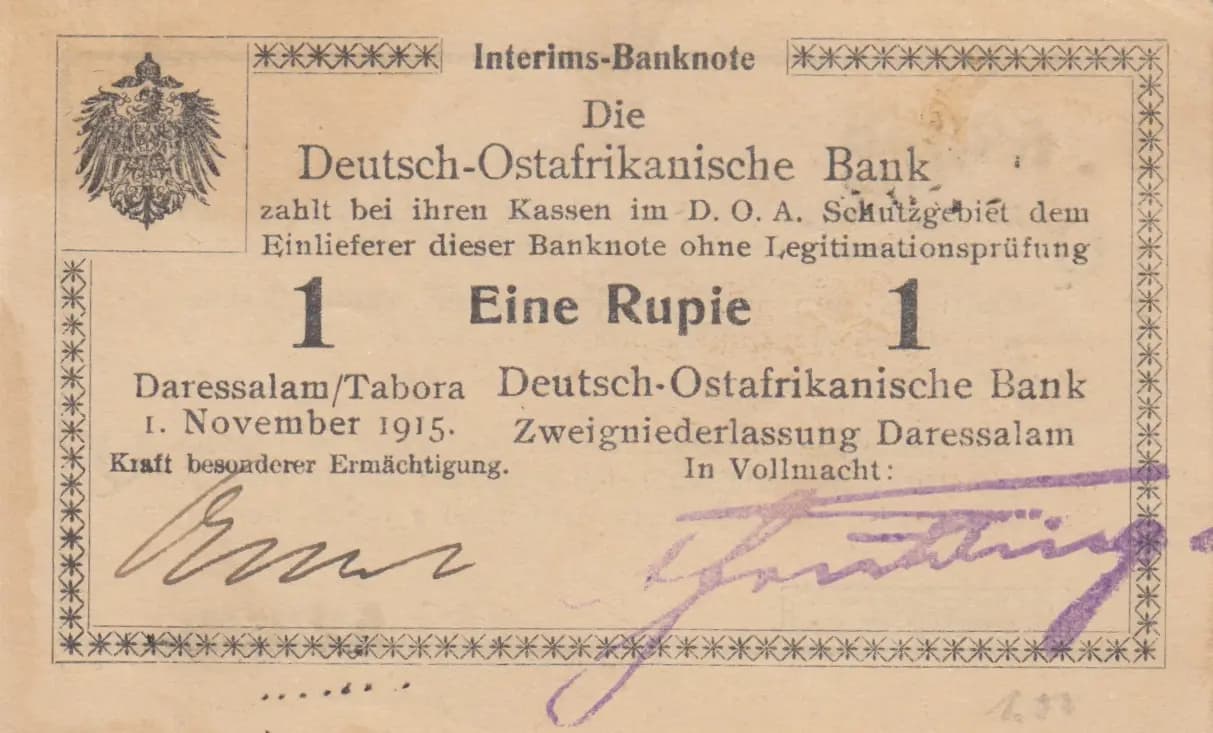
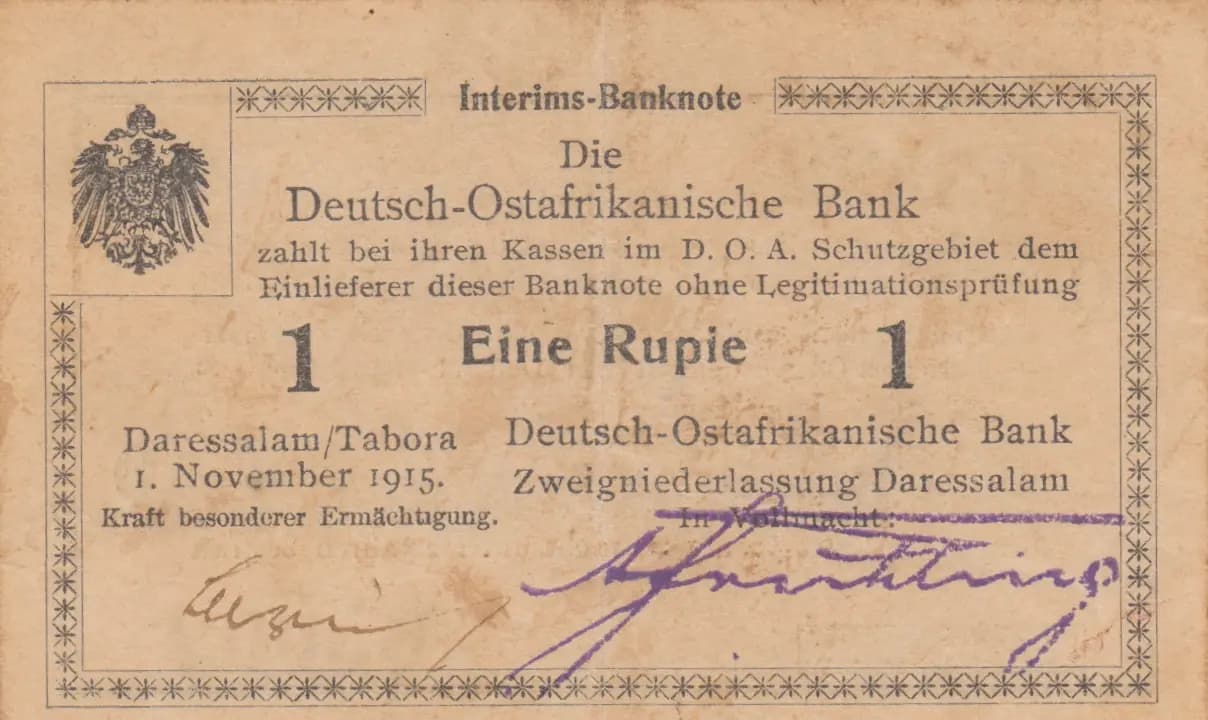
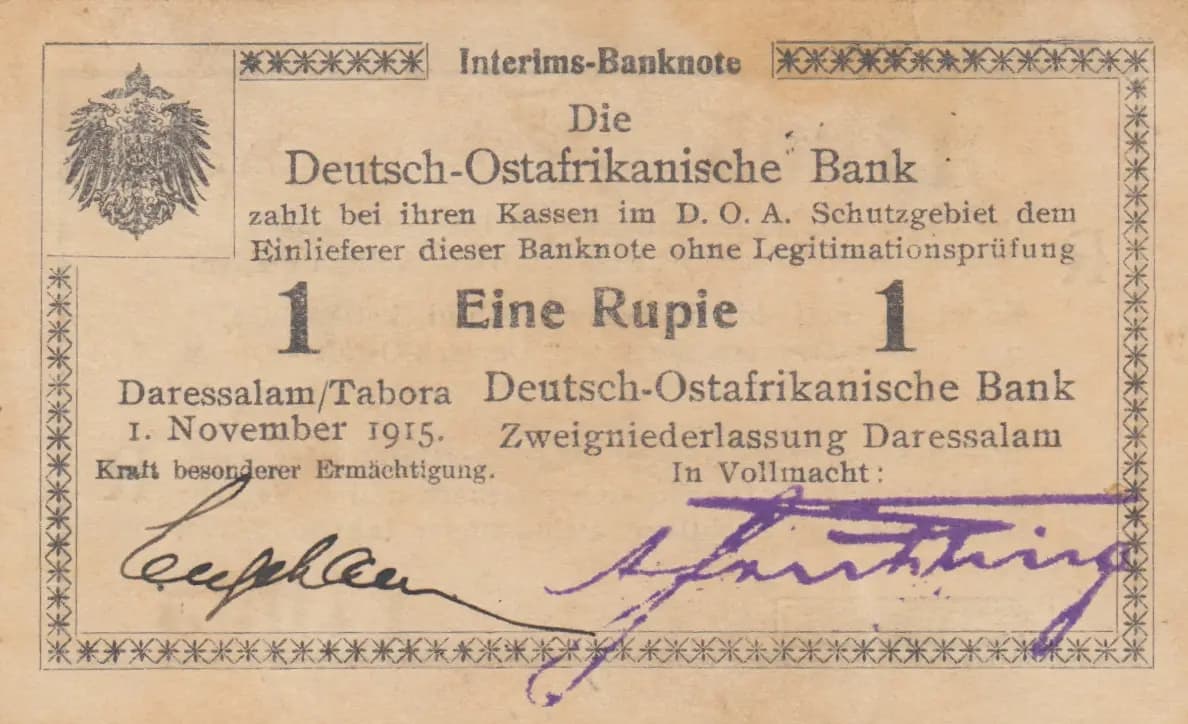
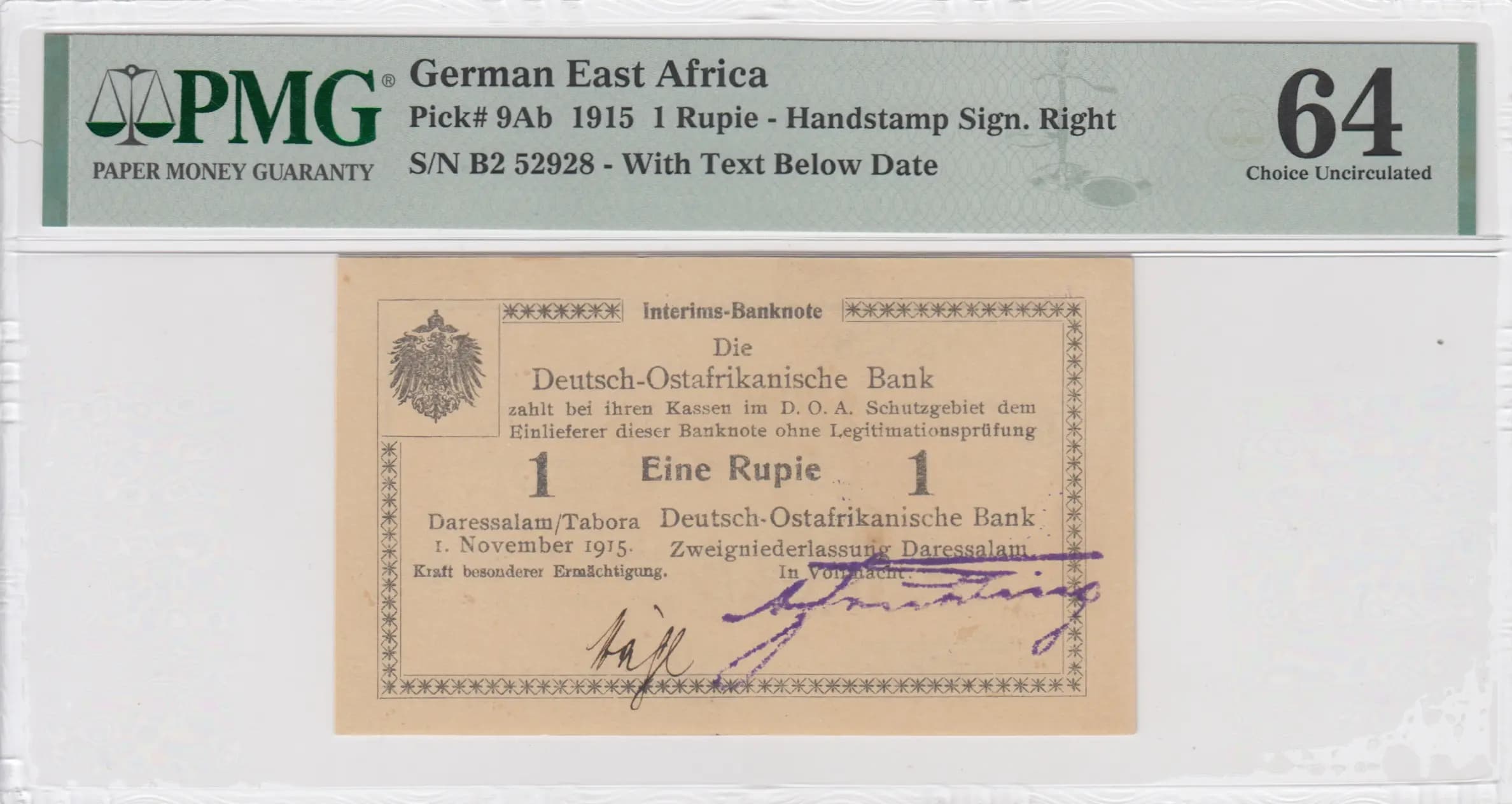
An exceptional example of the Deutsch-Ostafrikanische Bank's 1 Rupie Interims-Banknote from November 1, 1915, graded PMG 64 Choice Uncirculated. This German East Africa emergency currency features the Imperial German Eagle (Reichsadler) in the upper left corner and displays handwritten signatures in purple/blue ink, characteristic of emergency war-time banknotes. The note exhibits crisp paper quality with minimal age-related toning, representing a well-preserved specimen of this historically significant colonial currency.
Common. The Deutsch-Ostafrikanische Bank issued interim banknotes in substantial quantities during 1915-1916 to address currency shortages caused by wartime disruption. While these notes have historical significance as colonial artifacts and are desirable to collectors of German colonials and African banknotes, they were produced in numbers sufficient to ensure reasonable availability in the collector market. The Pick number P-9Ab designation indicates this is a recognized cataloged variety, suggesting multiple examples exist in collections. PMG 64 is an excellent condition grade, but the underlying note type itself is not scarce.
Issued during World War I when German East Africa faced currency shortages due to British naval blockades and territorial pressures, this interim banknote served as emergency currency backed by the Imperial Government. The bilingual German-Swahili text and reference to Dar es Salaam and Tabora reflect the administrative centers of the German colonial protectorate. The November 1915 date places this note during the final period of German control in the colony, which would be lost to British forces by 1916, making these emergency notes significant artifacts of Germany's colonial presence in Africa.
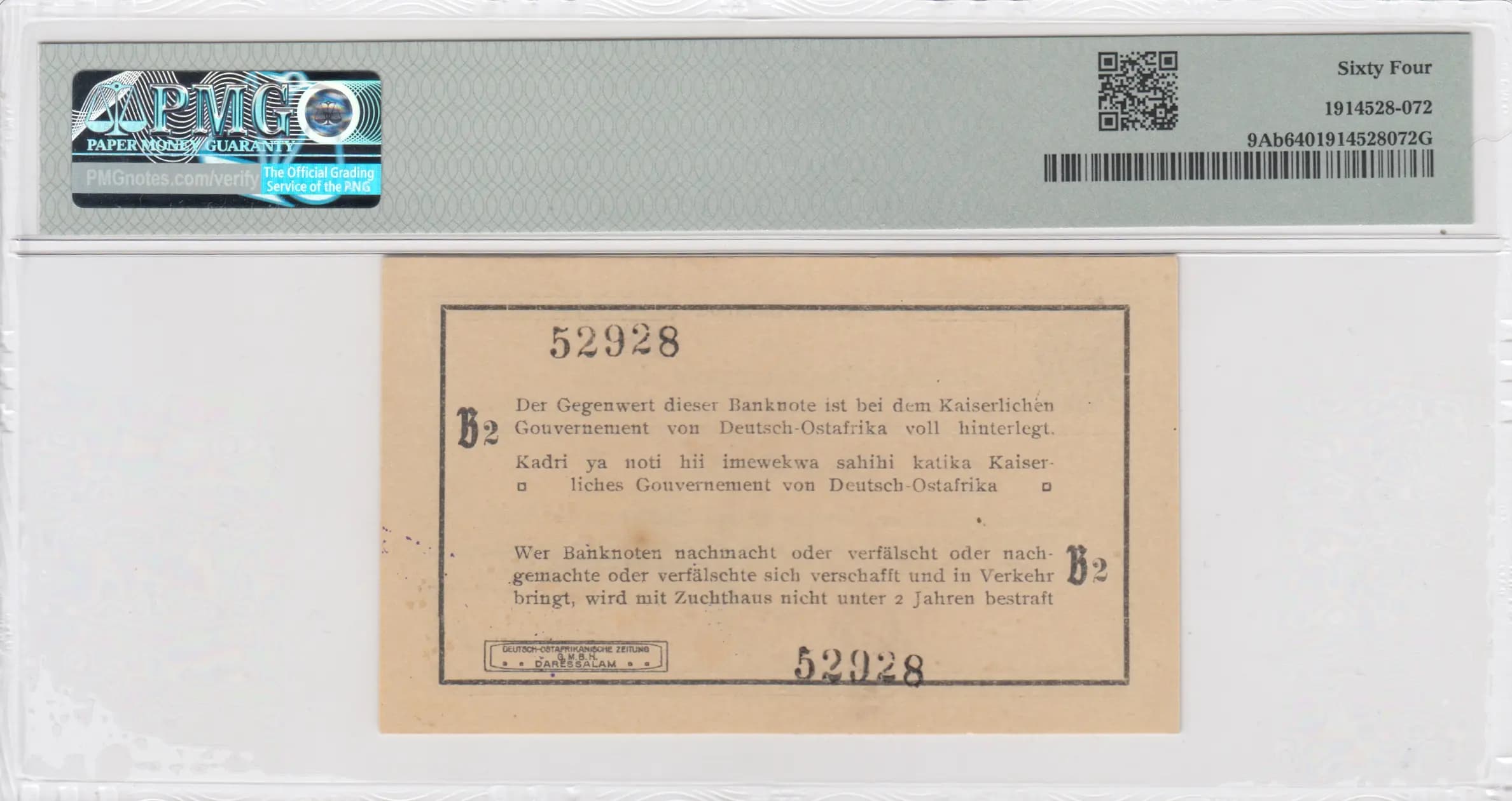
The obverse features a formal layout centered on bearer promise text, with the Imperial German Eagle (Reichsadler) emblem positioned prominently in the upper left corner, symbolizing German imperial authority. The note employs an ornate geometric decorative border framing the entire note, characteristic of German banknote design of the period. Two handwritten signatures in purple/blue ink appear on the right side, representing authorized officers—a security feature typical of emergency wartime currency. The denomination 'Eine Rupie' (One Rupee) appears in German, reflecting the use of the Indian rupee as currency standard in German East Africa. The reverse presents a formal legal text box containing bearer notes and counterfeiting penalties in both German and Swahili languages, with the serial number 52928 repeated at top and bottom margins. A printer's or newspaper mark reading 'DEUTSCH-OSTAFRIKANISCHE ZEITUNG DARESSALAM' appears at the bottom left, likely indicating the printing facility or authority certification. The color palette of cream/beige background with black and gray text printing creates a utilitarian appearance appropriate to emergency wartime currency.
FRONT: 'Interims-Banknote' (Interim Banknote) / 'Die Deutsch-Ostafrikanische Bank' (The German East African Bank) / 'zahlt bei ihren Kassen im D. O. A. Schutzgebiet dem Einlieferer dieser Banknote ohne Legitimationsprüfung' (pays at its counters in the D.O.A. protectorate to the bearer of this banknote without verification of legitimation) / 'Eine Rupie' (One Rupee) / 'Daressalam/Tabora' (Dar es Salaam/Tabora) / 'Deutsch-Ostafrikanische Bank' (German East African Bank) / '1. November 1915' (1st November 1915) / 'Zweigniederlassung Daressalam' (Branch office Dar es Salaam) / 'Kraft besonderer Ermächtigung' (By special authorization) / 'In Vollmacht:' (By proxy:). BACK: 'Der Gegenwert dieser Banknote ist bei dem Kaiserlichen Gouvernement von Deutsch-Ostafrika voll hinterlegt.' (The countervalue of this banknote is fully deposited with the Imperial Government of German East Africa.) / 'Kadri ya noti hii imewekwa sahihi katika Kaiser-liches Gouvernement von Deutsch-Ostafrika' (Swahili: The value of this note is properly deposited with the Imperial Government of German East Africa) / 'Wer Banknoten nachmacht oder verfälscht oder nachgemachte oder verfälschte sich verschafft und in Verkehr bringt, wird mit Zuchthaus nicht unter 2 Jahren bestraft' (Whoever counterfeits or forges banknotes or obtains counterfeit or forged banknotes and puts them into circulation will be punished with hard labor for not less than 2 years) / 'DEUTSCH-OSTAFRIKANISCHE ZEITUNG DARESSALAM' (German East African Newspaper Dar es Salaam). Serial number: 52928.
The note exhibits characteristics of letterpress printing, evidenced by the crisp, uniform impression of text and borders typical of early 20th-century banknote production. The ornate border pattern and geometric designs show the precision capable of traditional letterpress technology. The handwritten signatures in purple/blue ink were applied by hand after printing, a common security measure for wartime emergency notes. No specific printer attribution is provided in the catalog data; however, contemporary German East African banknotes of this period were typically produced by established German printing houses or, in some cases, printed locally in Dar es Salaam using available resources.
This specimen is identified as Series B2 per collector notes, indicating it belongs to a specific series within the 1915 1 Rupie issue. The handwritten signatures present on this example represent authentication by authorized officers; signature varieties may exist depending on which branch officials or proxies authorized individual notes. The serial number 52928 is unique to this note. The printer's mark 'DEUTSCH-OSTAFRIKANISCHE ZEITUNG DARESSALAM' on the reverse may indicate a printing location or authorization source specific to Dar es Salaam production. The Pick catalog P-9Ab variant designation suggests there are sub-varieties (P-9a, P-9b, P-9c, etc.) within this denomination, possibly relating to signature types, series letters, or printing locations.