1 rupee 1915
“serie P”
About This Note
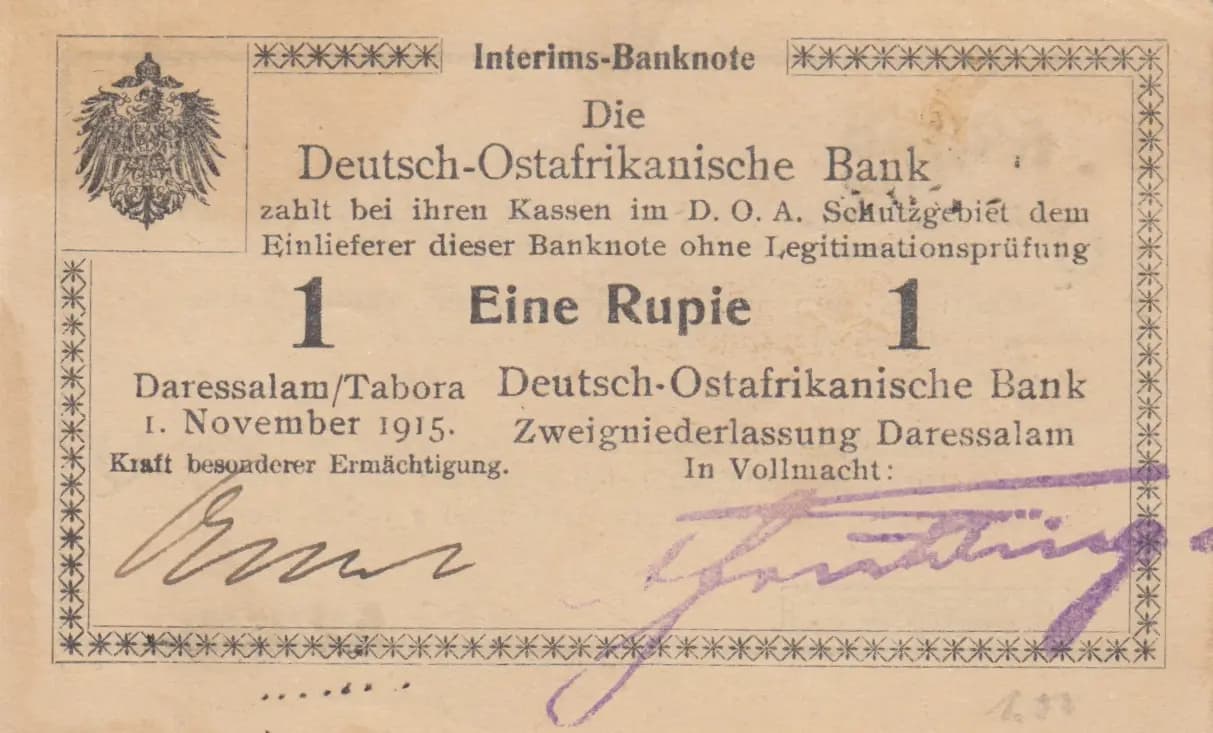
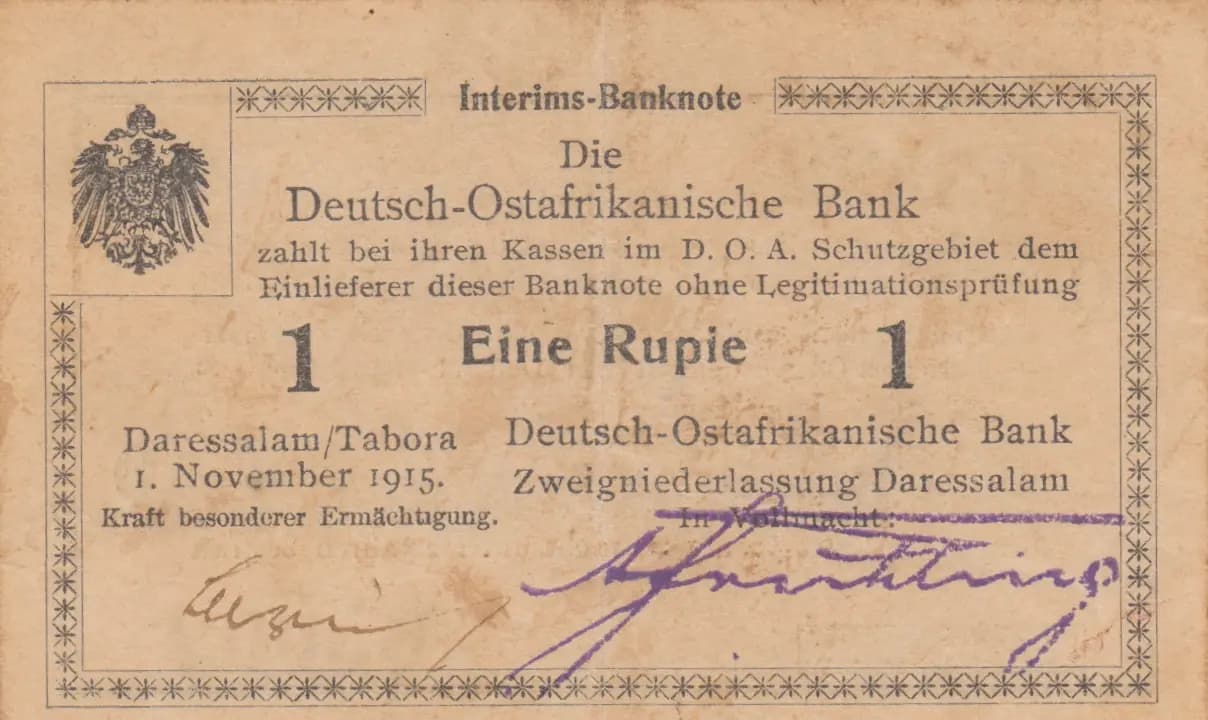
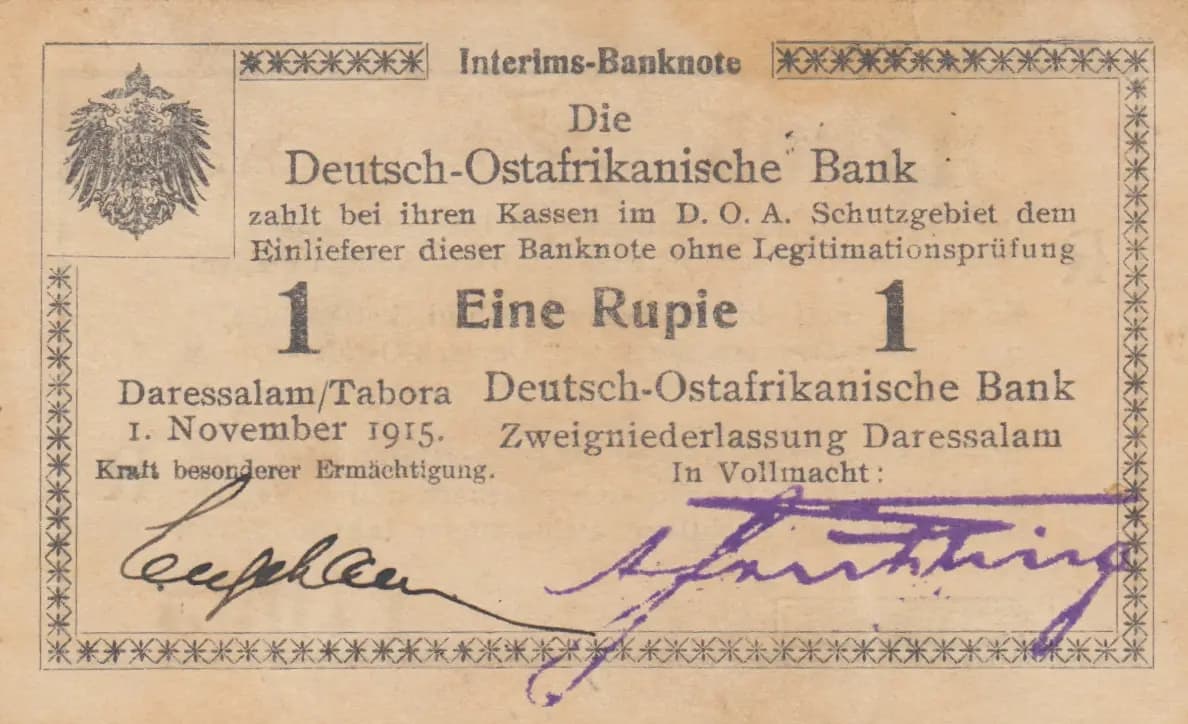
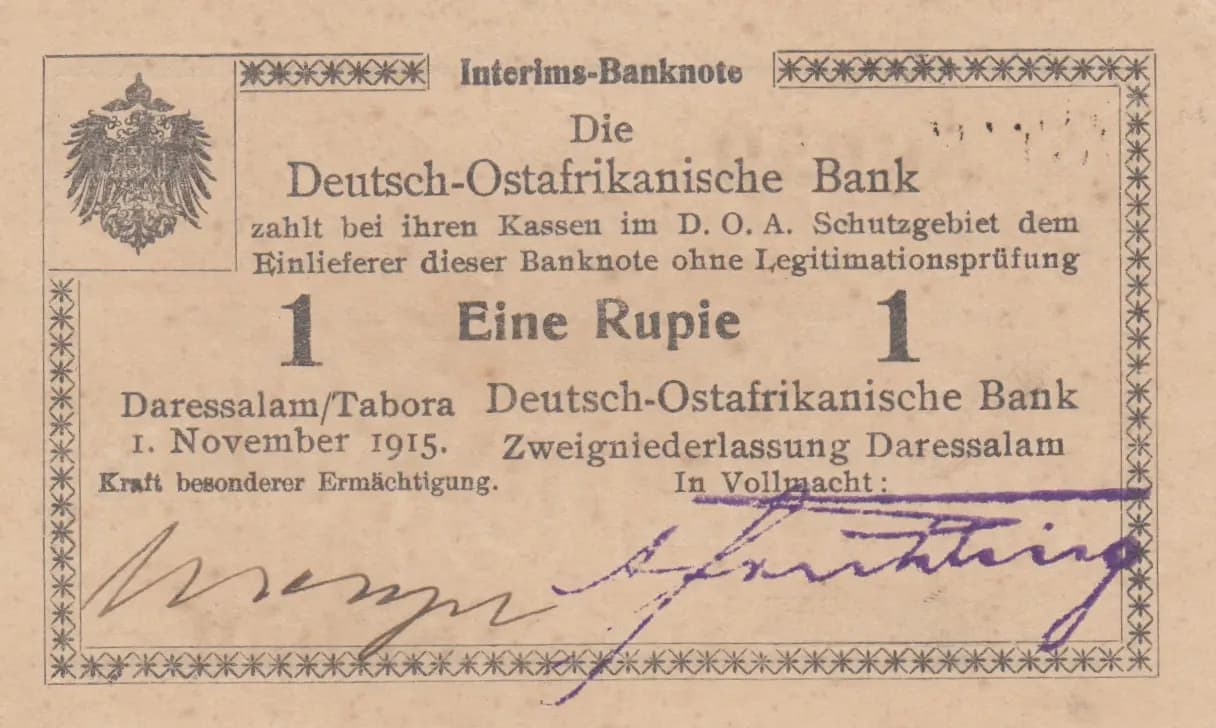
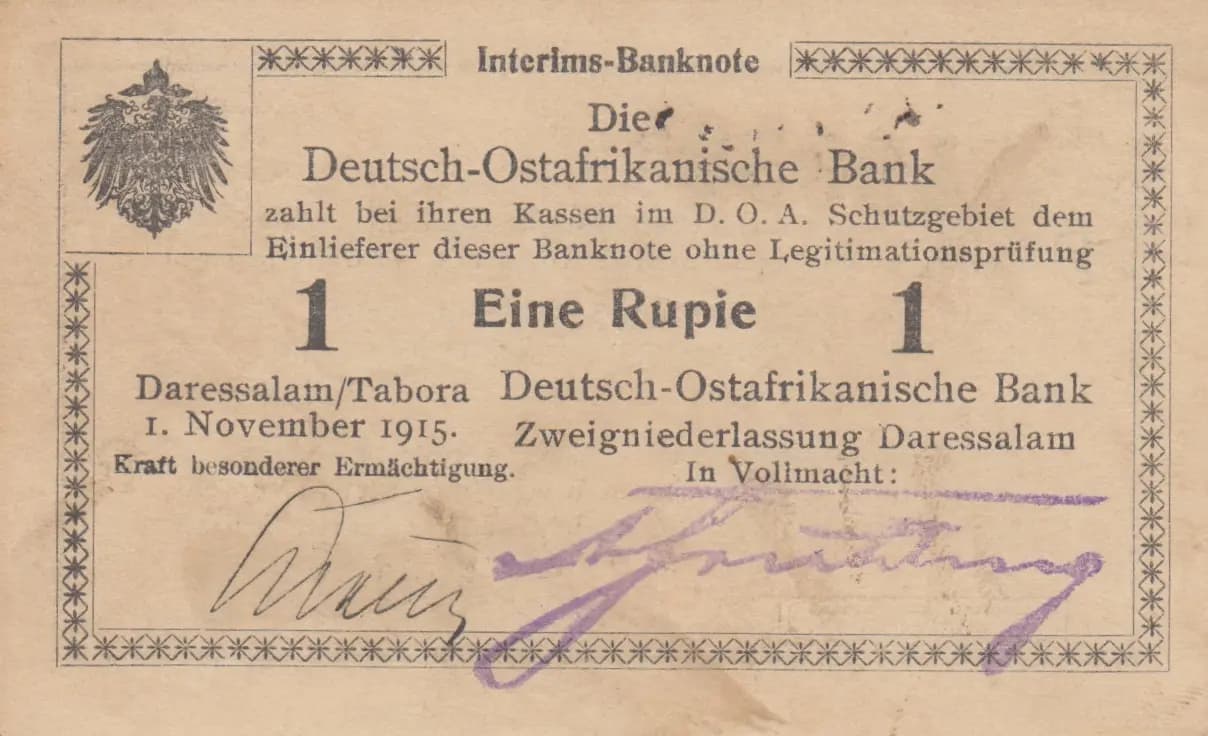
This is an Interims-Banknote (interim banknote) issued by the Deutsch-Ostafrikanische Bank on 1 November 1915, during Germany's colonial administration of East Africa. The note displays the German Imperial Eagle (Reichsadler) on the obverse with an ornamental cross-pattern border, denominated as 1 Rupie in both German and numerals. In AU condition, the note exhibits expected age-related patina including foxing, creasing, and yellowing typical of early 20th-century paper currency from this remote colonial territory, making it an historically significant example of German colonial currency.
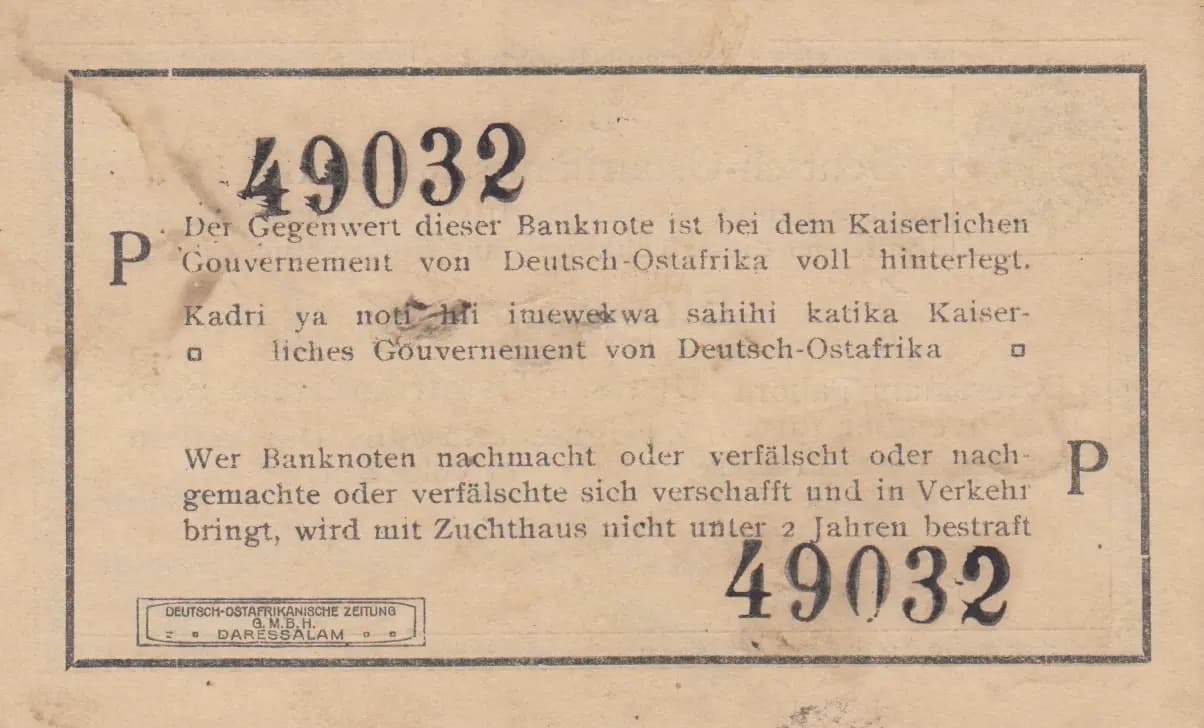
Common. German East African banknotes from 1915, particularly the 1 Rupie denomination which was the basic circulating unit, were issued in substantial quantities. The series P designation noted in the collector data and the serial number 49032 represent standard production runs from this interim issue. While all German East African currency is historically significant and collectible, the 1 Rupie denomination in AU condition is not considered scarce—these notes survive in moderate numbers in institutional and private collections. The widespread circulation of this denomination during the brief German colonial period and subsequent preservation by collectors limits its rarity status.
Issued during World War I when German East Africa was under siege by Allied forces, this interim banknote represents an emergency currency measure by the Deutsch-Ostafrikanische Bank to maintain economic function in the isolated colony. The German Imperial Eagle (Reichsadler) and references to the Kaiserian Government (Kaiserliches Gouvernement) reflect the formal authority structure of the German protectorate. The inclusion of Swahili text on the reverse demonstrates the colonial administration's pragmatic approach to currency circulation among the local population, while the November 1915 date places it during a critical period before the eventual fall of German East Africa to British forces by late 1916.
The obverse features a centrally-positioned German Imperial Eagle (Reichsadler) displaying spread wings and a crowned head, rendered in black ink against a tan/beige background. The eagle symbolizes German imperial authority and sovereignty over the East African protectorate. A distinctive ornamental border composed of repeated cross/asterisk patterns frames the entire note, serving both decorative and security purposes. The denomination '1' appears in large numerals on both the left and right edges, with 'Eine Rupie' (One Rupee) inscribed centrally. Official text identifies the issuing bank and location (Daressalam/Tabora), along with date, authorization statements, and signature lines rendered in purple/violet ink. The reverse contains primarily textual content in German and Swahili, including legal warnings, the deposit guarantee, and the serial number (49032) with prefix letter 'P' at top and bottom margins. A printer's mark from Deutsch-Ostafrikanische Zeitung G.m.b.H. appears at the bottom left of the reverse.
FRONT SIDE: 'Interims-Banknote' (Interim Banknote) | 'Die Deutsch-Ostafrikanische Bank' (The German East African Bank) | 'zahlt bei ihren Kassen im D. O. A. Schutzgebiet dem Einlieferer dieser Banknote ohne Legitimitsprüfung' (pays at its cashiers in the D.O.A. protectorate to the bearer of this banknote without legitimacy check) | '1 / Eine Rupie' (1 / One Rupee) | 'Daressalam/Tabora' (place of issue) | '1. November 1915' (date of issue) | 'Kraft besonderer Ermächtigung' (By special authorization) | 'Deutsch-Ostafrikanische Bank Zweigniederlassung Daressalam' (German East African Bank Branch Daressalam) | 'In Vollmacht:' (In full authority:) | BACK SIDE: Serial number '49032' with prefix 'P' | 'Der Gegenwert dieser Banknote ist bei dem Kaiserlichen Gouvernement von Deutsch-Ostafrika voll hinterlegt.' (The countervalue of this banknote is fully deposited with the Imperial Government of German East Africa.) | 'Kadri ya noti hii iniewekwa sahihi katika Kaiserliches Gouvernement von Deutsch-Ostafrika' (Swahili: The value of this note is properly deposited with the Imperial Government of German East Africa) | 'Wer Banknoten nachmacht oder verfälscht oder nachgemachte oder verfälschte sich verschafft und in Verkehr bringt, wird mit Zuchthaus nicht unter 2 Jahren bestraft' (Whoever counterfeits or forges banknotes or obtains counterfeit or forged ones and brings them into circulation shall be punished with imprisonment for not less than 2 years) | 'DEUTSCH-OSTAFRIKANISCHE ZEITUNG G.m.b.H. DARESSALAM' (German East African Newspaper Ltd. Daressalam - printer's identification)
The note was produced using letterpress printing, the standard method for banknote production in 1915. The sharp definition of the Imperial Eagle, the precise ornamental border patterns, and the clarity of the German and Swahili text indicate high-quality relief printing. The printer's mark identifies Deutsch-Ostafrikanische Zeitung G.m.b.H. in Daressalam as the production facility. The use of black ink for primary design elements with purple/violet ink for signatures represents the multi-color printing capability typical of colonial-era banknote production, though the color palette remained relatively austere compared to contemporary European currency.
This example is identified as Pick catalog number P-9Ab, series P, serial number 49032. The 'b' variant designation in the Pick catalog likely refers to specific signature or printing characteristics within the 1915 interim issue series. The prefix letter 'P' on this specimen matches the collector notation 'serie P,' confirming this as a specific identified variety. The November 1, 1915 date and dual-location issuance (Daressalam/Tabora) are standard for this interim issue. Known varieties for German East African 1 Rupie notes from this period include variations in signatures by different authorized officials and minor printing differences, but this specimen appears to be a standard example of the established P-9Ab variety classification.