1 rupee 1915
“serie R”
About This Note
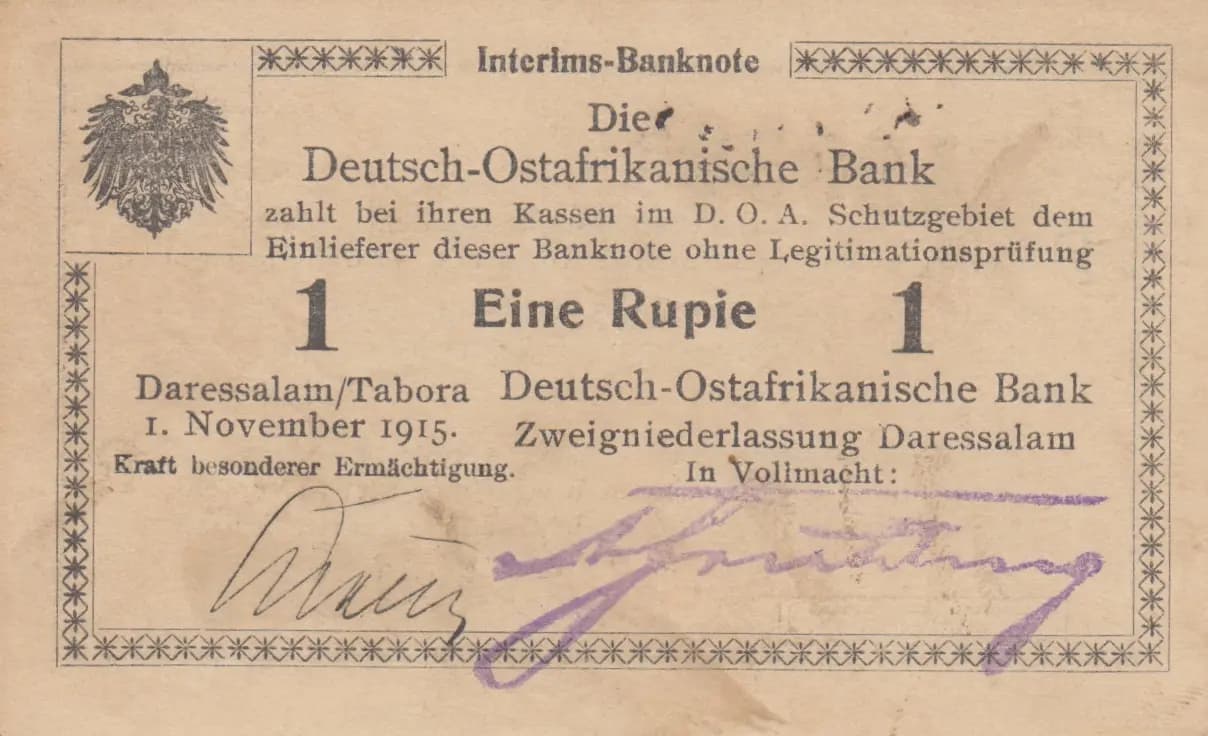
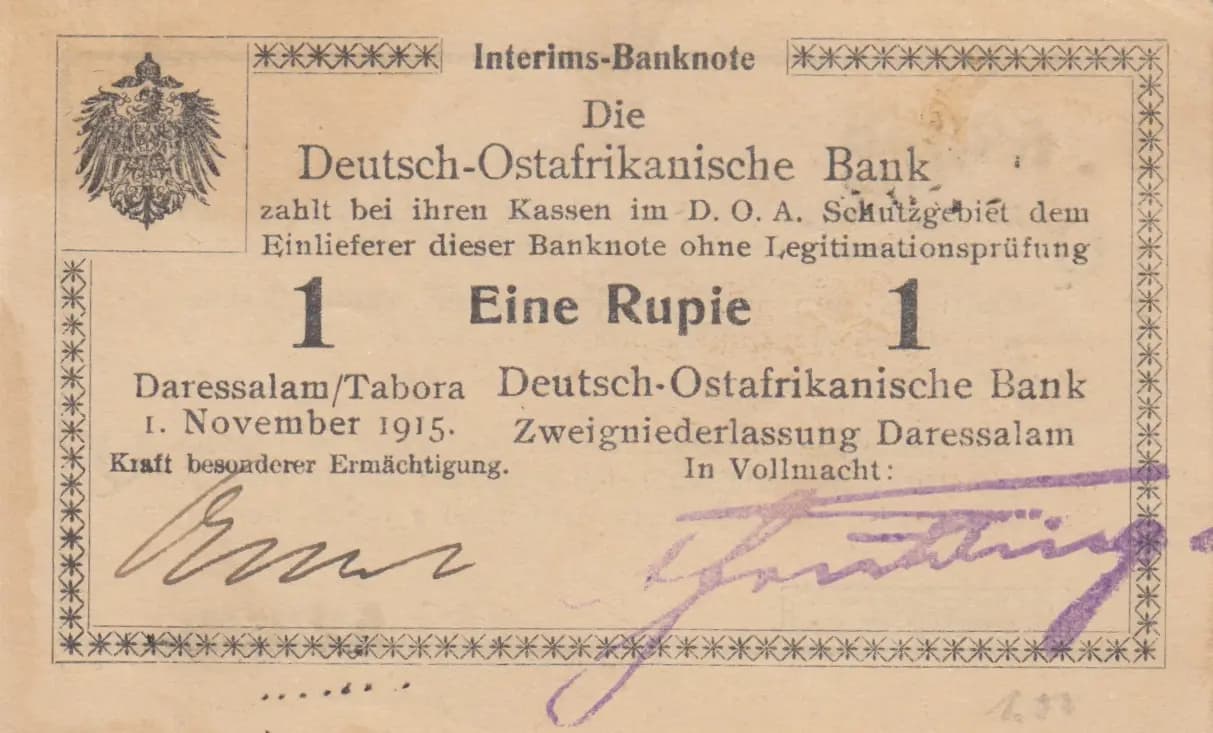
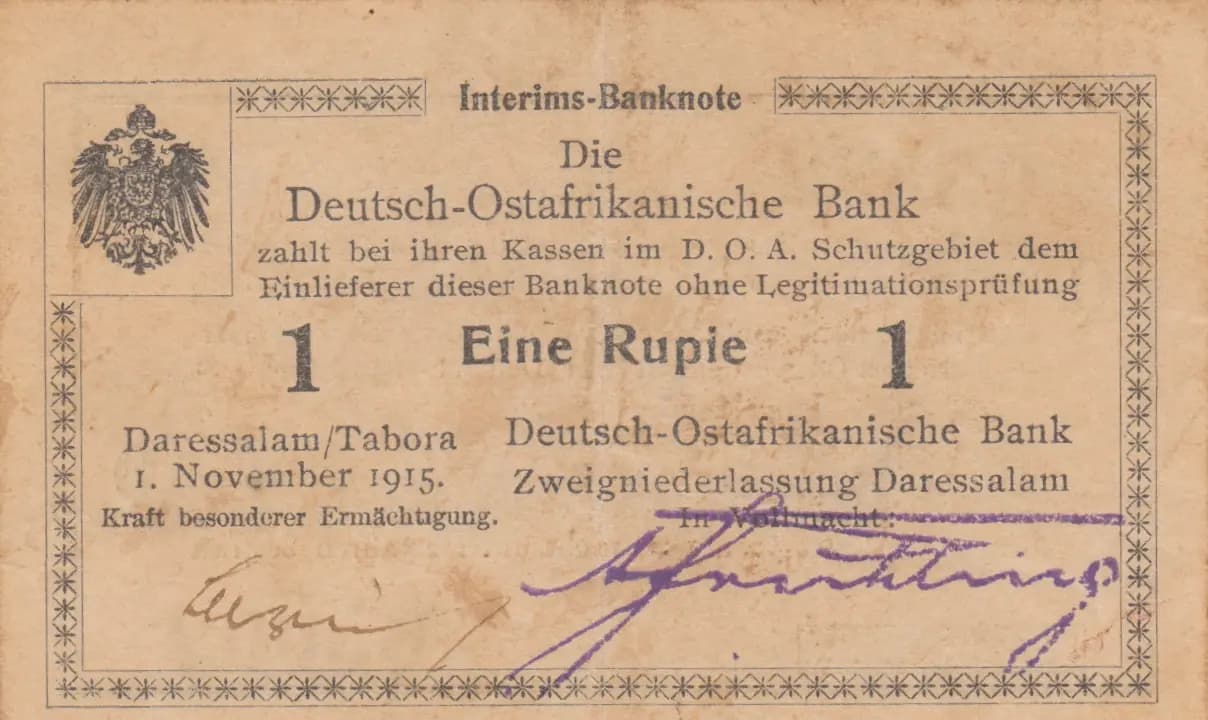
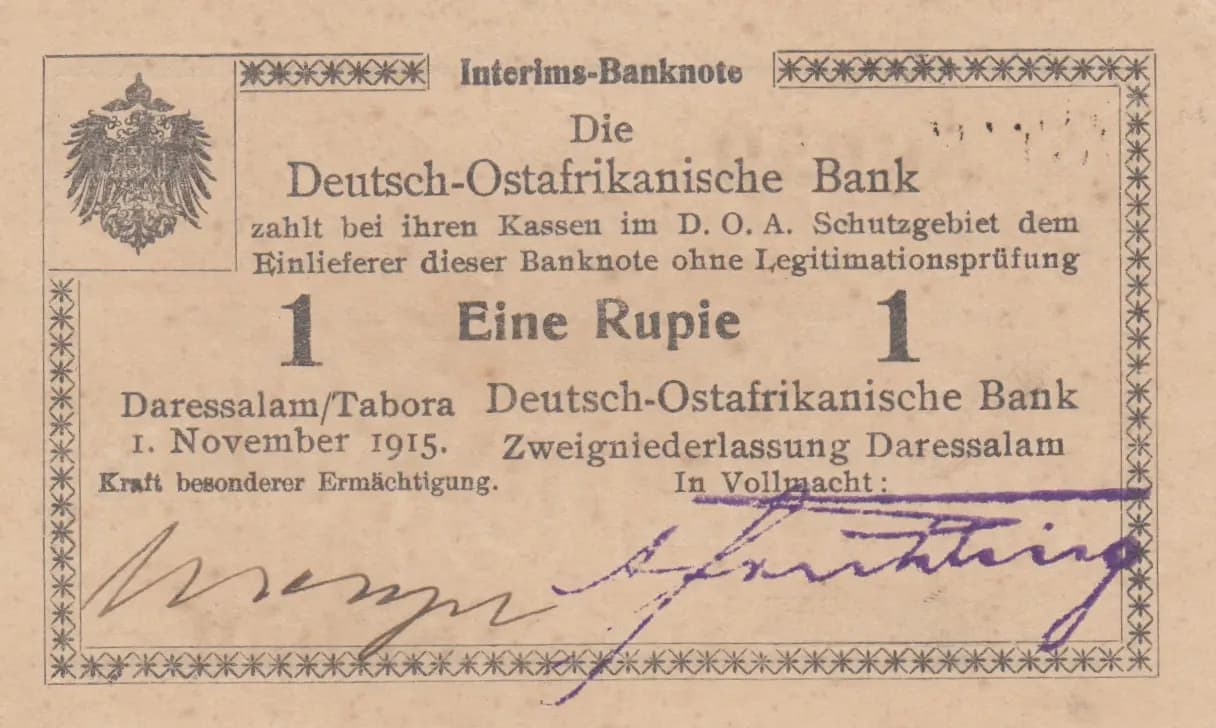
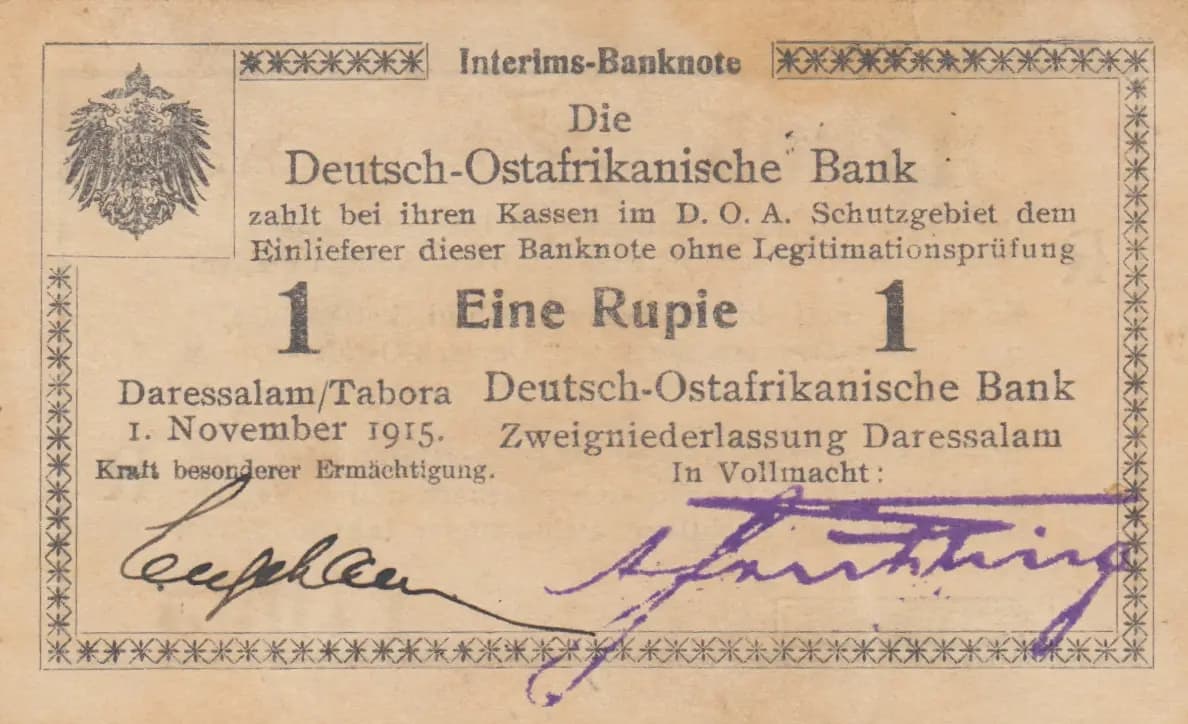
This is an exceptionally well-preserved AU-grade Interims-Banknote (interim banknote) issued by the Deutsch-Ostafrikanische Bank on November 1, 1915, during the final year of German control of East Africa in World War I. The note features the German Imperial Eagle coat of arms and bears a purple handwritten mark across the lower right, with clear dual signatures at the base. Series R designation with serial number 17095, this wartime emergency currency represents a crucial transitional period in German East African monetary history, issued just months before the territory fell to Allied forces.
Uncommon. While Deutsch-Ostafrikanische Bank notes are not common in the international numismatic market, this specific 1 Rupee 1915 issue (Pick 9Ab) circulated during the final operational months of the bank before German East Africa fell to Allied forces in 1916. The series R designation with this serial number range suggests moderate print quantities for wartime emergency currency, but significant attrition over more than a century of existence is likely. AU-grade examples are less frequently encountered than lower grades, as most surviving specimens show heavier circulation wear. The bilingual German-Swahili reverse and the unusual newspaper stamp add collector appeal, supporting an 'uncommon' rather than 'common' assessment for this condition grade.
This Interims-Banknote was issued under emergency conditions during World War I when German East Africa faced military pressure and currency shortages. The note explicitly states it was issued 'by special authorization' (Kraft besonderer Ermächtigung) from the branch office in Dar es Salaam/Tabora, reflecting the colonial administration's desperate attempt to maintain monetary circulation as the territory collapsed. The inclusion of Swahili language text alongside German on the reverse demonstrates the note's dual purpose in a colonial economic system where indigenous populations required currency access, making this a rare bilingual example of wartime emergency currency issued at the periphery of the German Empire.
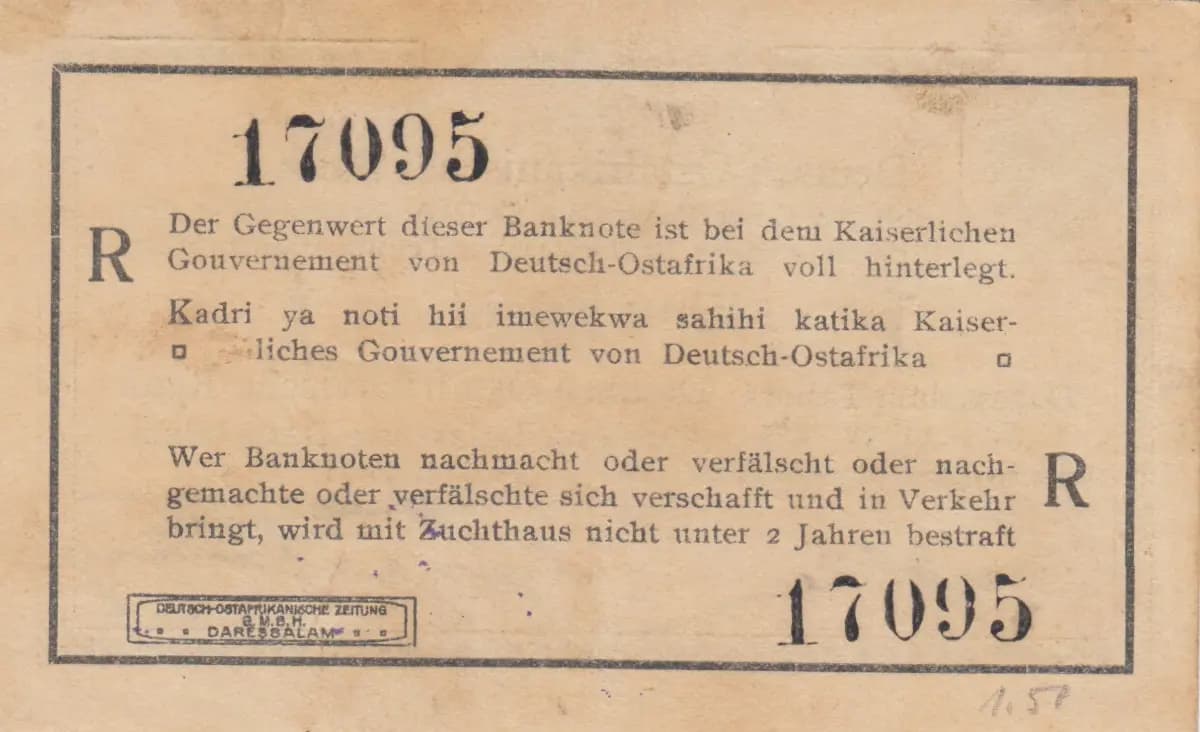
The obverse features the German Imperial Eagle (Reichsadler) with shield positioned prominently on the left side, serving as the primary heraldic symbol of German authority in the colonial territory. The note employs a tan/beige field with brown/dark brown printing, utilizing decorative borders with cross and asterisk patterns typical of early 20th-century German banknote design. The denomination 'Eine Rupie' (One rupee) is clearly displayed, reflecting the rupee standard used throughout German East Africa. The reverse contains the numerical serial reference 17095 with series letter 'R' positioned at top and bottom margins, along with bilingual text in German and Swahili affirming the note's backing by the Imperial Government. A rectangular stamp/seal from the Deutsch-Ostafrikanische Zeitung (German East African Newspaper) is impressed in the lower left corner of the reverse, an unusual feature indicating possible newspaper publication or verification of authenticity. Two handwritten signatures appear at the base of the obverse, authenticating the issue by bank officials.
FRONT: 'Interims-Banknote' (Interim banknote) / 'Die Deutsch-Ostafrikanische Bank' (The German East African Bank) / 'zahlt bei ihren Kassen im D. O. A. Schutzgebiet dem Einlieferer dieser Banknote ohne Legitimationsprüfung' (pays at its cashiers in the D. O. A. protectorate to the bearer of this banknote without verification of legitimation) / 'Eine Rupie' (One rupee) / '1' / 'Daressalam/Tabora' / 'Deutsch-Ostafrikanische Bank' / 'Zweigniederlassung Daressalam' (Branch Dar es Salaam) / '1. November 1915' / 'Kraft besonderer Ermächtigung' (By special authorization) / 'In Vollmacht:' (In authority:). BACK: '17095' (serial number) / 'R' (series designation) / 'Der Gegenwert dieser Banknote ist bei dem Kaiserlichen Gouvernement von Deutsch-Ostafrika voll hinterlegt.' (The countervalue of this banknote is fully deposited with the Imperial Government of German East Africa.) / 'Kadri ya noti hii imewekwa sahihi katika Kaiserliches Gouvernement von Deutsch-Ostafrika' (Swahili: The guarantee of this note is properly placed with the Imperial Government of German East Africa) / 'Wer Banknoten nachmacht oder verfälscht oder nachgemachte oder verfälschte sich verschafft und in Verkehr bringt, wird mit Zuchthaus nicht unter 2 Jahren bestraft' (Whoever counterfeits or forges banknotes or procures counterfeit or forged notes and puts them into circulation shall be punished with hard labor for not less than 2 years) / 'DEUTSCH-OSTAFRIKANISCHE ZEITUNG DARESSALAM' (German East African Newspaper Dar es Salaam).
This note was produced using letterpress/relief printing techniques typical of German banknote production in the 1910s. The crisp impression of text and decorative borders, combined with the clear handwritten signatures and the impressed newspaper stamp on the reverse, indicates traditional letterpress methodology. The bilingual text layout and colonial-era security features suggest production by a German security printer, likely in mainland Germany before shipment to German East Africa, though the handwritten signatures and purple mark were applied locally at the Dar es Salaam branch office.
This specimen is catalogued as Pick 9Ab, representing the specific variety designation for 1 Rupee notes issued November 1, 1915. The series letter 'R' with serial number 17095 places this within a documented series. The presence of the printed 'R' series designation on both obverse and reverse is consistent with the 9Ab variety. Handwritten signatures visible at the base represent individual officer authentication rather than a distinct variety variable. The purple handwritten mark on the obverse appears to be a subsequent collector's mark or authentication notation rather than an original issue feature. No overprints are visible, confirming this as a standard issue example of the series without additional variety modifiers.