1 rupee 1915
“serie A2”
About This Note
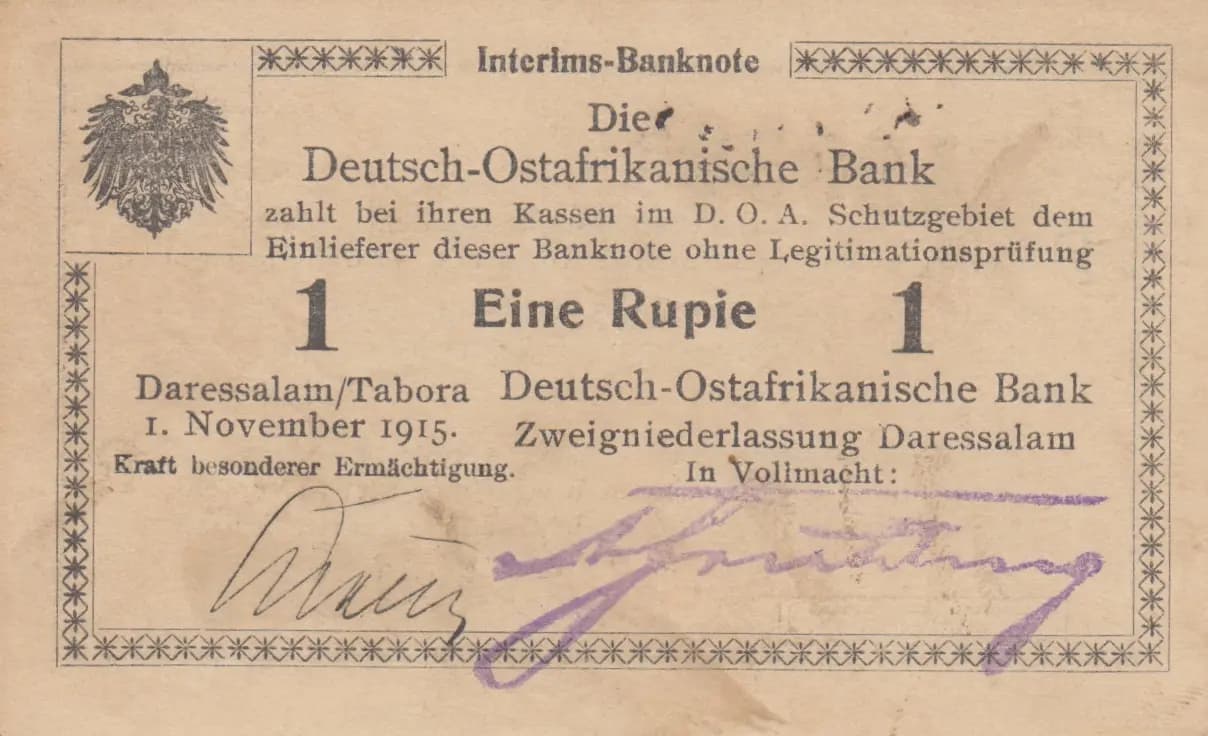
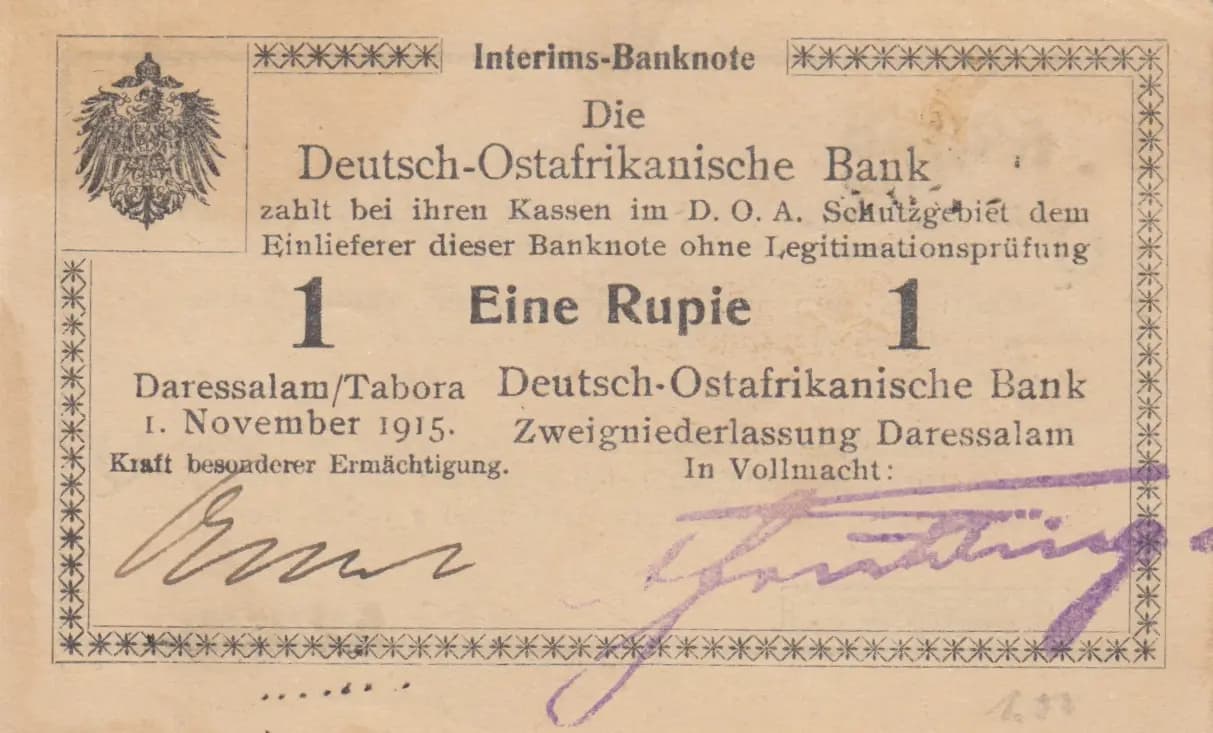
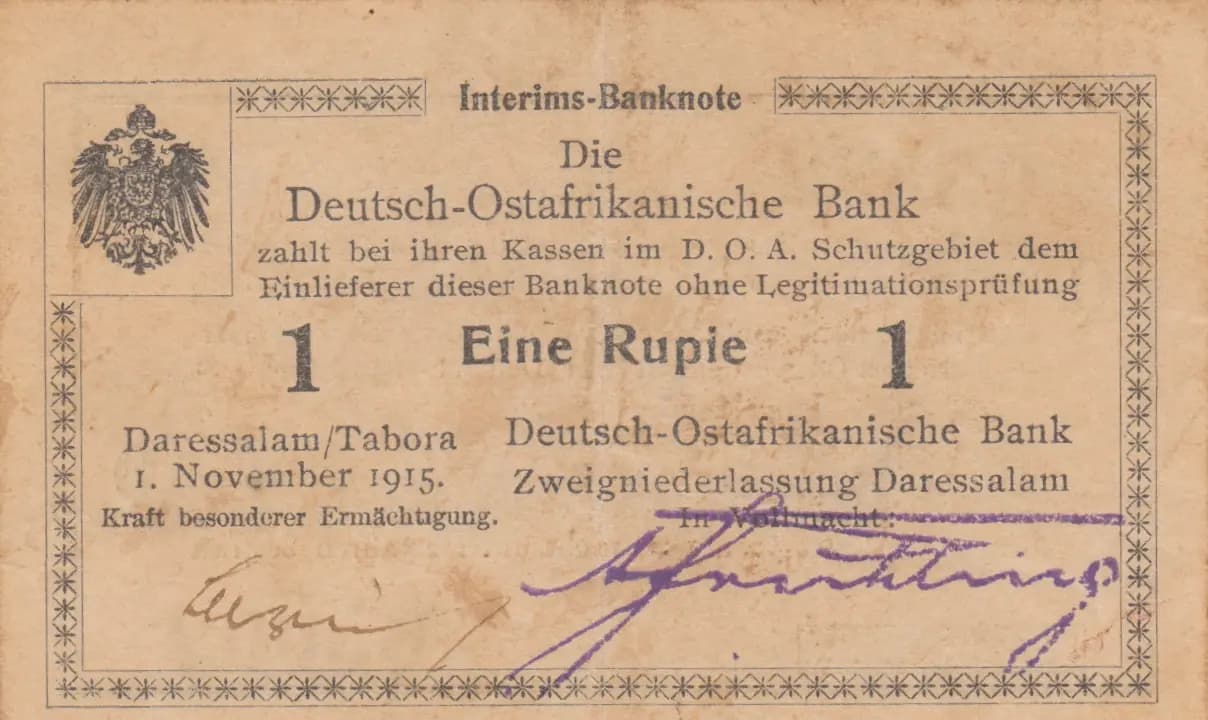
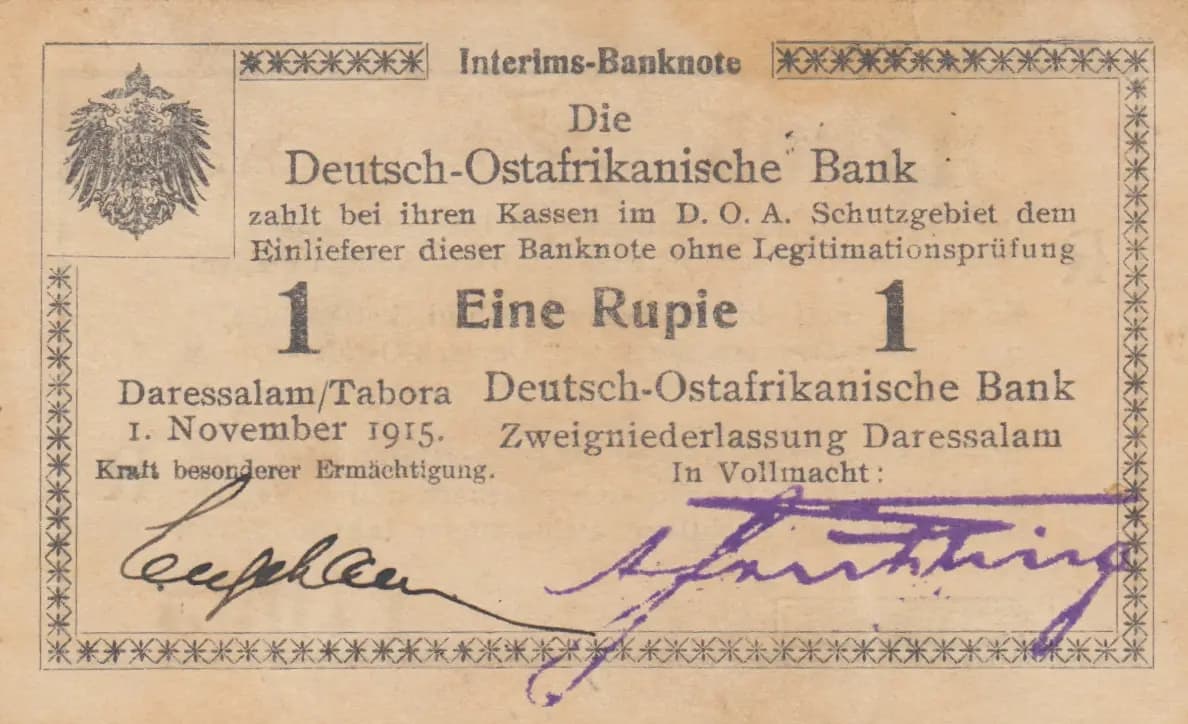
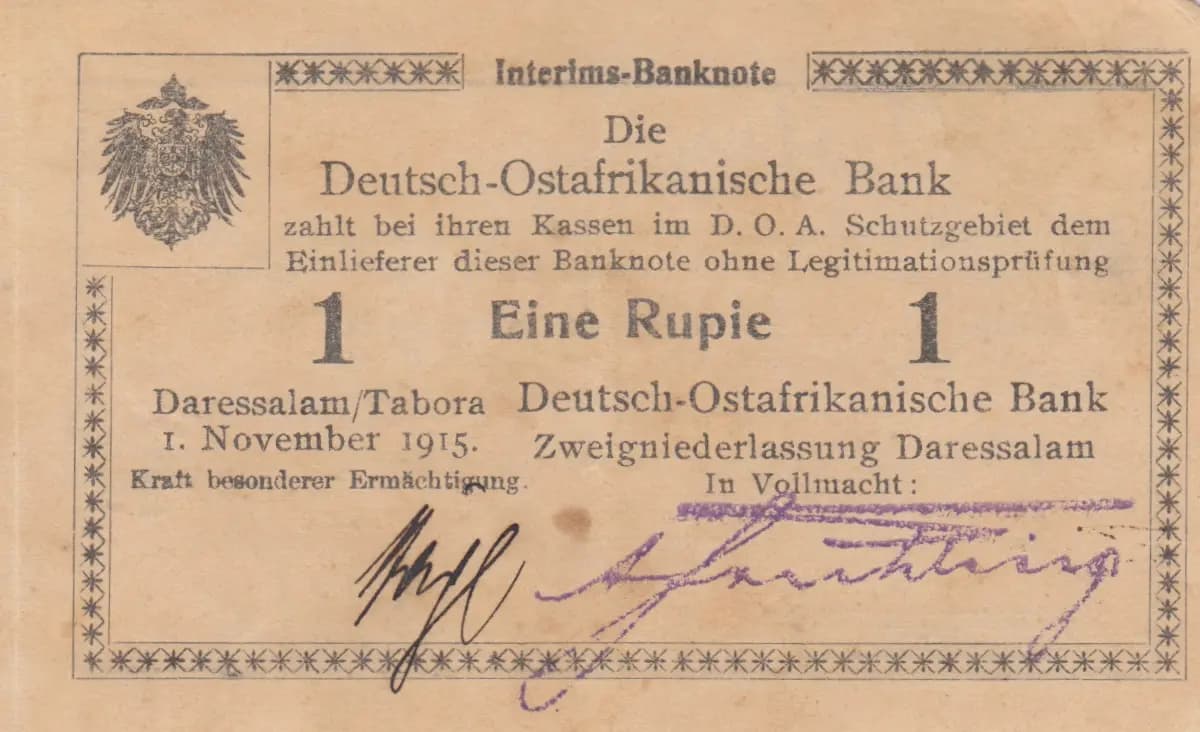
A German East African interim banknote (Interims-Banknote) issued by the Deutsch-Ostafrikanische Bank on 1 November 1915, denominated 1 Rupee. The note displays the characteristic tan/beige patina of early 20th-century paper with visible aging and foxing consistent with EF condition; it features handwritten signatures in black and purple ink and retains good legibility despite age-related discoloration. This specific example from Series A2 is historically significant as an emergency currency issued during the German colonial period in East Africa, bearing the Imperial Eagle coat of arms and dual-language instructions reflecting the colonial administrative structure.
Common. While German East African currency is collectible, interim banknotes from 1915 were issued in substantial quantities to address wartime currency shortages. The Pick catalog designation P-9Ab indicates this is a recognized standard variety within the catalog system. The observed condition (EF) and series designation (A2) suggest this note represents a standard circulating example rather than a rare variety or short-run printing. Notes from colonial German East Africa are routinely available in the collector market.
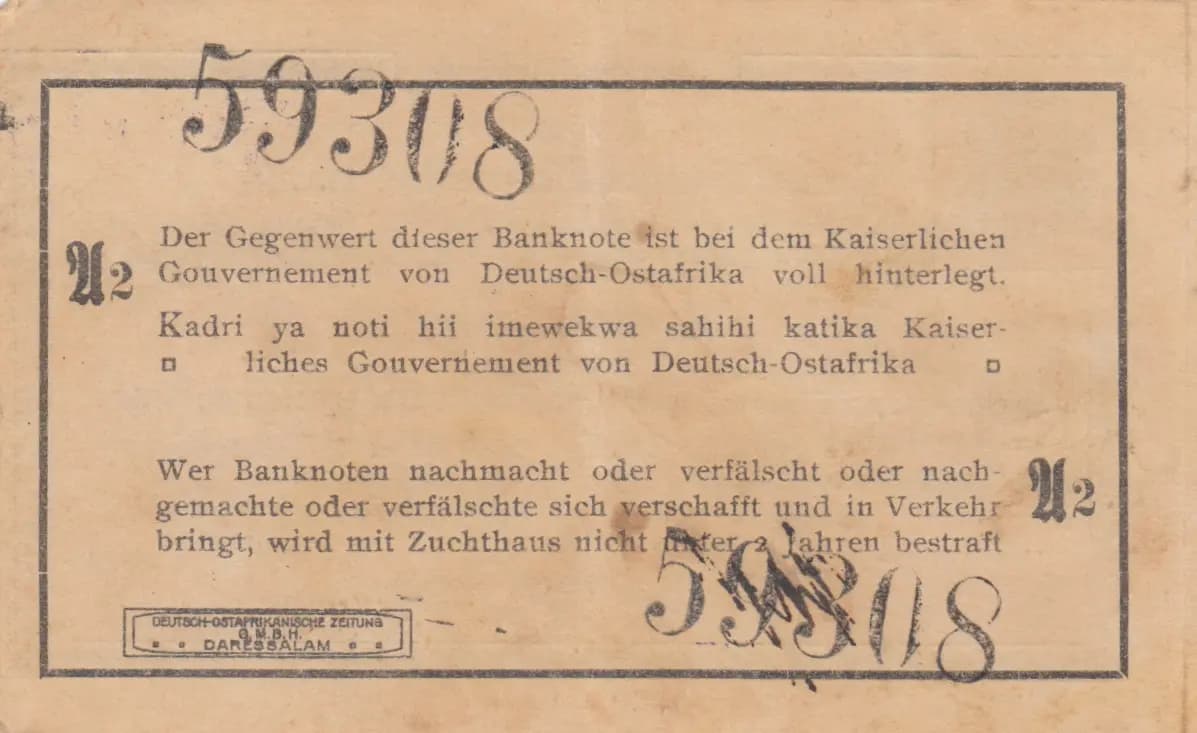
This interim banknote was issued during World War I when German East Africa faced severe monetary strain and supply disruptions from the German Reich. The note's explicit statement that 'the equivalent of this banknote is fully deposited with the Imperial Government of German East Africa' reflects the colonial government's attempt to stabilize local currency during wartime economic crisis. The inclusion of both German and Swahili text on the reverse demonstrates the colonial administration's recognition of the need to communicate with the local population, while the German Imperial Eagle symbolizes the territorial sovereignty and institutional authority of the Deutsch-Ostafrikanische Bank under imperial jurisdiction.
The note features a formal, symmetrical layout typical of early 20th-century German financial instruments. The obverse displays the German Imperial Eagle (Reichsadler) with crown positioned prominently in the upper left corner, serving as the principal symbol of imperial authority and sovereignty over the German East African protectorate. The design employs decorative border patterns of repeated small star/cross motifs framing the text. The reverse incorporates an unexpected design element—a masthead from the Deutsch-Ostafrikanische Zeitung (German East African Newspaper) published in Daressalam—which was likely used as a space-filling security or identification feature. The note is printed in tan/beige with black and gray text, and contains manuscript signatures in black and purple ink from authorized bank officials, indicating this was a hand-authorized emergency issue. The serial number 593118 appears both front and back.
FRONT SIDE: 'Interims-Banknote' (Interim Banknote); 'Die Deutsch-Ostafrikanische Bank' (The German East African Bank); 'zahlt bei ihren Kassen im D. O. A. Schutzgebiet dem Einlieferer dieser Banknote ohne Legitimationsprüfung' (pays at its cashiers in the D.O.A. protection zone to the presenter of this banknote without legitimation examination); 'Eine Rupie' (One Rupee); 'Daressalam/Tabora 1. November 1915' (Daressalam/Tabora 1. November 1915); 'Kraft besonderer Ermächtigung' (By special authorization); 'Deutsch-Ostafrikanische Bank Zweigniederlassung Daressalam In Vollmacht:' (German East African Bank Branch Daressalam By power of attorney). BACK SIDE: Serial number '593118'; 'Der Gegenwert dieser Banknote ist bei dem Kaiserlichen Gouvernement von Deutsch-Ostafrika voll hinterlegt.' (The equivalent of this banknote is fully deposited with the Imperial Government of German East Africa.); Mixed German/Swahili text confirming the note's value is held with the Imperial Government; 'Wer Banknoten nachmacht oder verfälscht oder nachgemachte oder verfälschte sich verschafft und in Verkehr bringt, wird mit Zuchthaus nicht unter 5 Jahren bestraft' (Whoever counterfeits or forges banknotes or obtains counterfeit or forged ones for circulation will be punished with hard labor for not less than 5 years); 'DEUTSCH-OSTAFRIKANISCHE ZEITUNG' and 'DARESSALAM' (German East African Newspaper masthead from Daressalam).
This interim banknote was produced using letterpress/relief printing for the primary text and vignette elements (Imperial Eagle, borders, and newspaper masthead), with the characteristic sharp, crisp impression quality visible in the surviving impressions. The handwritten signatures and serial numbers were added by hand in manuscript ink, a common practice for emergency currency issues during wartime when pre-printed signature blocks were unavailable or impractical. No commercial security printer attribution is recorded for this emergency interim issue; printing was likely accomplished locally in German East Africa using available equipment.
This note is identified as Pick P-9Ab, representing the 1 Rupee interim banknote from 1915. The variety is further specified by Series A2 designation, indicating the series prefix used in the serial numbering. The specific date of issue is 1. November 1915, issued from Daressalam/Tabora. The handwritten signatures and serial number 593118 are unique to this individual specimen but do not constitute a catalogable variety. No overprints or significant design variations are observed that would distinguish this as a separate Pick subvariety.