1 rupee 1915
“serie T”
About This Note
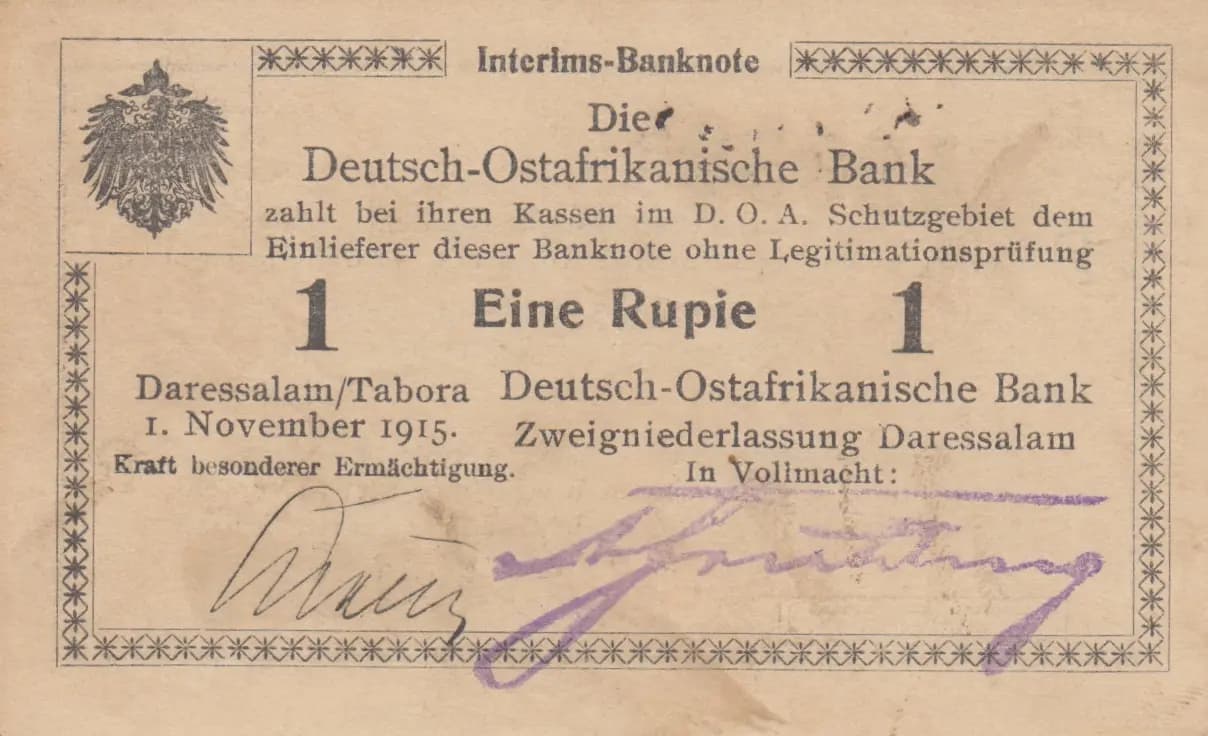
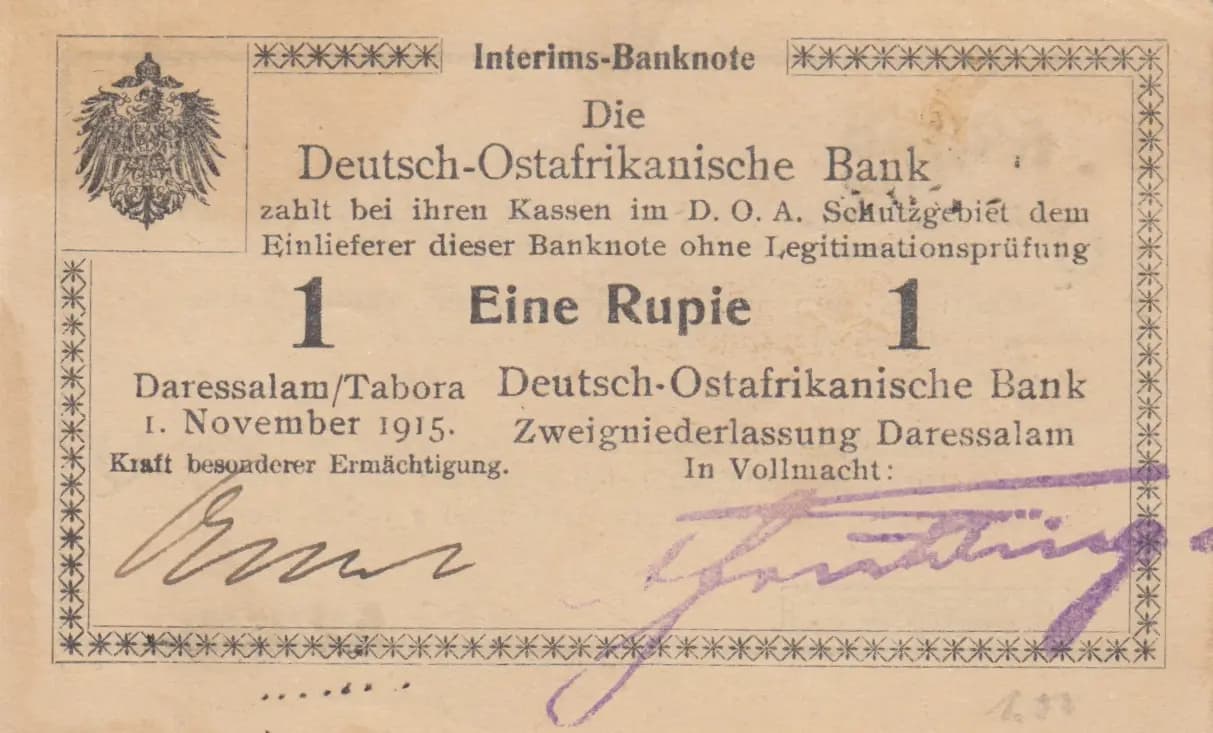
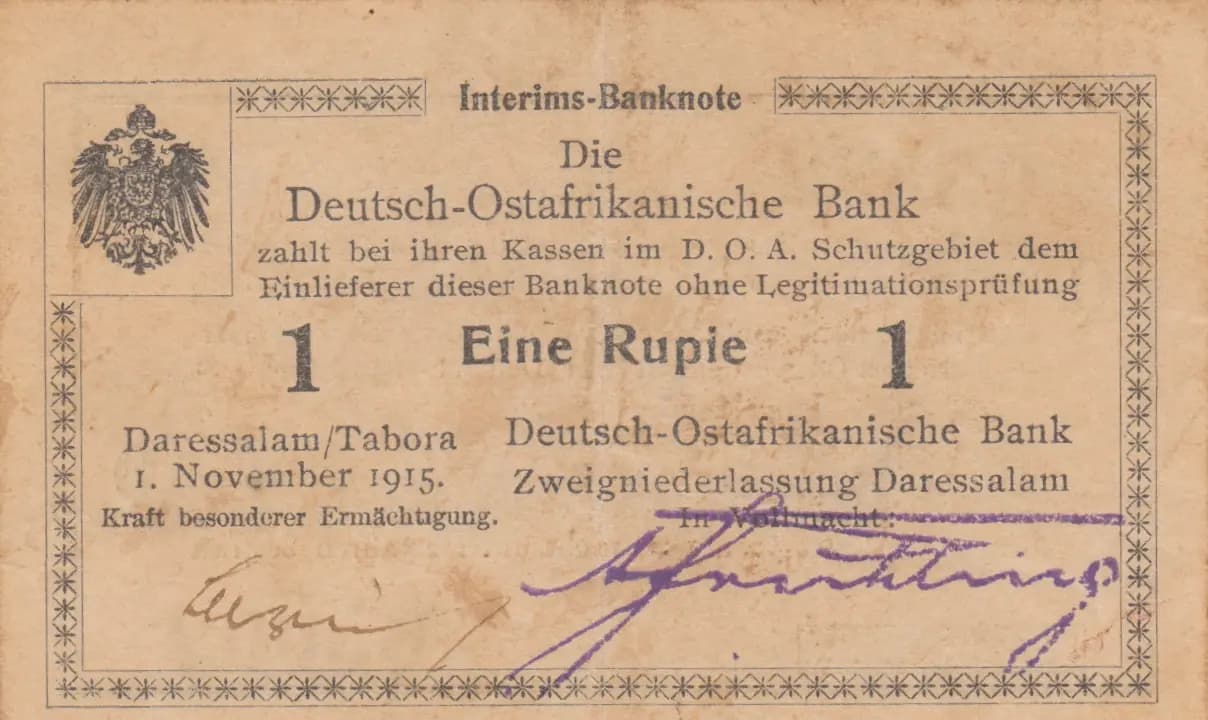
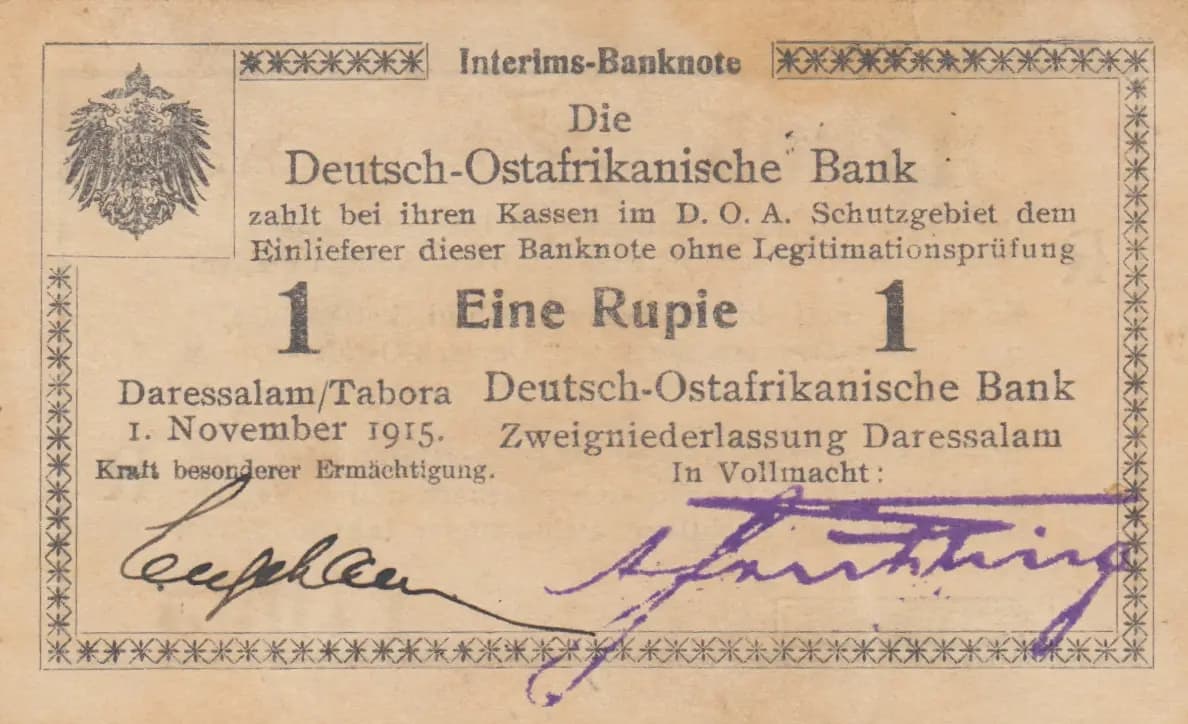
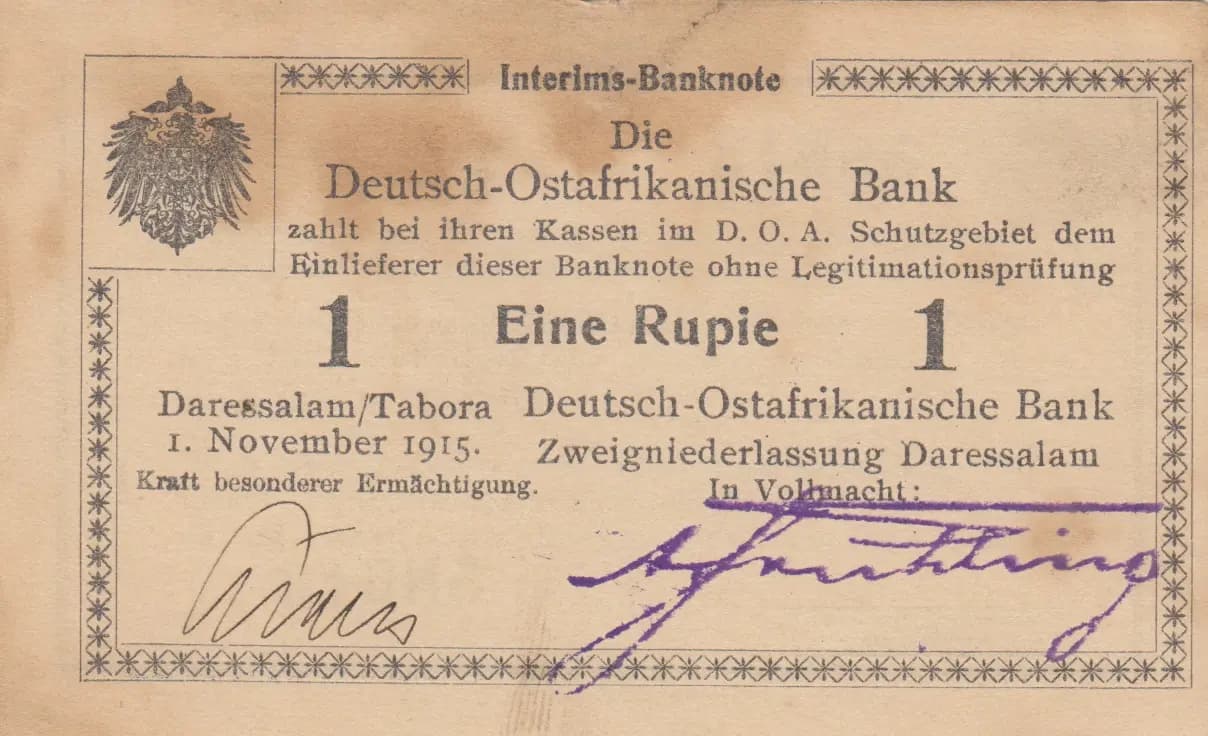
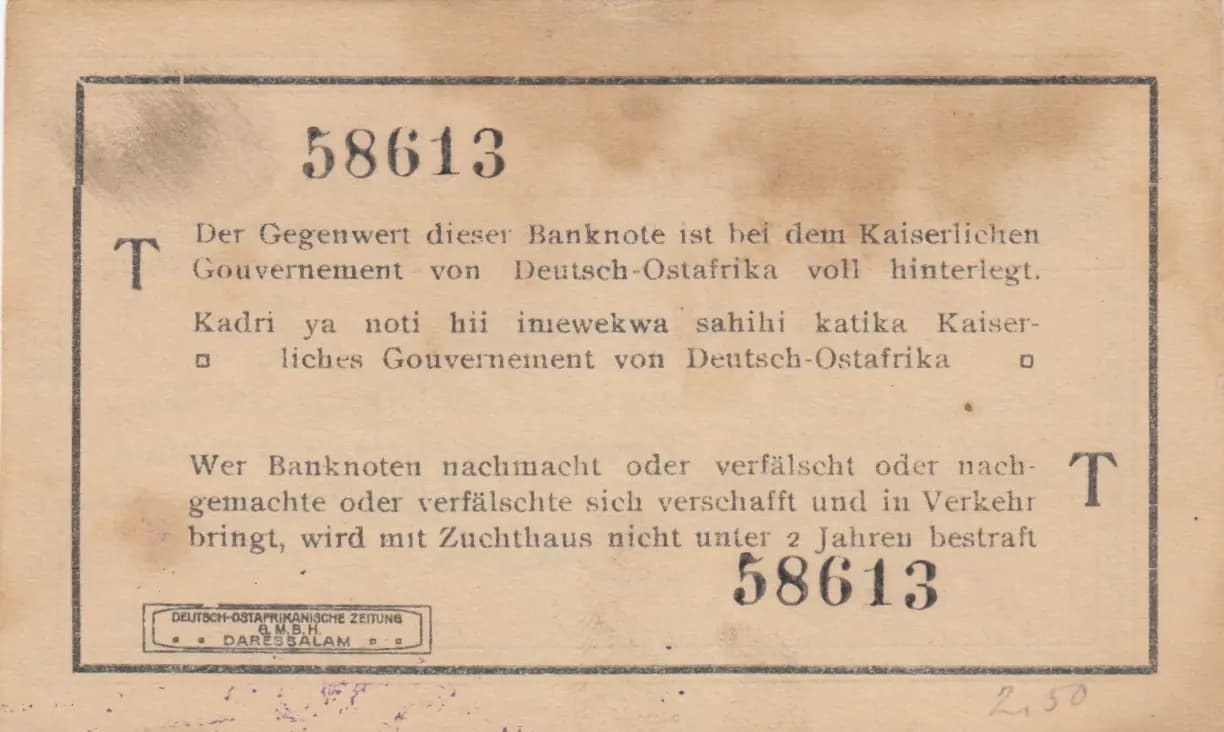
This is an exceptional AU-graded example of the Deutsch-Ostafrikanische Bank's 1 Rupee interim banknote from November 1, 1915 (Pick P-9Ab, series T). The note exhibits the characteristic tan-beige patina and age-related foxing typical of WWI-era East African currency, with crisp impressions of the German Imperial coat of arms and clear dual-language text. The presence of two distinct signatures in black and purple/violet ink, combined with the bilingual German-Swahili reverse, makes this a significant example of colonial monetary history during Germany's final years in East Africa.
Common. This interim banknote series from November 1915 represents standard emergency currency issued by the Deutsch-Ostafrikanische Bank during the final phase of German East African colonial administration. While German East African banknotes are not abundant in modern circulation, they were issued in moderate quantities appropriate to the territory's monetary needs. The Pick P-9Ab denomination and series T variety fall within regularly encountered examples in the collector market, particularly at AU grades where examples have survived with reasonable frequency. The absence of scarcity premium indicators and the straightforward nature of the note's issue suggest common classification.
Issued under special authorization during the final year of German colonial rule in East Africa, this interim banknote represents the Deutsch-Ostafrikanische Bank's emergency currency measures as World War I disrupted normal monetary supply. The German Imperial coat of arms (Reichsadler) depicted on the obverse symbolizes the German Empire's sovereignty over the territory, while the bilingual German-Swahili inscriptions on the reverse reflect the bank's need to communicate with both colonial administrators and the local African population. By 1915, with German East Africa under increasing military pressure, such interim notes became necessary when regular banknote supplies could not be maintained.
The obverse features the German Imperial coat of arms (Reichsadler)—a double-headed eagle with crown and shield—positioned prominently on the left side, symbolizing German sovereignty. The note is framed by decorative borders consisting of repeating star or asterisk patterns that encircle the entire design, providing both aesthetic appeal and subtle security through pattern complexity. Two signatures appear at the bottom in different inks (black and purple/violet), representing authorization by bank officials. The denomination '1 Rupie' is displayed numerically and written out in German. The reverse side is dominated by legal text in German and Swahili arranged in two columns, with the serial number 58613 displayed prominently at both top and bottom. A small rectangular stamp or seal reading 'DEUTSCH-OSTAFRIKANISCHE ZEITUNG DARESSALAM' appears in the lower left corner, indicating publication or official distribution details. The entire design employs typography and text hierarchy typical of early 20th-century German banking documents.
FRONT SIDE: 'Interims-Banknote' (Interim Banknote); 'Die Deutsch-Ostafrikanische Bank' (The German East African Bank); 'zahlt bei ihren Kassen im D. O. A. Schutzgebiet dem Einlieferer dieser Banknote ohne Legitimitätsprüfung' (pays at its counters in the D. O. A. protectorate to the depositor of this banknote without verification of legitimacy); '1 Eine Rupie 1' (1 One Rupee 1); 'Daressalam/Tabora' (Dar es Salaam/Tabora); '1. November 1915' (1 November 1915); 'Kraft besonderer Ermächtigung' (By special authorization); 'Deutsch-Ostafrikanische Bank' (German East African Bank); 'Zweigniederlassung Daressalam' (Branch office Dar es Salaam); 'In Vollmacht:' (In full authority:). REVERSE SIDE: '58613' (Serial number); 'Der Gegenwert dieser Banknote ist bei dem Kaiserlichen Gouvernement von Deutsch-Ostafrika voll hinterlegt' (The value of this banknote is fully deposited with the Imperial Government of German East Africa); 'Kadri ya noti hii imewekwa sahihi katika Kaiserliches Gouvernement von Deutsch-Ostafrika' (Swahili: The value of this note is properly registered with the Imperial Government of German East Africa); 'Wer Banknoten nachmacht oder verfälscht oder nachgemachte oder verfälschte sich verschafft und in Verkehr bringt, wird mit Zuchthaus nicht unter 2 Jahren bestraft' (Whoever counterfeits or forges banknotes or procures counterfeited or forged ones and puts them into circulation will be punished with imprisonment for not less than 2 years).
This interim banknote was produced using letterpress printing, as evidenced by the crisp, impression-based character of the text and the repeating decorative border patterns visible throughout. The dual-language text layout and the clear distinction between printed elements (main text and design) and handwritten elements (the two signature variants in different colored inks) confirm traditional relief printing methods. The printer for Deutsch-Ostafrikanische Bank interim notes of this period was typically affiliated with German printing houses coordinating with colonial authorities, though specific printer attribution for Pick P-9Ab would require archival confirmation.
This note is identified as series T based on catalog notation. The serial number observed is 58613. Pick cataloging for this issue distinguishes P-9Ab as a specific variety of the 1915 Deutsch-Ostafrikanische Bank 1 Rupee interim note. Variations within this issue may include differing signature combinations (as evidenced by the two distinct signature styles in black and purple/violet inks observed on this specimen) and potentially different series letter assignments. The dual-signature format visible here appears to represent standard authorization protocol for this interim issue, with both signatures likely representing different authorized signatories of the bank's Dar es Salaam branch office.