1 rupee 1915
“serie E2”
About This Note
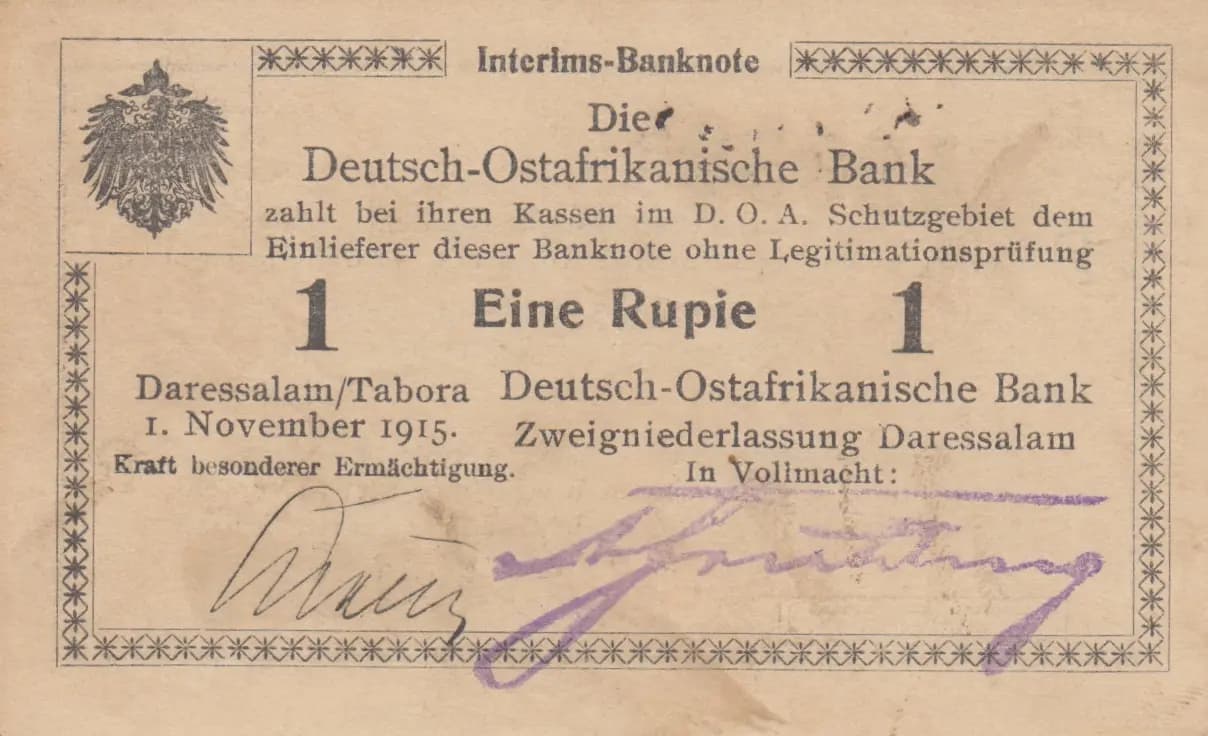
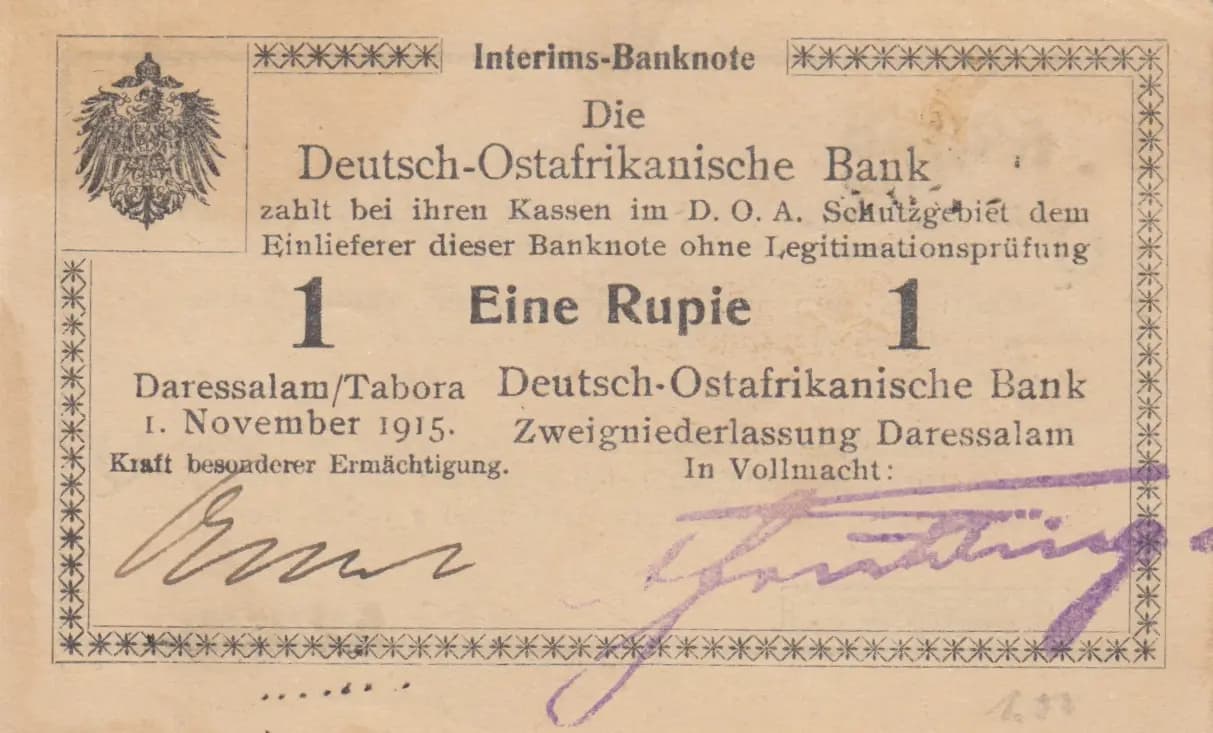
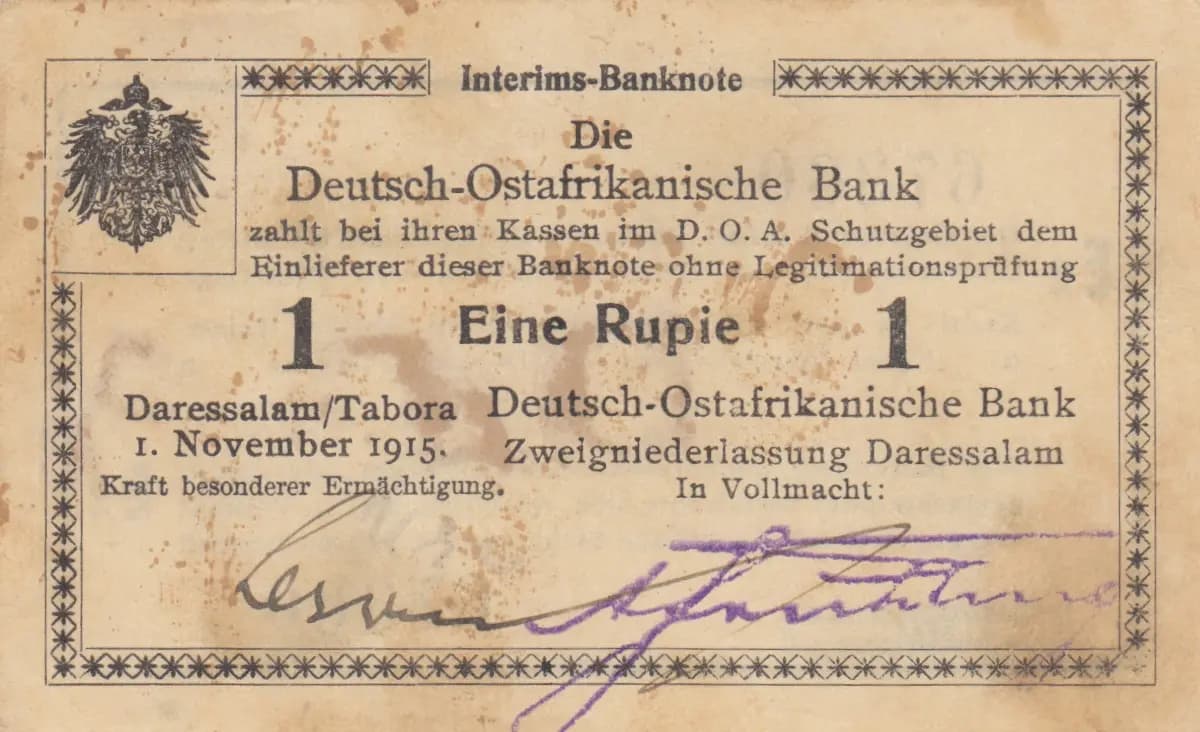
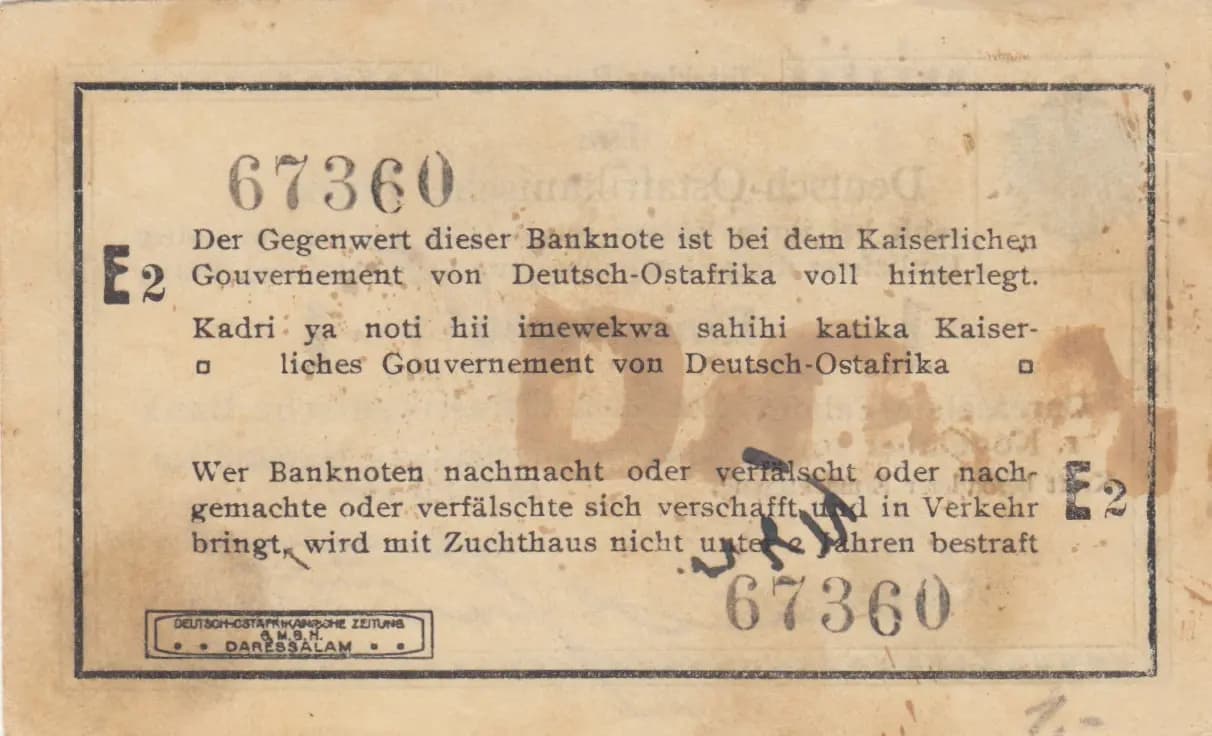
This AU-graded 1 Rupee Interims-Banknote from the Deutsch-Ostafrikanische Bank (1915) is a fascinating example of German colonial currency issued under emergency conditions during World War I. The note displays the characteristic beige-tan coloring with purple-blue handwritten signatures and extensive period foxing consistent with its 108+ year age, along with a prominent German Imperial Eagle emblem and formal German text explaining its redemption terms. This specific series E2 example (serial 67360) represents a historically significant monetary instrument from the final years of German East Africa, combining numismatic appeal with colonial historical importance.
Common. While these Interims-Banknoten from German East Africa are historically significant, they were issued in substantial quantities as emergency currency during 1915-1916. The Pick 9Ab cataloging and the AU condition of this specimen, combined with its clear series and serial number documentation, indicate it is not a scarce variety. German East African rupee notes from this period appear regularly in the numismatic market and auction results, typically at modest price points reflecting their status as common colonial emergency currency rather than rare or limited issues.
Issued on November 1, 1915, this interim banknote reflects Germany's monetary crisis in its East African colony during World War I, when traditional currency supplies were disrupted. The note's declaration that its value is 'fully deposited with the Imperial Government of German East Africa' underscores the legitimacy concerns of emergency wartime currency. The bilingual German-Swahili reverse and dual city references (Dar es Salaam/Tabora) demonstrate the administrative structure of the Schutzgebiet (protectorate) and its reliance on improvised financial instruments during the later stages of colonial rule.
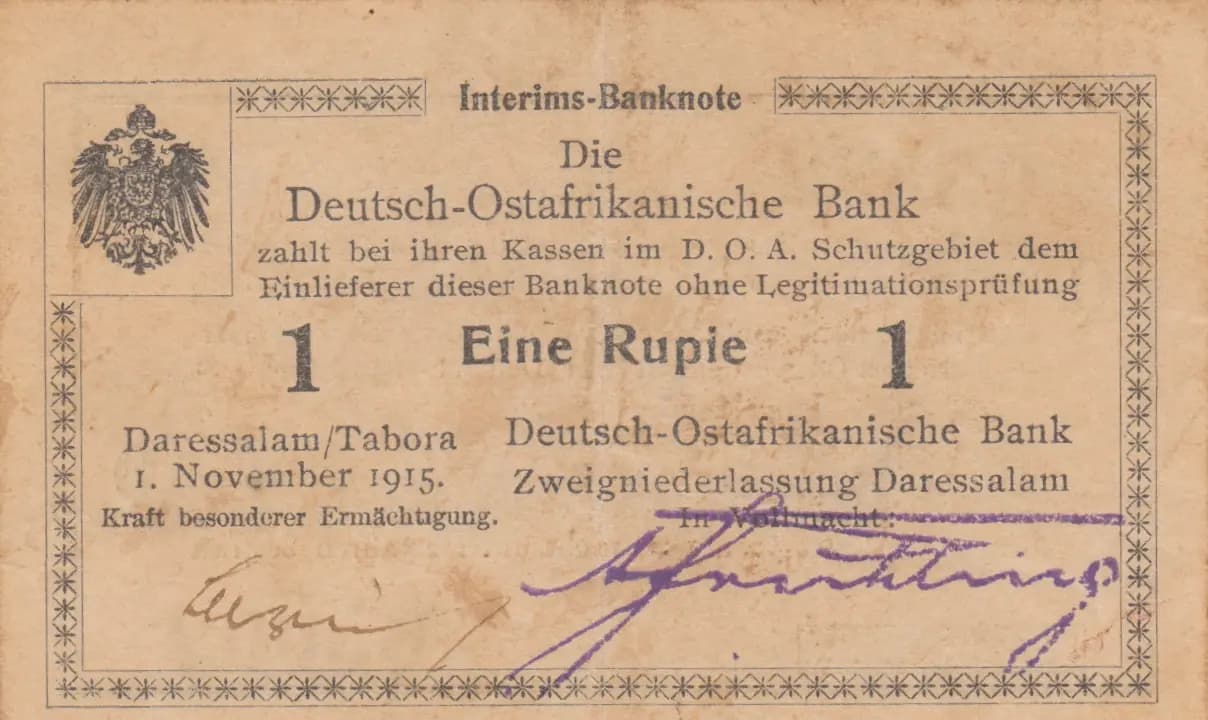
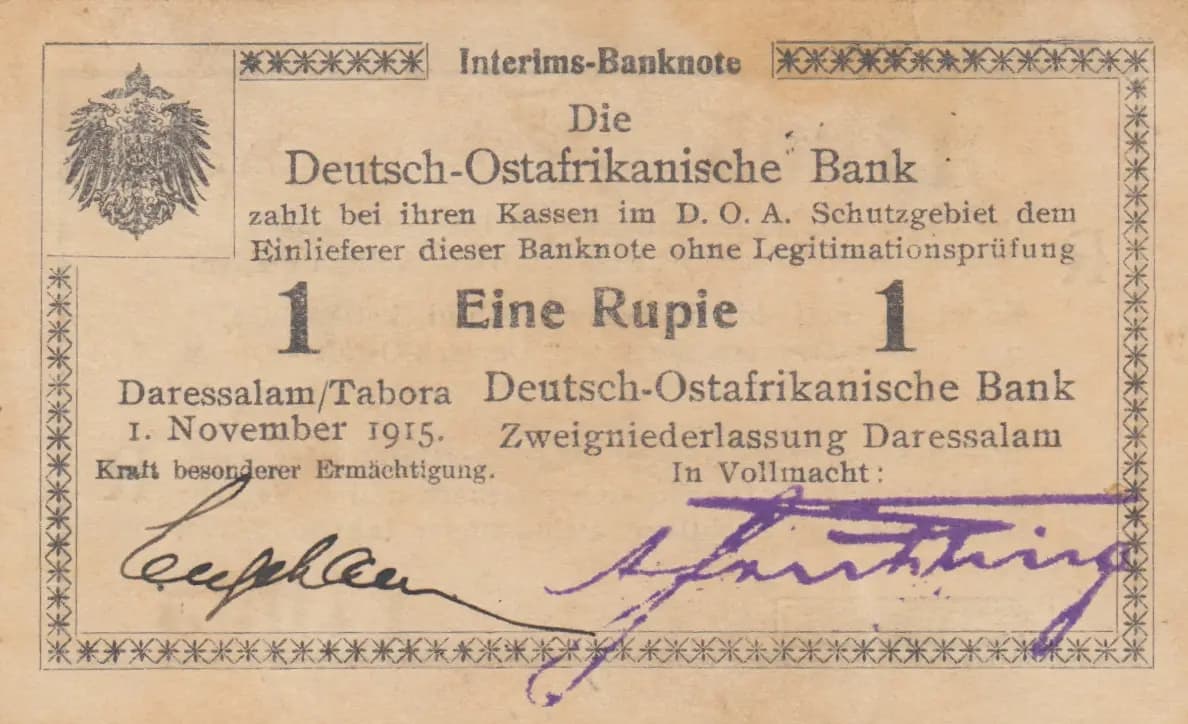
The obverse features a formal layout centered on the denomination 'Eine Rupie' with the German Imperial Eagle (Reichsadler) displayed prominently in an upper left square frame—a symbol of imperial authority. The note is bordered by a decorative geometric repeating pattern and contains substantial explanatory text in German addressing the redemption conditions and special authorization under which the note was issued. The reverse provides legal protections against counterfeiting, mirror text in German and Swahili reflecting the colonial administrative structure, and includes an official stamp from the Deutsch-Ostafrikanische Zeitung newspaper of Dar es Salaam, which served as a quasi-official gazette. The handwritten purple-blue signatures on the obverse represent authorization by bank officials and complete the formal administrative documentation aspect of this emergency currency.
FRONT SIDE: 'Interims-Banknote' (Interim Banknote) / 'Die Deutsch-Ostafrikanische Bank' (The German East African Bank) / 'zahlt bei ihren Kassen im D.O.A. Schutzgebiet dem Einlieferer dieser Banknote ohne Legitimationsprüfung' (pays at its counters in the D.O.A. protection area to the deliverer of this banknote without legitimacy verification) / 'Eine Rupie' (One Rupee) / '1' / 'Daressalam/Tabora' / '1. November 1915' (1st November 1915) / 'Kraft besonderer Ermächtigung' (By special authorization) / 'Deutsch-Ostafrikanische Bank' / 'Zweigniederlassung Daressalam' (Branch Office Dar es Salaam) / 'In Vollmacht:' (By Power of Attorney:) — BACK SIDE: Serial number '67360' / Series designation 'E2' / 'Der Gegenwert dieser Banknote ist bei dem Kaiserlichen Gouvernement von Deutsch-Ostafrika voll hinterlegt.' (The value of this banknote is fully deposited with the Imperial Government of German East Africa.) / Swahili equivalent text / 'Wer Banknoten nachmacht oder verfälscht oder nachgemachte oder verfälschte sich verschafft und in Verkehr bringt, wird mit Zuchthaus nicht unter 5 Jahren bestraft' (Whoever counterfeits or falsifies banknotes, or procures counterfeit or falsified notes and puts them into circulation will be punished with hard labor for not less than 5 years) / 'DEUTSCH-OSTAFRIKANISCHE ZEITUNG DARESSALAM' (German East African Newspaper Dar es Salaam)
This interim banknote was produced using letterpress/typographic printing for the primary text and border elements, with the decorative geometric border pattern created through standard typographic ornaments. The German Imperial Eagle emblem was likely engraved or lithographically reproduced. The handwritten signatures in purple-blue ink were added post-printing by authorized bank officials, a common practice for emergency colonial currency to ensure individual accountability. The reverse-side stamp from the newspaper was applied separately, likely using a rubber or metal stamp impression. The overall production reflects the practical, utilitarian approach necessitated by wartime monetary emergency rather than the more sophisticated intaglio methods used for standard currency denominations.
This specimen is identified as series E2 with serial number 67360, representing a specific printing run within the 1915 issue. The series letter (E) and sequence number provide exact catalog differentiation. Pick 9Ab designation (the 'b' suffix typically indicates a secondary issue or printing of the base design). Known varieties for this denomination include different series letters and signature combinations; the E2 series represents one of the documented printing runs from the November 1915 authorization period. The presence of handwritten signatures suggests individual branch authorization, with variations in signature styles and ink colors potentially distinguishing different issue batches within the same series.