1 rupee 1915
“serie D2”
About This Note
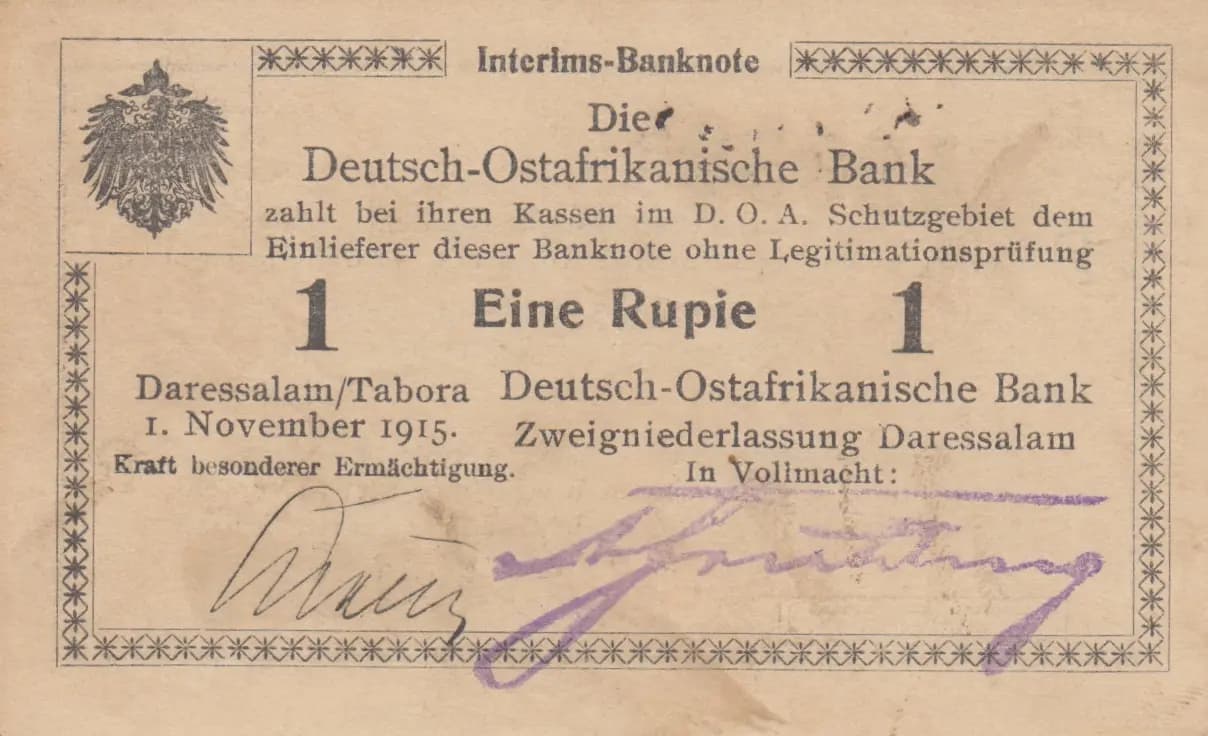
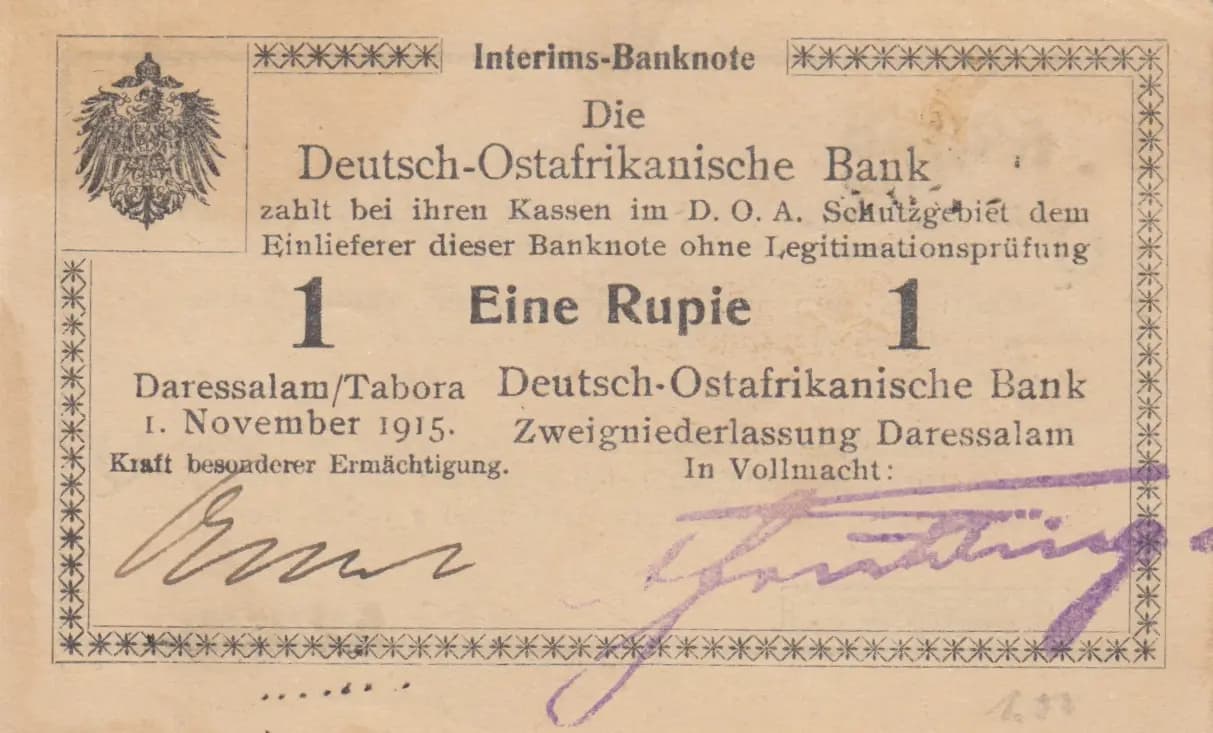
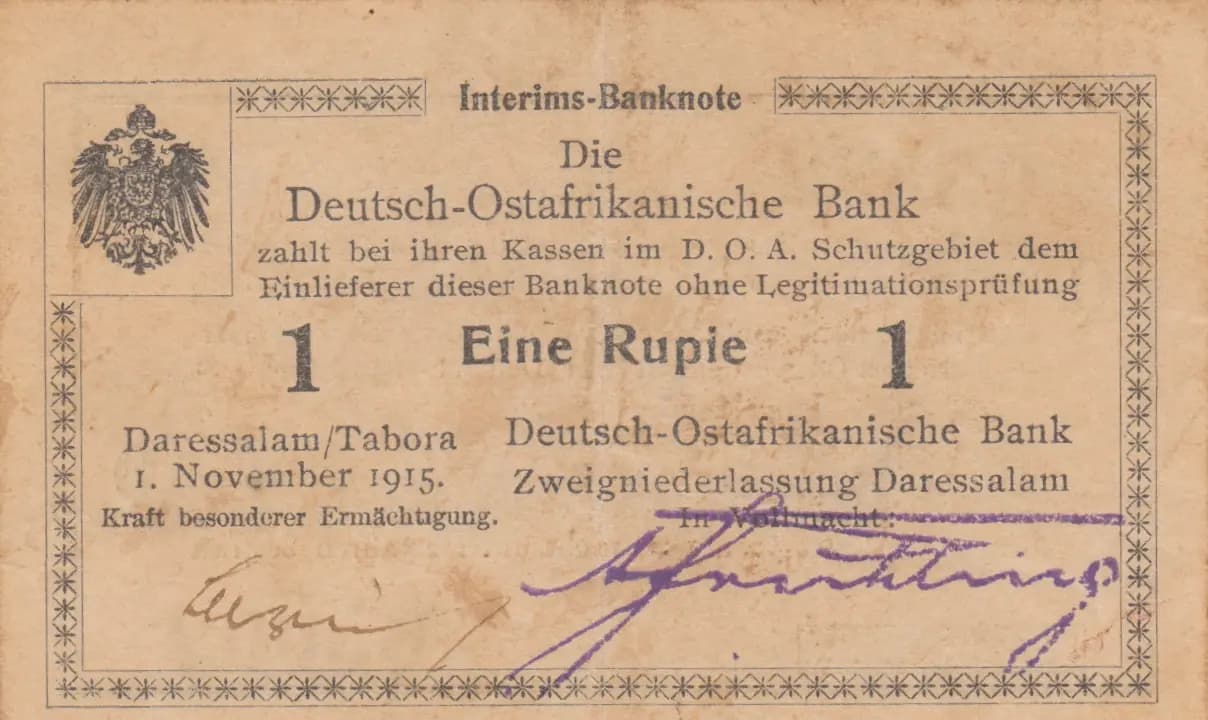
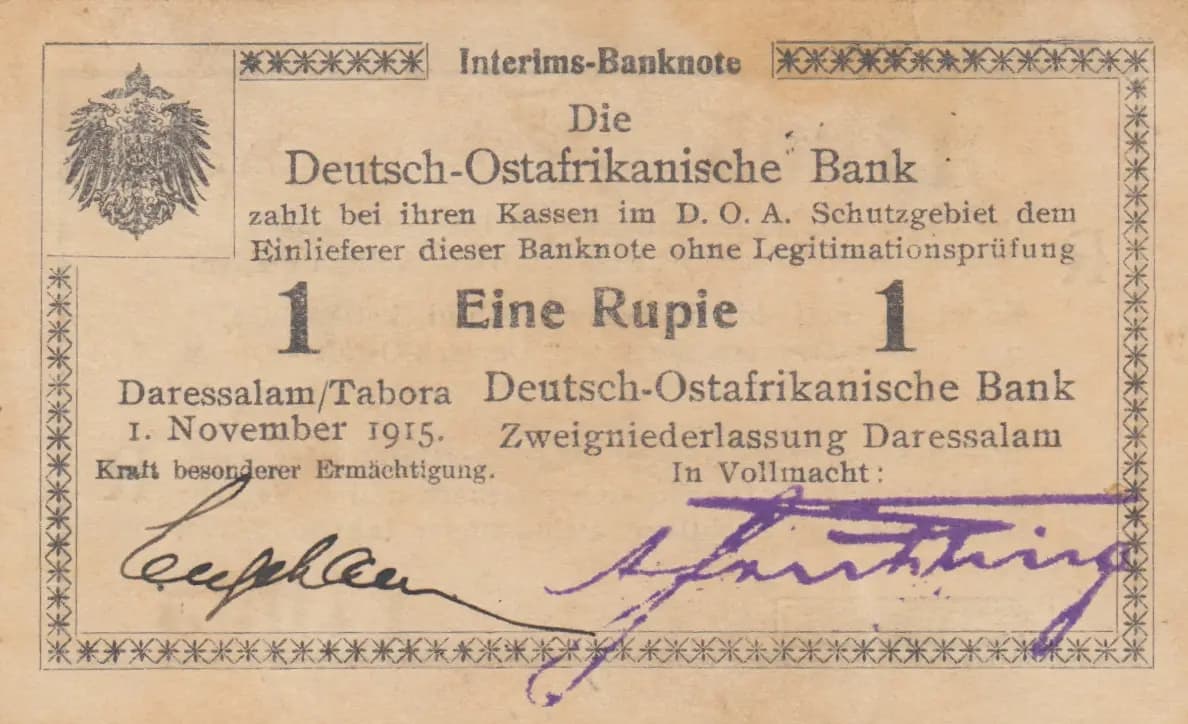
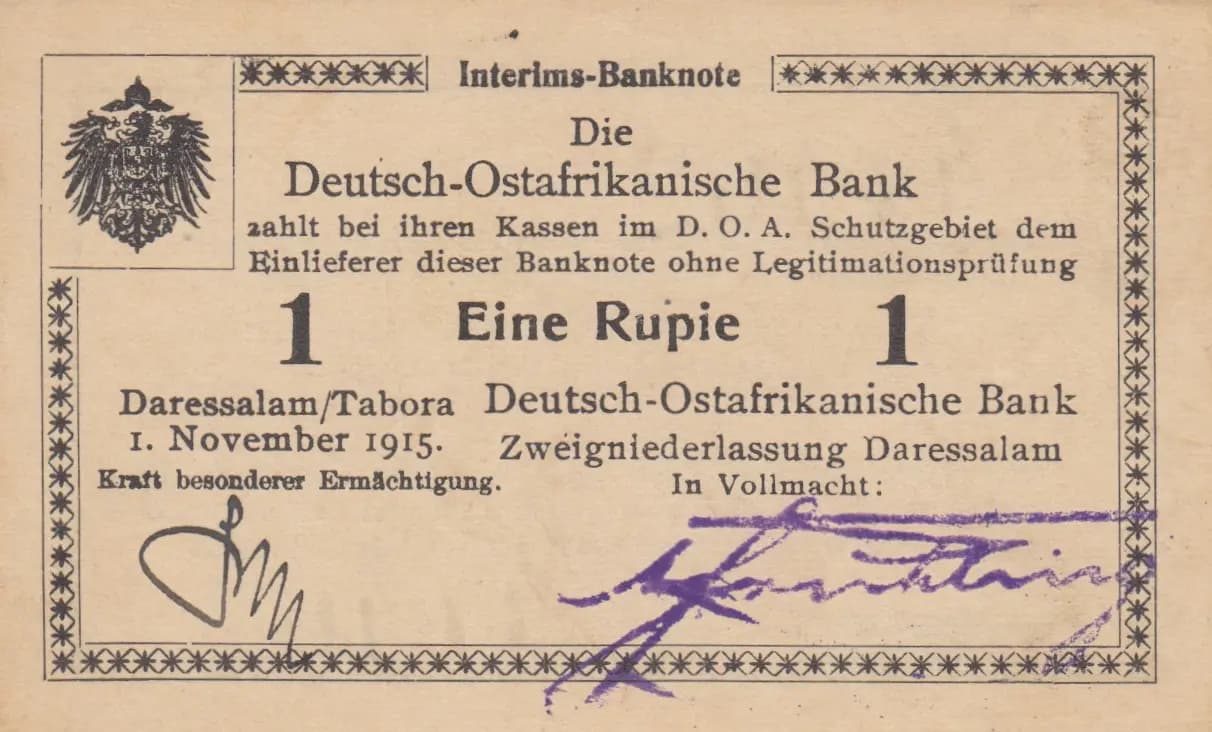
This is an AU-graded 1 Rupee interim banknote from the Deutsch-Ostafrikanische Bank dated November 1, 1915, representing an emergency currency issue during Germany's final year of colonial rule in East Africa. The note exhibits excellent preservation for its age with clear printing, legible text in both German and Swahili, and a distinctive handwritten signature in purple ink. This specific example carries the D2 series designation and serial number 41462, making it a notable specimen of this historically significant but short-lived German colonial currency.
Common. While German East African notes are collected within specialized numismatic circles focusing on German colonial currency, Pick-listed 1915 German East African rupee notes were issued in substantial quantities as emergency currency to facilitate commerce during WWI. The observed AU condition and D2 series designation do not represent noteworthy scarcity. These notes were widely circulated in the colony and subsequently dispersed through collections; surviving examples are readily available to collectors at modest valuations.
Issued in November 1915 during World War I when the German East African colony faced severe currency shortages and isolation from the German homeland, this interim banknote was backed by the Imperial Government of German East Africa rather than conventional reserves. The bilingual German-Swahili inscriptions and Dar es Salaam/Tabora issuing locations reflect the colonial administration's governance of the protectorate. The Imperial German Eagle coat of arms prominently displayed on the obverse symbolizes Imperial authority in the colony, which would cease to exist as a German possession within two years as the territory fell to Allied forces.
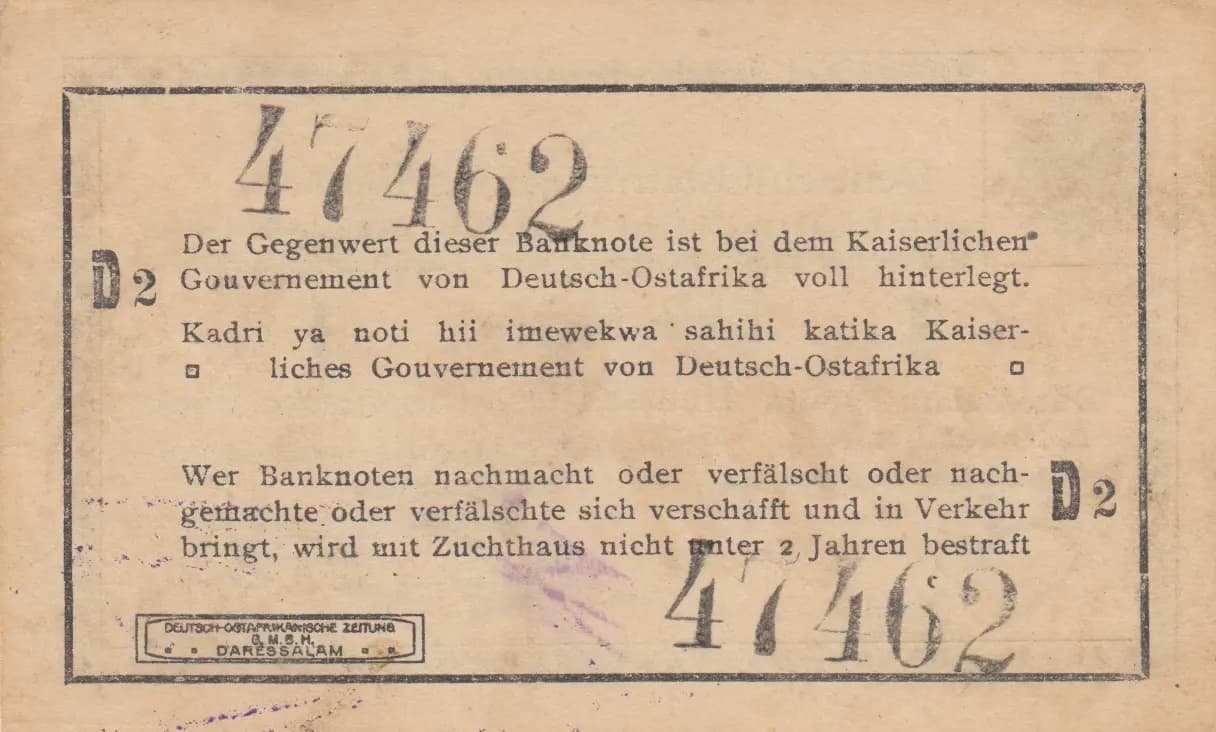
The obverse features the Imperial German Eagle coat of arms—a crowned heraldic eagle with shield—positioned in the upper left corner, symbolizing sovereign Imperial authority over the German East African protectorate. The denomination 'Eine Rupie' (One Rupee) is prominently displayed, reflecting the currency standard used in German East Africa. Ornamental borders consisting of repeated cross or X-like geometric patterns frame the note, a typical security feature of early 20th-century German banknote design. The reverse side contains regulatory and valuation text in both German and Swahili, indicating bilingual administrative reach, along with a rectangular stamp impression from the Deutsch-Ostafrikanische Zeitung (German East African Newspaper) of Dar es Salaam. A handwritten signature in purple-blue ink appears on the obverse, representing authorized authorization by bank officials. The tan/beige paper coloration is consistent with early 20th-century bond paper stock used for emergency currency issues.
FRONT SIDE: 'Interims-Banknote' (Interim Banknote) / 'Die Deutsch-Ostafrikanische Bank' (The German East African Bank) / 'zahlt bei ihren Kassen im D. O. A. Schutzgebiet dem Einlieferer dieser Banknote ohne Legitimationsprüfung' (pays at its cash desks in the D.O.A. protectorate to the depositor of this banknote without verification of legitimation) / 'Eine Rupie' (One Rupee) / 'Daressalam/Tabora' (Dar es Salaam/Tabora) / '1. November 1915' (1 November 1915) / 'Deutsch-Ostafrikanische Bank Zweigniederlassung Daressalam' (German East African Bank Branch Dar es Salaam) / 'In Vollmacht:' (By authority/power of attorney:) / 'Kraft besonderer Ermächtigung' (By special authorization). BACK SIDE: Serial number '41462' / Designation 'D 2' / 'Der Gegenwert dieser Banknote ist bei dem Kaiserlichen Gouvernement von Deutsch-Ostafrika voll hinterlegt.' (The value of this banknote is fully deposited with the Imperial Government of German East Africa.) / Swahili equivalent: 'Kadri ya noti hii imewekwa salihi katika Kaiserliches Gouvernement von Deutsch-Ostafrika' (The value of this note has been approved by the Imperial Government of German East Africa) / 'Wer Banknoten nachmacht oder verfälscht oder nachgemachte oder verfälschte sich verschafft und in Verkehr bringt, wird mit Zuchthaus nicht unter 2 Jahren bestraft' (Whoever counterfeits or forges banknotes or procures counterfeit or forged ones and brings them into circulation shall be punished with imprisonment for not less than 2 years) / Stamp: 'DEUTSCH-OSTAFRIKANISCHE ZEITUNG . . . DARESSALAM . .' (German East African Newspaper ... Dar es Salaam ...).
Letterpress printing on high-quality bond paper, a standard security method for German banknote production of the era. The clear, sharp impression of the Imperial Eagle, crisp text, and well-defined ornamental borders indicate professional German bank note printing, likely executed by one of the established German security printers contracted by the Reichsbank or the Deutsch-Ostafrikanische Bank. The handwritten signatures were added post-printing for authorization purposes. No additional security features such as watermarks, holograms, or color shifting inks are evident, consistent with the emergency interim nature of this issue.
This example is identified as Pick-9Ab with series designation D2 and serial number 41462. The 'Ab' designation in Pick's catalog typically indicates a specific variety within the 1 Rupee 1915 issue, often differentiated by printer, issuer branch variations, or signature varieties. The D2 series notation visible on the reverse is a significant identifying feature for this particular variety. The handwritten signature in purple ink represents an authorization signature variant, as different authorized officials signed notes during the issuing period. Serial number 41462 falls within the documented range for D2 series notes of this emission.