1 rupee 1915
“serie B2”
About This Note
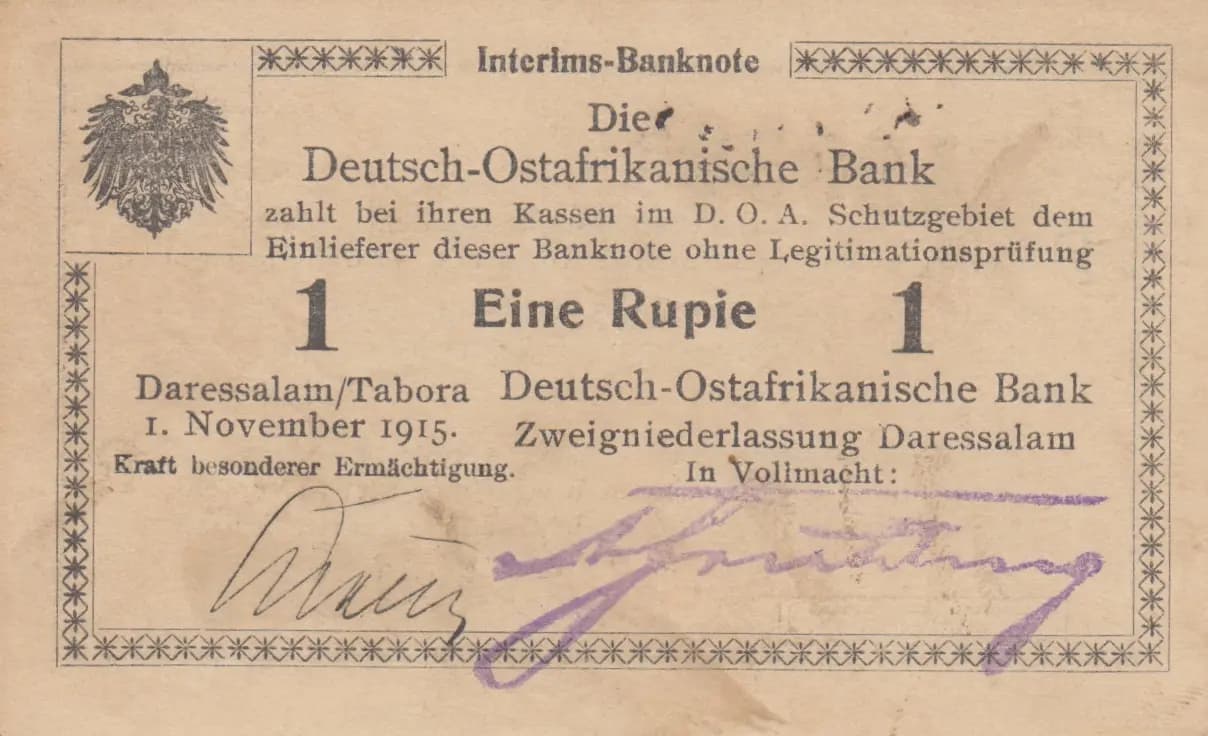
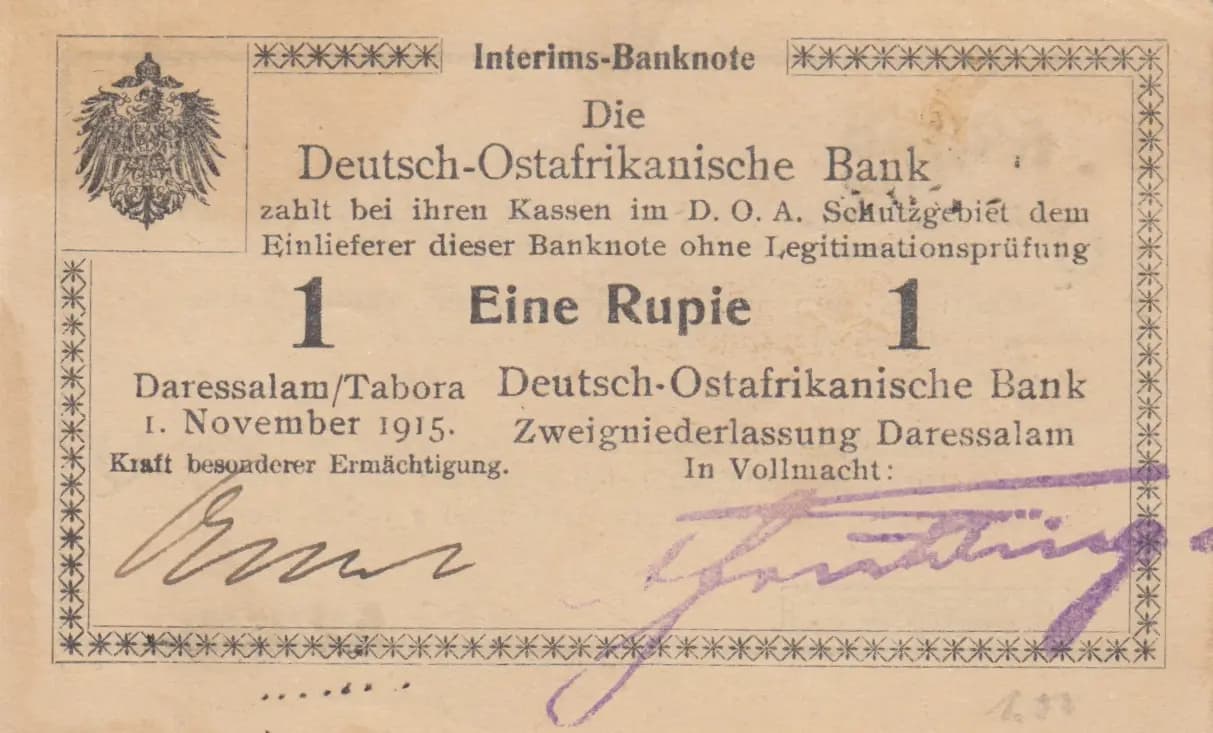
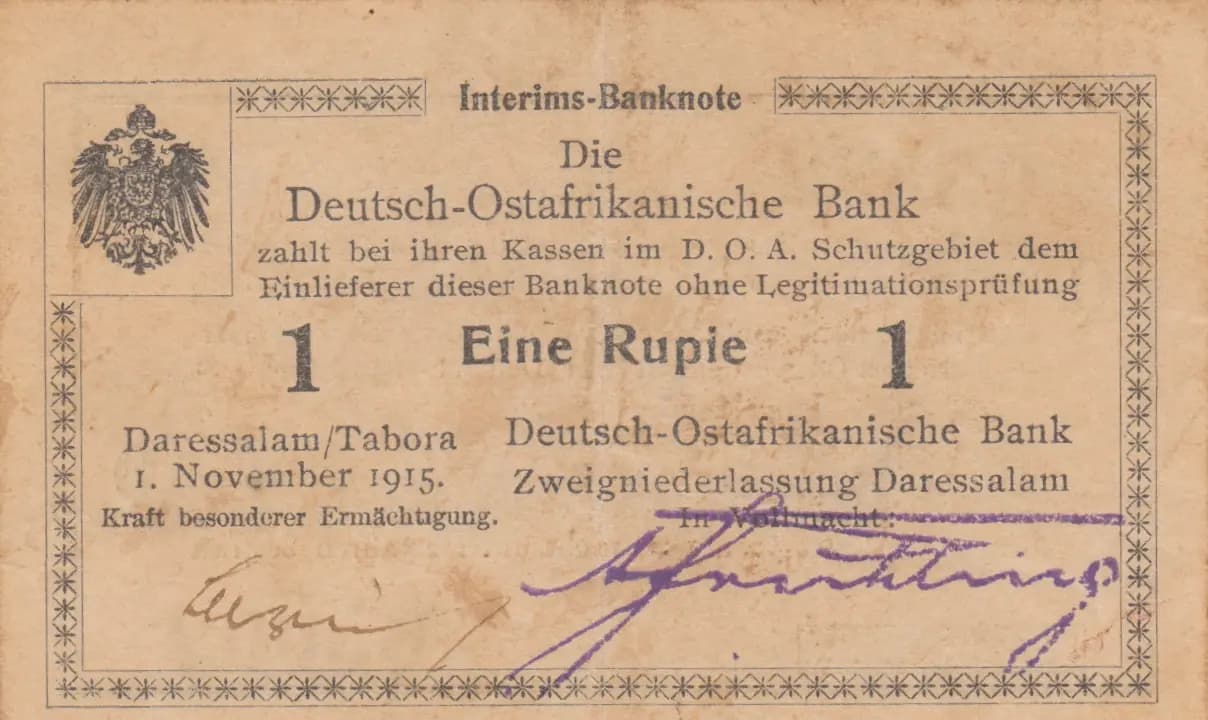
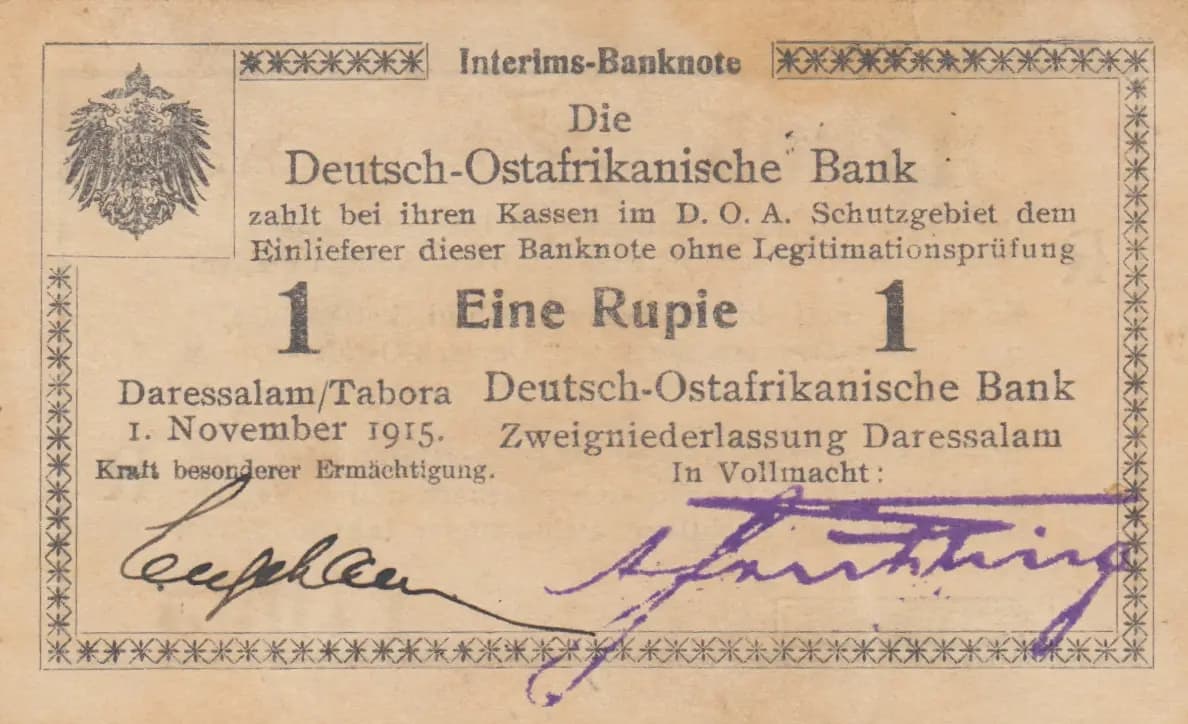
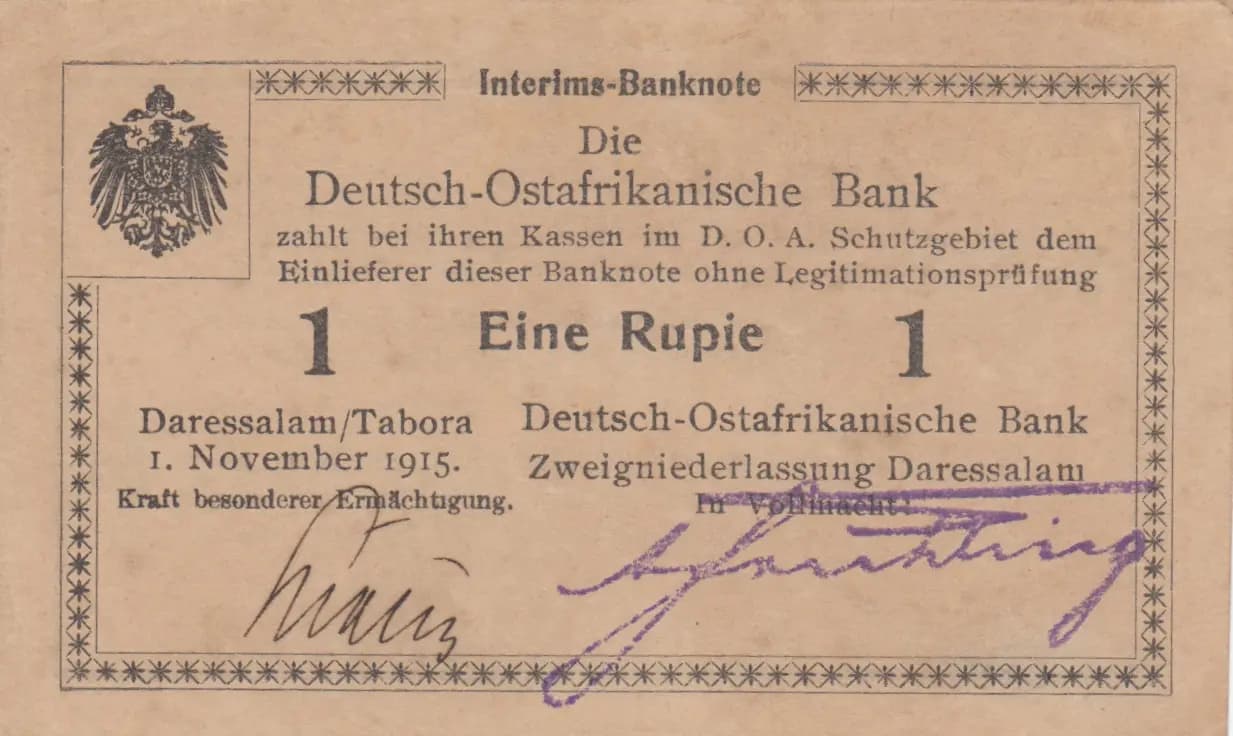
This is an exceptional AU-grade example of the 1915 German East African Bank 1 Rupee interim banknote (Pick P-9Ab), series B2. The note features the Imperial German eagle coat of arms and displays the characteristic tan/beige paper stock typical of WWI-era emergency currency. While showing honest age-related wear including creasing and foxing, the note retains excellent clarity of print and exhibits the handwritten signatures and purple administrative marks that authenticate its historical use in German East Africa.
Common. This interim banknote from 1915 was issued in substantial quantities during a period of monetary emergency in German East Africa. While German East African notes are less commonly encountered in collections compared to other colonial currencies, the 1 Rupee denomination was the most widely circulated of the interim series. The Pick P-9Ab designation indicates this is a standard variety without unusual characteristics that would restrict its availability. No print run data suggests restricted production, and these notes appear regularly in dealer inventories and auction results, typically at modest valuations.
This interim banknote was issued on November 1, 1915, during Germany's administration of German East Africa (Deutsch-Ostafrikanische Schutzgebiet) under the Deutsch-Ostafrikanische Bank. The 'interim banknote' designation and bilingual German-Swahili text reflect the transitional monetary conditions of colonial East Africa during the First World War, when traditional banking channels were disrupted and emergency currency became necessary. The note's connection to the Imperial Governor's office and dual issuance locations in Dar es Salaam and Tabora underscore the geographic reach of German colonial administration in the region.
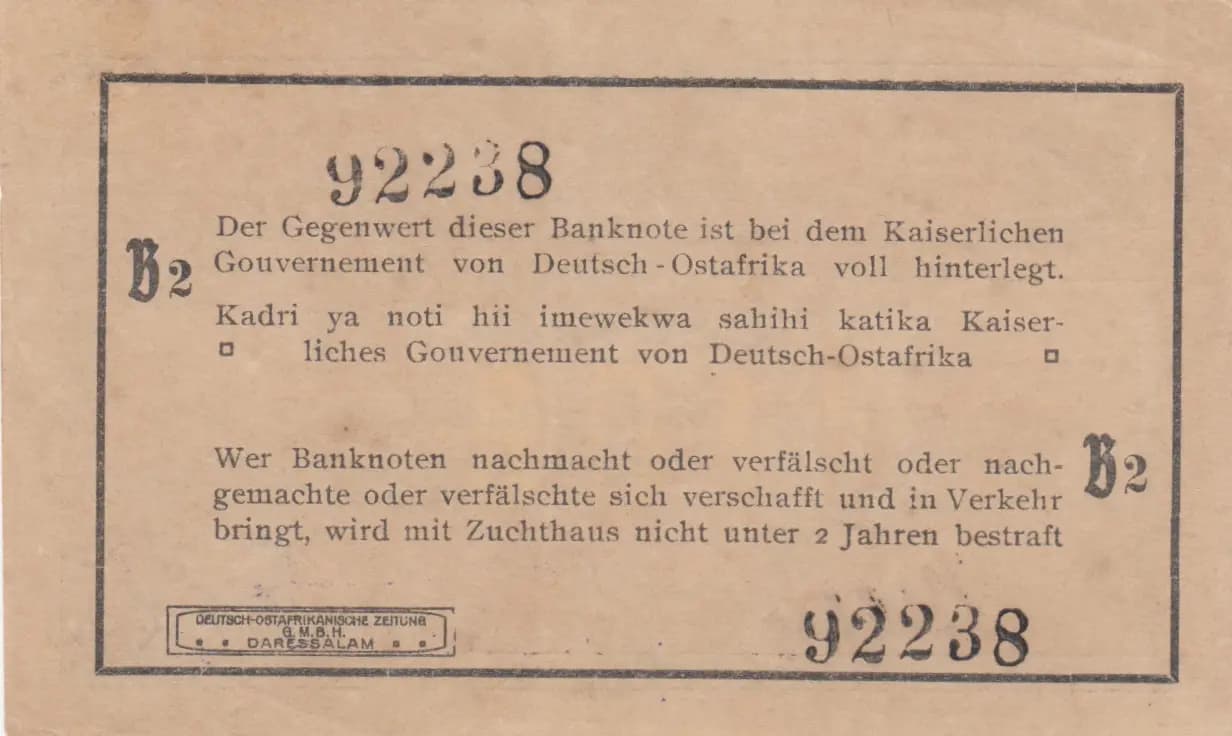
The obverse features the Reichsadler (Imperial German eagle coat of arms) prominently positioned in the upper left corner, displaying the heraldic authority of the German Empire over its colonial possession. The denomination '1 Rupie' is displayed in large, bold text as the note's primary identifying feature, positioned centrally. Decorative ornamental borders composed of repeated asterisk patterns frame the left and right margins, a common security design element for the period. The reverse side presents a more utilitarian design with a rectangular border frame, containing legal text, the serial number 92238, and notably includes a printed stamp box from the Deutsch-Ostafrikanische Zeitung newspaper in Dar es Salaam, reflecting the emergency nature of this interim currency. The bilingual German-Swahili text on the reverse demonstrates the colonial administration's recognition of local linguistic needs.
FRONT: 'Interims-Banknote' (Interim banknote); 'Die Deutsch-Ostafrikanische Bank' (The German East African Bank); 'zahlt bei ihren Kassen im D.O.A. Schutzgebiet dem Einlieferer dieser Banknote ohne Legitimationsprüfung' (pays at its cashiers in the D.O.A. protectorate to the depositor of this banknote without verification of legitimacy); 'Eine Rupie' (One Rupee); 'Daressalam/Tabora' (Dar es Salaam/Tabora); '1. November 1915' (1 November 1915); 'Kraft besonderer Ermächtigung' (By special authority); 'Deutsch-Ostafrikanische Bank Zweigniederlassung Daressalam' (German East African Bank branch office Dar es Salaam); 'Im Vollmacht' (By authority). BACK: Serial number '92238' (appears twice); 'Der Gegenwert dieser Banknote ist bei dem Kaiserlichen Gouvernement von Deutsch-Ostafrica voll hinterlegt' (The equivalent value of this banknote is fully deposited with the Imperial Government of German East Africa); 'Kadri ya noti hii imewekwa sahihi katika Kaiserliches Gouvernement von Deutsch-Ostafrica' (Swahili: The value of this note has been properly set aside with the Imperial Government of German East Africa); 'Wer Banknoten nachmacht oder verfälscht oder nachgemachte oder verfälschte sich verschafft und in Verkehr bringt, wird mit Zuchthaus nicht unter 2 Jahren bestraft' (Whoever counterfeits or falsifies banknotes, or acquires counterfeit or falsified notes and puts them into circulation, will be punished with imprisonment of not less than 2 years); 'DEUTSCH-OSTAFRIKANISCHE ZEITUNG G.m.b.H. DARESSALAM' (German East African Newspaper Ltd. Dar es Salaam).
This note was produced using letterpress (relief) printing, evidenced by the crisp, sharp impression of text and the uniform density of the black ink across both sides. The printing was executed by the Deutsch-Ostafrikanische Zeitung (German East African Newspaper) in Dar es Salaam, as indicated by the newspaper's stamp and attribution on the reverse. The paper stock is unwatermarked and relatively simple, typical of emergency wartime currency production. The handwritten signatures and administrative marks visible on the obverse were added by hand post-printing, standard practice for authorizing officers at the issuing bank.
This example is cataloged as series B2, a designation visible in the collector notes. Serial number 92238 places this note within the sequence of B-series production. The date '1. November 1915' is standard for the entire interim issue of this type. Variations in this series include different series letters (A, B, C, etc.) and corresponding serial number ranges. The handwritten signatures and administrative marks present on this specimen are typical of issued notes and do not constitute a distinct cataloged variety. Pick P-9Ab represents the standard variety of the 1 Rupee interim banknote; varieties P-9Aa and P-9Ac exist with different series designations.