50 francs 1942
Market Prices
137 salesAbout This Note
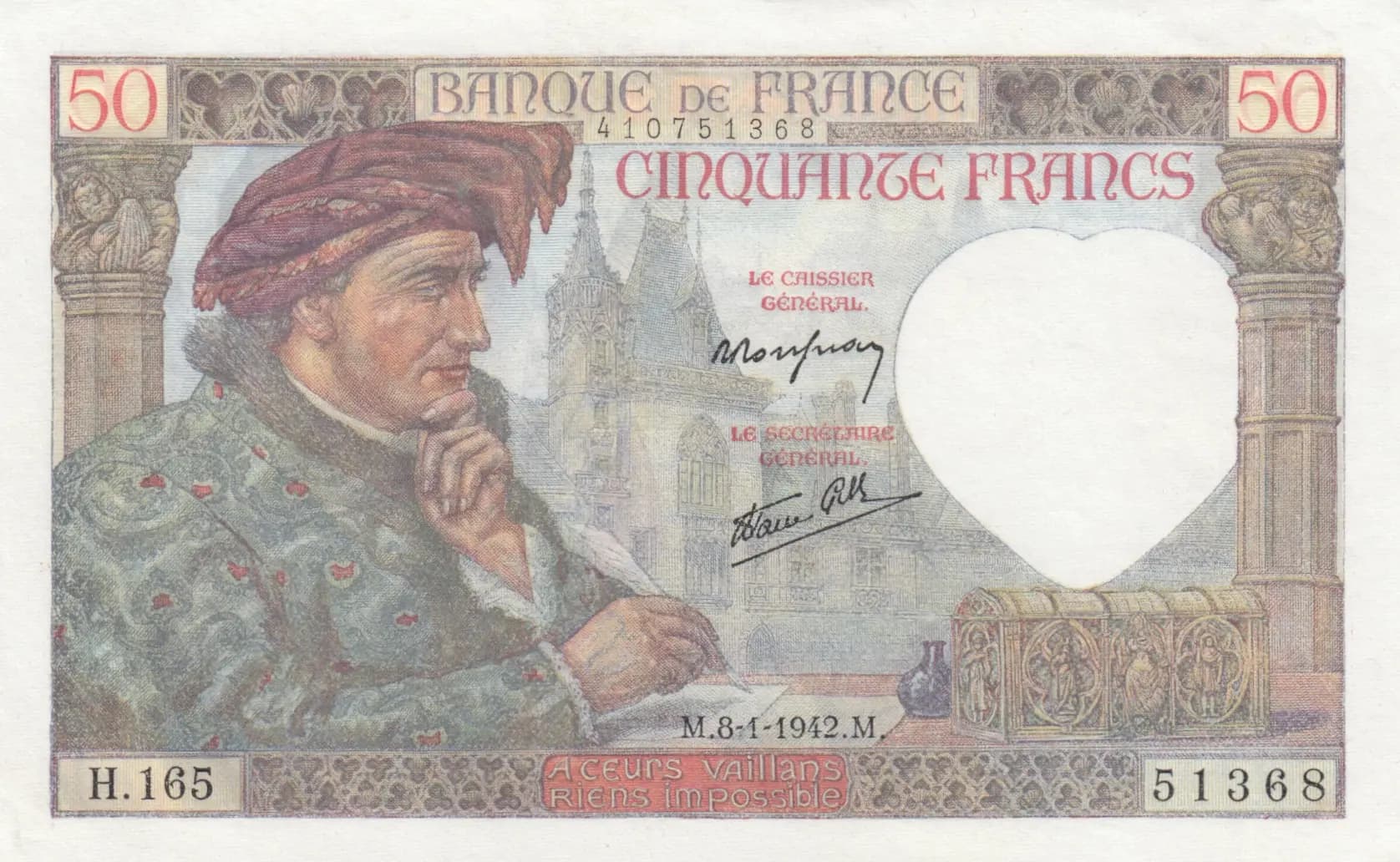
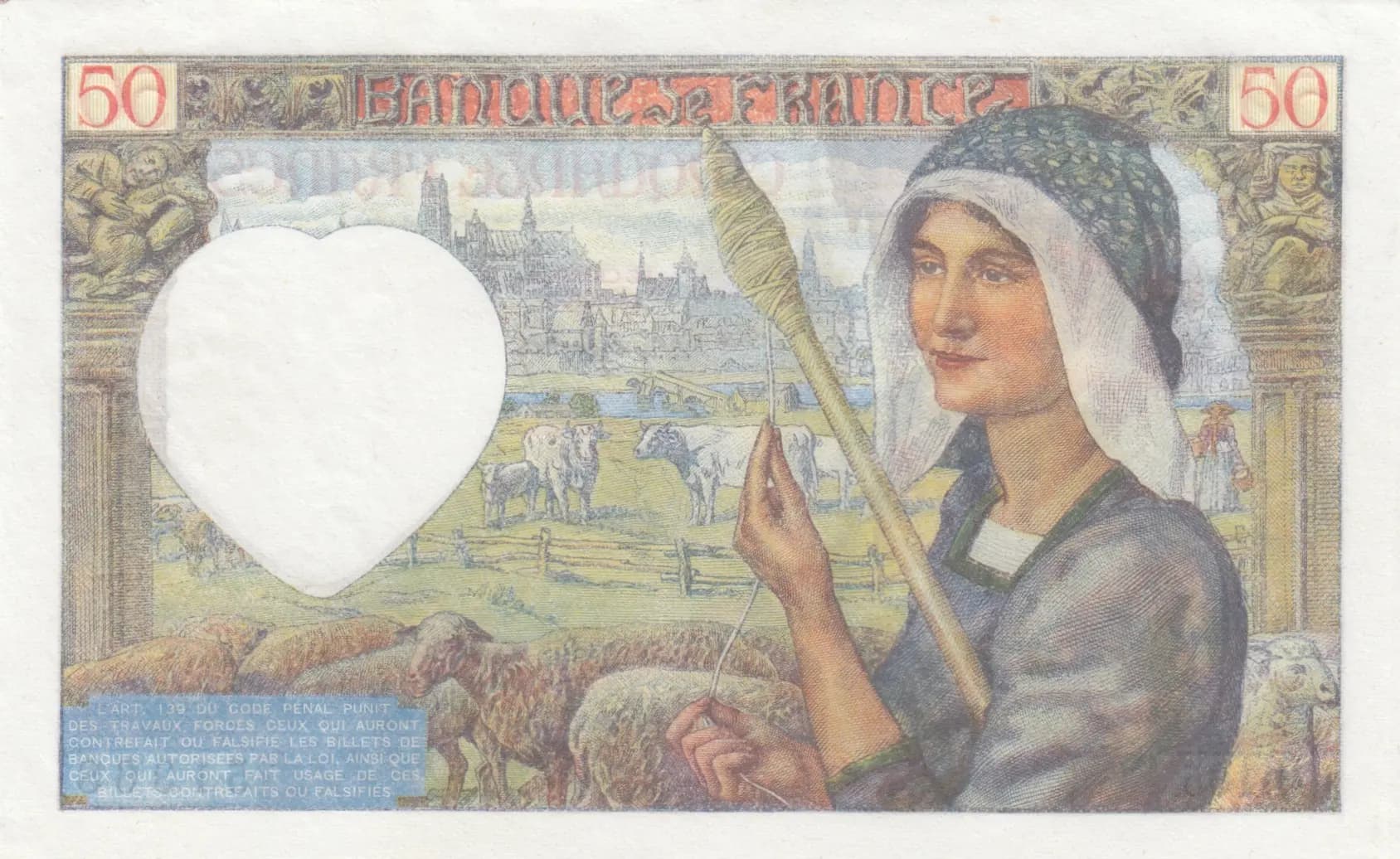
This is an uncirculated example of the French 50 francs note from 1942 (Pick P-93), featuring exceptional preservation with no visible wear, creases, or stains. The obverse depicts a contemplative male figure in Renaissance-style clothing set against a cathedral backdrop, while the reverse showcases a pastoral landscape with a female figure in traditional dress. The note displays the hallmark characteristics of Banque de France currency from the Vichy-era occupation period, with fine engraving quality and vibrant color preservation typical of pristine specimens.
Common. While this is a genuine historical note from the Vichy period with interesting political context, the eBay price data demonstrates consistent market pricing in the $40-$60 range for UNC examples over multiple decades, with even premium graded examples (PMG 67-68) rarely exceeding $200-$250. The significant print run from 1942 and continuous circulation of surviving examples indicate this is a readily available note in today's market. Common condition examples (F-VF) regularly sell for $2-$15, confirming widespread availability.
Issued during January 1942 under the Vichy French regime during Nazi occupation, this banknote reflects the institutional continuity of the Banque de France through the Second World War. The inscription 'Cœurs vaillants, rien impossible' (Courageous hearts, nothing is impossible) appears to reference the spirit of resistance or perseverance during this turbulent historical period. The note's classical imagery—featuring Renaissance portraiture and pastoral French landscapes—underscores the regime's appeal to French cultural heritage and national identity during occupation.
The obverse features a mature male figure in right-facing profile, identified as a Renaissance or historical personage based on period costume, wearing a distinctive burgundy velvet hat and green embroidered jacket with his hand positioned contemplatively near his chin. Behind this portrait stands an architectural element depicting a Gothic cathedral with characteristic spires. The reverse showcases a female figure in traditional dress with a white headdress and dark garments, holding a staff, set against an idyllic pastoral landscape populated with sheep, wooden fences, rolling fields, and fortified medieval architecture in the background. Both sides incorporate ornamental borders featuring Corinthian capitals and elaborate geometric and floral patterns typical of high-security currency design of the period. The white oval areas on both sides represent watermark zones. The denomination '50' appears in red in the corners of both sides, with the color palette dominated by greens, burgundies, blues, and earth tones.
FRONT: '50' (denomination in corners), 'BANQUE DE FRANCE' (Bank of France), 'CINQUANTE FRANCS' (Fifty francs), 'LE CAISSIER GÉNÉRAL' (The General Cashier), 'LE SECRÉTAIRE GÉNÉRAL' (The General Secretary), signatures of 'Moreau' and 'Alérien Gill', date code 'M.8-1-1942.M' (8 January 1942), serial identifiers 'H.165' and '51368', motto 'CŒURS VAILLANTS RIEN IMPOSSIBLE' (Courageous hearts, nothing is impossible). BACK: '50' (denomination in corners), 'BANQUE DE FRANCE' (Bank of France), legal warning: 'ART. 139 DU CODE PÉNAL PUNIT DE MORT OU DE TRAVAUX FORCÉS CEUX QUI AURAIENT CONTREFAIT OU FALSIFIÉ LES BILLETS DE BANQUES AUTORISÉS PAR LA LOI, AINSI QUE CEUX QUI AURAIENT FAIT USAGE DE CES CONTREFAITS OU FALSIFIÉS' (Article 139 of the Penal Code punishes with death or hard labor those who would have counterfeited or falsified banknotes authorized by law, as well as those who would have made use of these counterfeits or falsifications).
Intaglio (engraved) printing, characteristic of Banque de France currency of this era. The fine line engraving is evident throughout both obverse and reverse, with precise detail work in the portraiture, architectural elements, landscape features, and ornamental borders. The security printer for this series was typically Banque de France's internal printing facilities or contracted commercial security printers such as Bradbury, Wilkinson & Co. or similar firms capable of the high-security work required for French currency during this period.
The specific variety is identifiable by the date code 'M.8-1-1942.M' indicating an 8 January 1942 printing date, and serial prefix 'H.165' with individual serial number '4107513068'. The signature combination of 'Moreau' (General Cashier) and 'Alérien Gill' (General Secretary) is consistent with Banque de France officials of the 1942 period. No rare printing varieties have been documented for Pick P-93 in numismatic literature; all known variants from this issue appear to be standard circulation printings from the Vichy-era production run.