5 francs 1924
Market Prices
11 salesAbout This Note
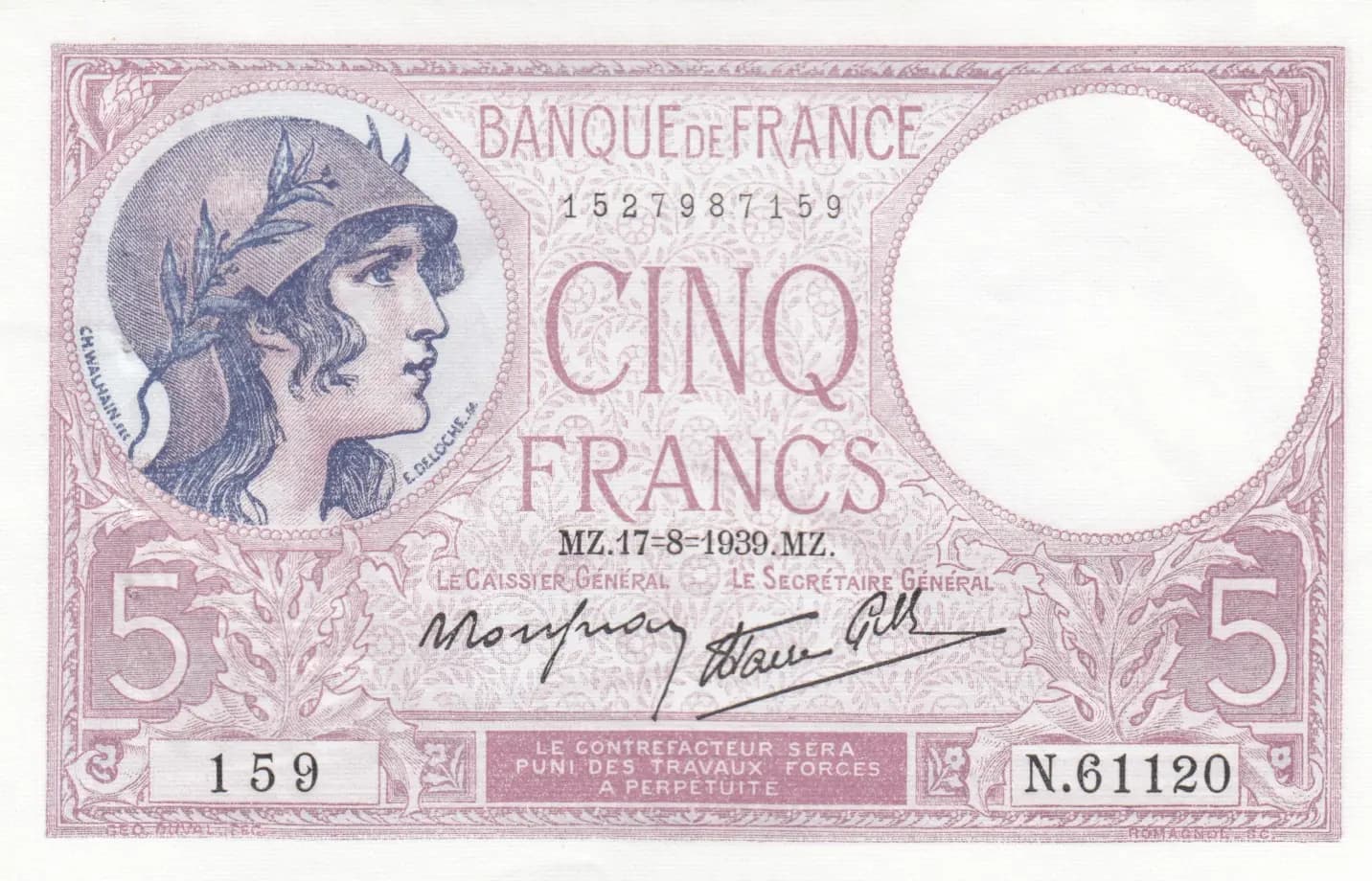
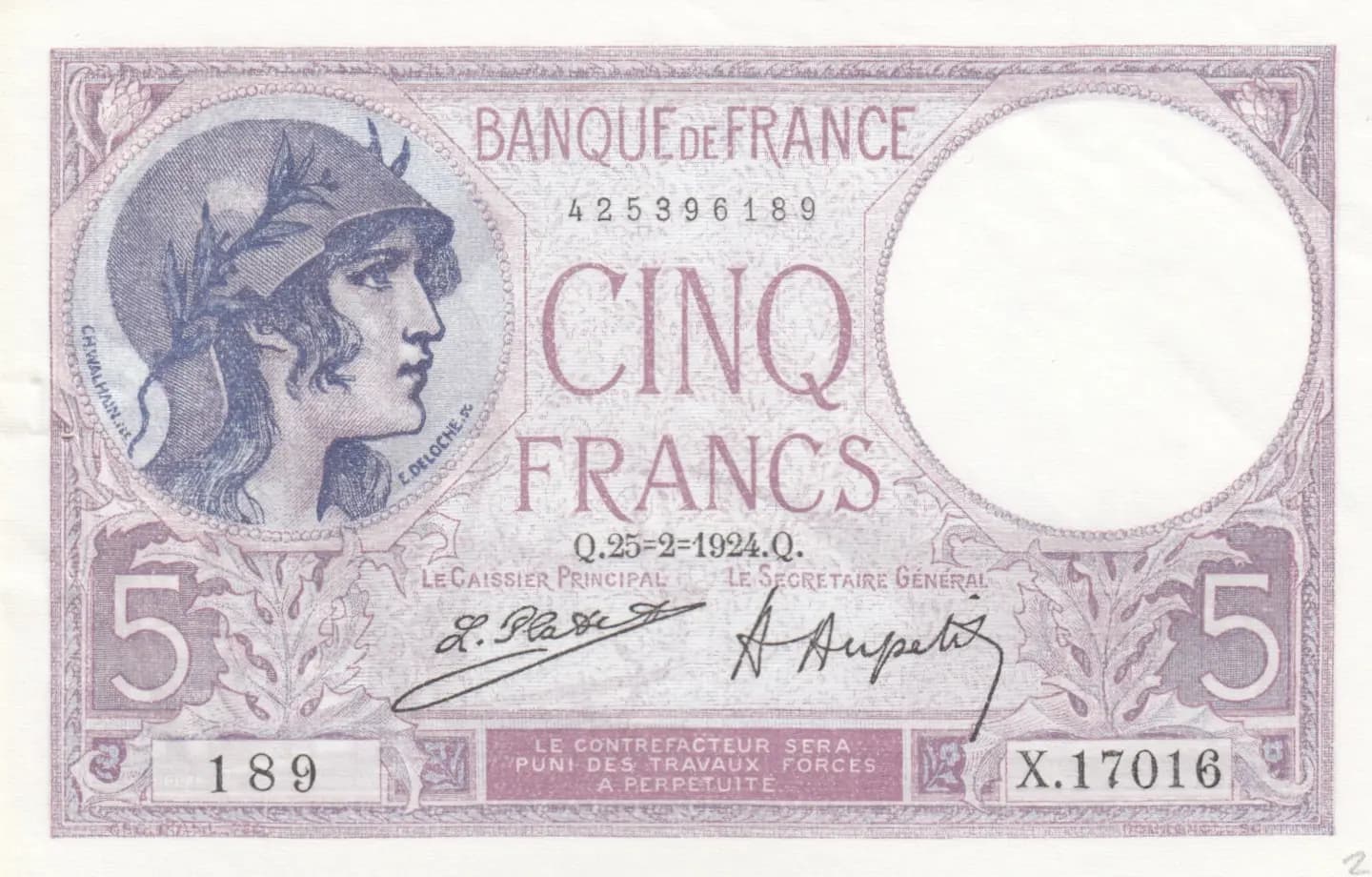
This is an AU-grade 1924 French 5 francs note (Pick P-72c) from the Banque de France, featuring a classical male profile portrait on the front and allegorical maritime imagery on the back. The note exhibits crisp, uncirculated characteristics with sharp engraving, vibrant pink/mauve coloring, and no visible wear, making it a desirable example of interwar French currency. The ornate design and historical signatures (L. Platet and A. Aupetit) document this piece of post-WWI French monetary history.
Common. The 1924 5 francs (P-72c) was issued in substantial quantities during a period of regular circulation. eBay market data shows consistent sales across multiple condition grades, with AU/UNC examples typically commanding $30-60, indicating a readily available note in the collector market. Print runs for this denomination and period were substantial, and survival rates remain high.
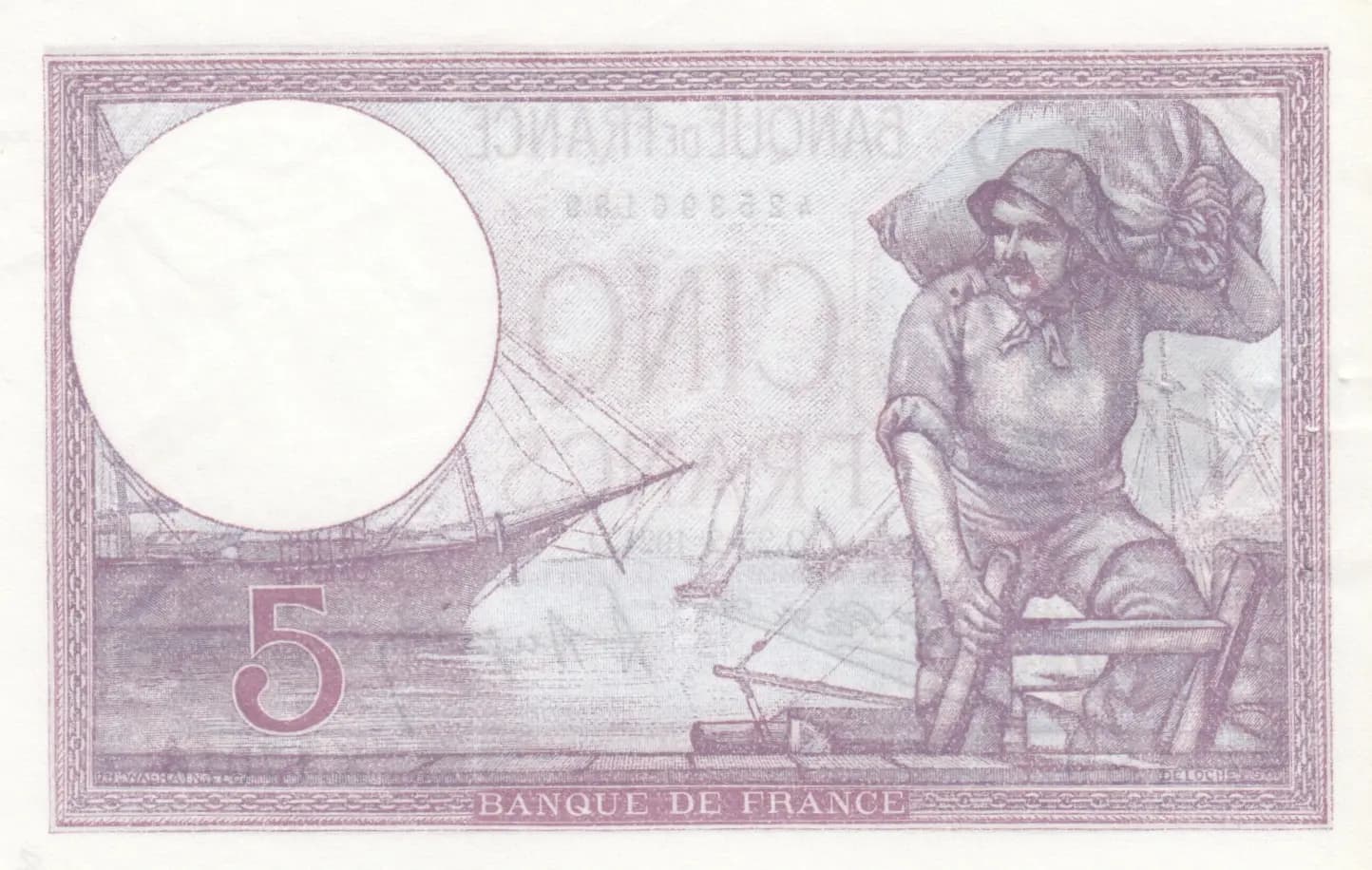
Issued during the post-World War I period (1924), this note reflects France's economic stabilization efforts under the leadership of the Banque de France. The allegorical imagery on the reverse—featuring a seated female figure with maritime symbols and a sailing ship—evokes France's commercial and naval traditions during a period of reconstruction and renewed international trade following the Treaty of Versailles. The classical male portrait on the front represents the republican values of the Third Republic during this economically volatile decade.
The front features a classical male profile portrait facing right, rendered in blue ink and framed in an ornate circular border with pearl-like beading, representing republican civic virtue. The figure wears what appears to be a Phrygian cap, a traditional symbol of liberty and the French Republic. The back depicts an allegorical female figure (representing Justice or Commerce) seated on the right, holding an anchor and gesturing toward a sailing ship depicted in the background—maritime symbols emphasizing France's commercial and naval heritage. Ornate scrollwork and floral decorative elements frame both sides, with large denomination numerals positioned in the corners. The pink and mauve color scheme creates a distinctive aesthetic characteristic of this series.
Front side: 'BANQUE DE FRANCE' (Bank of France), 'CINQ FRANCS' (Five francs), 'LE CAISSIER PRINCIPAL' (The Principal Cashier), 'LE SECRETAIRE GENERAL' (The General Secretary), signatures of L. Platet (Principal Cashier) and A. Aupetit (General Secretary), date notation '0.25-2-1924.Q' (February 2, 1924), serial number components 'X.17016' and '425396189'. Back side: 'BANQUE DE FRANCE' (Bank of France), denomination '5' (Five).
Intaglio engraving (taille-douce), the standard security printing method for French banknotes of this period. The fine line work visible in the background patterns, the sharp portrait rendering, and the intricate border details are consistent with steel-plate engraving. The Banque de France employed specialized security printers for this series, utilizing multiple plates and careful registration to prevent counterfeiting.
This specific example bears the date '0.25-2-1924.Q' (February 2, 1924) with signatures of L. Platet (Principal Cashier) and A. Aupetit (General Secretary). Serial number components visible include 'X.17016' prefix and '425396189'. The Pick P-72c designation encompasses notes from the 1917-1933 issue period; varieties within this picking number are typically distinguished by signature combinations, date variations, and serial number prefixes. The 'Q' suffix in the date notation may indicate a quarterly or sequential printing batch identifier used by the Banque de France during this period.