50 francs 1940
Market Prices
23 salesAbout This Note
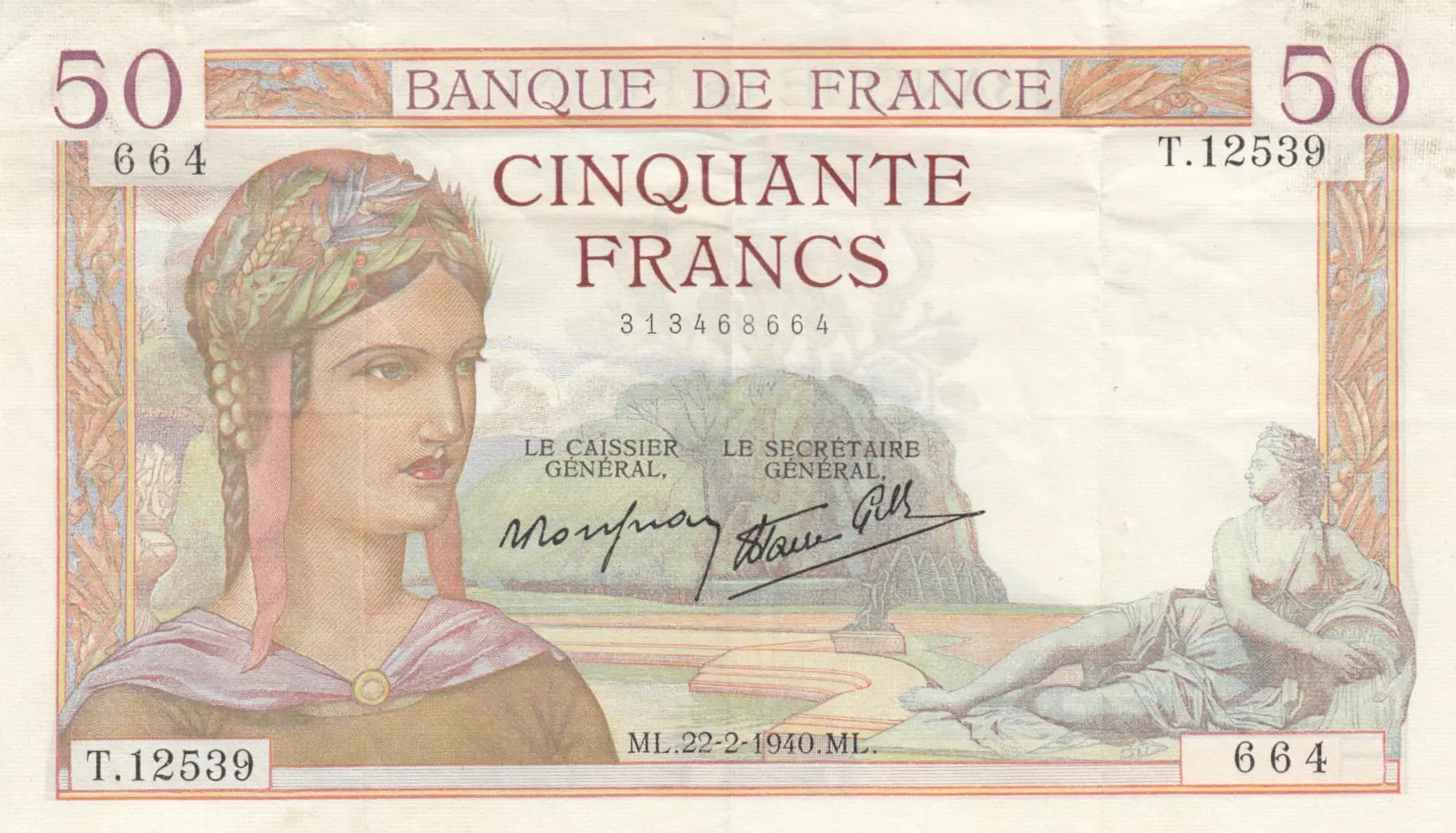
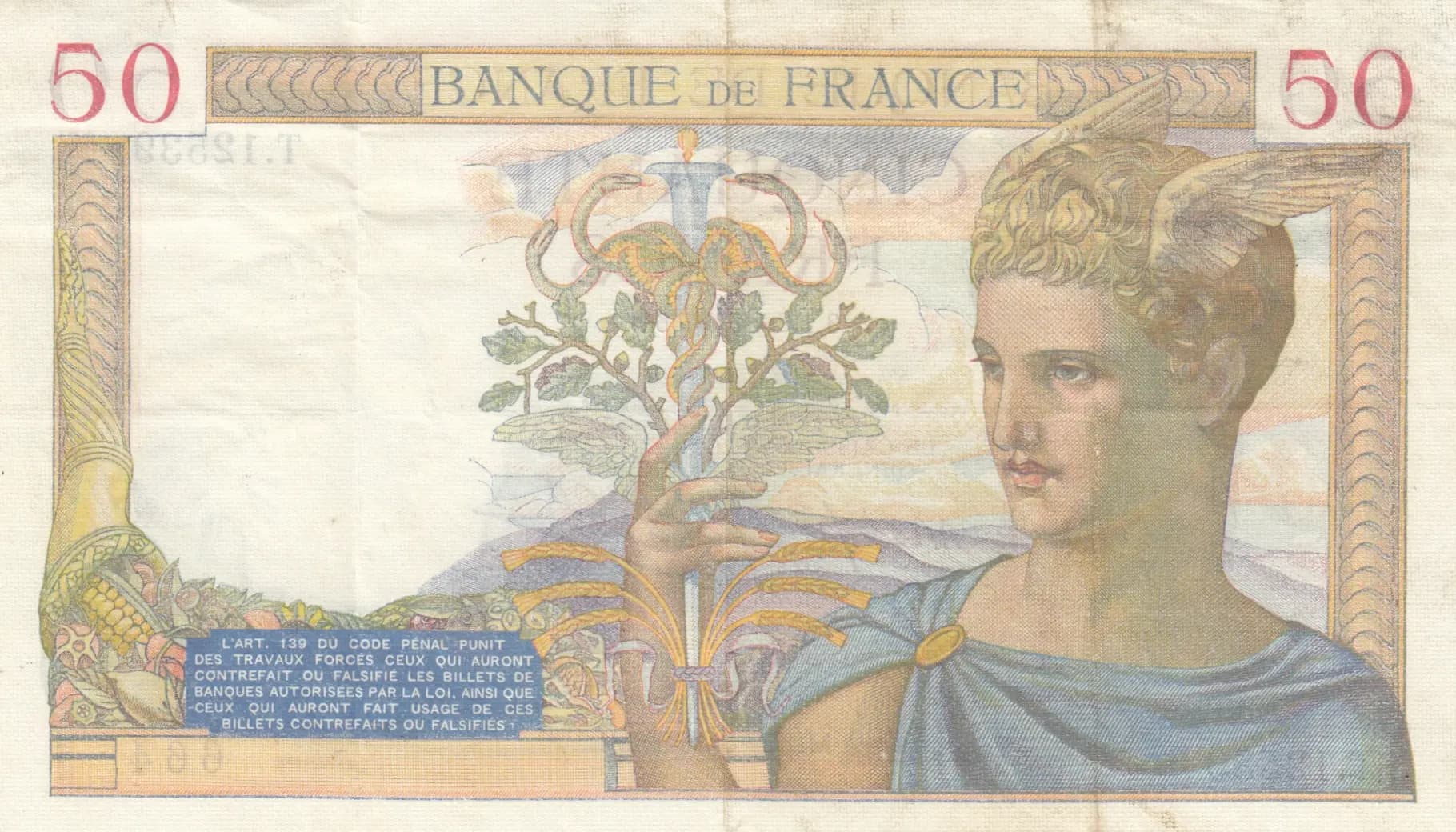
A Very Fine example of the 1940 French 50 Francs 'Cérès' note (P-85b), featuring classical allegorical designs with excellent detail preservation despite visible signs of age and circulation. The front showcases an elaborate profile portrait of Cérès in an ornate feathered headdress alongside a seated allegorical figure, while the reverse depicts Mercury in classical style with cornucopia elements. This note represents an important transitional period in French currency, issued during the tumultuous early days of World War II and the German occupation.
Common. This is a standard issue from the 1937-1940 series, and despite its historical significance, circulated widely. eBay market data shows consistent sales of VF-graded examples in the $5-$25 range over the past decade, with catalog values at $45 for VF condition. The 2016 catalog valuation of $45 VF supports this common classification. While historically important, the note lacks the scarcity factors (limited print run, recall, short-lived issuer) that would elevate it to uncommon or rare status. Millions were printed and circulated.
This 50 Francs note was issued by the Banque de France during 1940, a critical year marking the fall of France and the beginning of the German occupation. The classical allegorical imagery—Cérès (goddess of agriculture) on the obverse and Mercury (god of commerce) on the reverse—reflect the Third Republic's idealization of French prosperity and economic vitality. The date marking of 22 February 1940 (visible as ML.22-2-1940.ML) places this note just weeks before the German invasion in May 1940, making it a poignant artifact of France's final months of independence.
The obverse features Cérès, Roman goddess of agriculture and grain, depicted in classical profile facing left, adorned with an elaborate headdress incorporating feathers, ribbons, and draped fabric in pink and mauve tones, complemented by pearl earrings. To her right is an allegorical seated female figure in classical dress positioned by water, representing prosperity or commerce. The reverse portrays Mercury (Hermes), the classical god of commerce and trade, shown as a male bust in right profile with characteristic curled hair and classical styling. Mercury is depicted alongside a caduceus or ornamental staff with the heraldic symbol of France, and a cornucopia overflowing with fruits and vegetables symbolizing abundance and agricultural wealth. The entire composition is framed with intricate geometric and classical ornamental borders in earth tones and blues, characteristic of Belle Époque design principles applied to Third Republic currency.
FRONT: 'BANQUE DE FRANCE' (Bank of France), 'CINQUANTE FRANCS' (Fifty Francs), '50' (denomination), 'LE CAISSIER GÉNÉRAL' (The General Cashier), 'LE SECRÉTAIRE GÉNÉRAL' (The General Secretary), Serial designations 'T.12539' and '31346664', Date 'ML.22-2-1940.ML' (22 February 1940), with signatures including Morphillon. BACK: 'BANQUE DE FRANCE' (Bank of France), '50' (denomination), Legal warning: 'L'ART. 139 DU CODE PÉNAL PUNIT DES TRAVAUX FORCÉS CEUX QUI AURONT CONTREFAIT OU FALSIFIÉ LES BILLETS DE BANQUES AUTORISÉES PAR LA LOI, AINSI QUE CEUX QUI AURONT FAIT USAGE DE CES BILLETS CONTREFAITS OU FALSIFIÉS' (Article 139 of the Penal Code punishes with hard labor those who have counterfeited or falsified banknotes authorized by law, as well as those who have made use of these counterfeit or falsified banknotes).
Intaglio (engraved) printing in multiple colors, executed with fine line work and detailed engraving throughout. The security features include intricate border designs, fine line patterns, and multi-color intaglio printing technique. The Banque de France employed master engravers for this series; this particular note exhibits the high-quality craftsmanship standard for French banknotes of the period. The visible wear patterns, foxing, and discoloration are consistent with traditional rag-based paper stock used in French currency production.
This example is identified as Pick P-85b, indicating it belongs to the second major variety of the 1940 50 Francs issue. The serial number prefix 'T.12539' and the date marking 'ML.22-2-1940.ML' (22 February 1940) are characteristic of notes from this specific printing period. The signatures visible (including Morphillon as one of the official signatories) are consistent with early 1940 Banque de France authority documentation. The 'T' prefix and specific serial numbering scheme help distinguish this from earlier P-85a varieties and later wartime printings under Vichy authority.