1 franc 1919
About This Note
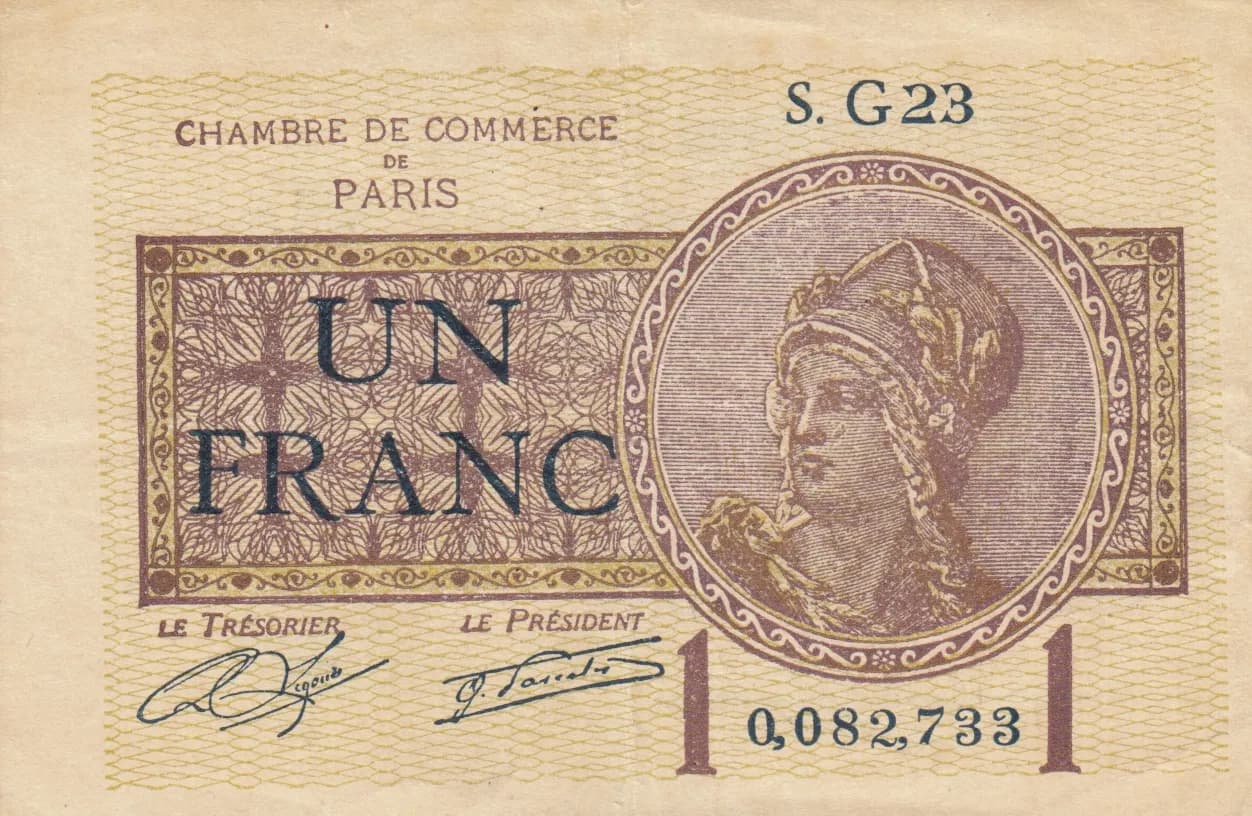
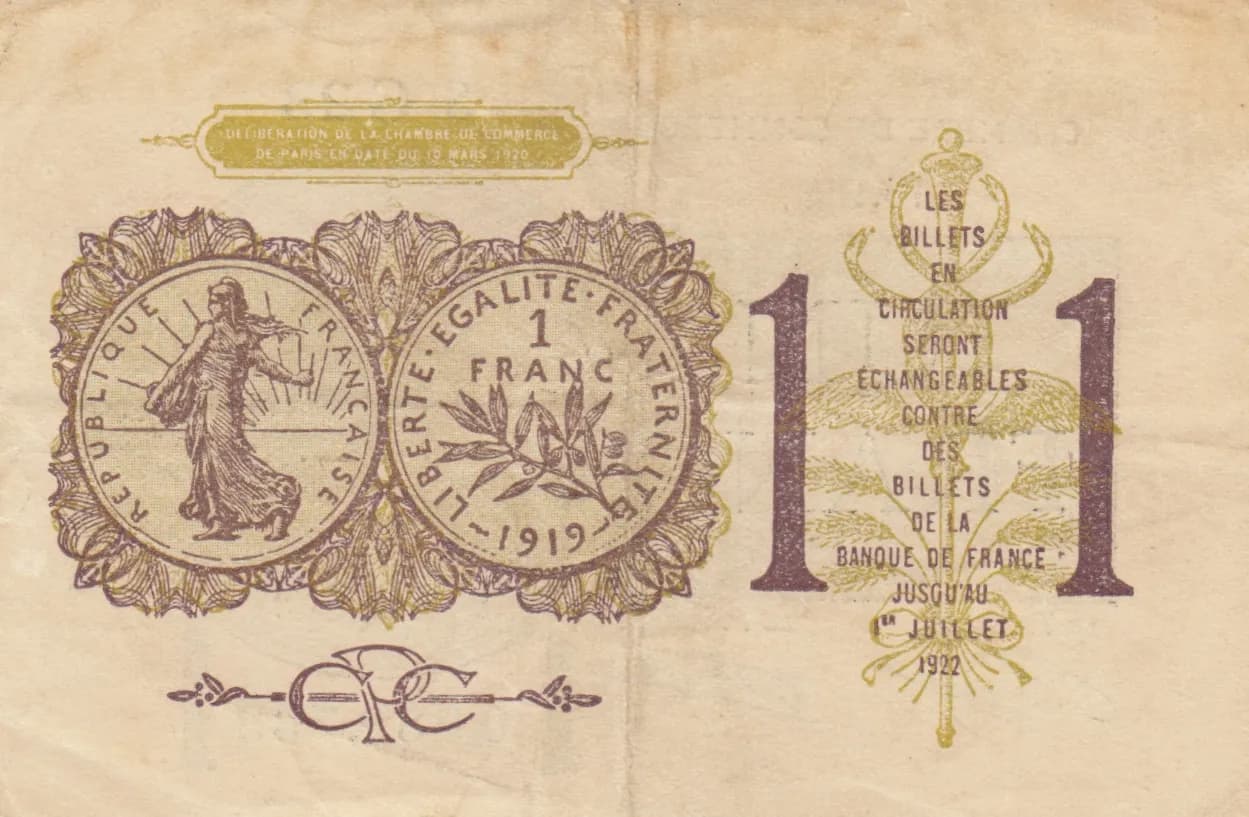
This is a 1 franc emergency banknote issued by the Chambre de Commerce de Paris in 1919, a transitional currency issued during post-World War I monetary instability. The note displays excellent preservation for its age, featuring a classical Marianne portrait wearing the Phrygian cap on the obverse and allegorical representations of Liberty, Equality, and Fraternity on the reverse—all rendered in fine engraved detail with brown and purple color schemes. The reverse includes a significant redemption note indicating circulation would be exchangeable for Bank of France notes until July 1, 1922, making this a fascinating artifact of France's post-war financial recovery period.
Common. Chamber of Commerce emergency notes from 1919-1920 were issued in substantial quantities to meet temporary monetary needs during post-war reconstruction. These notes were widely circulated and millions were eventually redeemed or destroyed as intended, making surviving examples relatively common in the market. The VF condition grade and the fact that the note survived intact through its redemption period are noteworthy for preservation, but the note itself is not scarce. Similar examples regularly appear in European numismatic markets at modest valuations.
Following World War I, the Chamber of Commerce of Paris issued these 1 franc notes as emergency currency to supplement the Bank of France's monetary supply during post-war reconstruction and inflation. The deliberate imagery of Republican virtue—Marianne with the Phrygian cap and the triad of Liberty, Equality, and Fraternity dated 1919—reinforces the themes of renewal and democratic stability following the war. The March 18, 1920 authorization date and the redemption deadline of July 1, 1922 reflect the temporary nature of these chamber notes, which were officially recognized as a stopgap measure during France's financial reorganization.
The obverse features a classical bust portrait of Marianne, the personification of the French Republic, rendered in right profile wearing the iconic Phrygian cap of Liberty. This allegorical representation anchors the note's patriotic message. The denomination 'UN FRANC' is prominently displayed in the center-left, flanked by ornamental borders featuring intricate geometric patterns typical of early 20th-century security engraving. Signature lines for the President and Treasurer are positioned below the portrait. The reverse presents two circular medallions at the top: the left contains an allegorical female figure labeled 'LIBERTÉ FRANCE,' while the right shows another classical female figure representing 'ÉGALITÉ FRATERNITÉ' with the date 1919. A large numeral '1' ornamentally designed occupies the right side. The central and lower portions contain the redemption text explaining the note's exchangeability, reflecting its status as emergency currency. The overall design palette uses brown and tan on the obverse and purple/maroon with cream and gold accents on the reverse.
FRONT SIDE: 'CHAMBRE DE COMMERCE' / 'DE PARIS' (Chamber of Commerce of Paris); 'UN FRANC' (One franc); 'LE PRÉSIDENT' (The President); 'LE TRÉSORIER' (The Treasurer); 'S. G23' (Serial/Reference marking); '0.082,733' (Serial number). BACK SIDE: 'DÉLIBÉRATION DE LA CHAMBRE DE COMMERCE DE PARIS EN DATE DU 18 MARS 1920' (Deliberation of the Chamber of Commerce of Paris dated March 18, 1920); 'LIBERTÉ FRANCE' (Liberty France) [within left medallion]; 'ÉGALITÉ FRATERNITÉ 1919' (Equality Fraternity 1919) [within right medallion]; '1 FRANC' (One franc); 'LES BILLETS EN CIRCULATION SERONT ÉCHANGEABLES CONTRE DES BILLETS DE LA BANQUE DE FRANCE JUSQU'AU 1er JUILLET 1922' (Bills in circulation will be exchangeable for Bank of France notes until July 1, 1922).
This note was produced using intaglio engraving (copperplate printing), the standard security printing method for high-value banknotes of the era. The fine line work, intricate cross-hatching visible throughout the allegorical figures and decorative borders, and the precise detail work characteristic of the intaglio process are evident in the visual analysis. The ornamental border patterns and detailed engraving of the medallion frames served as anti-counterfeiting measures. The specific printer for Chambre de Commerce de Paris notes of this period was typically handled by established security printers contracted by the Chamber, though attribution to a specific printer would require additional research into the archive.
The reference marking 'S. G23' and serial number '0.082,733' indicate this specific note's printing batch and individual sequence within the series. Varieties of Chambre de Commerce de Paris 1 franc notes can be distinguished by: (1) signature variations of the President and Treasurer officials; (2) serial number prefixes and ranges indicating different printings; (3) minor design variations between printings. The S. G23 designation likely refers to a specific plate or printing batch. Without access to comprehensive catalogs of all authorized signatures and printings for this issuer, definitive variety classification would require comparison with known reference collections.