5 francs 1939
Market Prices
45 salesAbout This Note
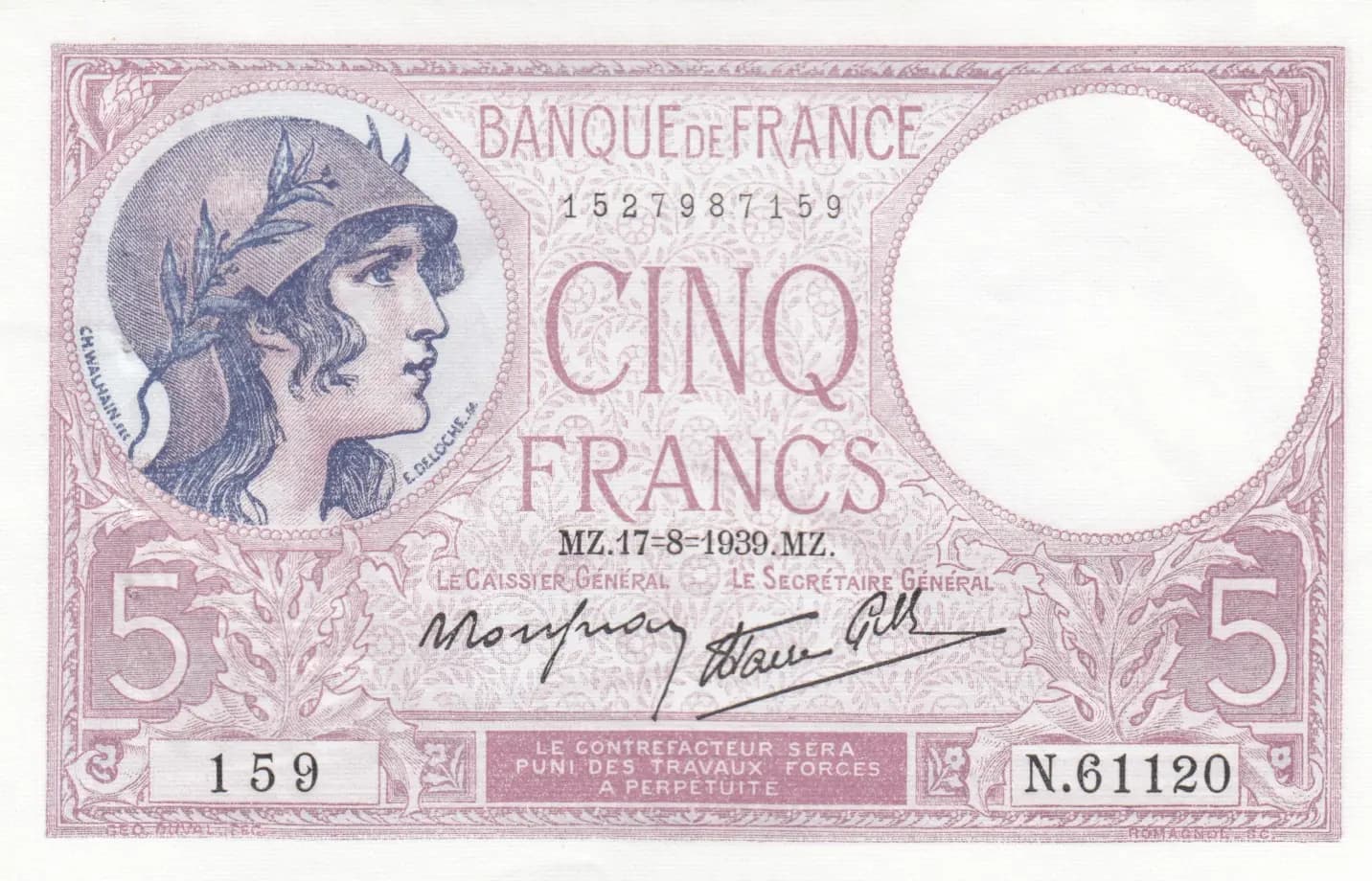
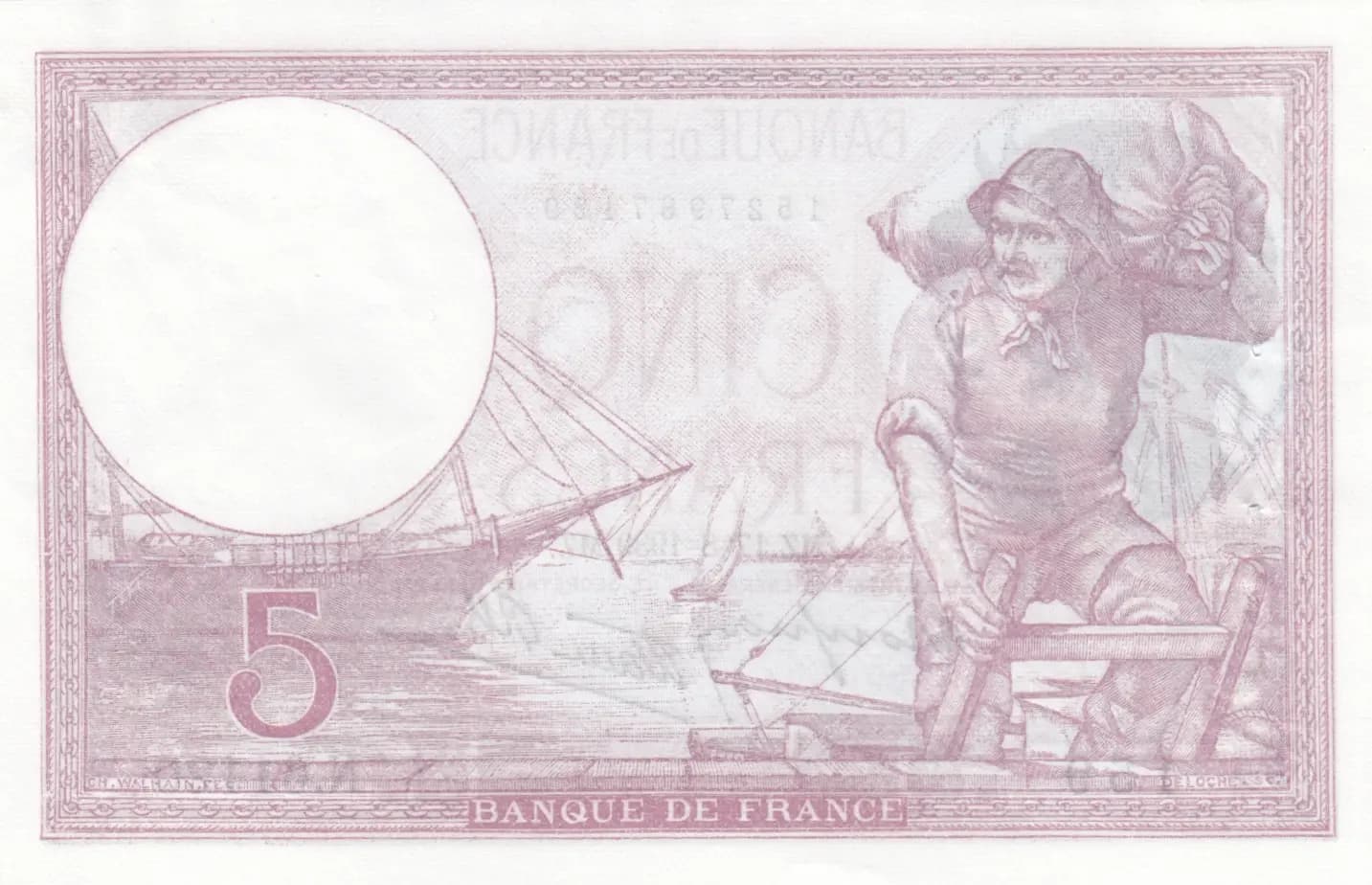
This is a pristine example of the French 5 Francs banknote from 1939, graded AU with exceptional preservation showing no visible wear, creasing, or damage. The note features a classical male portrait in laurel wreath on the obverse and allegorical maritime figures with sailing vessels on the reverse, both rendered in characteristic mauve and blue inks with intricate engraved detailing. The crisp, well-preserved fine engraving and complete absence of circulation marks make this a desirable specimen from the final year of the Third Republic's banknote design.
Common. While this specific 1939 date represents the final months before WWII, the 5 Francs Pick-83 was produced in substantial quantities during its issue period (1939-1940). eBay market data confirms this assessment: examples in lower grades (F-VF) consistently sell for $1-$10, with even premium grades (UNC) typically achieving $70-$80. The AU grade observed here represents strong preservation but not exceptional scarcity; the note's relatively modest market valuation and consistent availability across multiple sales dates indicate broad circulation among collectors and steady supply in the market.
Issued on August 17, 1939—just days before Nazi Germany's invasion of Poland and the outbreak of World War II—this banknote represents the final months of peacetime for France and the end of an era in French monetary design. The classical allegorical imagery and maritime elements reflect the Belle Époque aesthetic traditions that dominated French banknote artistry, while the aggressive counterfeiting warning ('forced labor in perpetuity') reflects the security concerns of the pre-war period. The 1939 date marks this as one of the last notes produced under the Third Republic before France's occupation and the transition to Vichy administration.
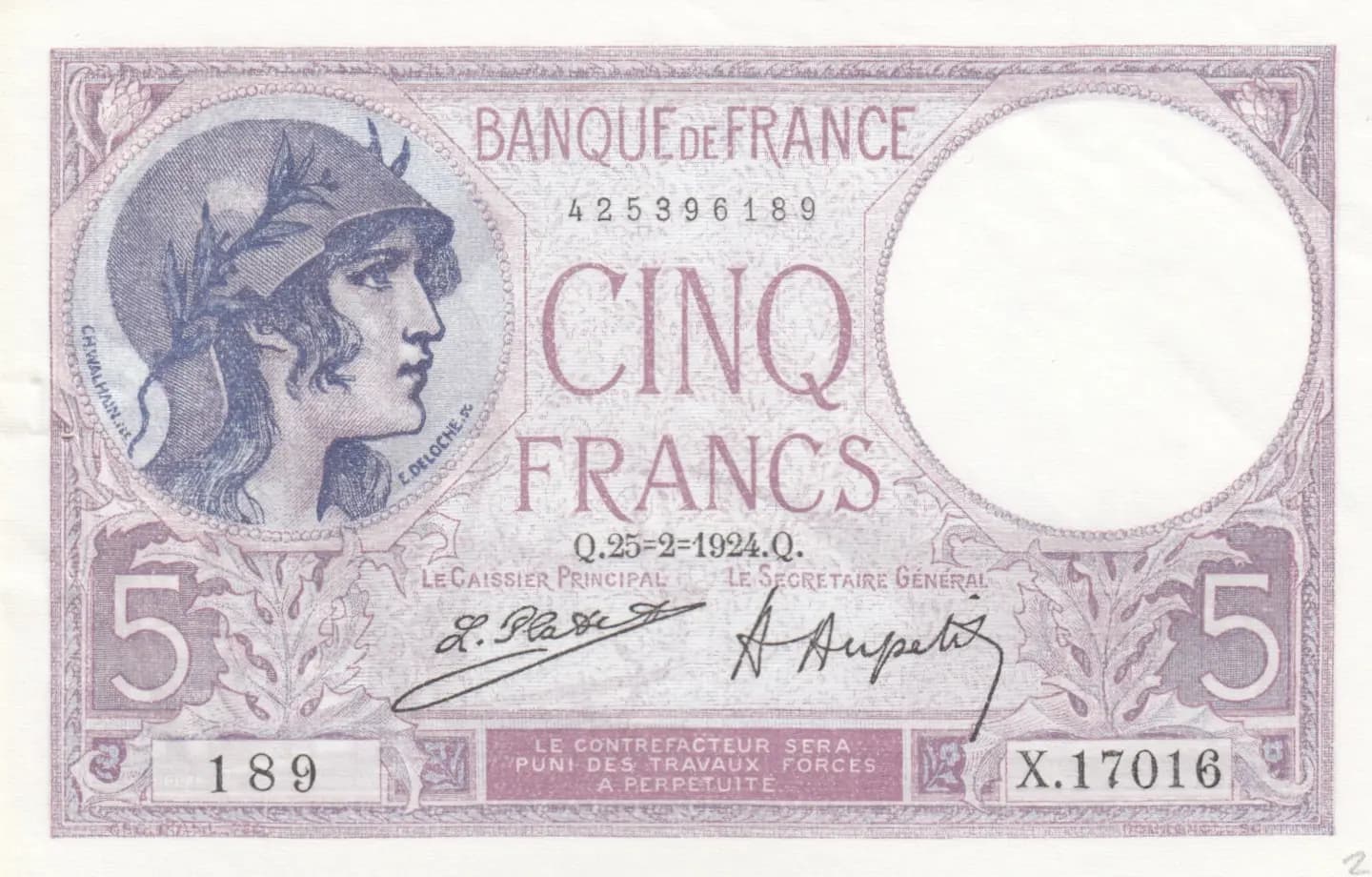
The obverse features a classical male portrait wearing a laurel wreath crown, rendered in blue ink and positioned within an ornate circular border on the left side, characteristic of French Republican iconography from this period. The reverse displays allegorical figures in a maritime composition, including a partially draped classical female figure and additional allegorical personages accompanied by a detailed sailing vessel with visible masts and rigging in the background, emphasizing France's maritime heritage and commercial strength. Both sides are framed by ornamental floral and geometric borders in mauve/purple, with large denomination numerals positioned in the corners. The composition balances classical artistic tradition with the security demands of modern currency, employing the fine-line engraving style that defined French banknote aesthetics of the interwar period.
FRONT: 'BANQUE DE FRANCE' (Bank of France) / 'CINQ FRANCS' (Five Francs) / Serial number: 1527987159 / Date marking: '17-8-1939' (August 17, 1939) / 'LE CAISSIER GÉNÉRAL' (The General Cashier) / 'LE SECRÉTAIRE GÉNÉRAL' (The General Secretary) / 'LE CONTREFACTEUR SERA PUNI DES TRAVAUX FORCÉS À PERPÉTUITÉ' (The counterfeiter will be punished with forced labor in perpetuity) / Series/batch: 159 / Serial: N.61120 / Artist mark: 'C. DELACROIX' / Two official signatures in cursive script. BACK: 'BANQUE DE FRANCE' (Bank of France) / '5' (denomination).
Intaglio engraving (line engraving/taille-douce), the traditional security printing method used by the Banque de France for this series. The notes were produced by the BdF's own printing facilities, which employed hand-engraved plates and multiple color printing to achieve the intricate detail visible throughout the design, including the fine line work in the portraits, allegorical figures, ornamental borders, and security features such as the detailed background scenes and complex geometric patterns.
This specific note carries the date marking '17-8-1939' (August 17, 1939), placing it within the final weeks of the 1939 issue. Serial number prefix 'N.61120' and series marking '159' may indicate printing batch variations. The signature block shows two officials' signatures typical of late Third Republic authorization marks. No major varieties (overprints, color variations, or design changes) are documented for Pick-83, though individual signature combinations and serial number prefixes distinguish specific printing runs within the broader 1939-1940 issue period.