50 francs 1980
Market Prices
47 salesAbout This Note
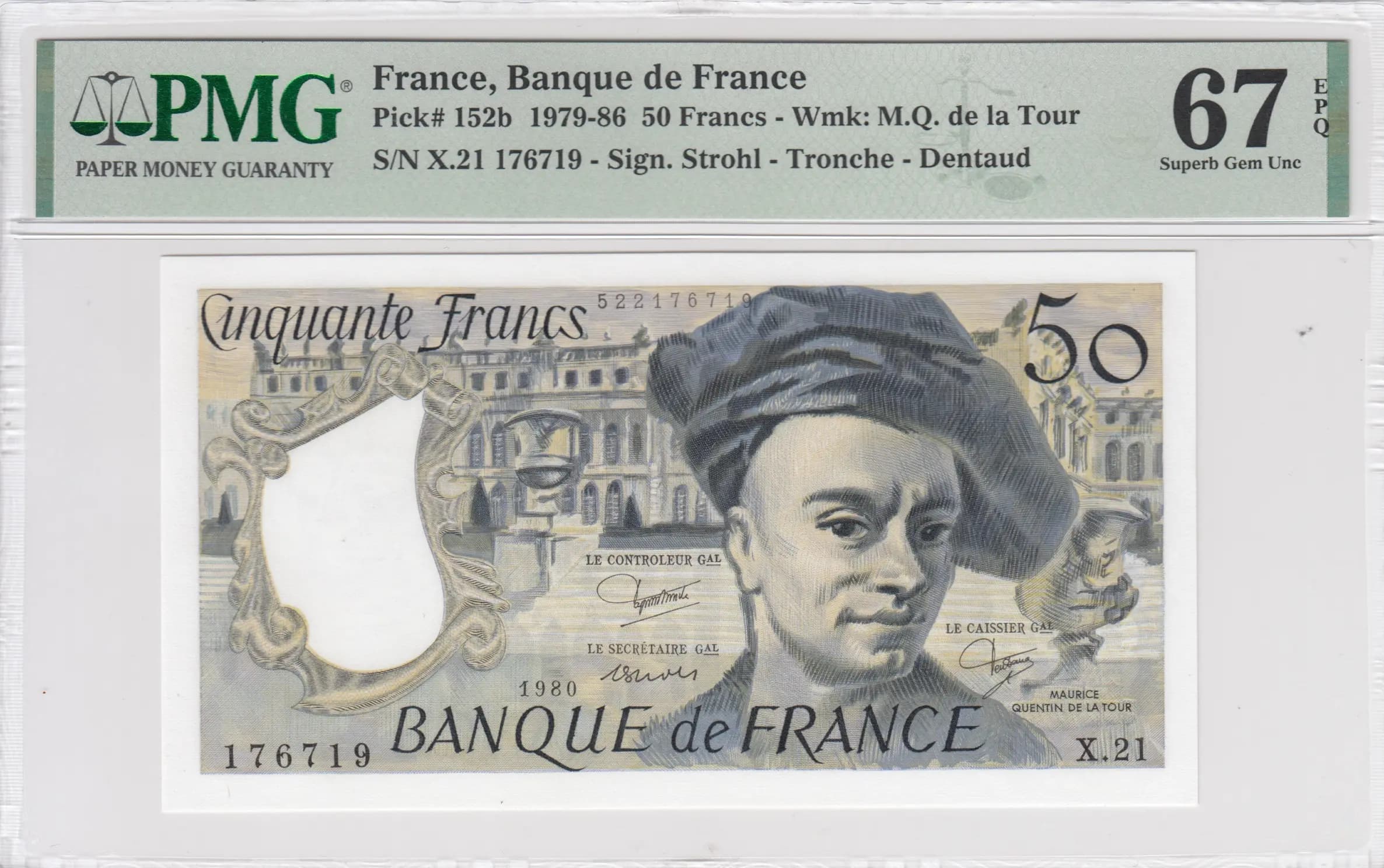
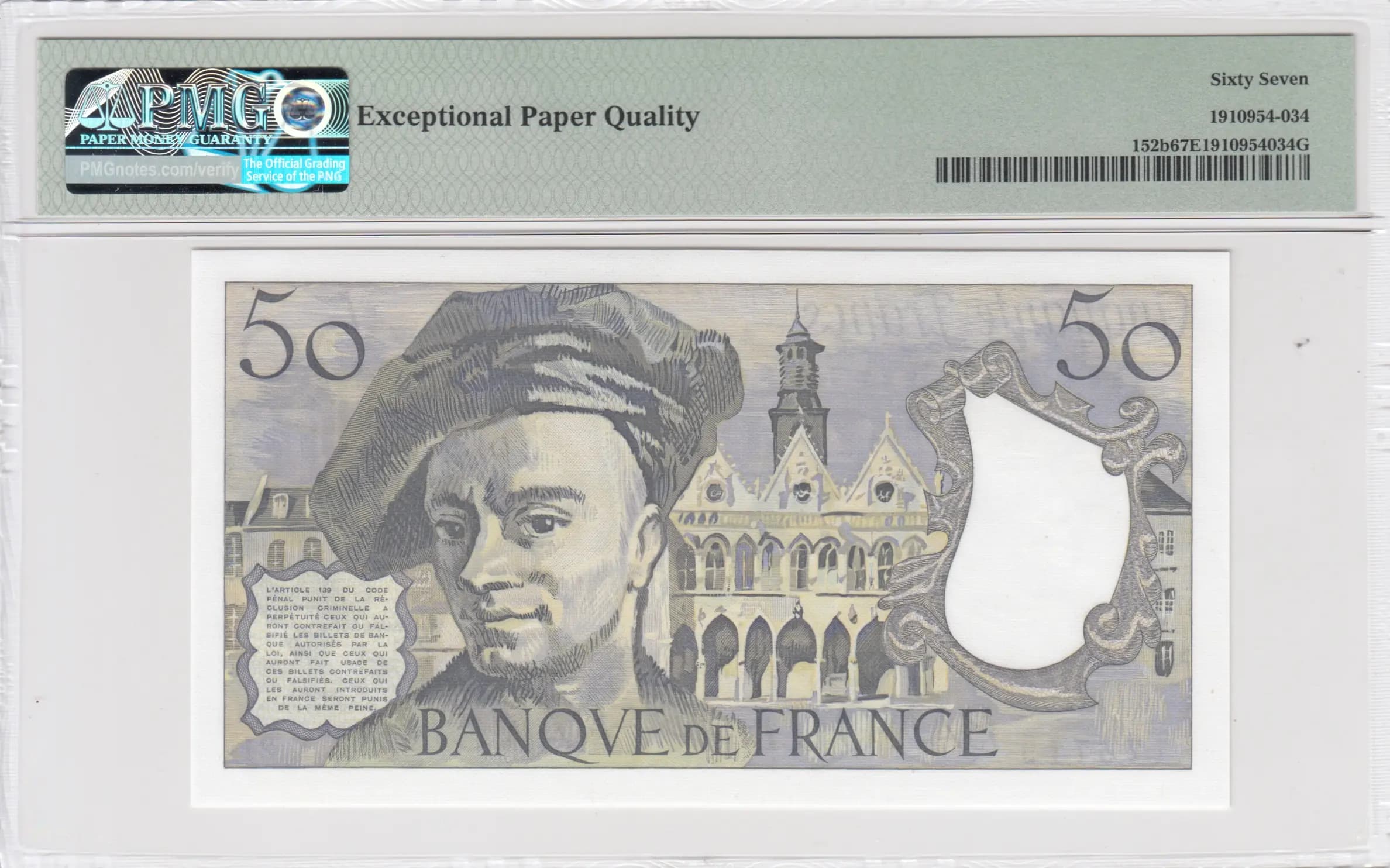
This 1980 issue 50 French Francs note (Pick 152b) features an exceptional PMG 67 EPQ grade, indicating near-pristine condition with virtually no handling wear. The note showcases the dual portrait of Maurice Quentin de la Tour—18th-century French artist and pastel master—rendered in elegant blue-gray intaglio against a cream background, with the Palace of Versailles depicted on the obverse and St. Quentin City Hall on the reverse. The crisp printing, vibrant colors, and complete absence of creases or stains make this an exemplary specimen of French banknote artistry from the final decades before the franc's replacement by the euro.
Common. This note was issued during a 16-year circulation period (1976-1992) by the Banque de France as a regular issue denomination with substantial print runs. eBay transaction history demonstrates consistent availability across all condition grades, with VF and circulated examples typically selling for $2-10 and uncirculated specimens for $12-20. While the PMG 67 EPQ grade represents an exceptional condition rarity within the population of surviving specimens, the underlying note type itself is not rare. The relatively modest premium realized even for high-grade examples ($70-77 for PMG 67s recorded in 2018-2020) confirms this is a common issue in numismatic markets.
Issued during the final decades of the French franc's circulation, this 1980 banknote honors Maurice Quentin de la Tour (1704-1788), one of France's most celebrated portrait painters and a figure emblematic of the Enlightenment era. The dual architectural settings—the Palace of Versailles representing royal patronage and the Gothic City Hall of St. Quentin representing his birthplace—underscore the note's celebration of French cultural heritage and regional pride. This series (1976-1992 span) represented the Banque de France's commitment to artistic excellence in currency design during a period of significant European monetary transition.
The obverse features Maurice Quentin de la Tour in left profile wearing a Renaissance-style hat, positioned at right center with a large decorative oval white cutout (watermark area) to the left. The Palace of Versailles renders in architectural detail in the background at left-center, establishing the royal cultural context. The reverse presents the same subject in profile wearing period clothing with beard, accompanied by the Gothic cathedral architecture of St. Quentin City Hall featuring pointed arch windows and characteristic medieval French ecclesiastical design. Both sides employ elaborate baroque-style decorative borders with fine scrollwork framing the portrait ovals. The color palette of cream-beige with blue-gray intaglio printing creates a refined, classical aesthetic appropriate to the Enlightenment-era subject matter.
Front: 'Cinquante Francs' (Fifty Francs), '50' (denomination), '1980' (year of issue), 'BANQUE DE FRANCE' (Bank of France), 'LE CONTROLEUR GAL' (The General Controller), 'LE SECRETAIRE GAL' (The General Secretary), 'LE CAISSIER GAL' (The General Cashier), 'MAURICE QUENTIN DE LA TOUR' (name of portrayed figure). Back: '50' (denomination), 'BANQUE DE FRANCE' (Bank of France), followed by legal text beginning 'L'ARTICLE 1er DU CODE DU DEVOIR SERVICE ET EN VERTU DU DROIT AU PRIVILEGE DE DROIT AU FAUX' (Article 1 of the Code regarding duty service and by virtue of the right to privilege against counterfeiting), with the inscription continuing regarding the legal status of all banknotes issued by the Banque de France.
Intaglio engraving (taille-douce), the standard security printing method for French banknotes of this era. The fine line work visible throughout, complex decorative borders, and layered architectural detail characteristic of intaglio production demonstrate mastery of this technique. The Banque de France's official printers employed multi-color offset underprinting in combination with intaglio engraving to achieve the multicolored effect described in catalog references. The watermark visible as the oval cutout area and the intricate security features embedded throughout the design reflect the sophisticated anti-counterfeiting standards maintained by French currency production facilities of the 1980s.
This specimen exhibits the signature variety identifier 'X.21' in combination with serial number component '176719', creating the full serial number sequence '5224167719 X.21'. The 1980 date and PMG 67 EPQ grade place this within the mid-production period of the 1976-1992 series. Known varieties for Pick 152b include different signature combinations (various Banque de France controller, secretary, and cashier signatures) and serial number prefix variations reflecting production runs and currency management protocols. No overprints or special designations are evident on this particular specimen.