5 francs 1967
Market Prices
57 salesAbout This Note
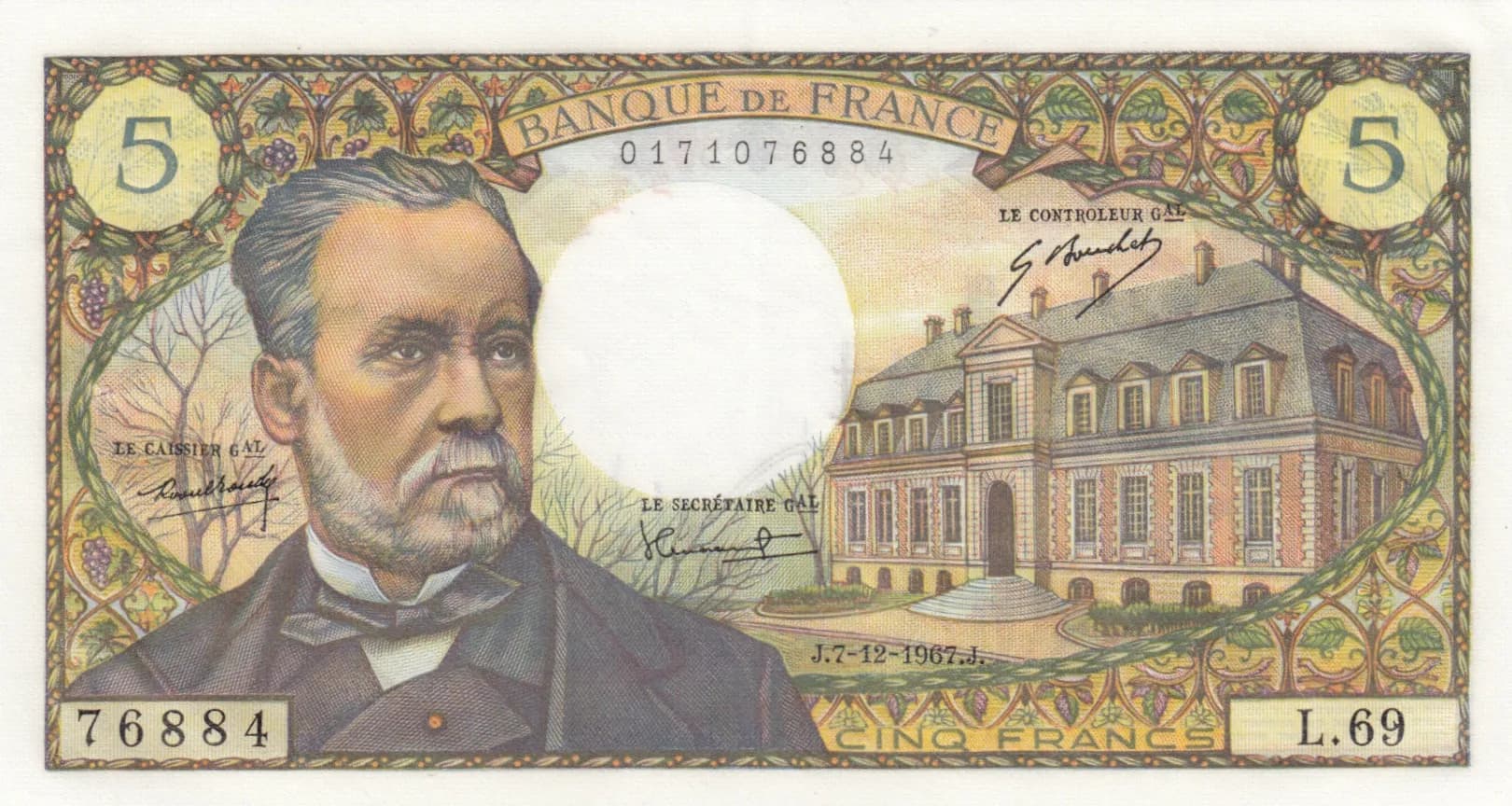
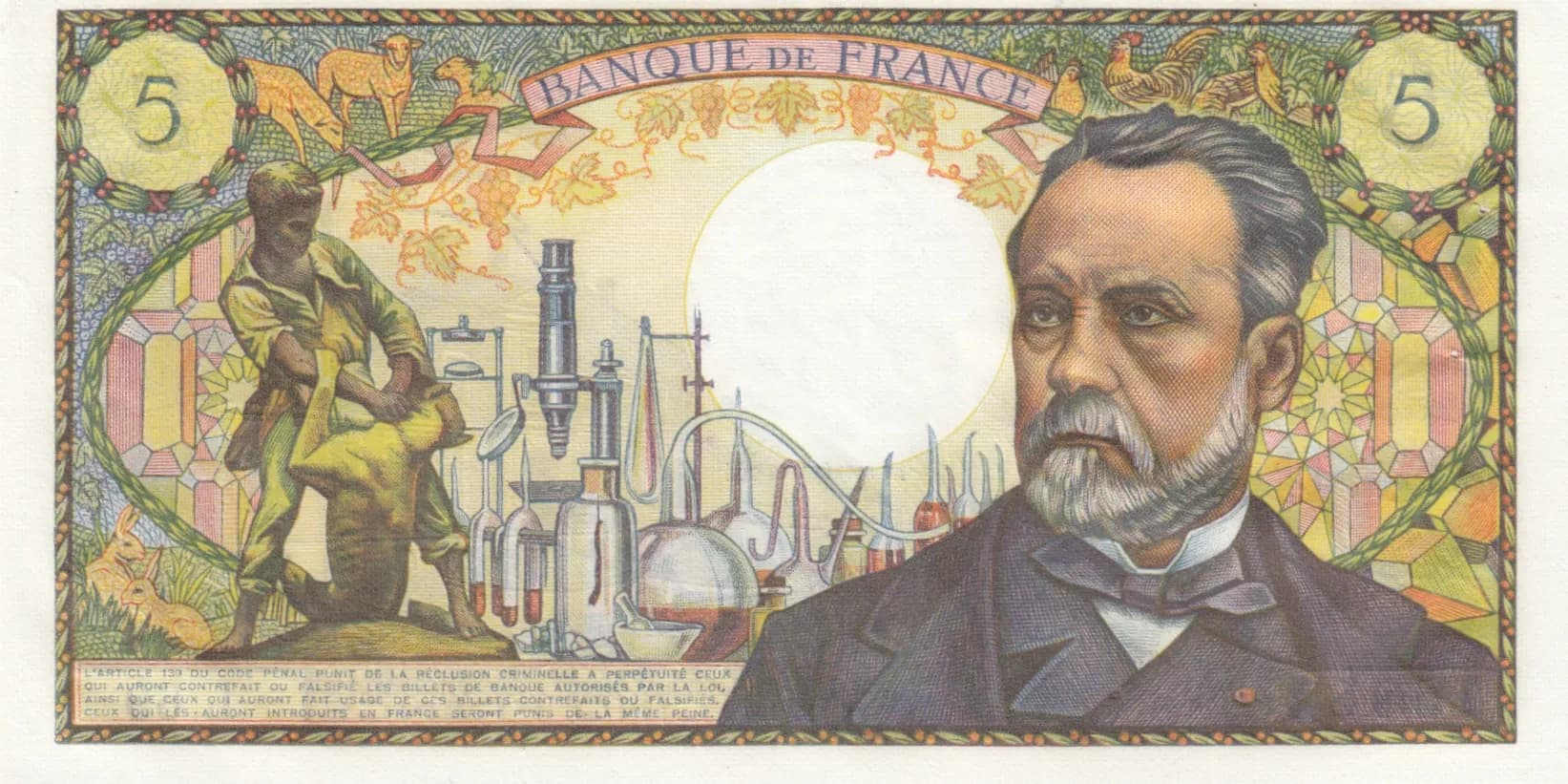
This is an exceptional uncirculated example of the 1967 French 5 Francs Pasteur note (Pick P-146b), displaying pristine condition with crisp details, vibrant colors, and no signs of circulation. The note features a striking dual portrait of Louis Pasteur alongside the iconic Pasteur Institute in Paris, complemented by elaborate decorative borders with grape vine motifs and scientific imagery on the reverse. This particular specimen represents the classic French banknote design aesthetic of the 1960s and commands strong collector interest, particularly in certified high grades.
Common. Despite the UNC condition grade of this specific specimen, the 1967 5 Francs Pasteur note (Pick P-146b) is a regular issue with substantial print runs. eBay price data confirms this: the vast majority of sales occur in the $5–$15 range for VF and lower grades, with even EF examples typically selling for $25–$56. Only certified high-grade specimens (PMG 64–68) command significantly higher prices ($72–$456), reflecting the collector premium for exceptional condition rather than rarity of the note type itself. The catalog 2019 value of $325 for UNC reflects condition rarity, not issue rarity. This note was produced in large quantities and remains readily available to collectors.
The 1967 5 Francs note commemorates Louis Pasteur, the pioneering French microbiologist whose revolutionary germ theory and vaccines transformed medicine and public health in the 19th century. The Pasteur Institute depicted on the obverse, a leading research facility in Paris that bears his name, underscores France's national pride in this scientific achievement. The reverse imagery—featuring scientific instruments and Pasteur's work against infectious disease—reflects the post-war period's emphasis on scientific progress and technological advancement in European society.
This banknote showcases a masterfully engraved portrait of Louis Pasteur—the bearded scientist in formal Victorian-era attire—positioned prominently on the left of the obverse, facing left in profile. The right side displays the Pasteur Institute, an ornate classical building with a distinctive mansard roof, symmetrical facade with arched entrance, and multiple tall windows representing the institution's architectural significance. The reverse features a second portrait of Pasteur, shown with his characteristic prominent mustache facing rightward, accompanied by allegorical scientific imagery including a classical robed statue (representing Science) and an array of laboratory instruments and scientific apparatus that symbolize his contributions to microbiology and public health. Elaborate decorative borders frame both sides, incorporating grape vine and leaf motifs in yellow, green, brown, tan, purple, and red tones, reflecting Belle Époque design sensibilities. The watermark area occupies a large circular space at the note's center on both sides, and fine line engraving throughout provides security against counterfeiting.
OBVERSE: 'BANQUE DE FRANCE' (Bank of France); 'CINQ FRANCS' (Five Francs); 'LE CAISSIER GAL' (The General Cashier); 'LE CONTROLEUR GAL' (The General Controller); 'LE SECRETAIRE GAL' (The General Secretary); Date marking 'J.7-12-1967.J.' (7 December 1967); Series marking 'L.69'; Serial number '0171076884'. REVERSE: 'BANQUE DE FRANCE' (Bank of France); Denomination '5'; Legal warning: 'L'ARTICLE 139 DU CODE PENAL PUNIT DE LA RECLUSION CRIMINELLE A PERPETUITE CELUI QUI AURONT CONTREFAIT OU FALSIFIE LES BILLETS DE BANQUE AUTORISES PAR LA LOI...' (Article 139 of the Penal Code punishes with lifelong criminal imprisonment those who counterfeit or falsify banknotes authorized by law, as well as those who facilitate the introduction into France of counterfeit or falsified banknotes, punishable by up to twenty years imprisonment and an equivalent fine).
Intaglio (copperplate) engraving, the standard security printing method for French banknotes of this period. The Banque de France employed France's national security printer (Imprimerie Nationale) for this series, utilizing multiple engraved plates and fine-line techniques to create the intricate detail visible in the portraits, architectural elements, and decorative borders. The layered color application and the precision of the geometric and botanical border patterns are characteristic of post-war French banknote production standards.
Series marking 'L.69' indicates this note belongs to a specific printing batch. The date reference 'J.7-12-1967' confirms issuance on 7 December 1967. Serial number '0171076884' is unique to this individual specimen. The Pick P-146b designation denotes the standard Pasteur design of this denomination and year; no significant varieties (such as overprints, signature variants, or major color differences) are indicated by the visual analysis. Collectors may encounter minor variations in signature combinations and exact serial number ranges across the print run, but these do not constitute recognized major varieties in standard catalogs.