200 francs 1983
Market Prices
47 salesAbout This Note
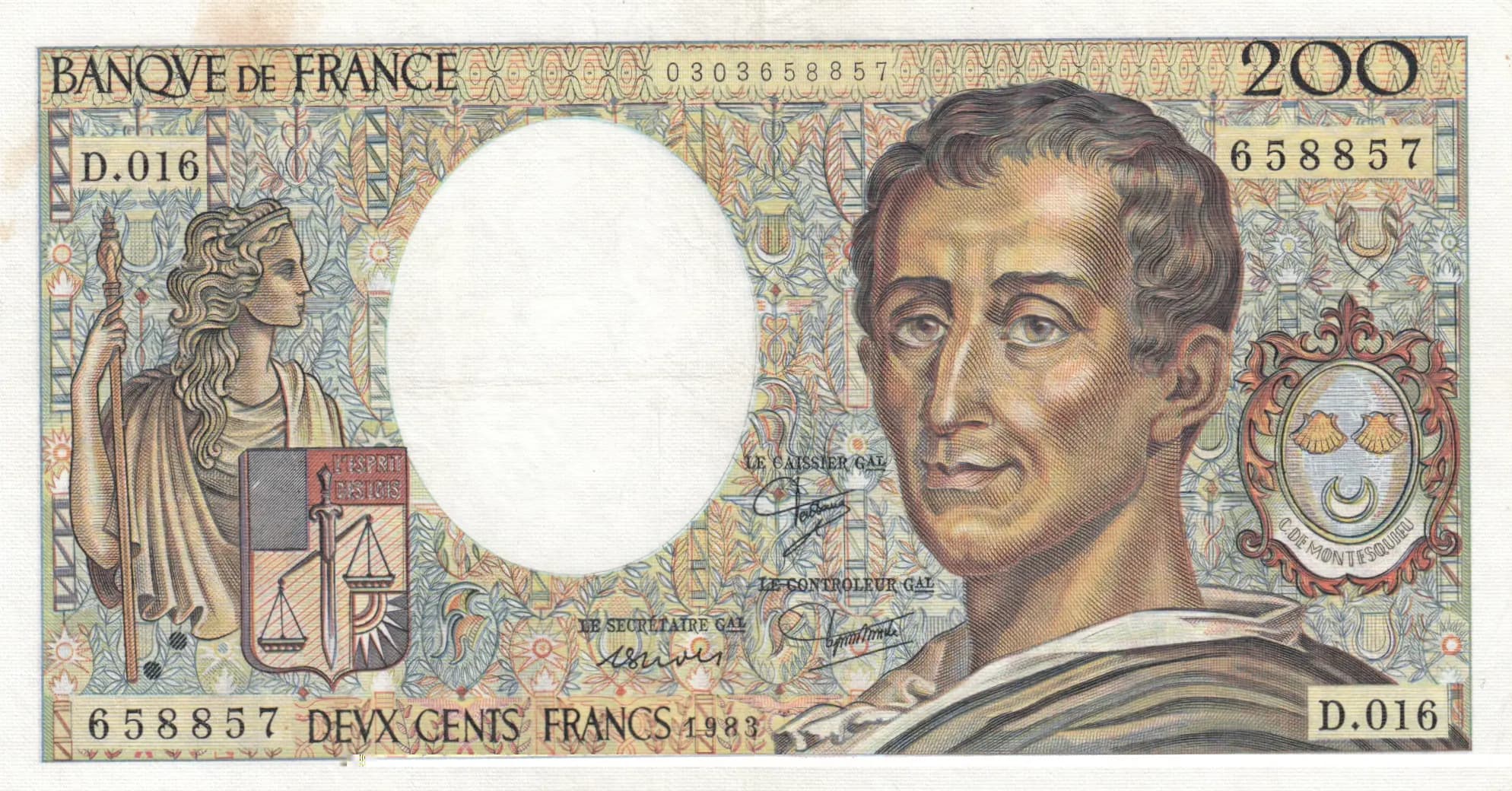
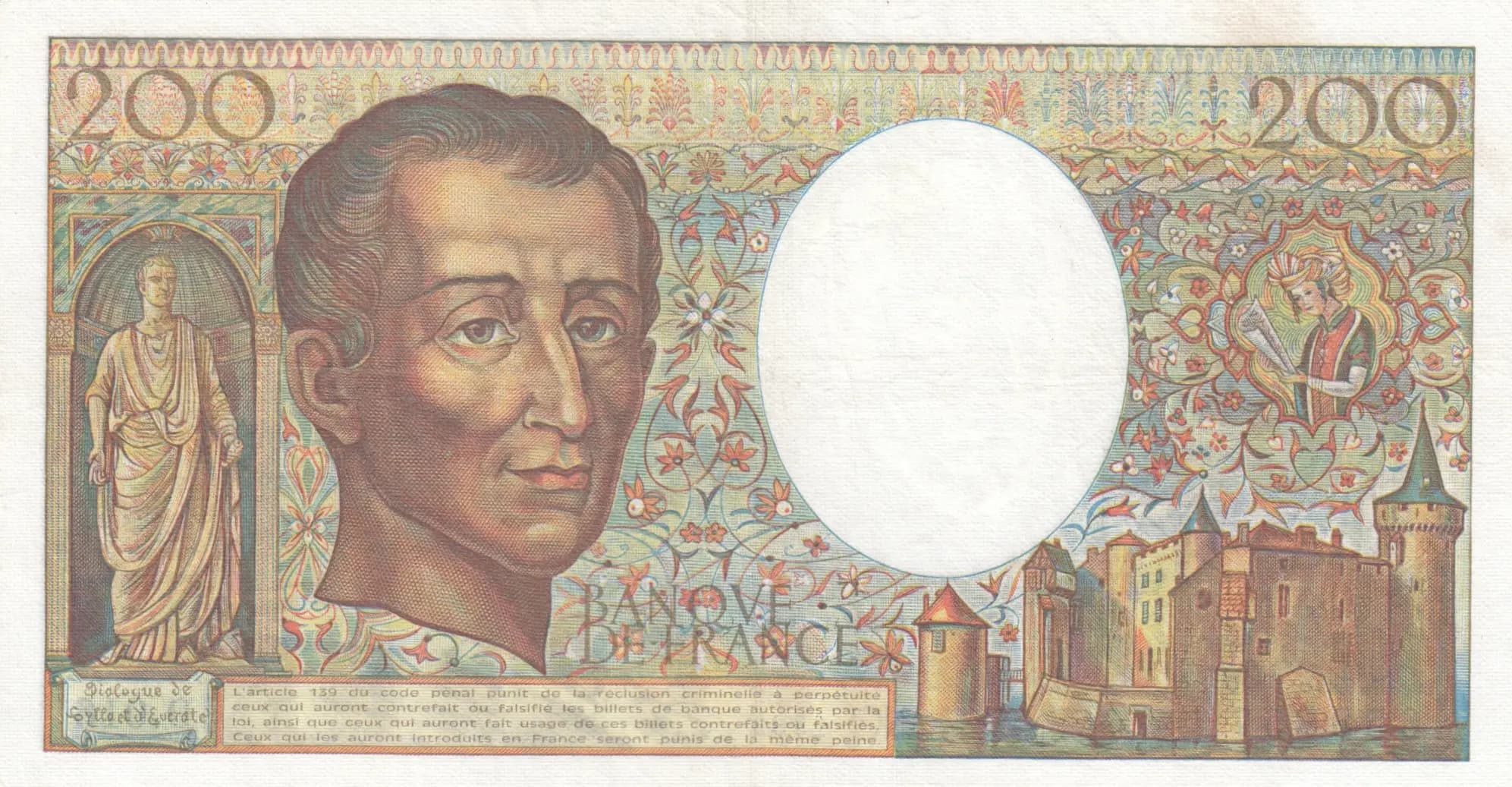
This is a VF-graded 200 French Francs note from 1983, issued by the Banque de France under Pick catalog P-155a. The note displays the distinctive multi-colored design characteristic of this denomination, featuring ornate decorative patterns in greens, golds, and earth tones with sharp, crisp printing throughout. The obverse presents a classical allegorical female figure (Justicia) on the left alongside a male portrait, while the reverse showcases the same subject with La Brède castle—Montesquieu's birthplace—rendered in fine detail, making this an exemplary specimen of French classical period banknote artistry.
Common. This note is from a regular issue series (1981-1994) with substantial circulation volumes. eBay market data strongly supports this assessment, with VF-graded specimens consistently selling for $4.25-$9.99 USD, indicating healthy supply and moderate collector demand at modest price points. While certain professionally-graded high-grade specimens (PMG 68) command premium prices ($250-$306), the base VF grade in question reflects typical market pricing for abundant post-1980s French francs. There is no evidence of low print runs, recalls, or scarcity factors for this Pick number.
Issued during 1981-1994, this note commemorates Charles de Secondat, Baron de La Brède et de Montesquieu (1689-1755), the influential French philosopher and political theorist. The inclusion of Justicia (the classical female figure representing justice and law) and the prominent display of La Brède castle reflects the Banque de France's effort to honor intellectual heritage during the latter stages of the French franc era. The elaborate engraving style and allegorical iconography are typical of French banknote design from this period, emphasizing cultural and civic values.
The obverse features Charles de Secondat, Baron de La Brède et de Montesquieu, depicted as a male portrait in classical style on the right side, accompanied by an allegorical female figure representing Justicia (Justice) on the left, identifiable by her classical draped robes and bearing. A heraldic shield with maritime symbols appears near the female figure on the left, while an ornamental cartouche with shell motifs adorns the right side. The reverse displays the same subject with an architectural representation of La Brède castle, the philosopher's birthplace in Aquitaine, rendered as a fortified medieval structure with multiple towers. Throughout both sides, elaborate floral and geometric patterns in the background employ fine line work characteristic of high-quality intaglio engraving. The dominant color palette comprises gold/tan, greens, browns, beige, and rust-red accents, creating a sophisticated and dignified aesthetic appropriate to the subject matter.
FRONT SIDE: 'BANQUE DE FRANCE' (Bank of France); 'DEUX CENTS FRANCS' (Two Hundred Francs); '200' (denomination); 'LE CAISSIER GAL' (The General Cashier); 'LE CONTROLEUR GAL' (The General Controller); 'LE SECRETAIRE GAL' (The General Secretary); Serial designation 'D.016' with serial number '0303658857'; Date '1983'. BACK SIDE: '200' (denomination, appears twice); 'BANQUE DE FRANCE' (Bank of France); Legal warning: 'Article 139 du code pénal punit de la réclusion criminelle à perpétuité ceux qui auraient contrefait ou falsifié les billets de banque autorisés par la loi, ainsi que ceux qui auraient fait usage de ces billets contrefaits ou falsifiés. Ceux qui les auraient introduits en France seront punis de la même peine.' (Article 139 of the penal code punishes with life imprisonment those who have counterfeited or forged banknotes authorized by law, as well as those who have used these counterfeit or forged banknotes. Those who have introduced them into France will be punished with the same penalty.); Literary reference: 'Dialogue de Sylla d'Auvergne' (Dialogue of Sylla of Auvergne).
Intaglio engraving, likely produced by the Banque de France's security printing facility. The fine line work, intricate background patterns, multiple color registration, and sharp detail visible throughout—particularly in the portraits, architectural elements, and decorative motifs—are consistent with advanced intaglio printing techniques employed for French banknotes of this era. The precision of the engraving and security features suggests professional security printer production meeting the highest standards of the period.
This note is cataloged as Pick P-155a, identified by the Montesquieu watermark (C.B. de Montesquieu). The PMG population report indicates four variants exist for this base Pick number (P-155a, P-155b, P-155d, P-155e), suggesting minor variations in signatures, printing dates, or other distinguishing characteristics within the 1981-1994 issuance period. The observed serial number prefix 'D.016' and the 1983 date marking visible on this specimen place it within the early-to-mid range of this note's production run. Without access to specialized French banknote variety guides, the specific sub-variety characteristics distinguishing P-155a from its counterparts (P-155b, P-155d, P-155e) cannot be definitively determined from the visual analysis alone, though signature variations or printing facility differences are likely factors.