20 francs 1943
Market Prices
116 salesAbout This Note
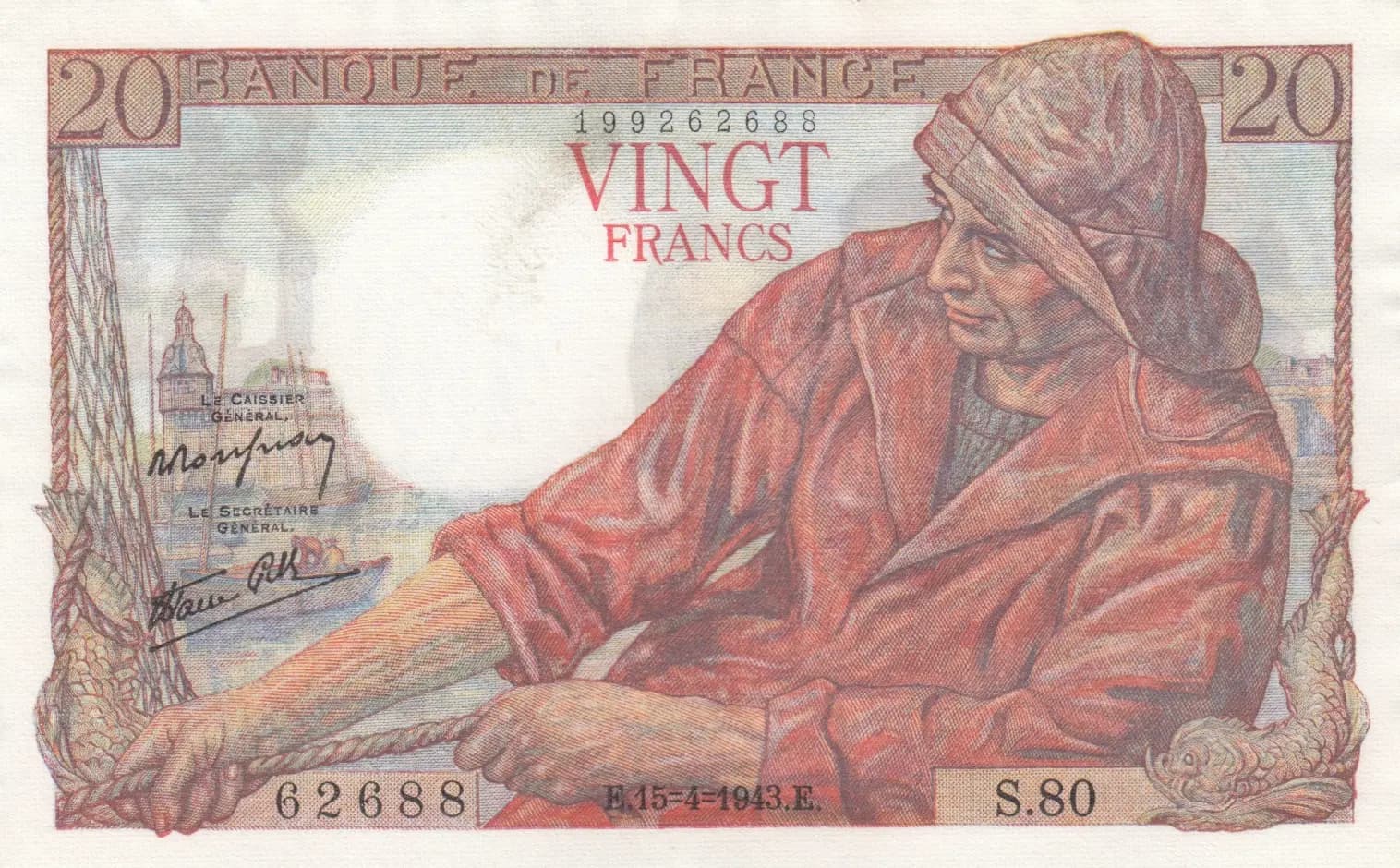
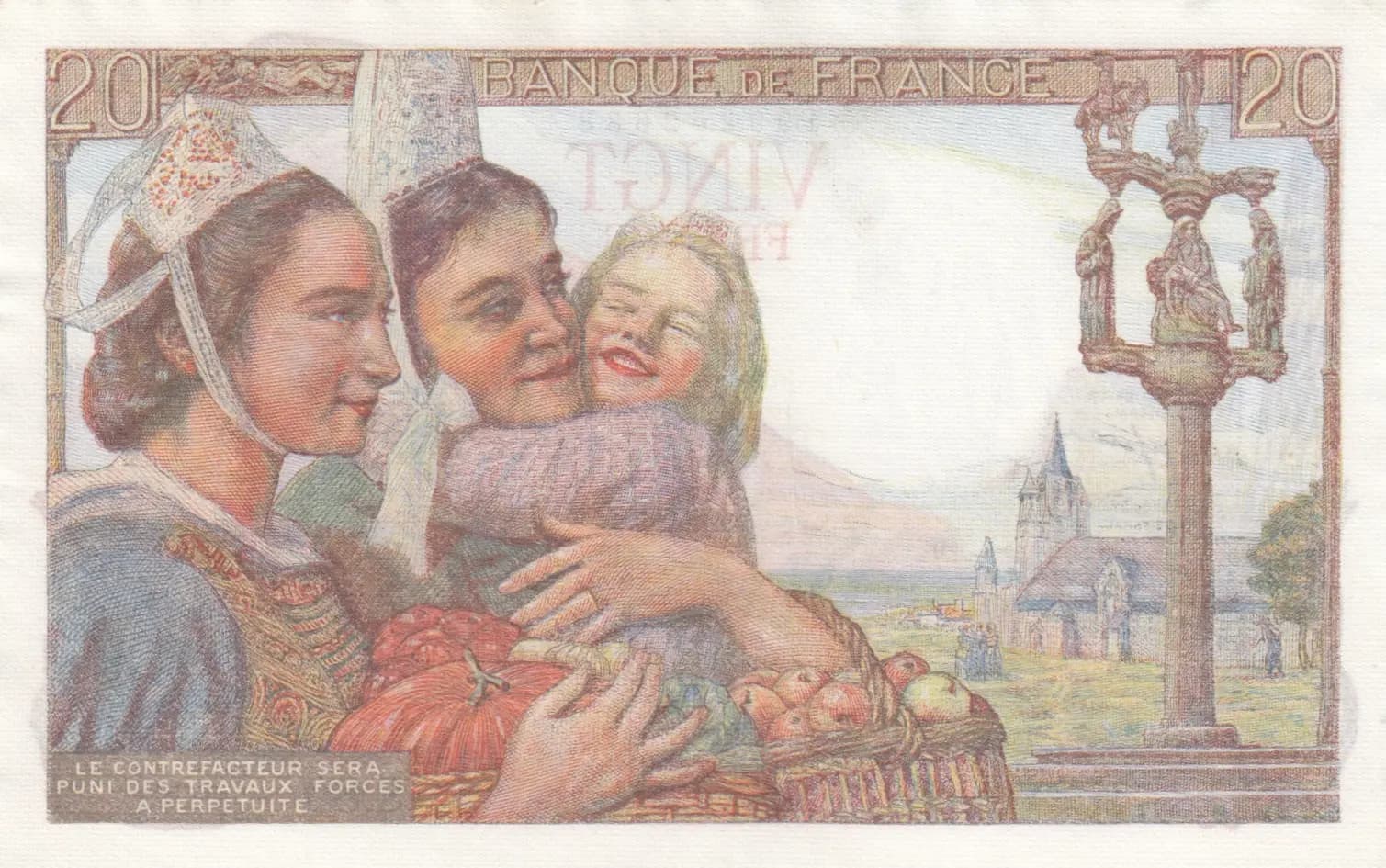
This is a 20 Francs banknote from the Banque de France dated April 15, 1943 (Pick P-100a), commonly known as the 'Pêcheur' (Fisherman) note among collectors. The obverse features a bearded man in red clothing and head covering in classical engraving style, while the reverse depicts two women and a child with a Breton landscape including a church and arched structure. In AU condition, this note displays the natural patina and light foxing consistent with its age, with intact paper structure and no significant tears or damage.
Common. The eBay price data shows consistent market activity with numerous sales across all condition grades from 2009 to 2025, with most ungraded examples selling for $1–$15 and even PMG-graded specimens (PMG 63–67) typically fetching $20–$140. An AU-graded note of this type would be expected to sell in the $30–$60 range based on recent comparable sales, indicating steady collector demand for a widely produced and available issue. The 1942–1950 production period was lengthy, and surviving examples are abundant in the market.
Issued during the final year of World War II German occupation of France, this banknote represents the Vichy regime's continued currency production under Nazi control. The pastoral imagery—a fisherman on the obverse and Breton women with child and architectural landmarks on the reverse—reflects the Vichy regime's idealization of rural, traditional French life and family values as propaganda. The 1943 date places this issue near the end of the occupation period, before the Liberation in August 1944.
The obverse features a male figure (the 'Fisherman' for which this note is nicknamed) depicted in three-quarter profile facing right, wearing traditional red clothing with a wrapped head cloth or turban, rendered in fine classical engraving. A secondary vignette on the left shows an institutional building with a domed structure. The reverse presents an allegory of Breton culture and motherhood: a woman on the left in profile wearing a traditional Breton bonnet holds an infant, with another woman's face visible to the right, all set against a pastoral landscape featuring a church with multiple spires and an arched aqueduct or bridge structure. Ornate decorative borders with floral and scrollwork patterns frame both sides. The color palette employs red-brown, tan, cream, blue-grey, and green tones typical of the period's engraving style.
FRONT: 'BANQUE DE FRANCE' (Bank of France), '20' and 'VINGT FRANCS' (Twenty Francs) in multiple locations, 'CAISSIER GENERAL' (Chief Cashier), 'LE SECRETAIRE GENERAL' (General Secretary), date designation 'E.15-4-1943.E' (April 15, 1943), series marking 'S.80', and serial number '19926268' and '62688'. BACK: '20' and 'VINGT' (Twenty) in multiple locations, 'BANQUE DE FRANCE' (Bank of France), and the counterfeiting warning 'LE CONTREFACTEUR SERA PUNI DES TRAVAUX FORCES A PERPETUITE' (The counterfeiter will be punished with hard labor for life).
Intaglio (engraved) printing on paper, the standard method used by the Banque de France for high-security banknotes during this period. The detailed cross-hatching, fine line work, and three-dimensional quality of the portraits and landscapes are characteristic of intaglio engraving. This note was likely produced by the Banque de France's printing facility or contracted security printer using steel engraving plates, a technique that provided security through the difficulty of reproduction.
This specific example is dated April 15, 1943 with series designation 'S.80' and serial number prefix evident from the inscriptions. The visual analysis confirms the standard 'Pêcheur' design with the characteristic red-clothed male figure on the obverse and Breton woman-and-child reverse composition. No overprints or special markings are visible that would indicate a scarce variety. The note represents a standard emission from the mid-period of the Pêcheur series' long circulation run.