1000 francs 1944
Market Prices
17 salesAbout This Note
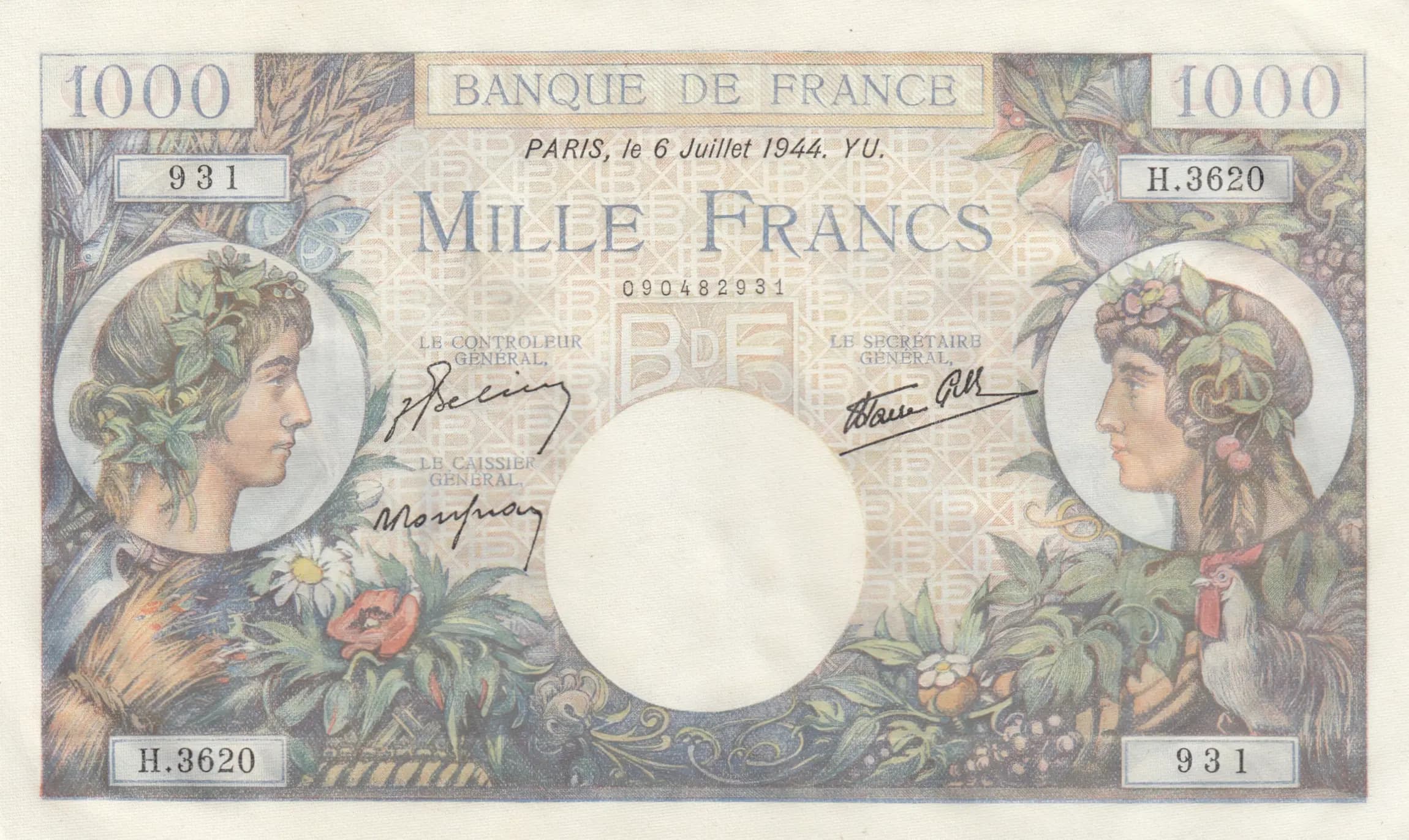
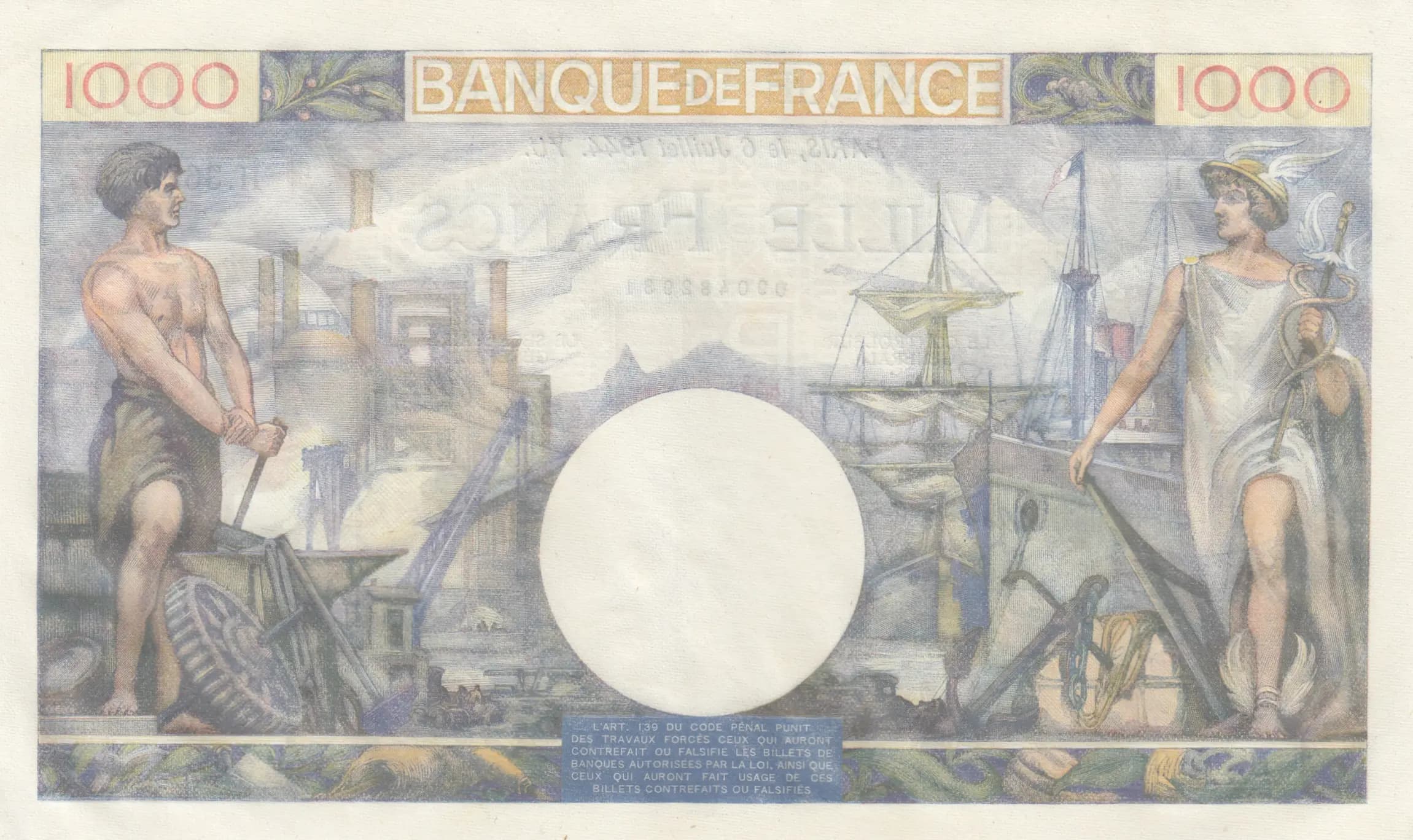
This is a 1944 French 1000 Francs banknote (Pick-96c) issued by the Banque de France on July 6, 1944, during the Liberation period. The note displays exceptional condition with sharp, vibrant printing throughout both sides, crisp imagery, and no visible wear, consistent with uncirculated status. The ornate allegorical design featuring classical female portraits on the obverse and male labor/commerce figures on the reverse exemplifies the artistic quality of mid-20th century French currency design.
Common. The 1944 1000 Francs note is a regular issue with substantial circulation, as evidenced by the consistent market activity documented in the eBay sales history. Current market prices for UNC specimens range from $295-$418, with PMG-graded examples in the 64-67 range selling regularly between $200-$590. The recent 2025 sale of a PMG 67 for $316 demonstrates ongoing collector demand at moderate pricing levels. Print runs for this denomination during the Liberation period were substantial, and surviving examples in all grades remain readily available to collectors.
Issued in July 1944, immediately following the D-Day invasion and during France's liberation from Nazi occupation, this banknote represents Banque de France currency during the critical transitional period of the Fourth Republic. The reverse side's allegorical depictions of industrial labor (bare-chested figure with hammer) and maritime commerce (figure with trident amid sailing vessels and port infrastructure) reflect France's post-war emphasis on economic reconstruction and national recovery. The formal signatures of three officials—Contrôleur Général, Secrétaire Général, and Caissier Général—underscore the governmental authority reasserting control over French monetary systems during the Liberation.
The obverse features two classical female allegorical figures in profile, each adorned with laurel wreaths, positioned symmetrically and facing inward toward a central circular space (watermark area). Between them flows ornate botanical and agricultural ornamentation including wheat stalks, grapes, daisies, poppies, and flowering vines—symbolizing France's agricultural wealth and natural resources. The Banque de France coat of arms occupies the center. The reverse depicts two complementary male allegorical figures representing the pillars of national economy: on the left, a bare-chested laborer holding a hammer stands before industrial factory buildings with smoking smokestacks; on the right, a clothed merchant or maritime figure holds a trident and caduceus (symbol of commerce and Mercury), positioned amid a harbor scene with multi-masted sailing ships, vessels, and port infrastructure. The color palette of blue-gray, tan, pale blue, green, and brown creates a sophisticated, restrained aesthetic appropriate to the 1944 period.
FRONT SIDE: 'BANQUE DE FRANCE' (Bank of France), 'PARIS, le 6 Juillet 1944. VU.' (Paris, July 6, 1944. Seen/Approved), 'MILLE FRANCS' (One Thousand Francs), '1000' (denomination), 'LE CONTROLEUR GENERAL' (The General Controller), 'LE SECRETAIRE GENERAL' (The General Secretary), 'LE CAISSIER GENERAL' (The General Cashier), Serial number '090482931', Reference mark 'H.3620', and '931'. BACK SIDE: '1000' and 'BANQUE DE FRANCE' (denomination and issuer identification repeated), followed by the statutory counterfeiting warning: 'L'ART. 139 DU CODE PENAL PUNIT DES TRAVAUX FORCES CELUI QUI AURAIT CONTREFAIT OU FALSIFIE BANQUES AUTORISEES PAR LA LOI, AINSI QUE CEUX QUI AURAIENT FAIT USAGE DE CES BILLETS CONTREFAITS OU FALSIFIES' (Article 139 of the Penal Code punishes with forced labor anyone who would have counterfeited or falsified banks authorized by law, as well as those who would have made use of these counterfeit or falsified notes).
This banknote was produced using traditional engraved intaglio printing (taille-douce), characteristic of Banque de France currency of this era. The fine, detailed engraving work visible throughout both sides—particularly in the intricate portraiture, the delicate botanical motifs, and the complex industrial scenes—demonstrates the high-security engraving standards employed by the French central bank. Multiple color printing was applied in successive passes to achieve the multi-hued composition. The Banque de France's printing was conducted at its official security printing facilities in Paris.
This specific example is identified as Pick-96c, the third cataloged variety of the 1944 1000 Francs issue. The visible serial number 090482931 with reference mark H.3620 should be cross-referenced against known variety documentation to confirm any specific variety designation (varieties may differ by signature combinations, control marks, or printing batches). The July 6, 1944 date is standard for this issue, printed directly on the note. Future detailed examination under magnification would determine if this represents a specific plate variety or signature variant within the Pick-96c classification.