1000 francs 1939
Market Prices
38 salesAbout This Note
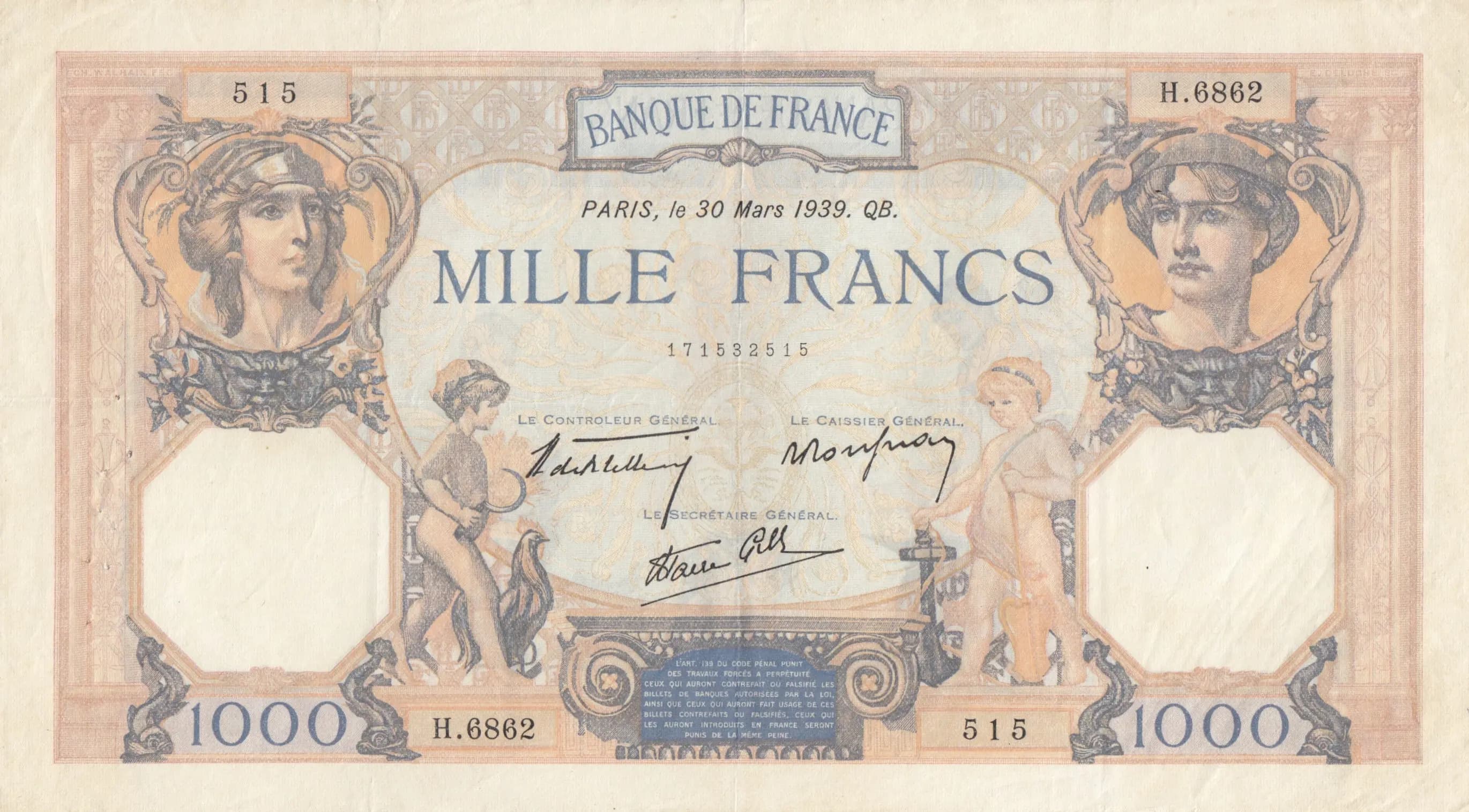
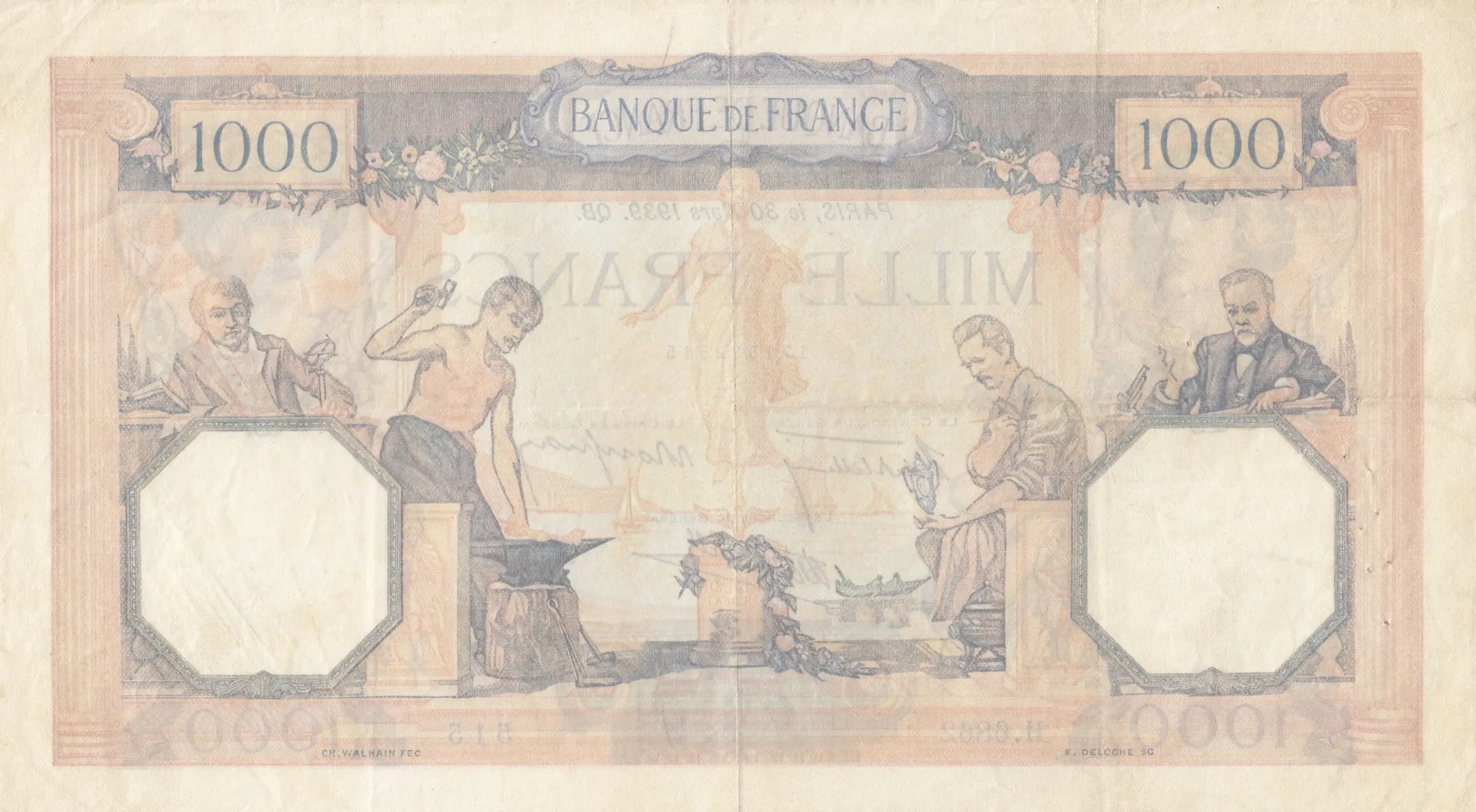
This is a VF-graded 1000 Francs banknote from the Banque de France, dated March 30, 1939, representing the classic "Cérès et Mercure" design series. The note displays excellent preservation with sharp engraving, uniform cream patina, and only light creasing consistent with careful handling. The dual allegorical female figures on the obverse and the thematic labor/commerce scenes on the reverse showcase the fine classical artistry typical of interwar French currency design.
Common. Secondary market data from realbanknotes.com shows consistent eBay activity with VF-graded examples selling in the $7–$35 range (2014–2020), and more recent sales of similar grades at $15–$26. The note was issued during a seven-year window (1937–1940) with substantial circulation. Production runs for this denomination and period were standard, not limited. The absence of significant scarcity signals in the market and routine availability in middle grades confirm common status.
Issued during the final year before World War II, this 1939 banknote reflects the Belle Époque artistic tradition while the imagery of labor, commerce, and prosperity represented France's pre-war economic ideals. The allegorical figures of Cérès (goddess of agriculture) and Mercury (god of commerce) emphasize the nation's wealth sources, while the reverse depicts workers, merchants, and craftsmen—including a figure representing Louis Pasteur—celebrating French industrial and scientific achievement during a period of mounting geopolitical uncertainty.
The obverse features two allegorical female profiles in classical style—Cérès (left) and Mercury/Mercure (right), both wearing elaborate classical headdresses and ornamental frames. A cherub and decorative putti occupy the lower center. The reverse depicts a thematic composition representing French labor, commerce, and science: a figure seated at a desk (representing administrative/mercantile authority), a muscular male figure symbolizing industrial labor and strength, a youthful figure in the center, and a well-dressed gentleman on the right (likely representing Louis Pasteur, the celebrated scientist). The design employs Baroque ornamental flourishes, scrollwork, and architectural elements throughout. Two large octagonal blank areas on both sides (watermark fields) frame the central compositions. The color palette of salmon-pink, peach, cream, and blue-grey creates a harmonious classical aesthetic characteristic of high-denomination French notes from this period.
FRONT SIDE: 'BANQUE DE FRANCE' (Bank of France) | 'MILLE FRANCS' (One Thousand Francs) | 'PARIS, le 30 Mars 1939. QB.' (Paris, March 30, 1939. QB [control mark]) | 'LE CONTROLEUR GÉNÉRAL' (The General Controller) | 'LE CAISSIER GÉNÉRAL' (The General Cashier) | 'LE SECRÉTAIRE GÉNÉRAL' (The General Secretary) | Serial number: 171532515 H.6862 515. REVERSE SIDE: 'BANQUE DE FRANCE' (Bank of France) | '1000' (denomination, appears multiple times) | 'CH. WALMAIN FEC' (Charles Walmain, artist, Latin for 'made/created by') | 'F. DELOCHE SC' (F. Deloche, engraver, Latin 'sculpsit' for 'engraved by')
Engraved intaglio printing on the Banque de France's equipment, executed by the renowned engraver F. Deloche (reverse signature 'F. DELOCHE SC'). The exceptional clarity and fine line work visible in the detailed allegorical figures, decorative borders, and security features confirm traditional steel-plate intaglio methodology. The quality of impression and sharpness of design elements indicate professional security printing standards maintained by the French central bank during this period.
This specific example is dated 30 Mars 1939 (March 30, 1939) with series identifier 'QB' and serial number 171532515 H.6862. The Pick catalog designates this as P-90c, which represents a specific printing variant within the 1937–1940 series. Known varieties exist within this issue based on control marks (QB, RA, RB, etc.), signature combinations of the three officials (Contrôleur Général, Caissier Général, Secrétaire Général), and date ranges. The 'QB' control mark and 1939 date place this in a mid-series printing. No overprints or exceptional marks are visible; this represents a standard issue from the final year of production before wartime suspension.