5 pounds 1975
Market Prices
6 salesAbout This Note
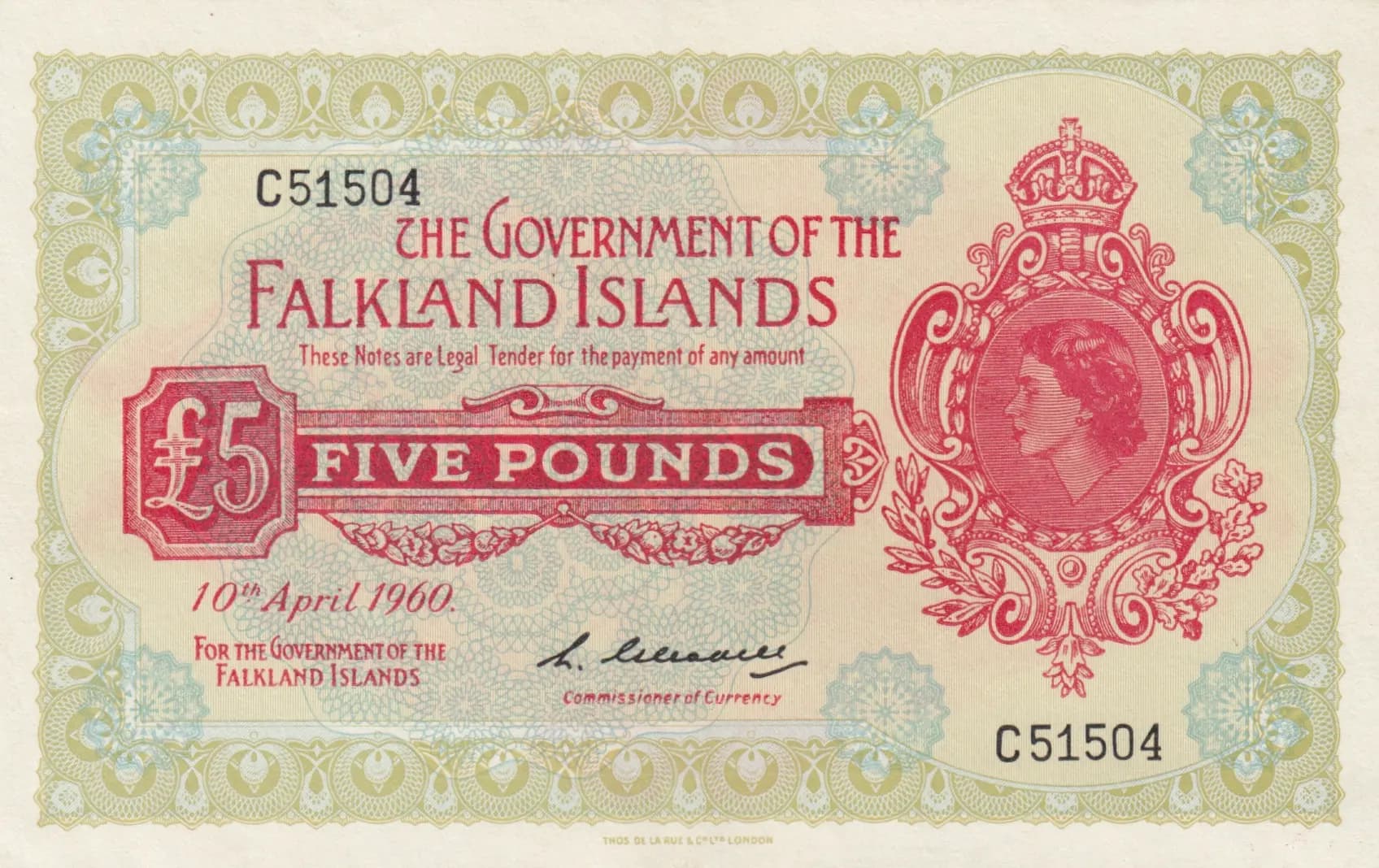
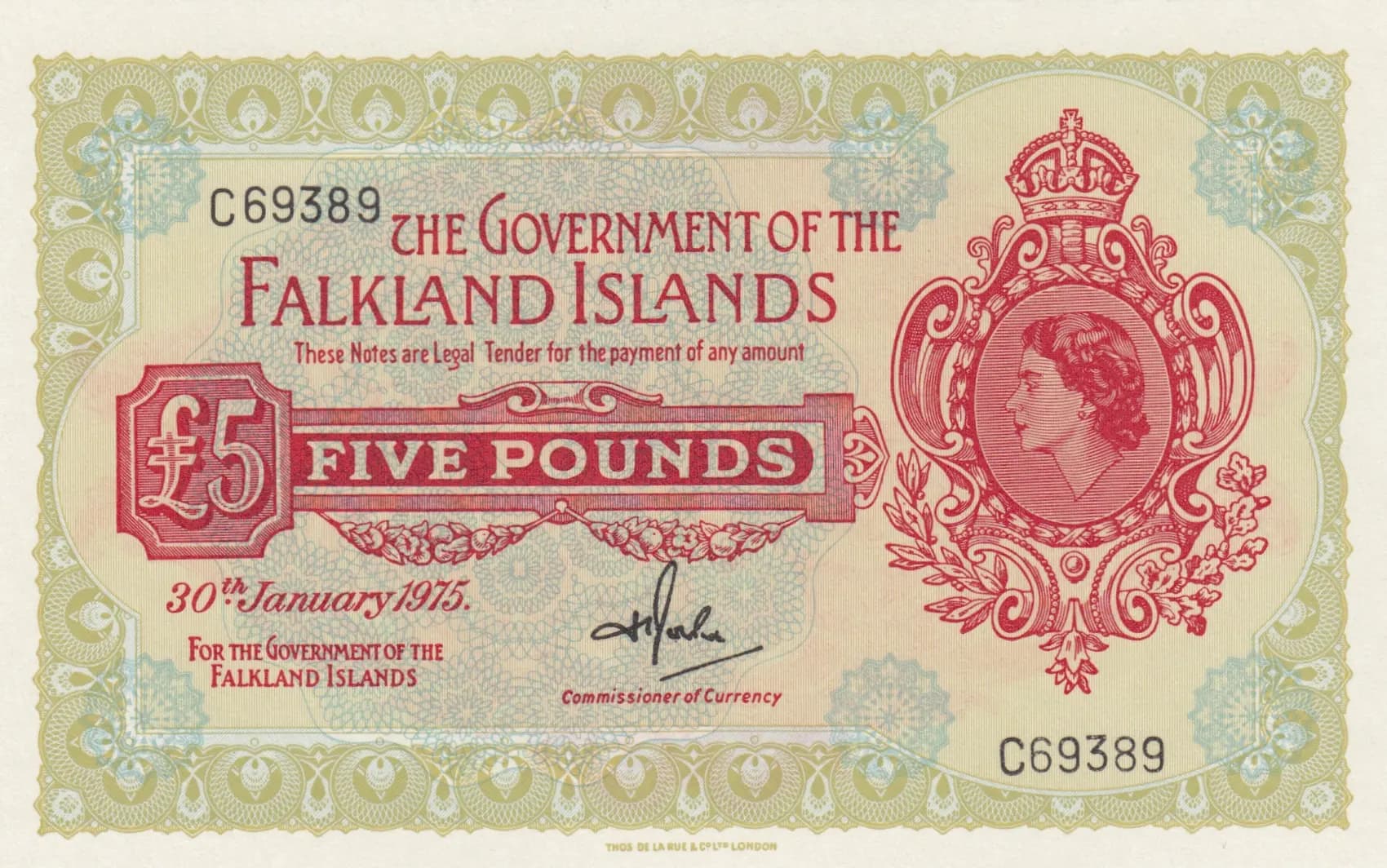
This is an exceptional uncirculated example of the 1975 Falkland Islands £5 note (Pick P-9b), printed by Thomas de la Rue. The note displays vibrant red on green coloring with a crisp, clean appearance throughout, featuring a right-facing crowned portrait of Queen Elizabeth II rendered in fine red engraving. All security features and ornamental detailing remain sharp and pristine, with no visible wear, creases, or stains, making this an excellent collector specimen that commands strong market value.
Common. This note survives in relatively large quantities despite being from a small territory. The eBay price tracking data shows consistent sales across multiple grades, with UNC examples selling in the $500–$600 range historically (2011–2020), indicating steady collector demand rather than scarcity. The 2019 catalogue value of $900 for UNC reflects strong but not exceptional rarity. Print runs for Commonwealth territorial issues of this era were substantial, and the 1975 series was not recalled or superseded quickly. No evidence of short print runs or extraordinary demand suggests this is a commonly encountered note among serious collectors.
This 1975 issue represents the Falkland Islands' assertion of monetary sovereignty during the mid-Cold War period, issued by the Government of the Falkland Islands with the Queen's portrait as a symbol of Commonwealth membership. The note's date of 30th January 1975 falls during a period of heightened political tension over the islands' status, preceding the 1982 Argentine invasion by seven years. The ornate Victorian-style engraving and security design reflect the British Crown's careful stewardship of the territory's financial institutions.
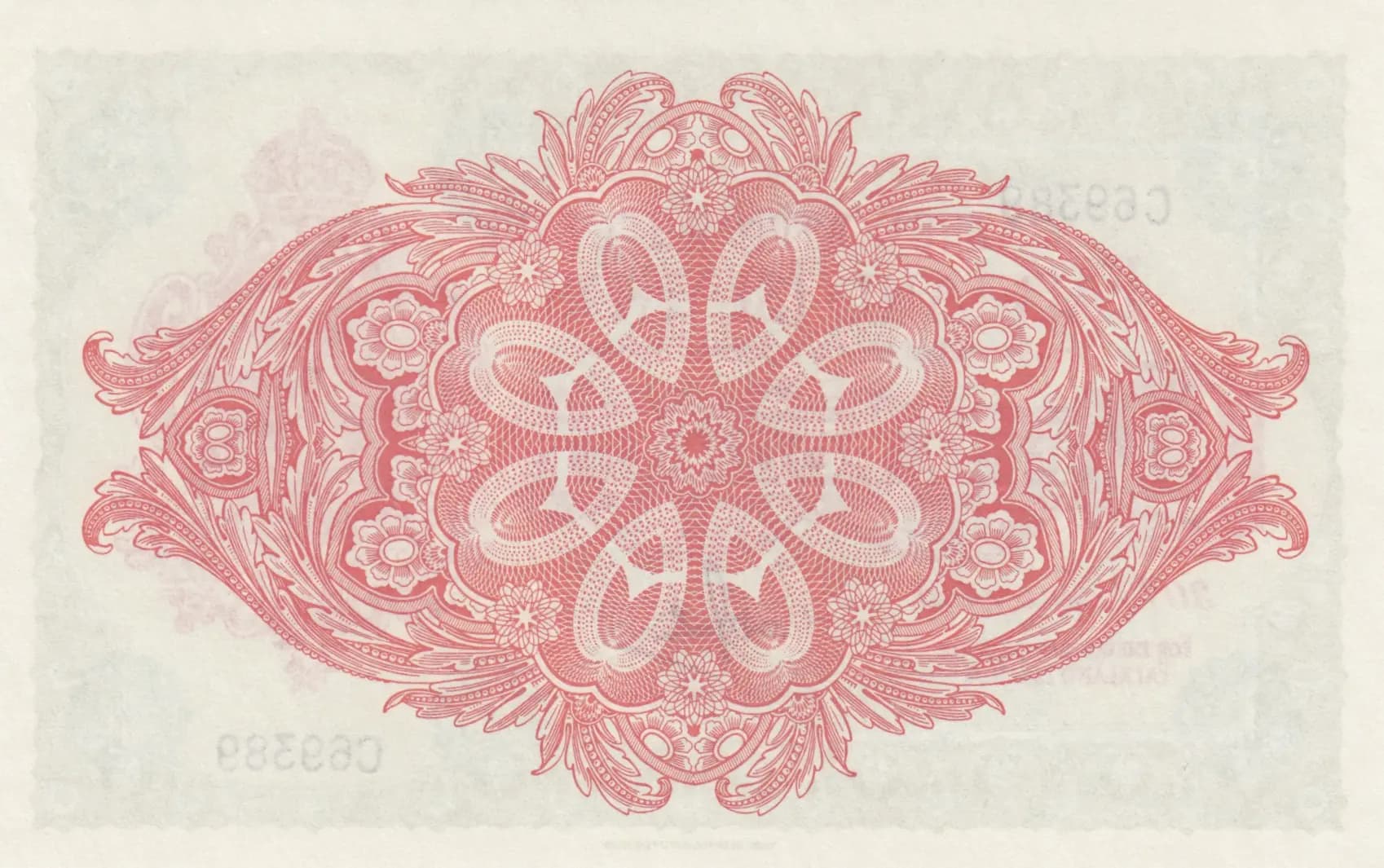
The obverse features an elegant right-facing profile portrait of Queen Elizabeth II wearing a crown, positioned in a medallion on the right side of the note and surrounded by heraldic wreath ornamentation. The portrait is rendered in red engraving against a contrasting green underprint base. The denomination 'FIVE POUNDS' appears prominently in a red box on the left. The entire note is framed by ornate decorative borders incorporating repeating geometric and floral motifs in gold/tan and green tones. The reverse presents an entirely abstract composition of interlocking ornamental patterns—floral and geometric elements arranged in symmetrical, radiating designs forming a central medallion—all executed in fine red line engraving on a cream background. This design serves both aesthetic and security functions, characteristic of high-quality Commonwealth currency design.
Front Side: 'THE GOVERNMENT OF THE FALKLAND ISLANDS' (issuing authority); 'FIVE POUNDS' and '£5' (denomination); '30th January 1975' (issue date); 'These Notes are Legal Tender for the payment of any amount' (legal tender declaration); 'FOR THE GOVERNMENT OF THE FALKLAND ISLANDS' (authorization); 'Commissioner of Currency' (authorized official title); 'THOMAS DE LA RUE & Co LTD LONDON' (printer identification); Serial numbers 'C69389' and 'C69339' (note identification). Back Side: 'D882390' (reference mark or serial notation visible in faint text).
Intaglio engraving (line engraving), executed by Thomas de la Rue & Co Ltd of London. The note employs multiple-color intaglio printing with separate passes for red, green, and tan/gold inks. The fine line work, intricate ornamental patterns, and complex anti-counterfeiting designs visible throughout are consistent with traditional engraved banknote production of the 1970s era. The crisp, sharp impression of all design elements and text indicates high-quality offset intaglio printing.
This note is catalogued as Pick P-9b, one of five recognized variants in the PMG population report for this base Pick number (P-9a, P-9as, P-9b, P-9bs, P-9s). The 'b' designation indicates this is a specific variety within the 1975 issue, likely differentiated by signature variants or minor design characteristics. The serial number prefix 'C' and the date 30th January 1975 are consistent with standard issuance of this variety. No overprints or special markings are evident from the visual analysis.