5 pounds 1960
Market Prices
2 salesAbout This Note
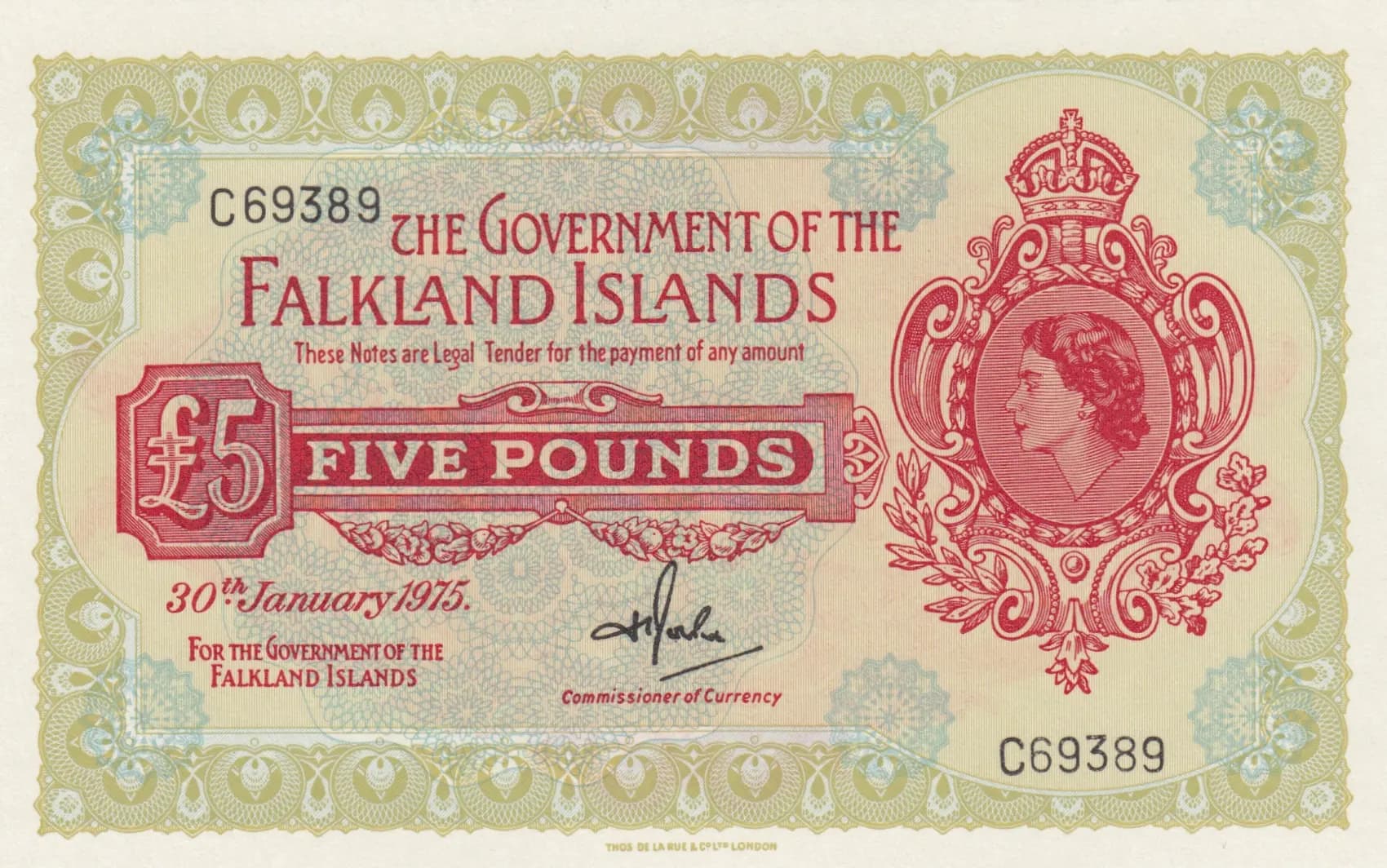
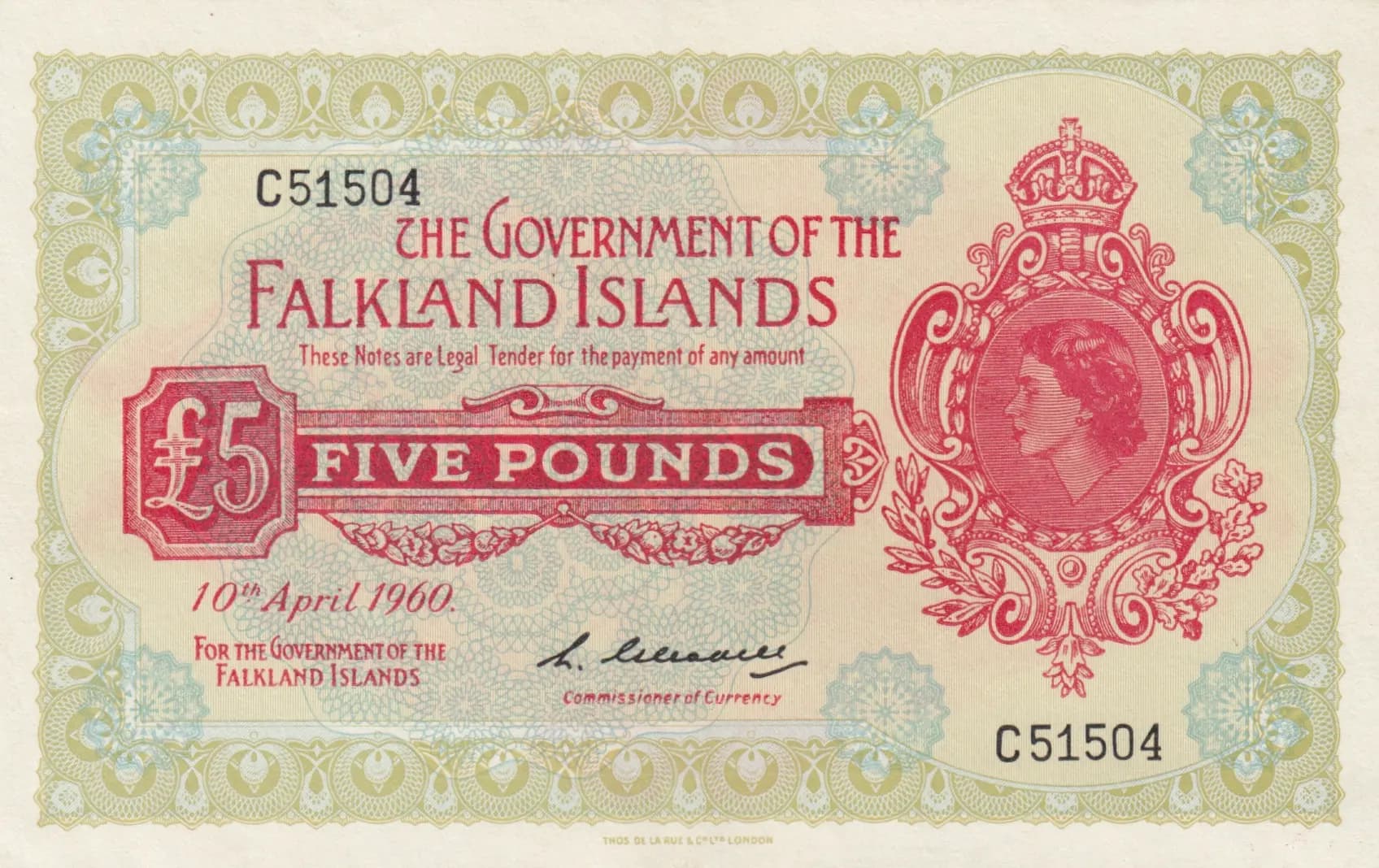
This is a crisp, well-preserved example of the 1960 Falkland Islands £5 note (Pick P-9a) in Excellent Fine condition, featuring an ornate portrait medallion of Queen Elizabeth II in profile on the right side, surrounded by elaborate engraved scrollwork and crowned heraldic flourishes. The note displays the characteristic red-on-green color scheme with cream backgrounds and demonstrates exceptional preservation with sharp detail throughout, making it an attractive example of early Commonwealth currency design from this remote territory.
Common. While this is an early issue from a small territory, the 1960 £5 Falkland Islands note remains relatively common in the numismatic market. eBay transaction data shows an EF example sold for approximately $204 in January 2024, placing it in the moderately collectible range but well below the thresholds for scarce or rare notes. The large catalog value range ($250 VF to $1,000 UNC in 2019) reflects normal collector demand rather than rarity. Multiple varieties exist (P-9a through P-9bs), suggesting respectable print runs and circulation among variants.
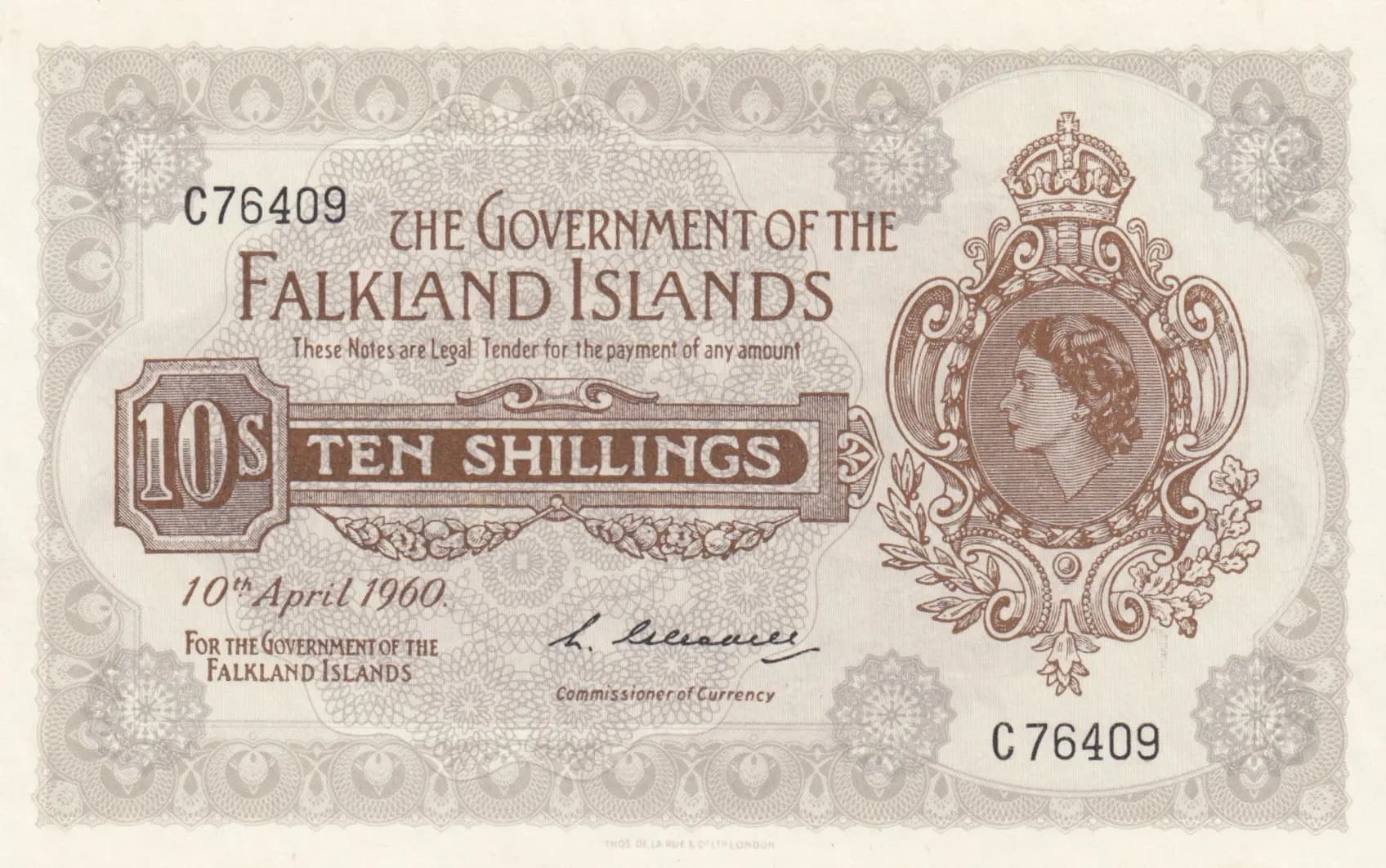
Issued on 10th April 1960 by the Government of the Falkland Islands, this note represents the early post-war monetary autonomy of the British Overseas Territory, featuring the portrait and regnal authority of Queen Elizabeth II who had ascended the throne just eight years prior. The ornate engraving style and design reflect the formal Commonwealth currency standards of the mid-twentieth century, with the elaborate central medallion and scrollwork typifying the security and prestige printing traditions of Thomas de la Rue during this era.
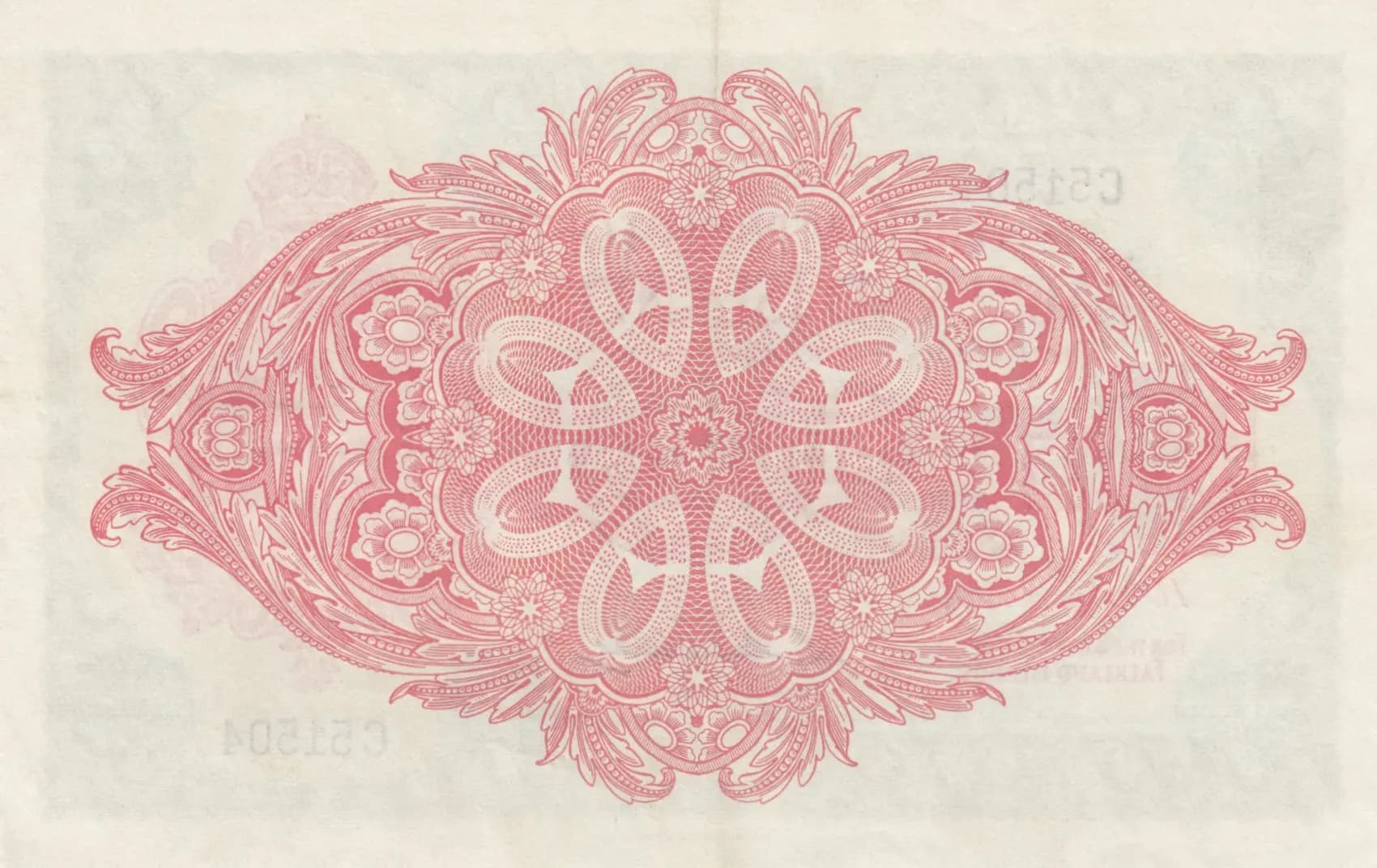
The obverse features a formal portrait medallion of Queen Elizabeth II in right-facing profile, rendered in fine intaglio engraving within an elaborate ornamental frame crowned with a royal crown. The portrait is surrounded by intricate scrollwork, floral flourishes, and geometric patterns typical of high-security currency engraving of the period. The left side carries the issuing authority text and denomination in red against a green underprint, with the entire note bordered by ornate geometric patterns in cream and green. The reverse presents a symmetrical ornamental composition dominated by a central rosette or mandala-like medallion with flowing scrollwork and botanical motifs extending across the width of the note in red against cream, creating a complex anti-counterfeiting pattern through its intricate symmetrical design.
FRONT: Serial number (C51504) appears in top left and bottom right corners. Central text reads 'THE GOVERNMENT OF THE FALKLAND ISLANDS' with denomination '£5 FIVE POUNDS' in red. Legal tender statement: 'These Notes are Legal Tender for the payment of any amount.' Issue date: '10th April 1960.' Signature block: 'FOR THE GOVERNMENT OF THE FALKLAND ISLANDS / Commissioner of Currency / L. Simmary' [signature]. Printer mark: 'TWO DE LA RUE & C° LONDON' (Thomas de la Rue & Company, London). BACK: Text 'MOZARAL' visible (likely watermark or security feature indicator); reverse features purely decorative ornamental design without additional inscriptions.
Intaglio engraving (line engraving/copperplate printing) executed by Thomas de la Rue & Company, London, the world's premier security printer. The note demonstrates characteristic fine-line intaglio work with complex decorative borders, portrait medallion engraving, and the layered color printing (red and green) typical of TDLR's Commonwealth currency production during this period.
This note is identified as Pick P-9a (1960 issue, Thomas de la Rue printer). The PMG Population Report indicates five cataloged variants exist for this base Pick number: P-9a, P-9as (specimen), P-9b, P-9bs (specimen), and P-9s (specimen). The serial number C51504 and signature of Commissioner L. Simmary are consistent with standard P-9a characteristics. The specific issue date of '10th April 1960' on the face is a distinguishing feature of the first issue; later variants (P-9b) may carry different dates. No overprints or unusual signatures are apparent in this example.