5000 marka 1920
“serie E”
Market Prices
About This Note
This is a 5000 Marka Estonian Republic Treasury Bill (Kassa-veksel) from 1920, Series E, representing an important early financial instrument of the newly independent Estonian state. The note exhibits VF condition with significant aging characteristics including foxing, discoloration, and archival red markings that suggest it has been in institutional collections for decades. The prominent pink/magenta official seal and detailed Estonian text make this a notable example of Estonia's early monetary policy during its first years of independence.
Common. The eBay market data shows VF examples selling in the $45-82 range, with most comparable pieces priced well under $200 USD, indicating reasonable availability in the collector market. While this is a specific and interesting type of early Estonian financial instrument from an important historical period, the note does not appear to be scarce. Series E examples are documented, and the Pick catalog designation (P-38Rs) indicates this is a recognized standard variety rather than an error or limited emergency issue. The presence of multiple eBay sales at moderate prices strongly suggests adequate supply in the collector market.
Issued in 1920 by the Estonian Republic's State Treasury (Riigikassa) following Estonia's declaration of independence in 1918, this 6% treasury bill reflects the new nation's efforts to finance its establishment and operations during a period of economic transition. The maturity date of February 1, 1921, and the formal governmental signatures (Minister of Finance, Director of State Treasury) demonstrate the official nature of this financial instrument as part of Estonia's early republican monetary system. These treasury bills served as both financial instruments and evidence of the young nation's sovereignty and administrative capacity.
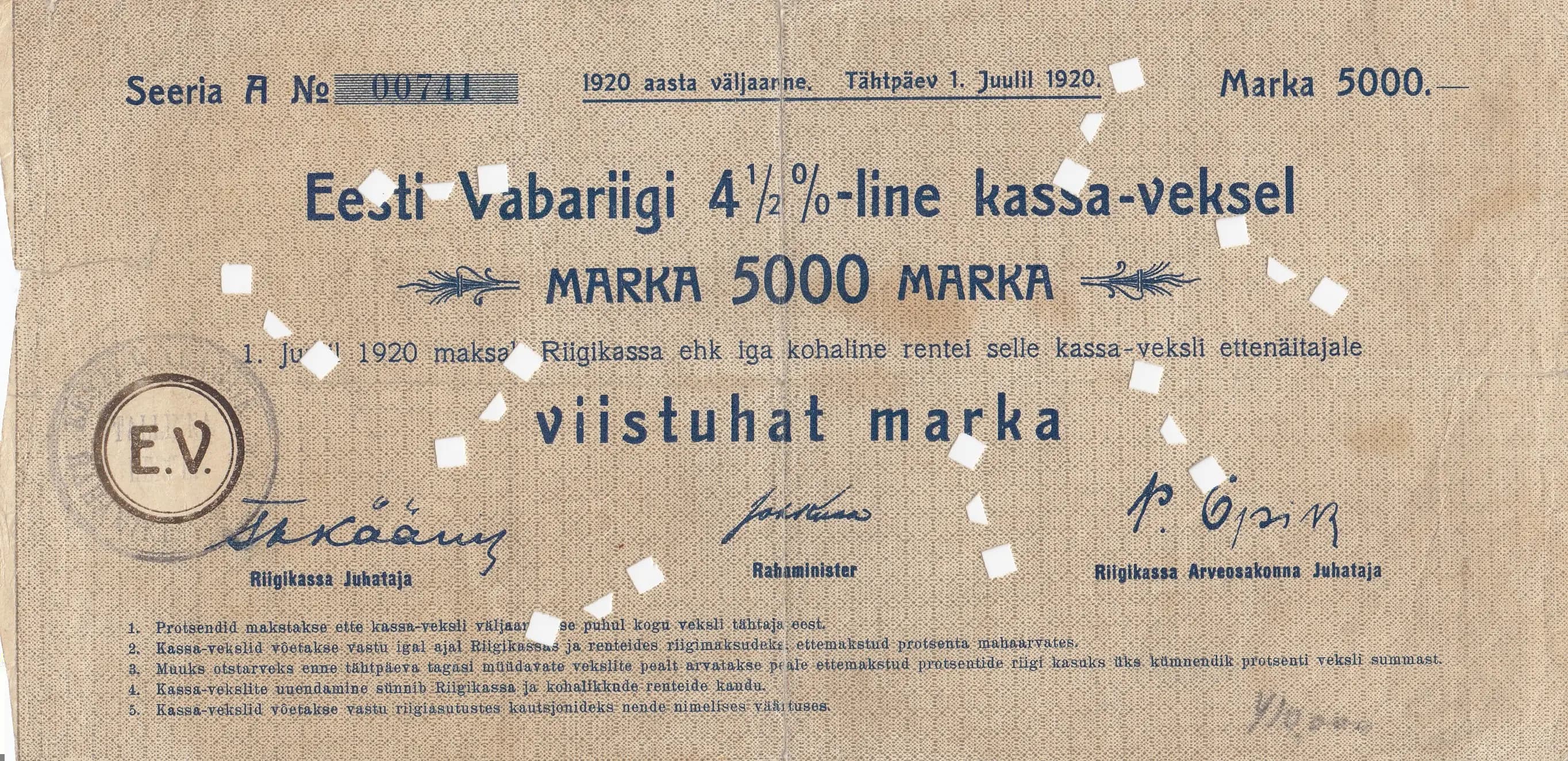
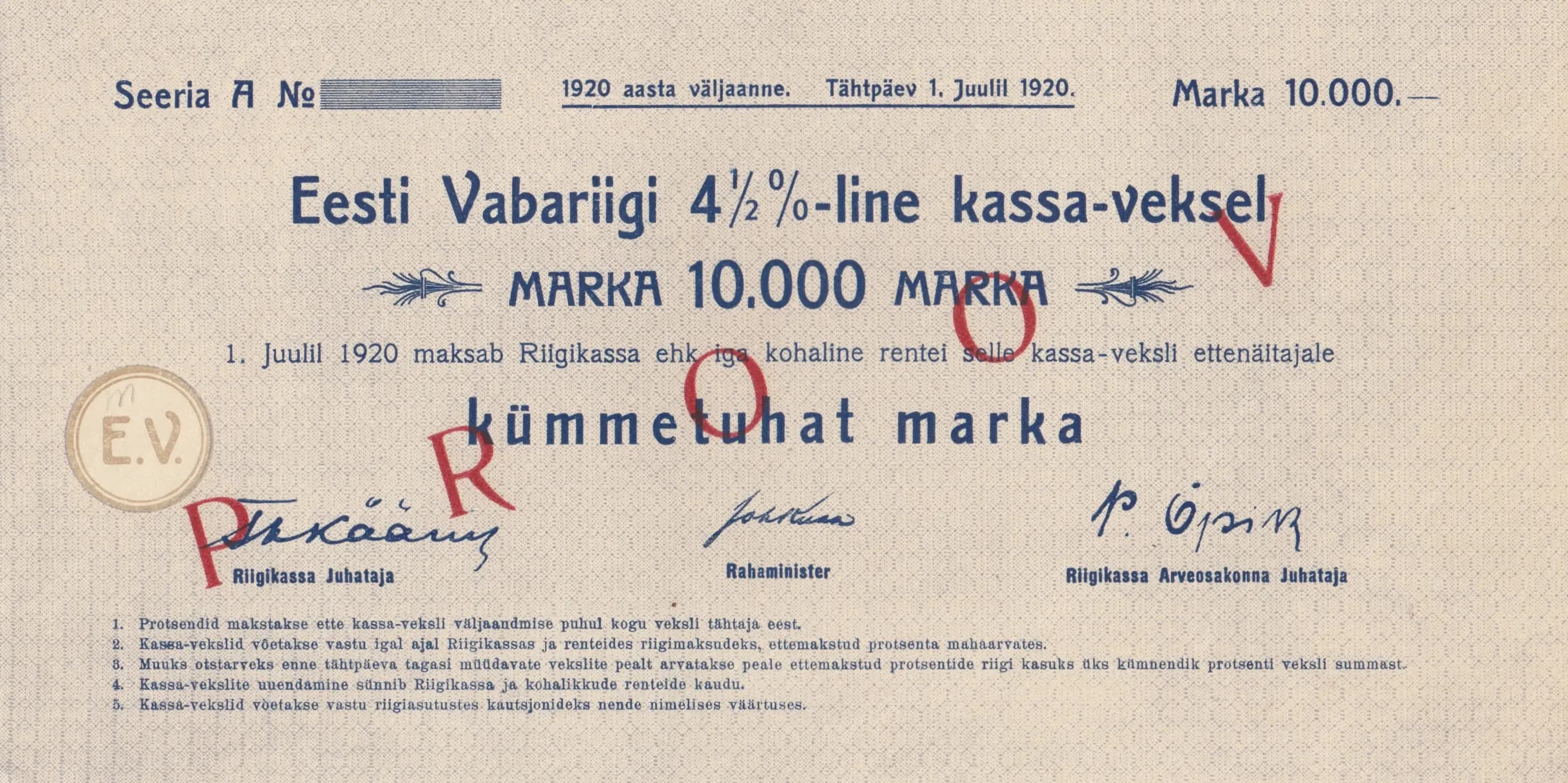
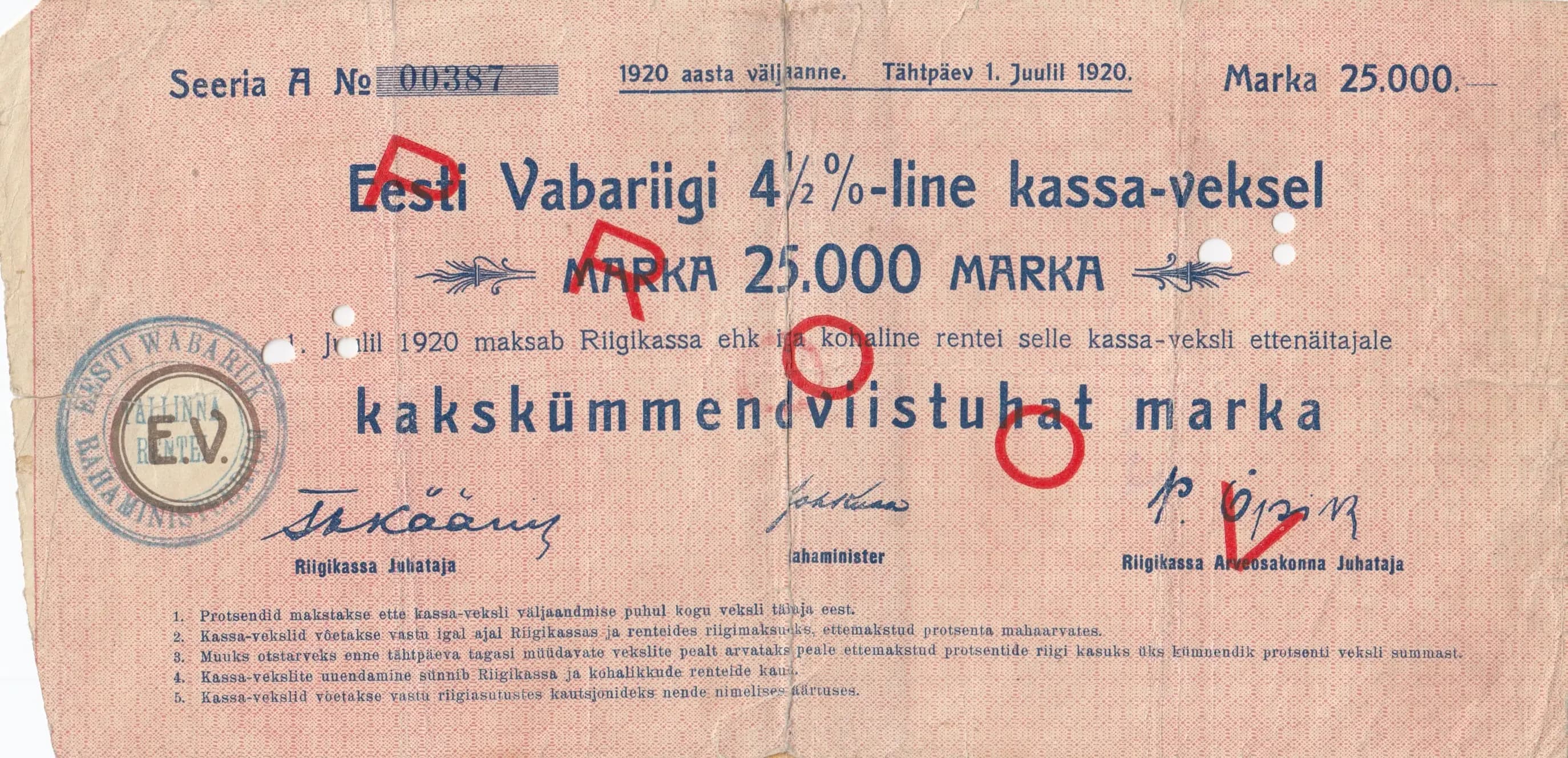
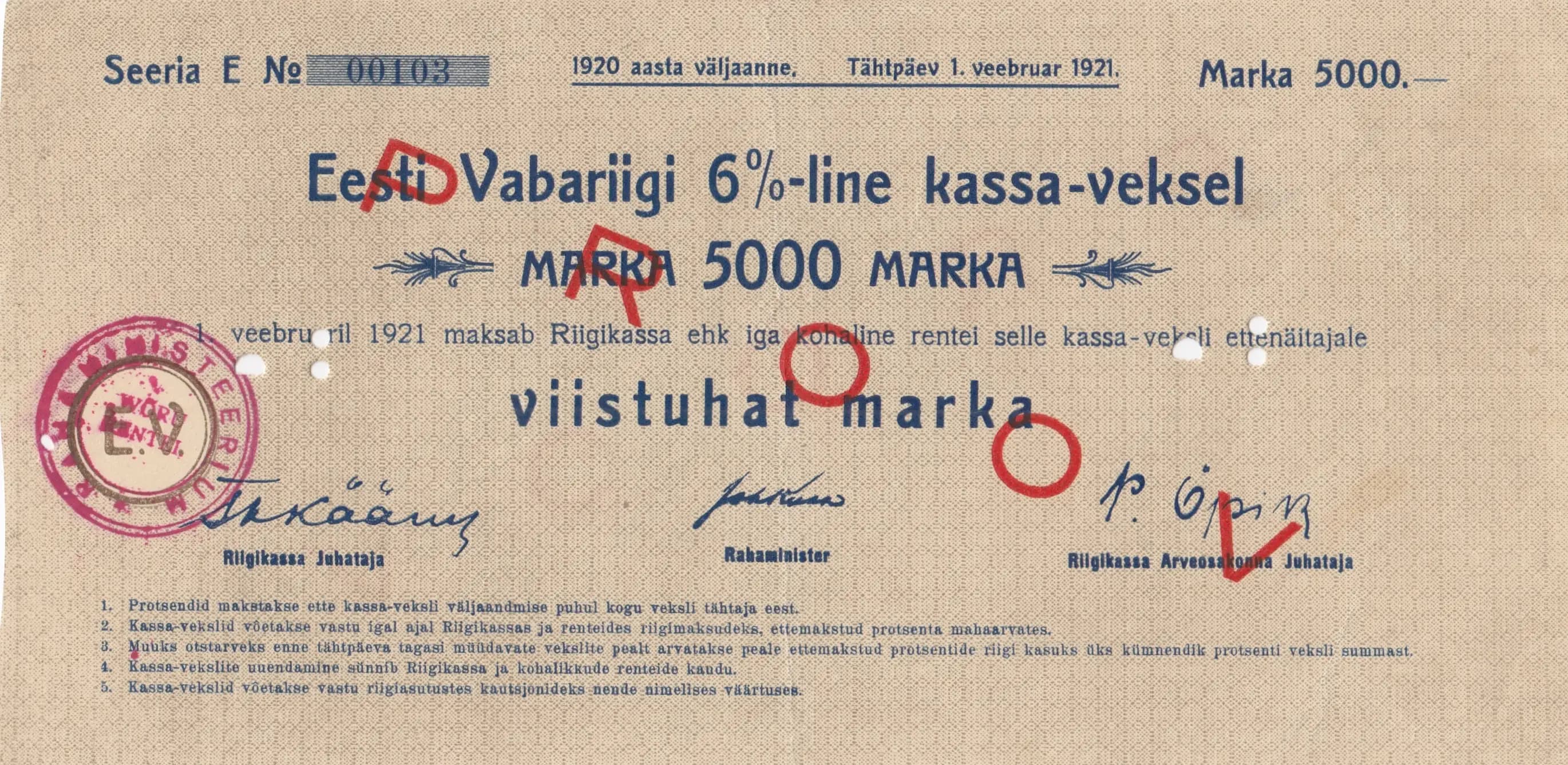
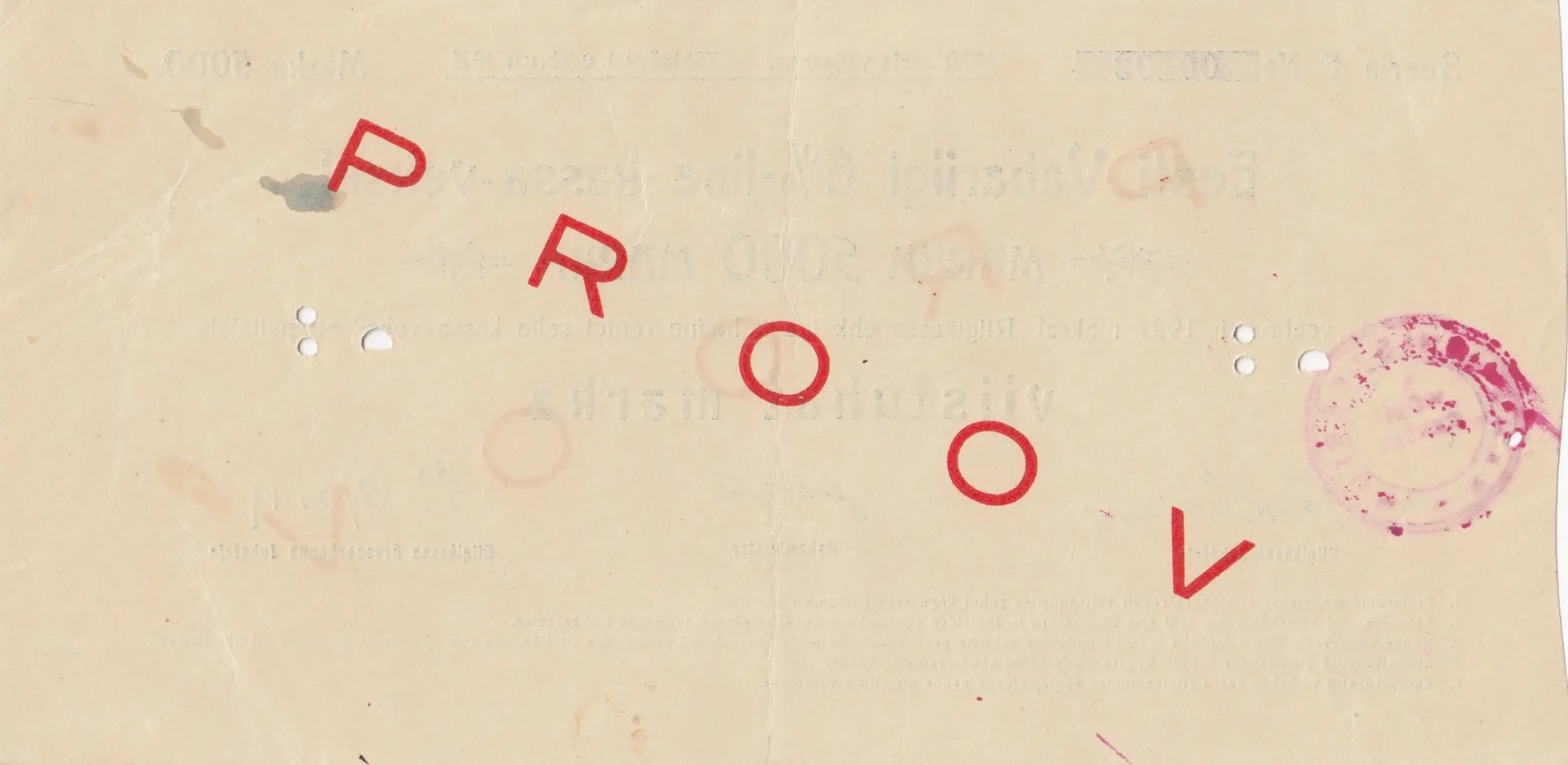
This is a treasury bill rather than a conventional banknote, designed as a formal financial certificate of the Estonian Republic. The front features a clean, text-based layout with decorative leaf and branch motifs flanking the denomination 'MARKA 5000 MARKA' in the center. A prominent circular official seal stamp in pink/magenta appears on the left side of the front, bearing text around its perimeter and serving as the primary security device. The document displays a beige/cream colored paper stock printed in dark blue and black inks with carefully set typography reflecting official government documentation standards of the period. The back side is largely blank or minimally printed, typical of treasury bills of this era which primarily served as negotiable financial instruments rather than display pieces. The formal layout, multiple signature lines for three high-ranking government officials, and detailed terms and conditions printed in small type on the front demonstrate the legal and financial nature of this instrument as official state debt.
FRONT SIDE: 'Seeria E № 00103' (Series E No. 00103); '1920 aasta väljaanne. Tähtpäev 1. veebruar 1921.' (1920 issue. Maturity date February 1, 1921.); 'Marka 5000.' (Mark 5000.); 'Eesti Vabariigi 6%-line kassa-veksel' (Estonian Republic 6% treasury bill); 'MARKA 5000 MARKA' (MARK 5000 MARK); 'viistuhal marka' (five thousand marks); 'veebru ril 1921 maksab Riigikassa ehk iga oomline rentei selle kassa-veksel ettenäitajale' (February 1921 payable by State Treasury or any branch office to bearer of this treasury bill); Signature lines for 'Riigikassa Juhataja' (Director of State Treasury), 'Rahaminister' (Minister of Finance), and 'Riigikassa Arveospidaja Juhataja' (Director of State Treasury Accounting). TERMS: '1. Protsendid maksatakse ette kassa-veksli väljäandmise puhul kogu veksli tähtajale eest.' (Interest is paid in advance for the entire duration of the treasury bill from issuance.); '2. Kassa-vekslid võetakse vastu igal ajal Riigikassas ja renteides riigimaksudeks, ettemaekstud protsendil mahaarvatres.' (Treasury bills are accepted at any time at the State Treasury and branch offices as payment for state taxes, with advance interest deducted.); '3. Muuks otstarveks enne tähtpäeva tagasi muudavate: veksile peab arvatakse peale ettemakstud protsendi riigi kasusk ilks kilomendik protsendi veksli summast.' (For other purposes before maturity date, redemption requires deduction from the bill of State Treasury fee and one-tenth percent of the bill amount.); '4. Kassa-vekslid jäävad seadusega arvel Riigikassa ja kohalikkude renteide kandi.' (Treasury bills remain under law in the accounts of State Treasury and local branch offices.); '5. Kassa-vekslid võetakse vastu riigiastutsutes kautsjonideks nende nimelist viiriltueses.' (Treasury bills are accepted at state institutions as collateral for their respective named purposes.). BACK SIDE: 'PROO' (archival notation).
Letterpress printing technique, utilizing multiple passes of dark blue and black inks on beige/cream stock. The fine detail visible in the typography and decorative elements, combined with the crisp circular seal stamp impression in pink/magenta, indicates professional security printing typical of early 20th century European government financial instruments. The even ink coverage and precise registration of multiple color elements suggest this was produced by an established security printer, likely a specialist in governmental financial documents. The characteristic aging patterns and ink behavior visible in the visual analysis are consistent with period-appropriate printing methods and materials used in 1920.
This example is specifically identified as Series E, Number 00103, from the 1920 issue with maturity date of February 1, 1921. The Pick reference P-38Rs indicates this is the 'R' (regular) series in standard condition, distinguished from the P-38A variety which is noted in external references as having orange coloring (this example shows the gray/beige standard coloring). The denomination on this note is definitively 5000 Marka (despite the external catalog reference to 200 Marka showing a data inconsistency), as confirmed by multiple inscriptions 'MARKA 5000 MARKA' and 'viistuhal marka' (five thousand marks) visible in the visual analysis. The archival red markings and 'PROO' notation on the reverse suggest this example has institutional provenance, possibly from a museum, bank archive, or significant collection.