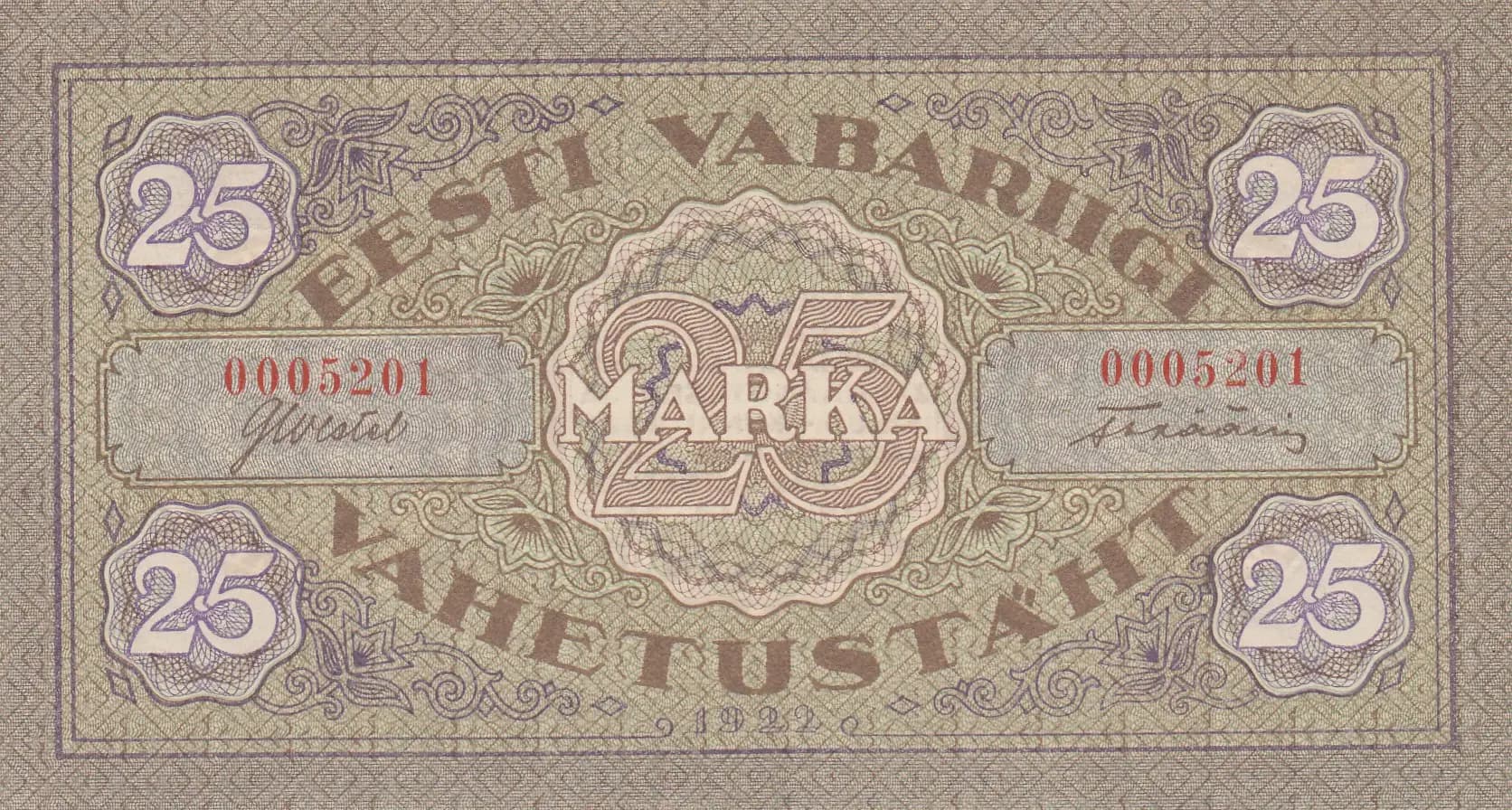
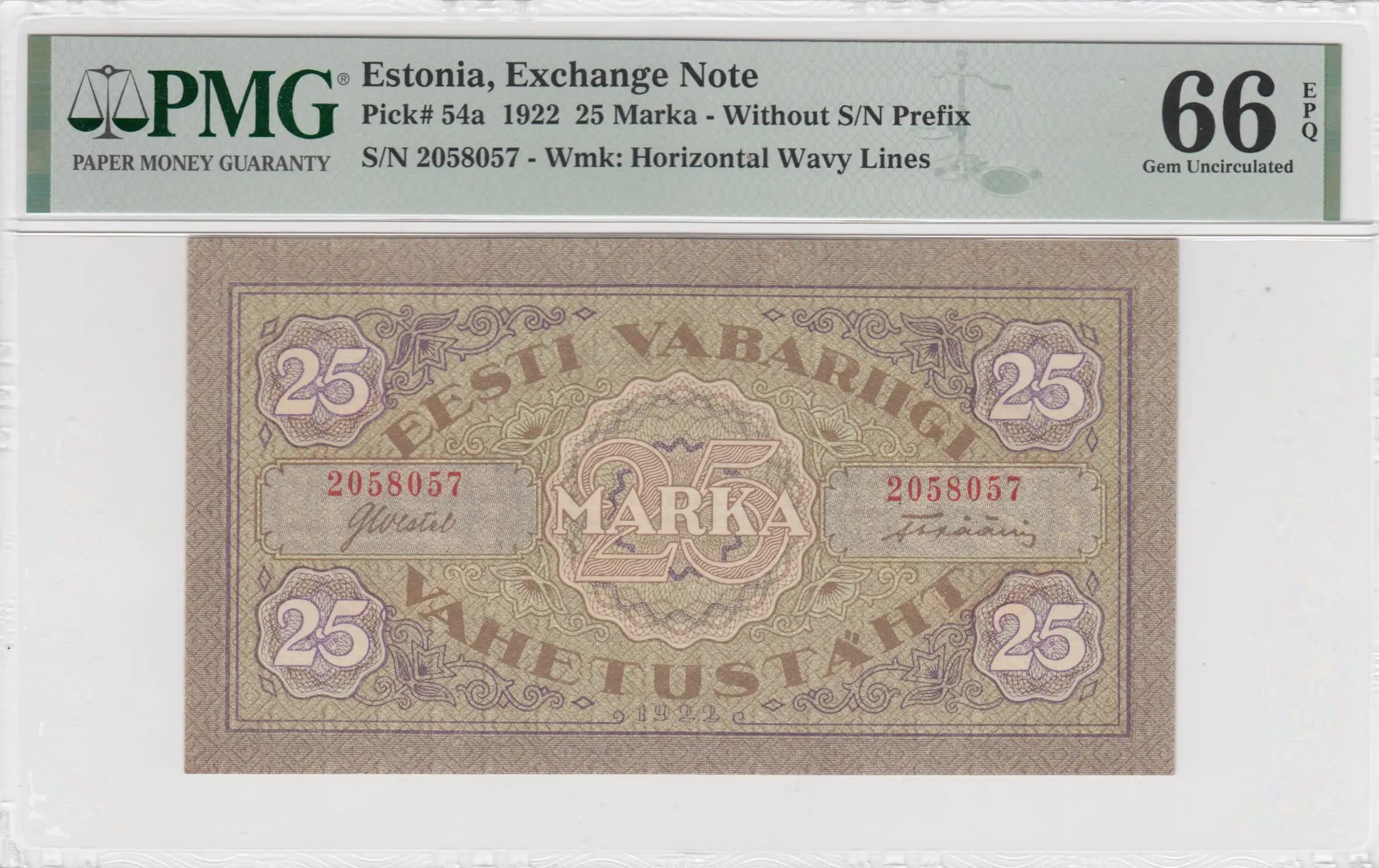
25 marka 1922 pair
Market Prices
3 salesAbout This Note
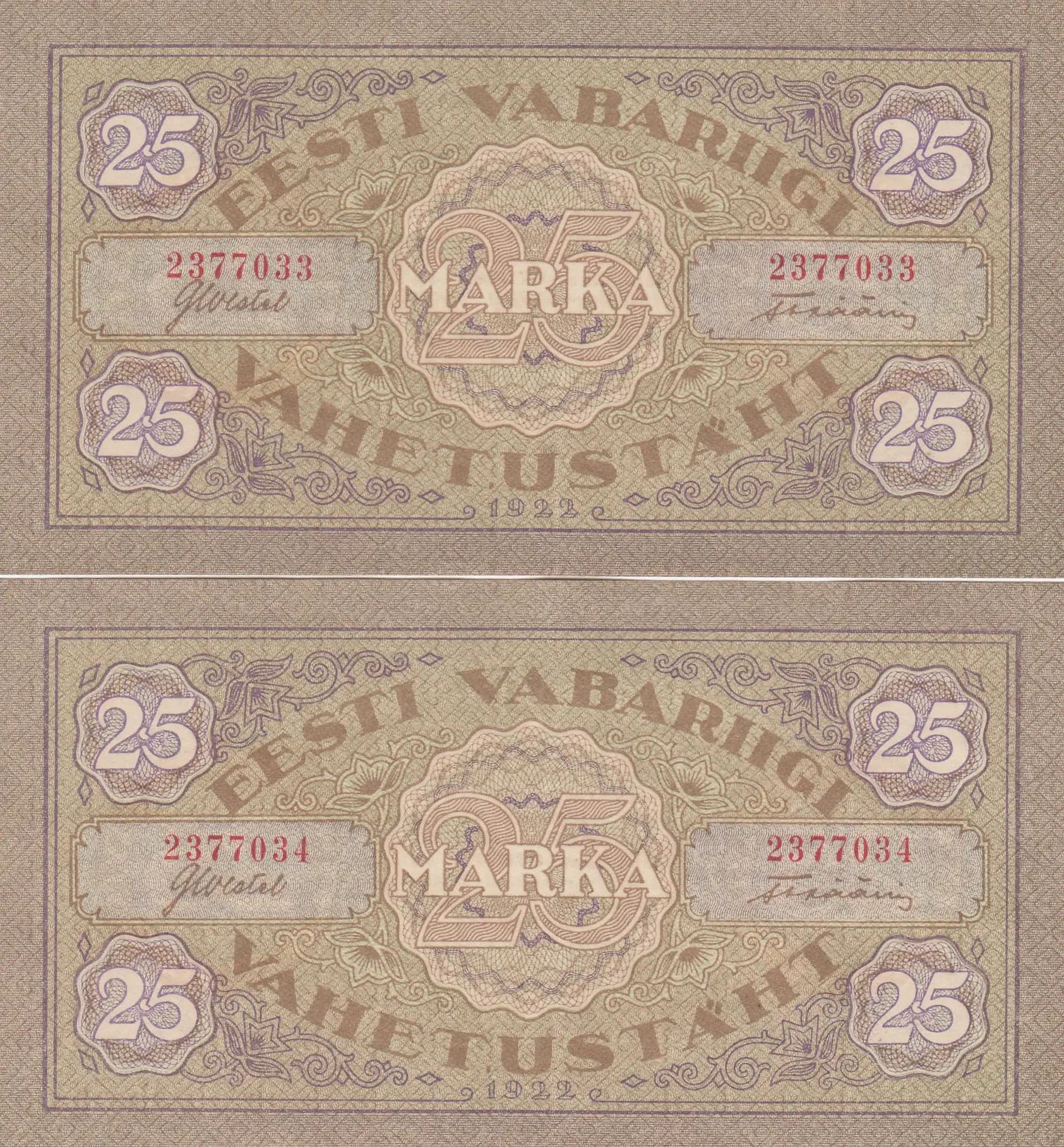
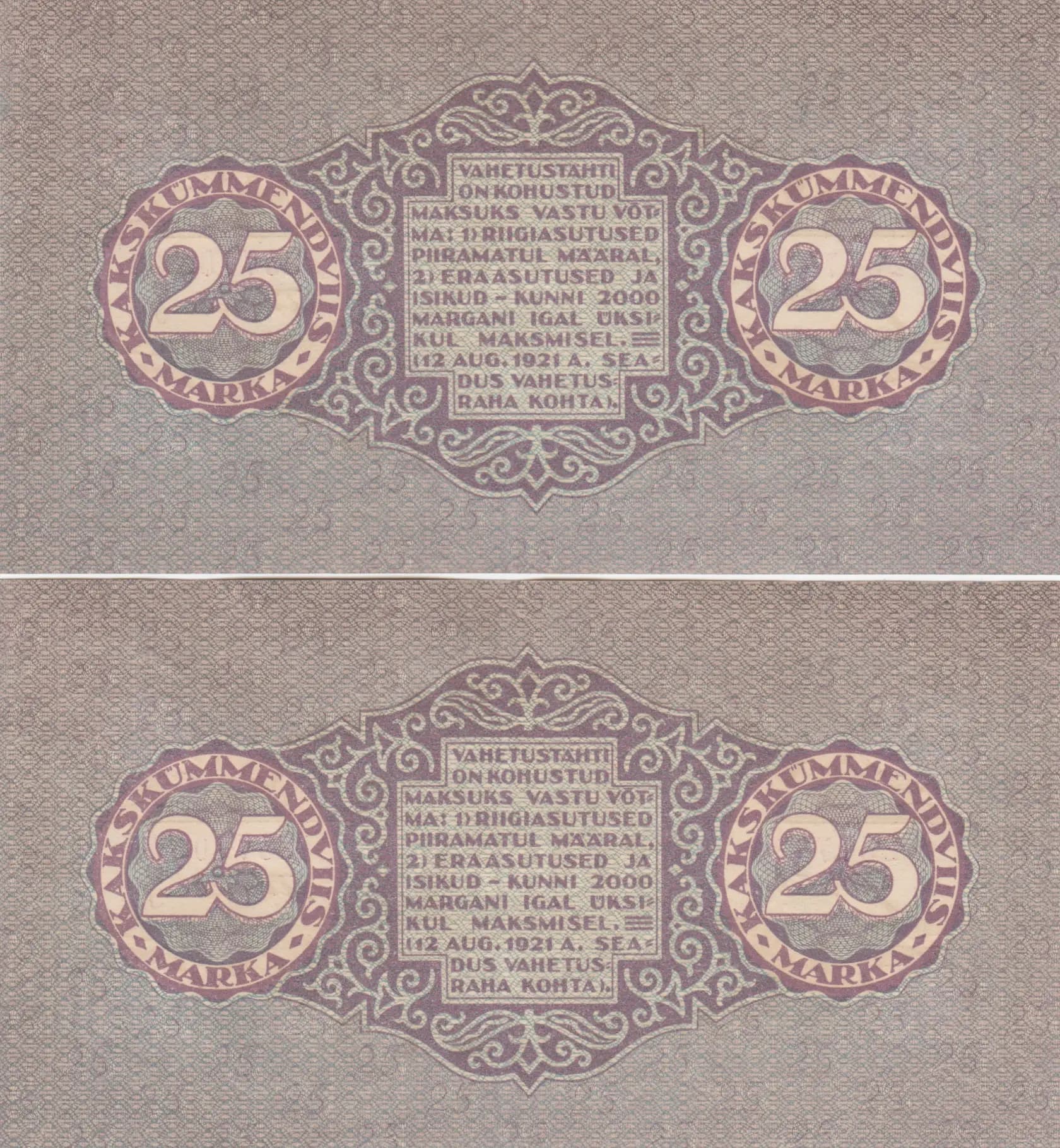
A spectacular consecutive pair of Estonia's 1922 25 Marka notes in uncirculated condition, displaying pristine preservation with vibrant brown, purple, and cream coloring throughout. The notes showcase the intricate Art Nouveau-style design characteristic of early Estonian currency, featuring ornamental medallions, elaborate scrollwork, and dual serial numbers (2377033-2377034) in red cartouches. This denomination represents an important transitional piece from Estonia's early independence period, with both obverse and reverse sides displaying exceptional detail and eye appeal typical of UNC specimens.
Common. The eBay market pricing history (examples selling for $12.50-$36 with modest bidding activity) and the 2016 catalog valuation of $150 for UNC specimens indicate this is a regularly traded note with modest collector demand. No evidence of restricted print runs, recalls, or scarcity exists for P-54a. The note is straightforward early Estonian currency rather than an error, overprint variety, or short-lived issue.
Issued in 1922 by the Treasury of the newly independent Estonian Republic (Eesti Vabariik), these notes commemorate the nation's first years of sovereignty following independence from the Russian Empire in 1918. The inscription 'RIIGI ÜHISUS' (State Unity) and the dated legal text referencing June and August 1922 reflect the establishment of Estonia's monetary system and exchange regulations during the formative period of the Estonian mark. The Art Nouveau aesthetic and ornamental design language were typical of Northern European currency design in the early 1920s, projecting stability and national identity.
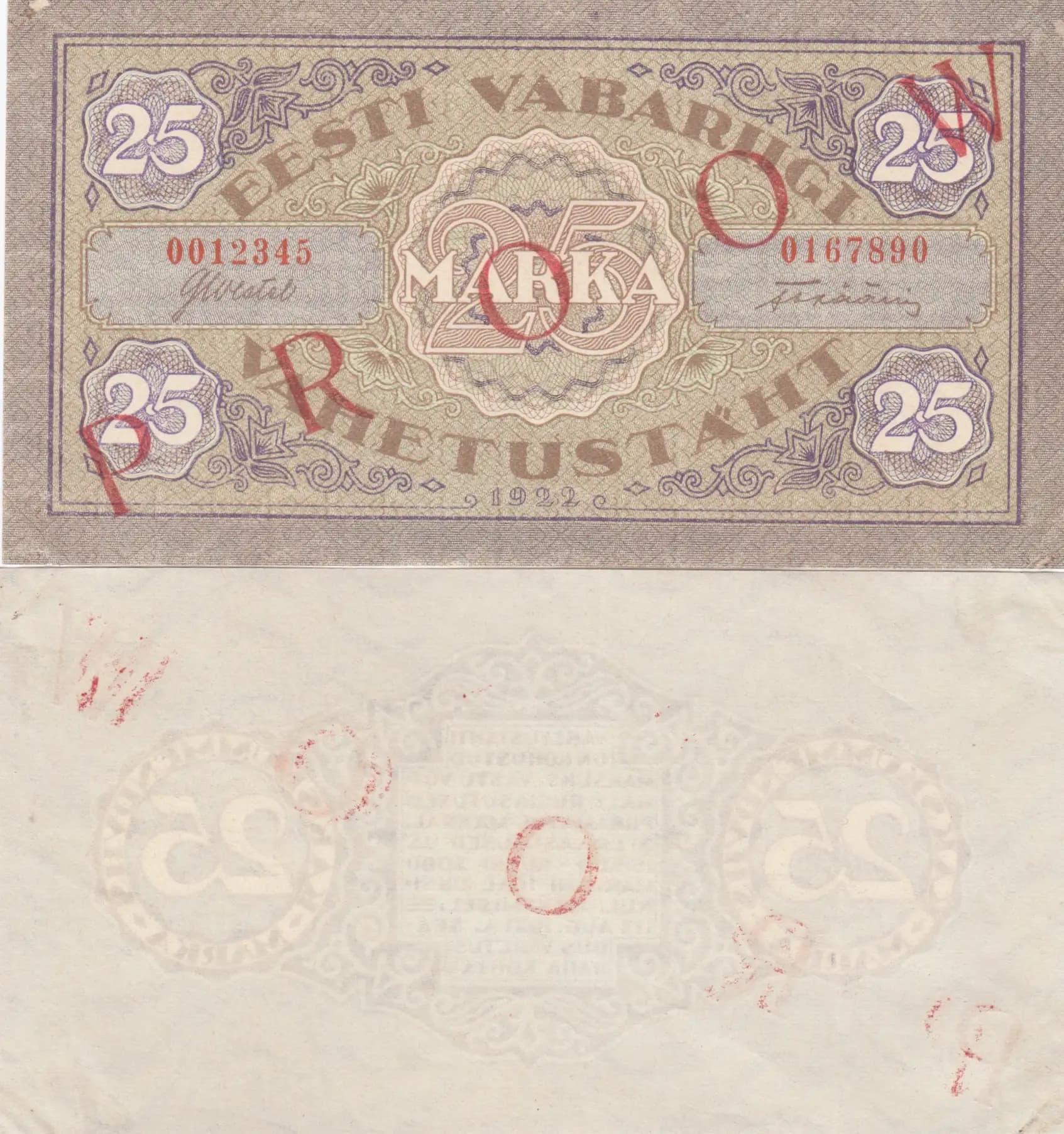
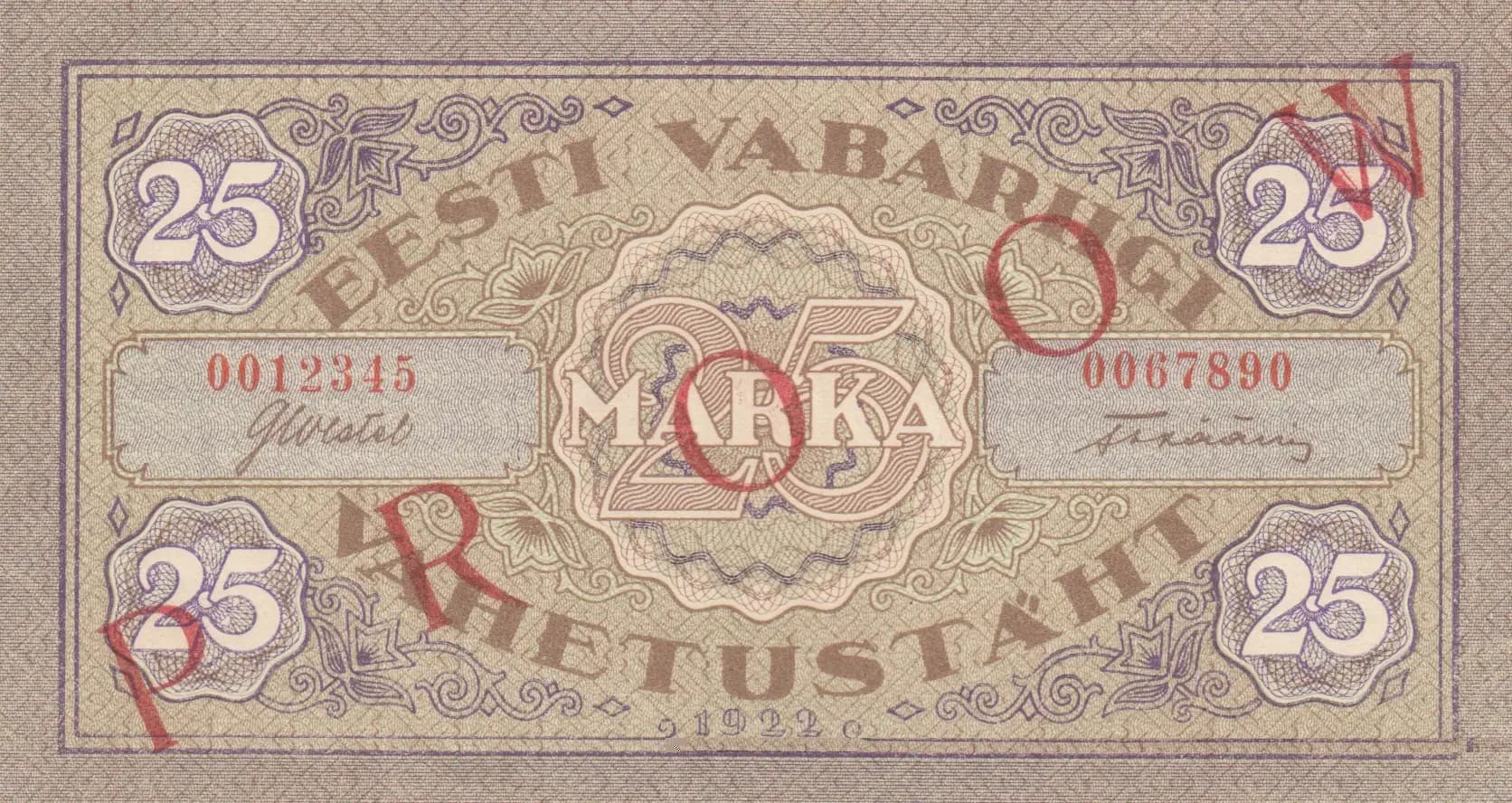
This 25 Marka note exemplifies early 1920s Estonian monetary design, featuring a symmetrical Art Nouveau layout with no portrait figures but rather symbolic representations of national identity through ornamental design. The obverse displays two large circular medallions containing outlined '25' denominations within decorative frames, flanking a central rectangular cartouche bearing legal text regarding currency exchange. The reverse features a dominant central medallion with '25 MARKA' in large lettering, surrounded by extensive ornamental scrollwork, floral motifs, and geometric patterning. The color scheme of brown on olive and lilac underprint (obverse) and lilac on gray underprint (reverse) creates visual distinction between sides while maintaining design cohesion. The watermark consists of horizontal wavy lines running throughout the paper, providing anti-counterfeiting protection.
OBVERSE (Front): Central text describes exchange terms and conditions with two variants dated 15 June 1922 and 15 August 1922, establishing that the notes are valid legal tender ('VAHETUSANTH ON KOHUSTUD MAKSUKS') for payment to government institutions ('RIGIASUTUSED') without limitation ('PIIRAMATUL MAÄRAL'), and to private individuals up to 2000 marks per transaction. Denomination markers read 'SUMMANDI' and 'MARKA' flanking the '25' numerals. REVERSE (Back): 'EESTI VABARIIK' (Estonian Republic) appears across the top; the central medallion displays '25 MARKA' prominently; 'RIIGI ÜHISUS' (State Unity) frames the sides; and '1922' appears at the base. Serial numbers '2377033' and '2377034' are printed in red on rectangular cartouches on both sides of the central design.
Intaglio (engraved) printing, evidenced by the fine line work, intricate ornamental patterns, and dimensional security features visible in the detailed medallions and scrollwork. The sharp definition of the '25' denominations, the precision of the serial numbers in red ink, and the complexity of the overall design are characteristic of high-security intaglio production. This printing method was standard for Estonian state currency during the 1920s and provided superior counterfeiting protection for the period.
This specimen is cataloged as Pick P-54a (1922 25 Marka without serial number prefix letters). PMG records indicate variants P-54c and P-54cs exist (Series A, possibly with different prefix designations or print runs). The consecutive serial numbers (2377033-2377034) without alphabetic prefixes are consistent with the P-54a designation. No overprints, signature variants, or date variations are evident on these notes; both display identical design characteristics and the same legal text dating conventions, making them standard examples of the primary 1922 issue.