25 marka 1922
Market Prices
3 salesAbout This Note
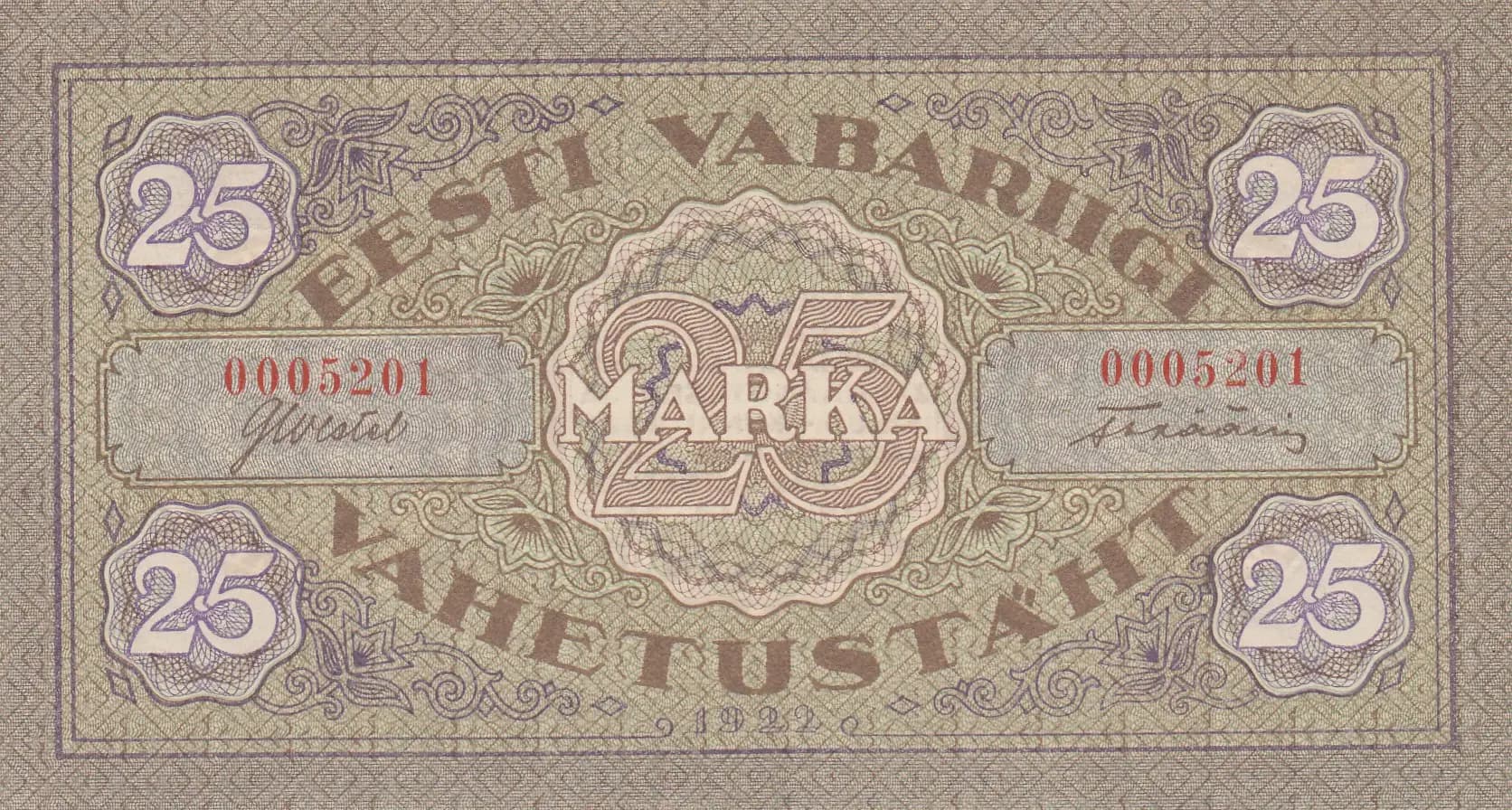
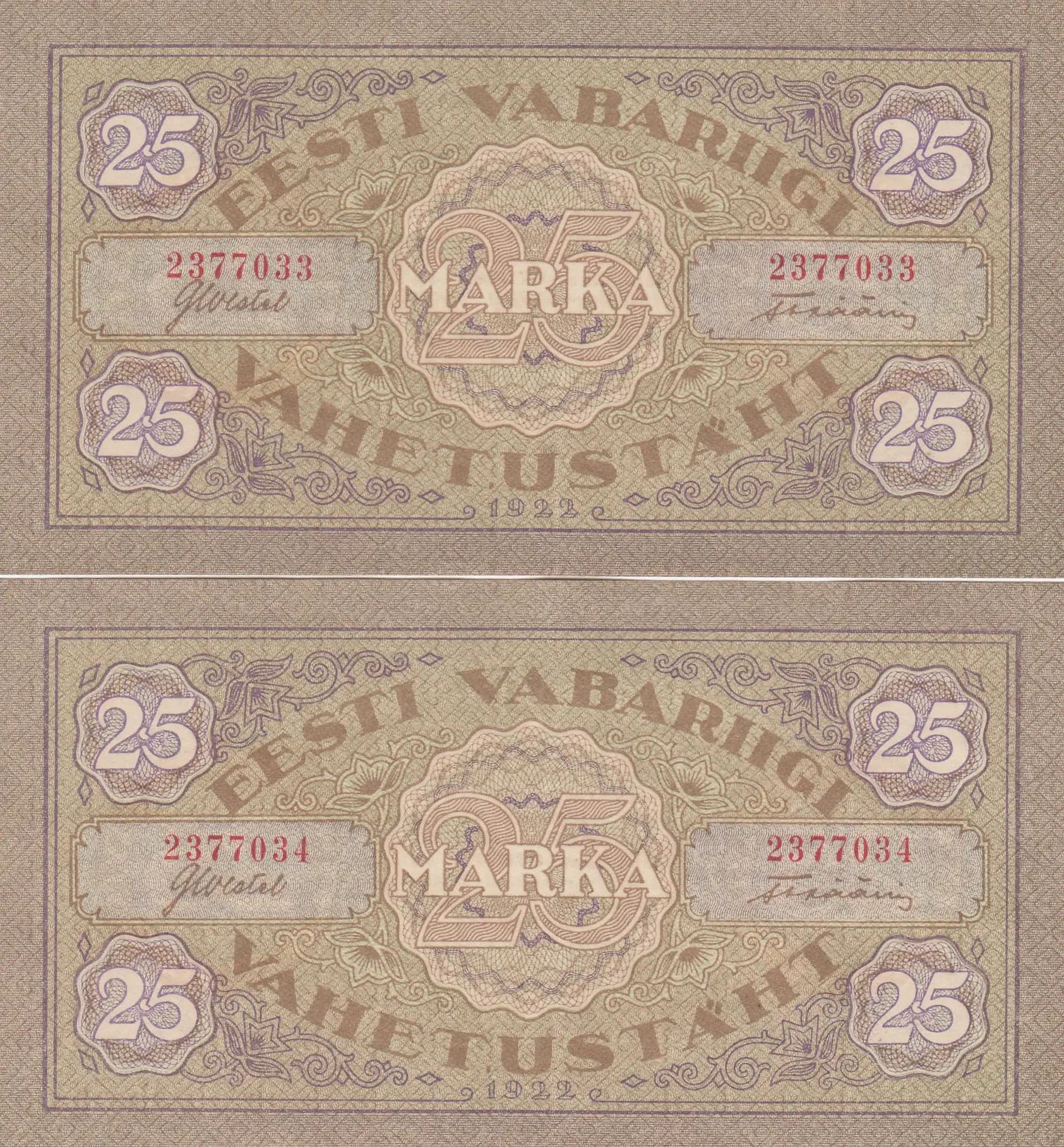
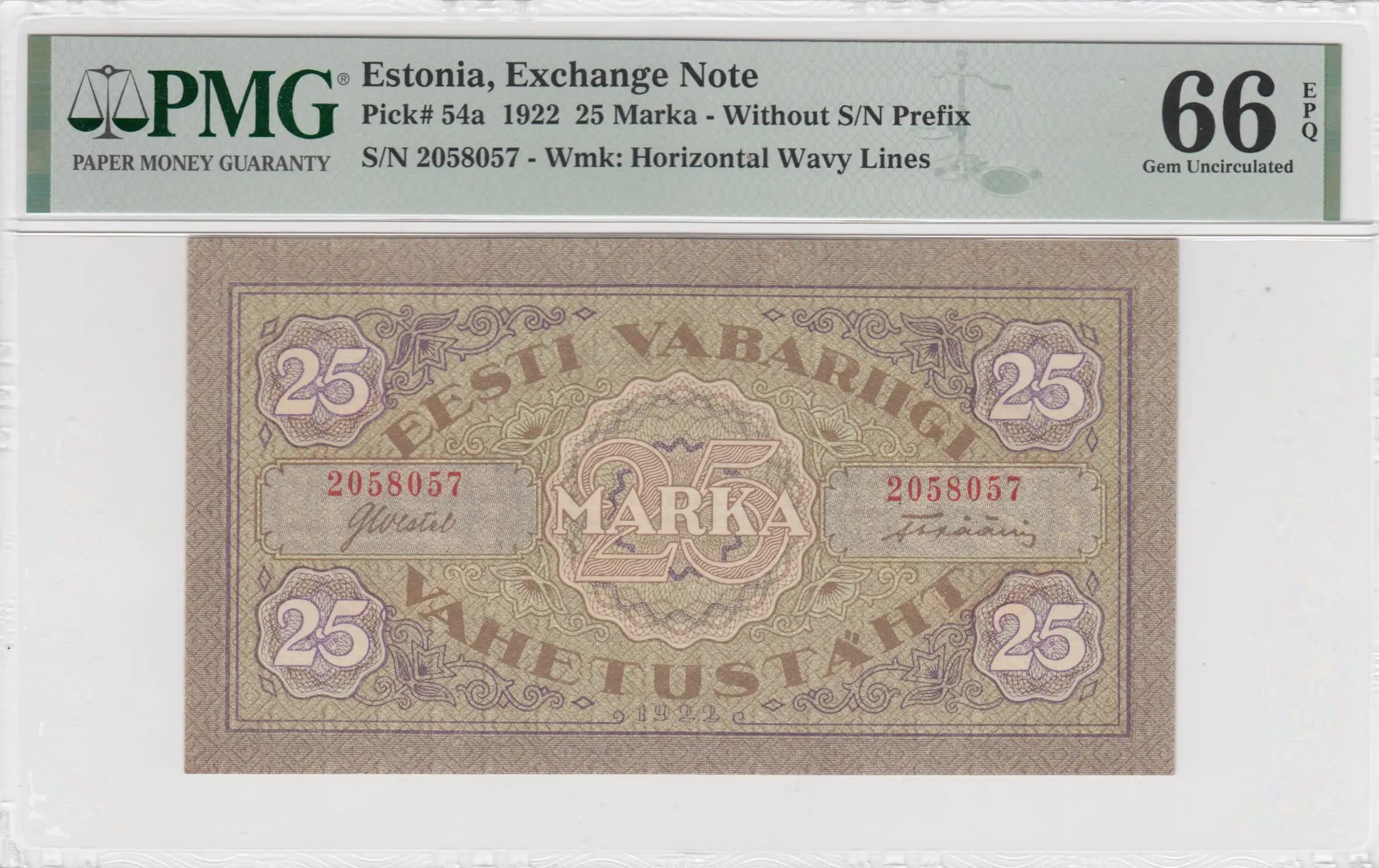
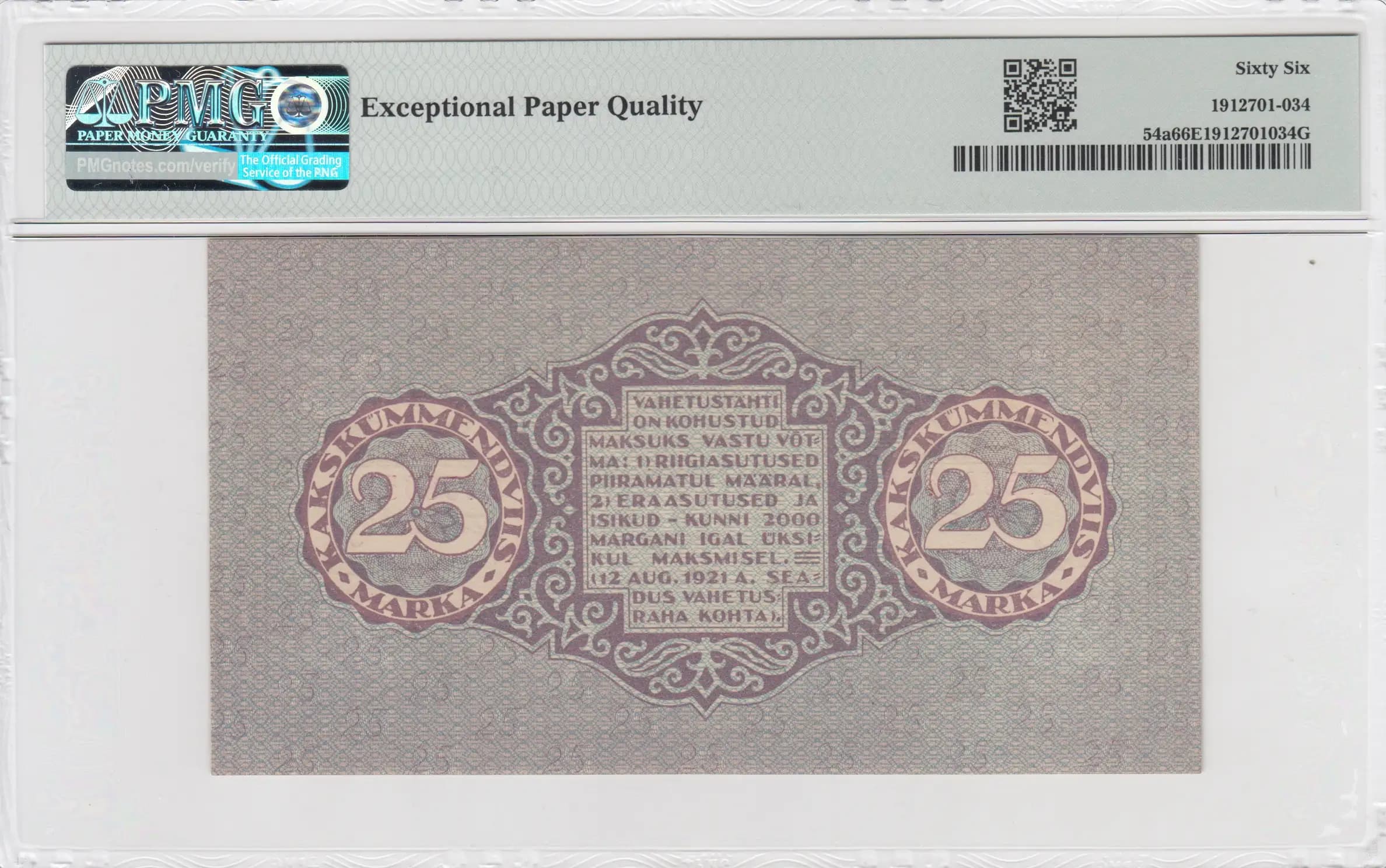
This is an exceptionally well-preserved Estonian 25 Marka exchange note from 1922, graded PMG 66 Gem Uncirculated with Exceptional Paper Quality. The note features elegant baroque revival design work in brown, purple, and pink tones on both sides, with ornamental scrollwork and symmetrical denomination markers. This particular example shows pristine paper quality with no wear, creasing, or stains, representing an outstanding specimen of early Estonian currency.
Common. The eBay price history provided shows recent sales in the $12.50–$36 range for lower grades (F condition), with 2016 catalogue values placing VF specimens at $50 and UNC at $150. The PMG 66 grade represents exceptional quality that would command a premium within its market, but the note itself was part of a regular issue with standard circulation. The 25 Marka denomination was one of the primary denominations in this series, suggesting adequate print runs. No evidence of rarity or limited mintage is present in the provided catalog data.
The 25 Marka denomination was issued by the newly independent Estonian Republic in 1922, during the immediate post-independence period following Estonia's separation from Russia in 1918. The reverse contains official text referencing August 12, 1921 legislation regarding exchange notes (vahetusrahani), indicating this was a special-purpose currency issued under specific state authority for regulated circulation among state institutions and local authorities. The baroque revival design aesthetic reflects the cultural identity and artistic standards of the young Estonian nation seeking to establish itself on the international stage.
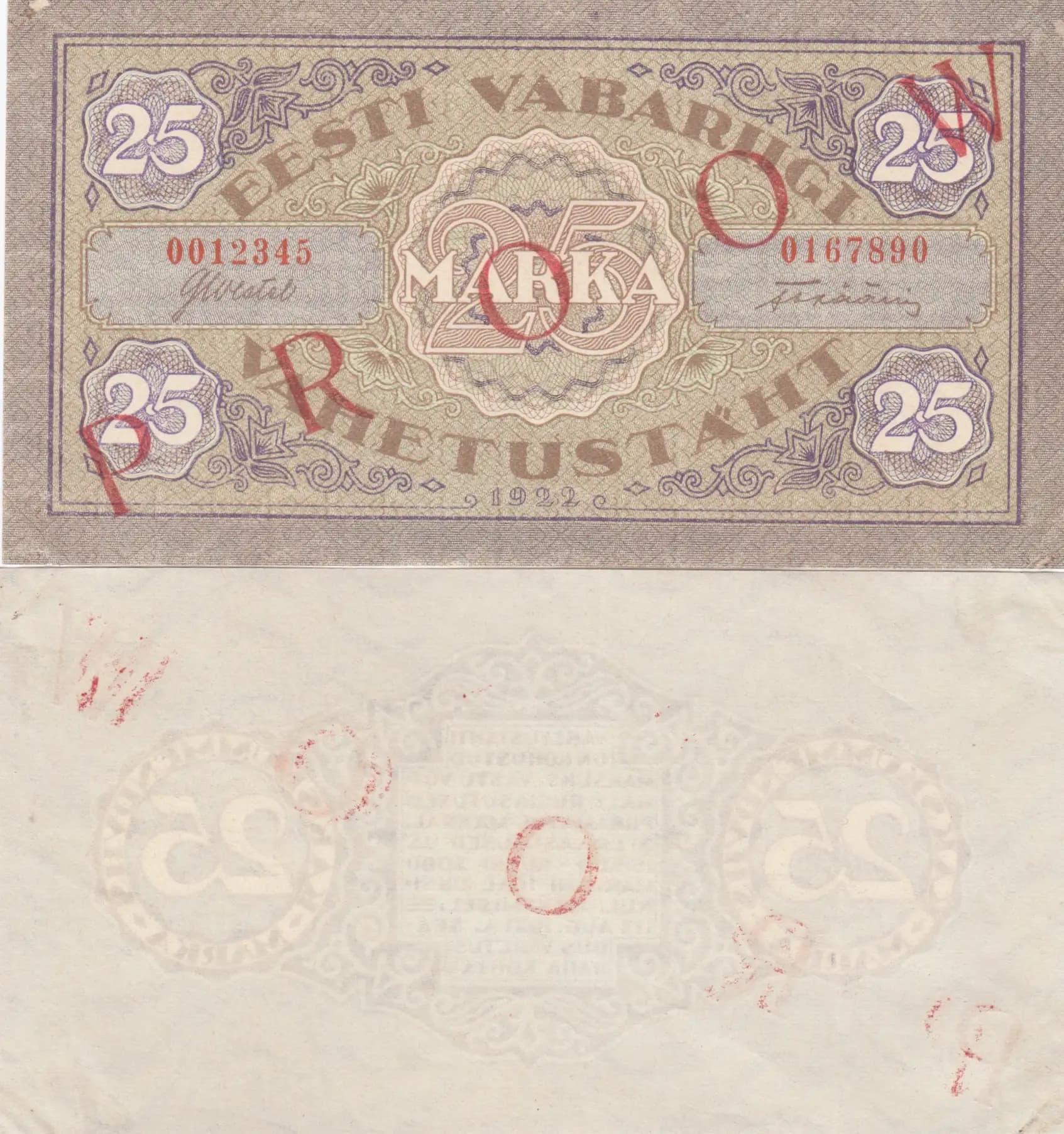
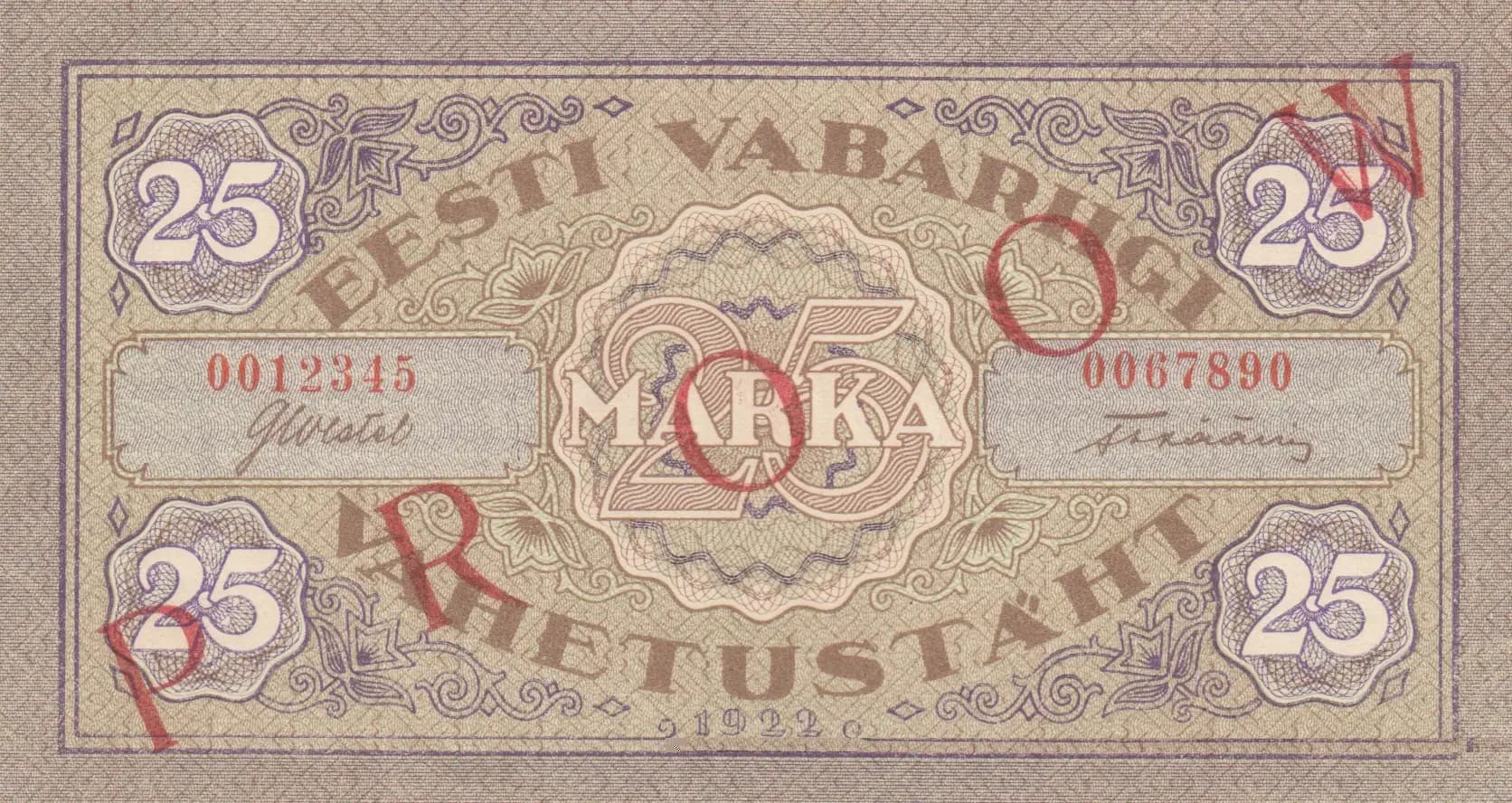
The 25 Marka note employs a symmetrical baroque revival design philosophy characteristic of 1920s European banknote production. The obverse features a tan and beige field with purple and pink ornamental elements, including large denomination numerals '25' positioned in all four corners within decorative cartouches. The center displays an elaborate scrollwork frame containing the issuer identification 'PESTI VABARIIK' (Estonian Republic) with the denomination 'MARKA' prominently displayed. Red serial numbers are integrated into decorative cartouches flanking the central design. The reverse mirrors this aesthetic with cream and mauve tones, replacing the corner numerals with two large circular medallions containing '25', and positioning the extensive regulatory text within a central ornamental cartouche. Both sides employ intricate geometric and floral baroque-inspired patterns as integral design elements rather than mere background, creating a sophisticated, unified appearance befitting a national currency of a newly sovereign state.
FRONT SIDE: '25' (denomination), 'PESTI VABARIIK' (Estonian Republic), 'MARKA' (Marka/Mark currency unit), '2058057' (serial number), '1922' (year of issue). BACK SIDE: '25' and 'MARKA' (denomination repeated), extended regulatory text reading approximately: 'VAHETUSRAHANI ON KOHUSTUD MAKSUSE-VASTU VOT MAI:D RIIGIGASUTUSED PIIRAMAS ILULEAGA, PIESASUTUSED JA ISI KUD - KUNNI 2000 MARGANI IGAL UKSE KUL MAKSMISELE (12 AUG.1921 A. SEA DUS VAHETUS RAHA KOHTAD' (Official regulations stating that state institutions, local government bodies, and individual entities are obligated to accept this exchange note in payment up to 2000 marks per transaction, under the provisions of the August 12, 1921 law regarding exchange currency).
The note exhibits characteristics consistent with intaglio (engraved) printing, the standard security method for banknote production in the 1920s. The crisp, sharp detail visible in the ornamental scrollwork, the precise registration of multiple color layers (brown, purple, pink on the obverse; mauve, gray on the reverse), and the depth of the printed lines all indicate professional engraved plate production. The horizontal wavy line watermark noted in the security features represents a paper-based security measure. The printer for Estonian banknotes of this period was typically a Western European security printer, though specific attribution would require consultation of Estonian Central Bank archives.
Per the PMG Population Report reference data, this base Pick number (P-54a) has two documented variants: P-54c and P-54cs, both identified as 'Series A' notes. The absence of serial number prefix letters noted in the REALBANKNOTES.COM reference is consistent with the P-54a variety designation. The visual analysis confirms the note bears serial number '2058057' in red within decorative cartouches, without letter prefixes, confirming P-54a classification. No date or signature variations are apparent from the visual analysis provided.