25 marka 1919
Market Prices
3 salesAbout This Note
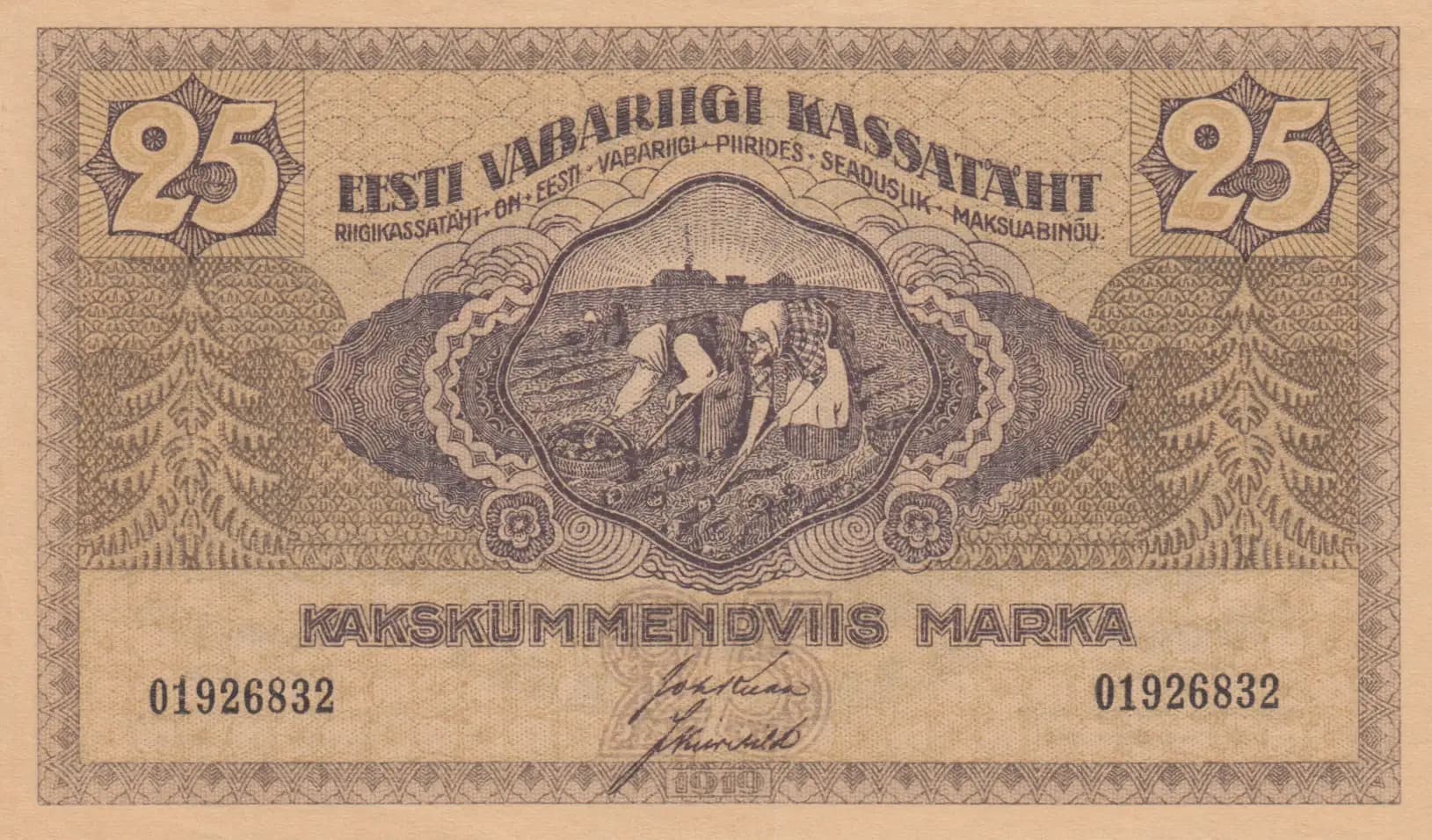
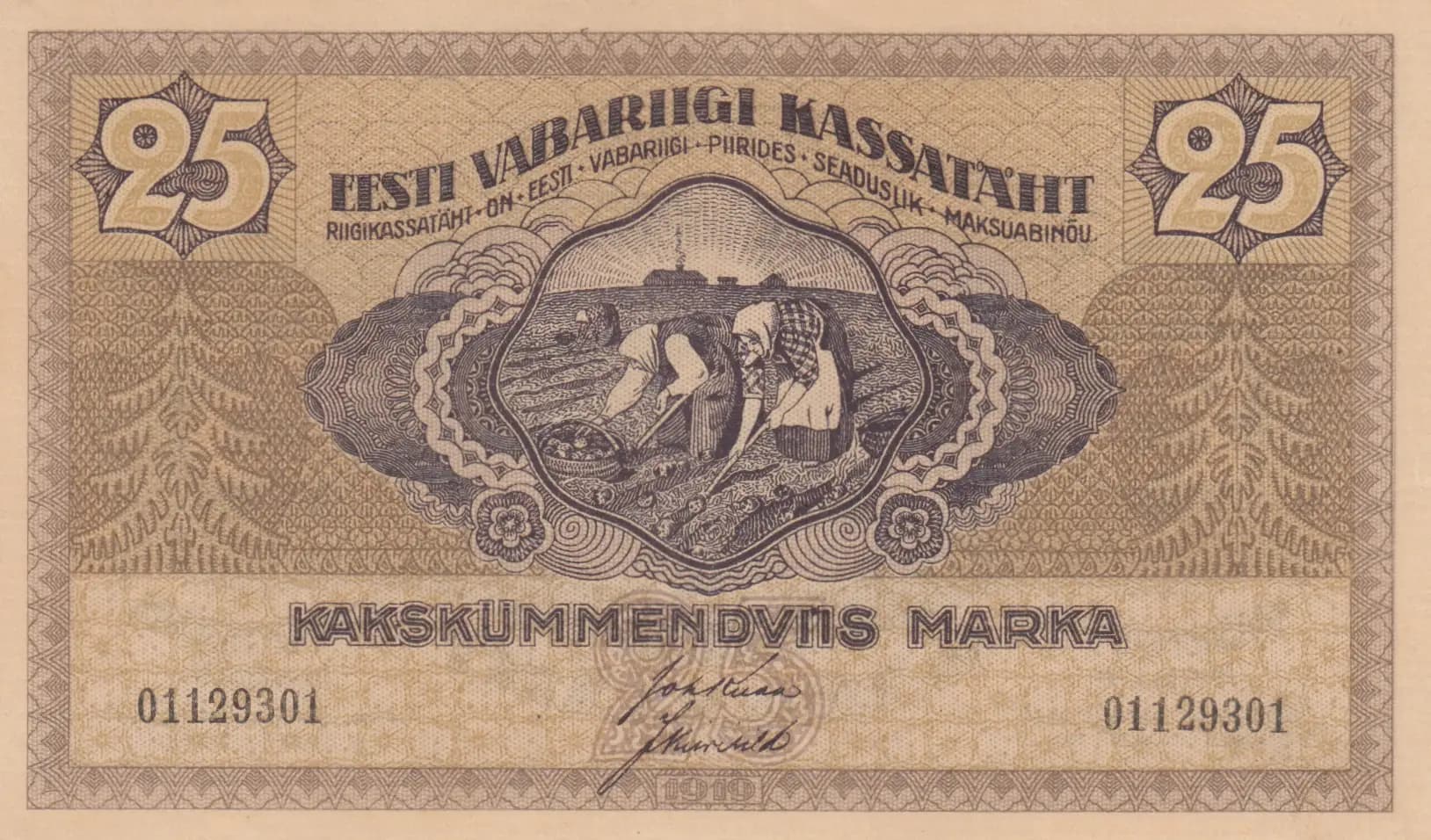
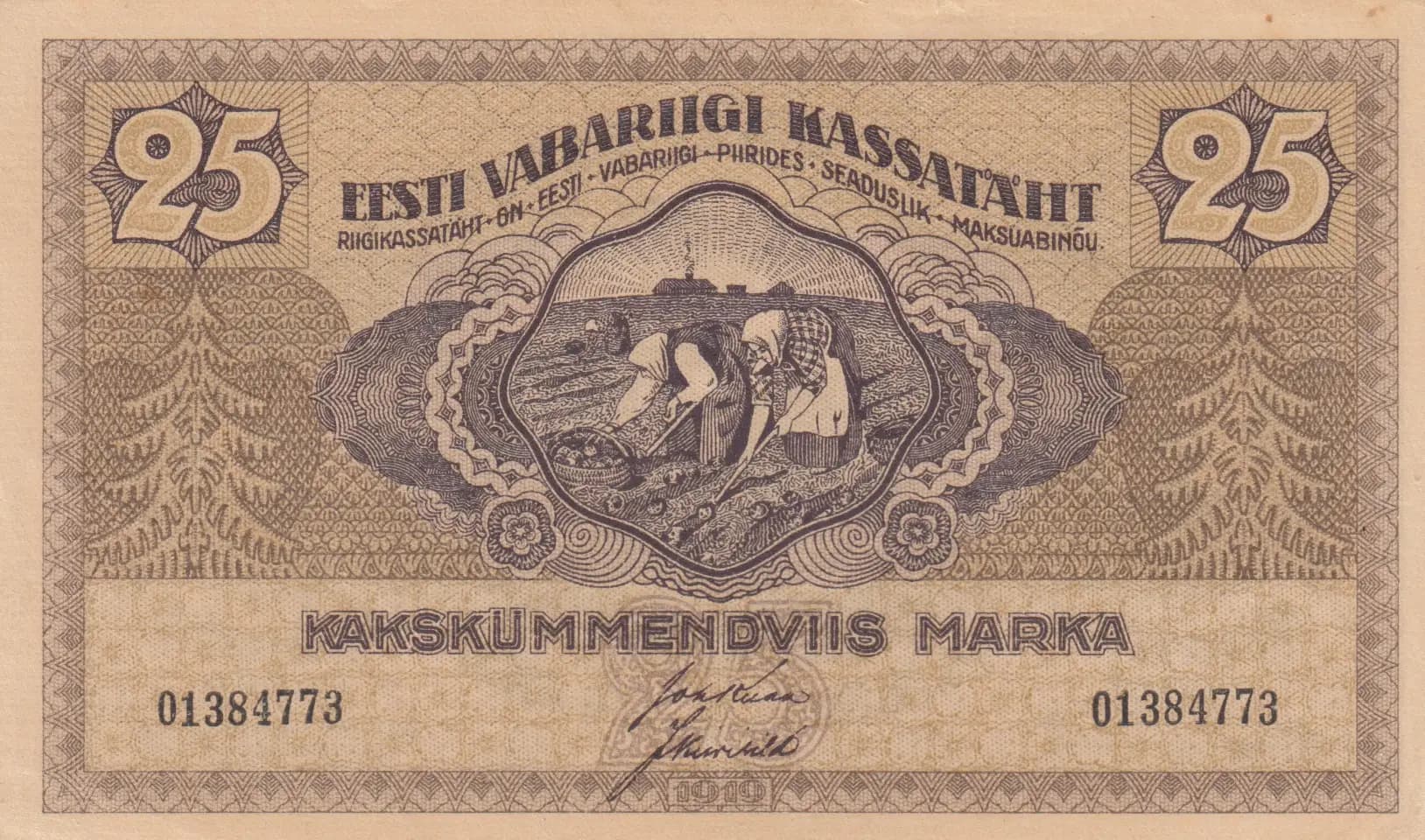
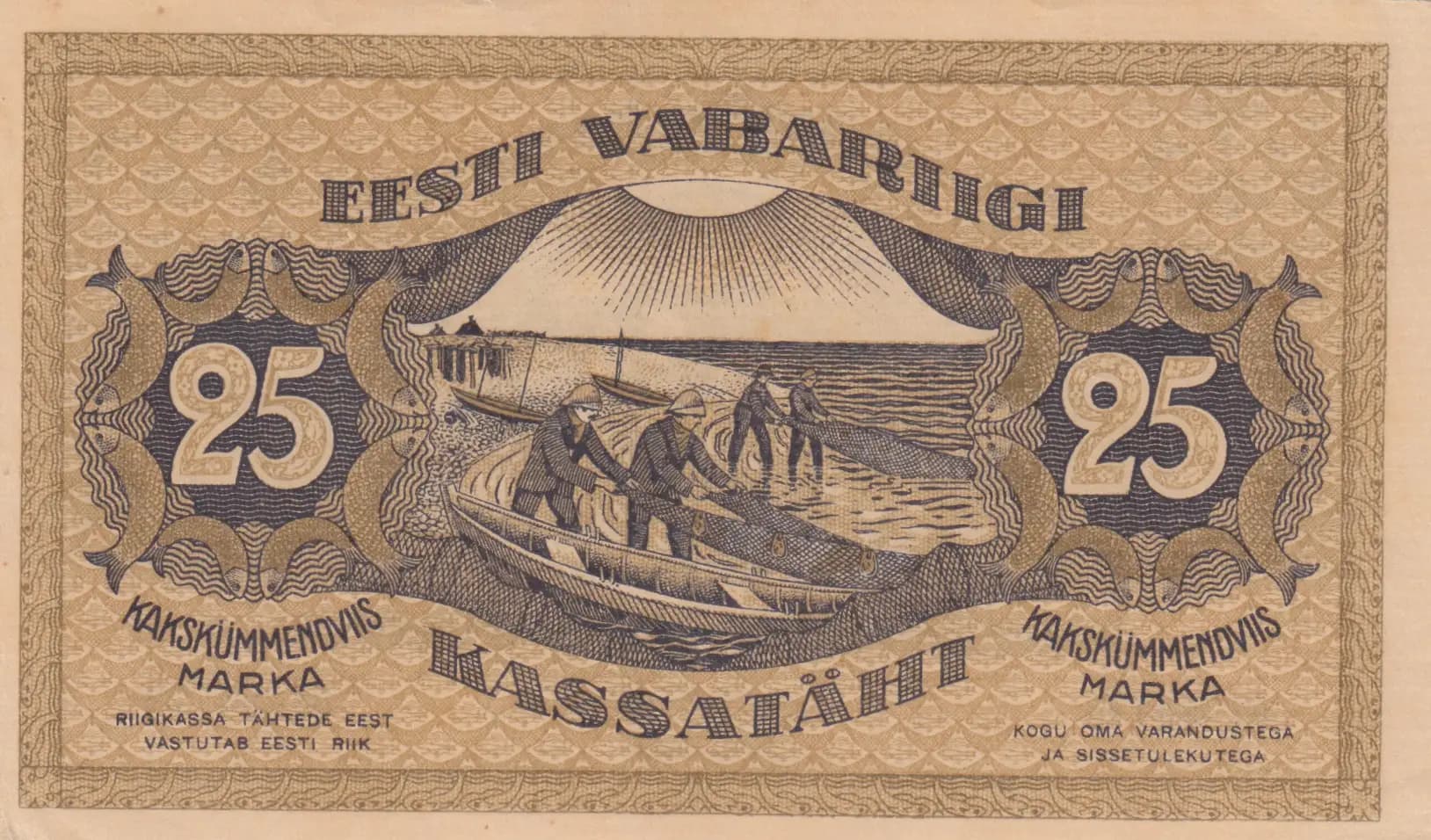
This 25 Marka note from 1919 represents an early issue of the newly independent Estonian Republic, featuring beautifully engraved vignettes of agricultural and fishing scenes that symbolize the nation's economic foundation. The note displays an AU condition grade with aged patina, yellowing consistent with early 20th-century paper, and crisp, legible printing throughout—a desirable example of Estonia's first currency issue with clear serial number 01384773 visible on both sides.
Common. The 25 Marka 1919 (P-47b) was a regular issue of the newly established Estonian Republic and saw substantial circulation. Market data from realbanknotes.com shows eBay sales in the $13.50–$25.60 range for lower grades (VG-F) and around $22.50 for VF examples, with 2016 catalog values of $50 (VG), $100 (VF), and $200 (UNC). These prices reflect a liquid, readily available market typical of common early 20th-century European notes. AU examples trade at moderate premiums but are not scarce.
Issued in 1919 during Estonia's declaration of independence from Russia, this banknote celebrates the nation's primary economic activities through its dual imagery: potato harvesting on the obverse and coastal fishing on the reverse, reflecting the agrarian and maritime character of the new Baltic state. The Estonian-language inscriptions and state treasury backing represent the establishment of Estonian sovereignty and the creation of its own monetary system following centuries of foreign rule.
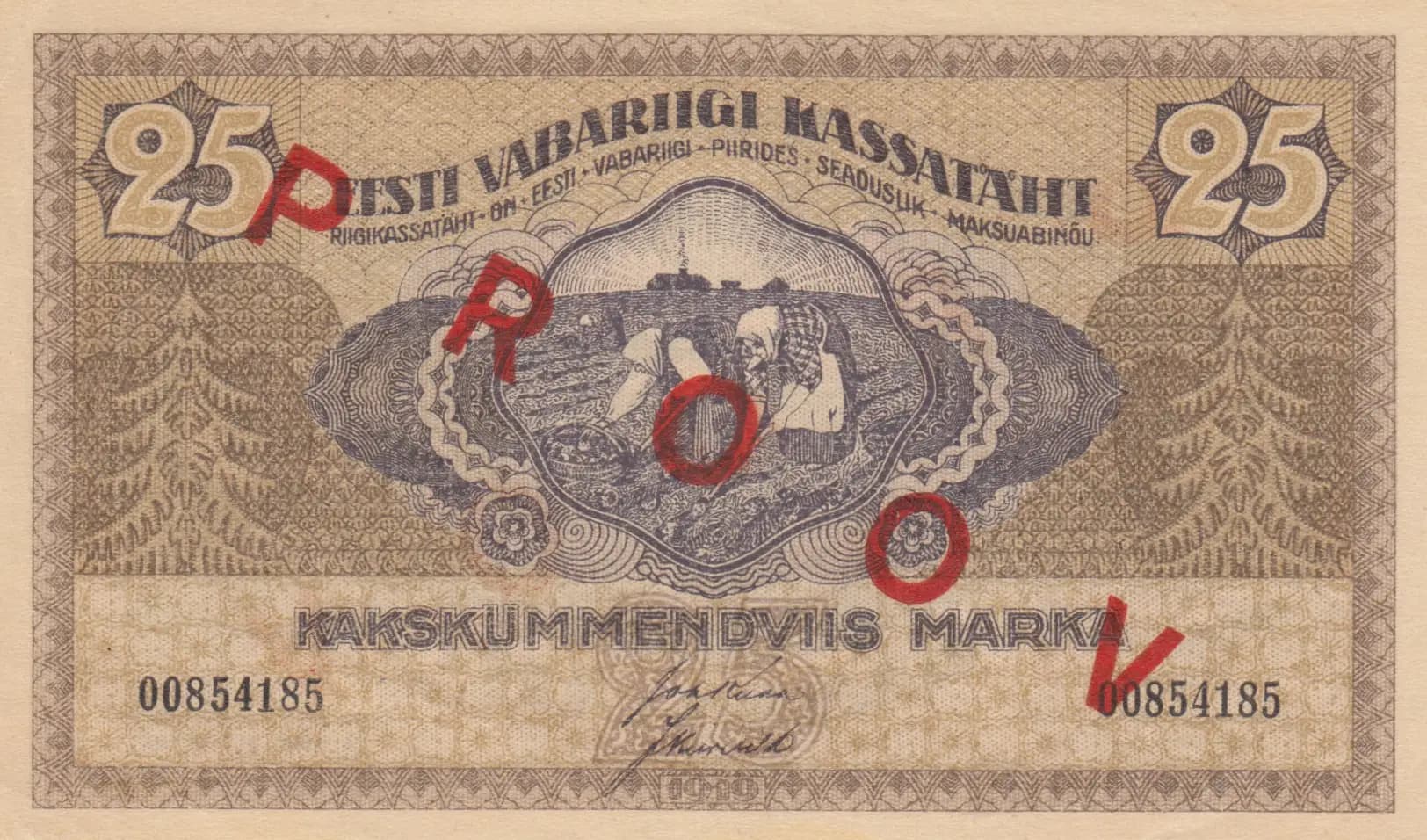
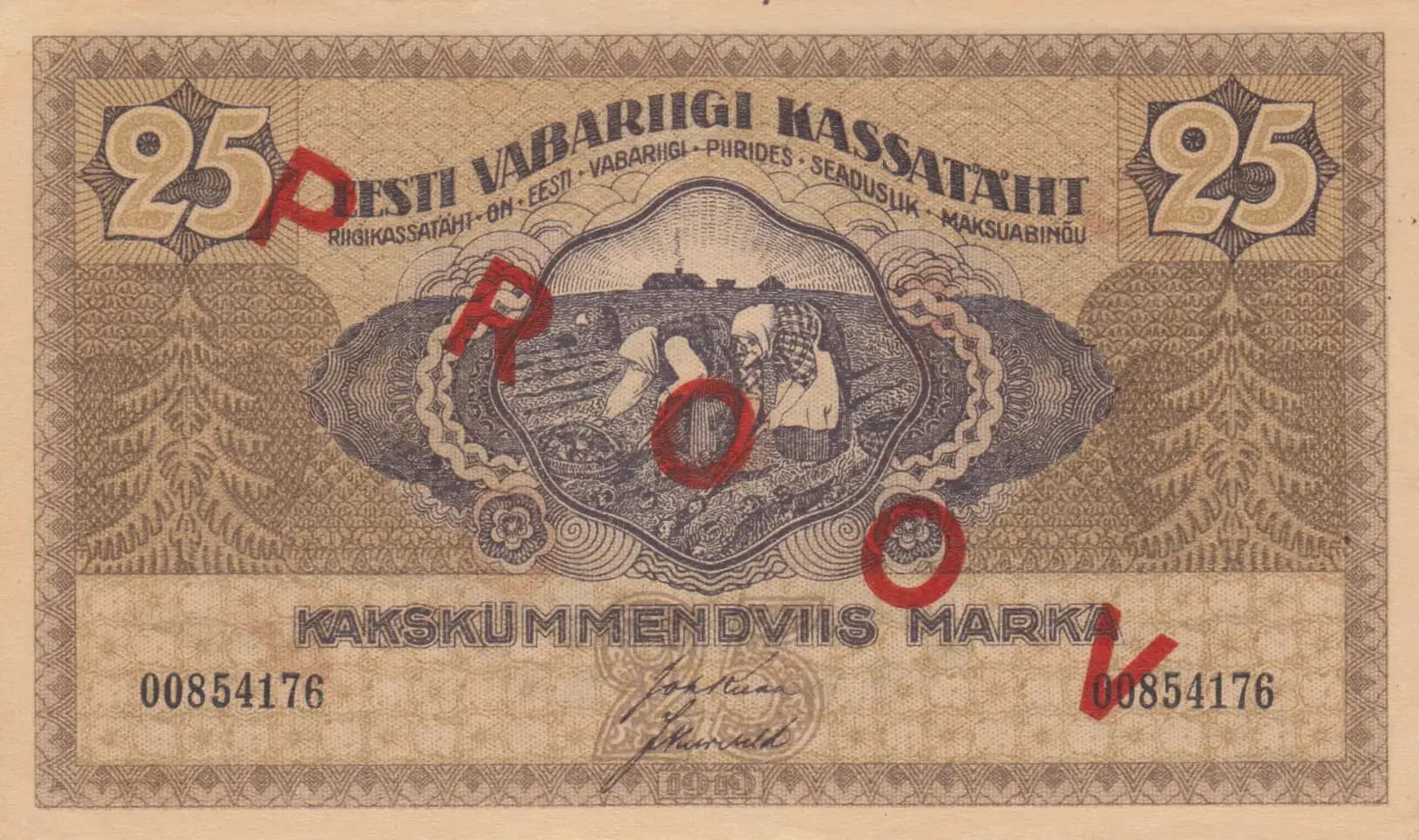
The obverse depicts a pastoral agricultural scene centered on potato harvesting, with rural workers in a landscape setting framed by ornate geometric and floral borders. The reverse features a fishing scene with figures in a boat on coastal waters, with a prominent mountain or volcanic peak in the background, similarly framed in elaborate decorative scrollwork. Both sides display the denomination '25' in large, circular ornamental designs positioned at left and right margins. The color scheme of browns, tans, and beiges was typical of early Estonian currency design, with fine engraved detail work throughout the vignettes and border elements.
FRONT: 'EESTI VABARIIGI KASSATAHIT' (Estonian Republic Banknote); 'RIIGIKASSATAHT - EE - EESTI - VABARIIGI - PIIRIDES - SEADUSLIK - MAKSUABINGU' (State Treasury Note - within the borders of the Estonian Republic - legal tender); 'KAKSKUMMENDVIIS MARKA' (Twenty-five marks); Serial number: 01384773. BACK: 'EESTI VABARIIGI KASSATAHIT' (Estonian Republic Banknote); 'KAKSKUMMENDVIIS MARKA' (Twenty-five marks, repeated); 'RIIGIKASSA - TAHTEDE EEST VASTUTAB EESTI RIIK KOGU OMA VARANDUSTEGA JA SISSETULEKUTEGA' (The Estonian State is responsible for this banknote with all its property and revenue).
Intaglio engraving (recess printing) on banknote paper with watermark of vertical wavy lines. The fine line work visible in the vignettes, ornamental borders, and denomination numerals is characteristic of high-security engraved banknote production typical of 1919 currency. The printer for Estonian 1919 issues has not been definitively confirmed from catalog sources but likely involved German or Scandinavian security printers given Estonia's geographic and economic ties.
This note is cataloged as Pick P-47b, one of three documented variants for the base 25 Marka 1919 issue (P-47a, P-47b, and P-47s also exist). The 'b' designation likely indicates a specific printing or state variation. The serial number 01384773 is unique to this individual note. No overprints, signatures, or date variations are noted in the visual analysis, and the note appears to be from the standard regular issue production rather than a special variant category.