25 000 marka 1920
“serie E”
Market Prices
About This Note
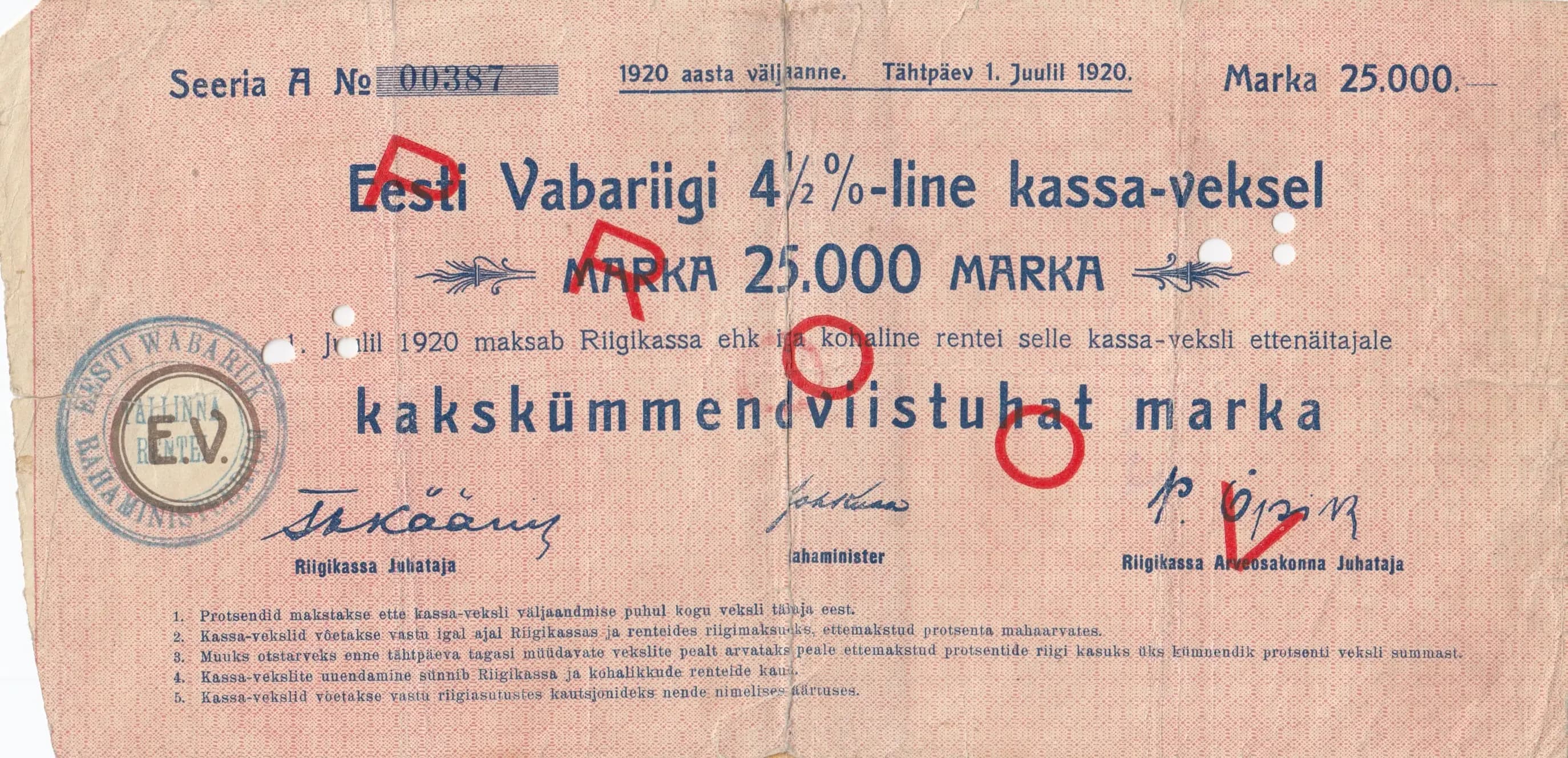
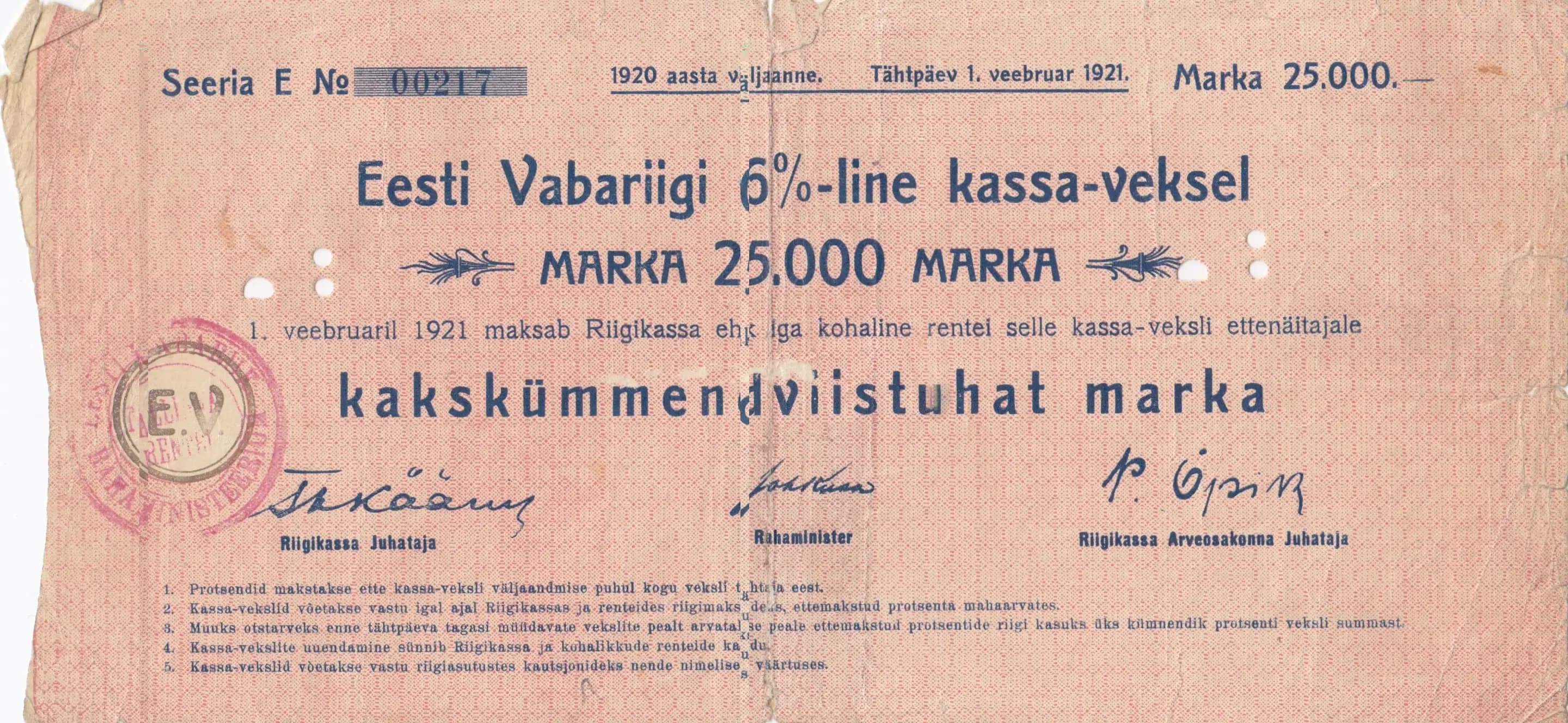
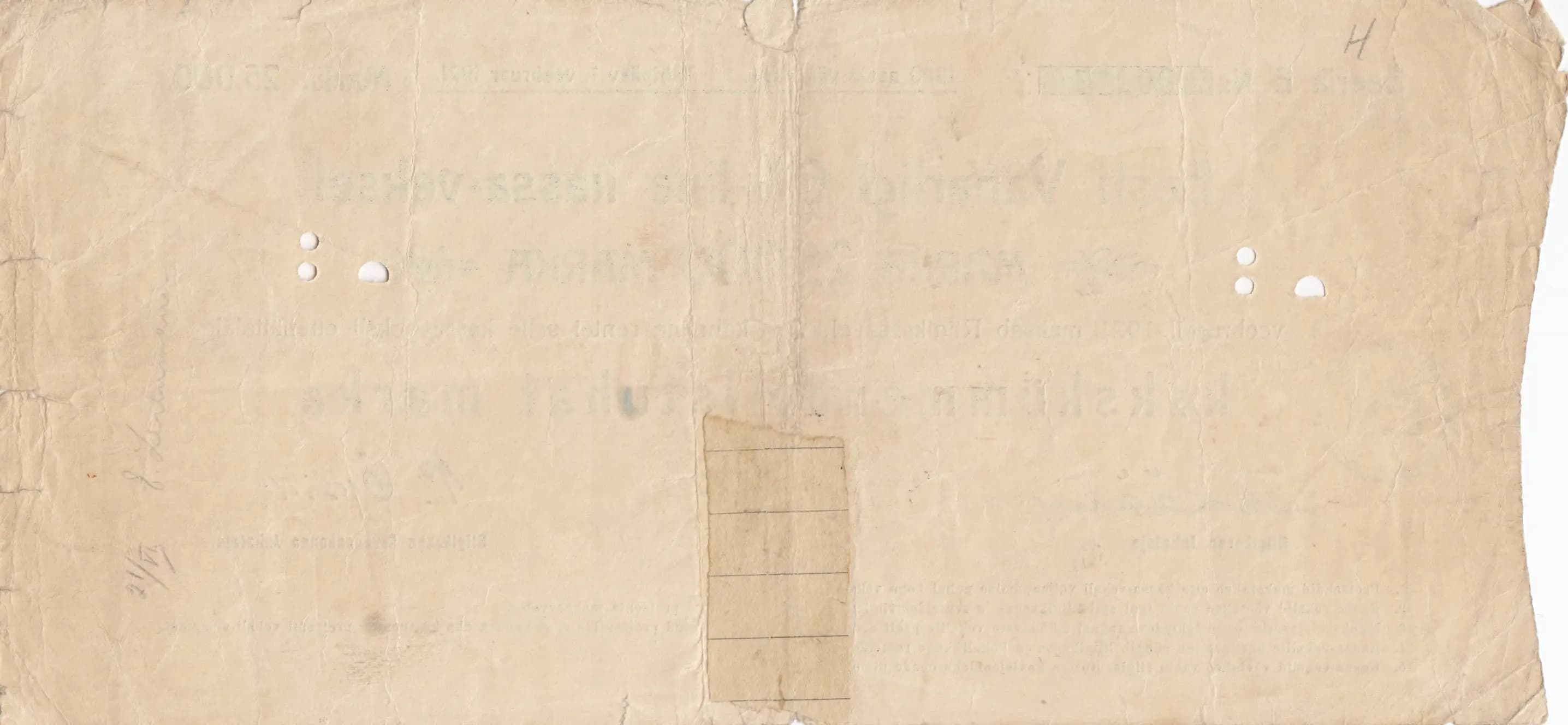
This is an Estonian Republic 25,000 Marka bond certificate (kassa-veksel) from 1920, Series E, graded in Fine condition. The note features a distinctive pinkish-salmon colored front with dark blue text, an official circular seal with the Estonian 'E' monogram, and three signature lines representing State Treasury officials. The reverse is nearly blank cream-colored paper with archival pinning holes, consistent with institutional holdings. This is a scarce high-denomination bond certificate from Estonia's early independence period, representing an important transitional financial instrument during the nation's post-WWI establishment.
Uncommon to Scarce. While the catalog reference indicates these bonds were issued as regular treasury instruments in 1920, several factors limit availability: (1) High denomination (25,000 Marka) made these institutional/investor holdings rather than circulation notes, reducing survival rates; (2) Redemption on February 1, 1921 means surviving examples represent notes that escaped destruction or were retained as souvenirs/collections; (3) Collector market pricing shows VF examples at $54.90-$82.00 and F graded at $300 (catalog value 2016), indicating moderate scarcity; (4) Institutional pinning holes visible on this example suggest it was archived, a factor affecting both rarity and desirability. This series E example represents a genuine survivor from Estonia's critical founding period.
Issued in 1920 during the early years of the Estonian Republic (established 1918), this 6% bond certificate reflects the new nation's efforts to stabilize its finances and establish fiscal credibility following independence from the Russian Empire. The note's designation as a 'kassa-veksel' (treasury bond/cash certificate) with a February 1, 1921 maturity date indicates it was a short-term treasury instrument used to finance governmental operations during Estonia's critical founding years. The tri-signature approval structure (State Treasury Director, Financial Minister, and Accounting Department Director) demonstrates the formal institutional framework the young republic had quickly established.
This bond certificate displays the formal design conventions of early 20th-century treasury instruments. The front features a prominent circular official seal positioned on the left side, containing an 'E' monogram (representing Eesti/Estonia) surrounded by circumferential text, which serves as the primary security and authentication device. The color scheme—pinkish-salmon background with dark blue typography—creates strong visual contrast for legibility and security purposes. Decorative floral ornamental elements flank the denomination text, typical of period bond designs. The layout includes five detailed conditions of redemption printed in fine type at the bottom, reflecting the legal and financial specificity required for treasury instruments. No portraits or landmarks appear on the note; the design emphasizes text, official seals, and decorative borders rather than allegorical imagery.
FRONT: 'Series E No. [crossed out] 0217' (serial identification); 'Issued in 1920. Due date February 1, 1921' (temporal information); 'Mark 25,000' (denomination in words); 'Estonian Republic 6% bond certificate' (instrument type); 'MARK 25,000 MARK' (denomination emphasis); 'On February 1, 1921, the State Treasury at the local Treasury will pay the bearer of this bond certificate twenty-five thousand marks' (payment promise); 'State Treasury Director' / 'Financial Minister' / 'State Treasury Accounting Department Director' (signature titles); 'Interest is paid in advance at the time of issuing the bond certificate for the entire bond' (Condition 1); 'The bond certificate is accepted at any time at the State Treasury and treasuries for payment of state taxes, etc.' (Condition 2); Conditions 3-5 regarding early redemption, renewal procedures, and collateral acceptance. BACK: Blank.
The note exhibits characteristics of letterpress printing combined with lithography, typical of early Estonian monetary and bond production. The sharp, crisp blue text, fine-line decorative borders, and ornamental floral elements suggest lithographic printing for the background and design elements, with letterpress for the primary text. The official seal shows detailed line-work consistent with engraved printing techniques. Hand-applied signatures in three locations indicate manual completion of individual certificates. The uniform color saturation and registration of multi-color elements suggest professional security printing by a specialist firm, though the specific printer cannot be definitively identified from the visual evidence alone.
This is Pick-38T (or P-38T), identified as a 25,000 Marka denomination from 1920, Series E. The external reference catalogs show a P-38A variant exists with orange coloring (vs. the pink/salmon of this specimen), indicating color varieties within the pick number. The catalog reference also mentions P-38 at 200 Marka denomination exists, creating potential confusion; this specimen is definitively the 25,000 Marka type. The serial number (E 0217 after crossing out) places this in Series E as noted in collector records. The crossed-out or obscured serial notation may indicate either a printing correction or an archival marking from institutional holding.