25 000 marka 1920
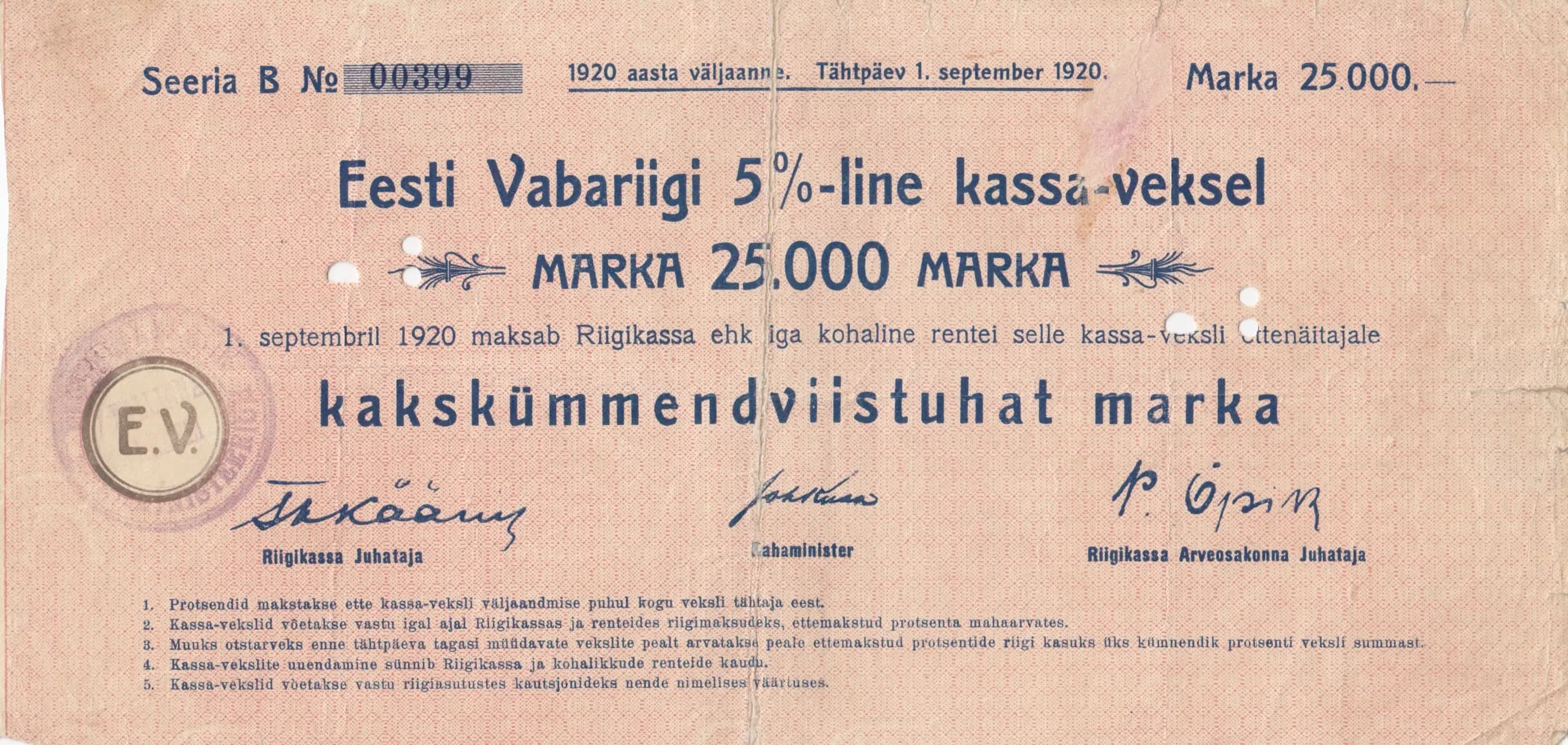
“serie B”
Market Prices
About This Note
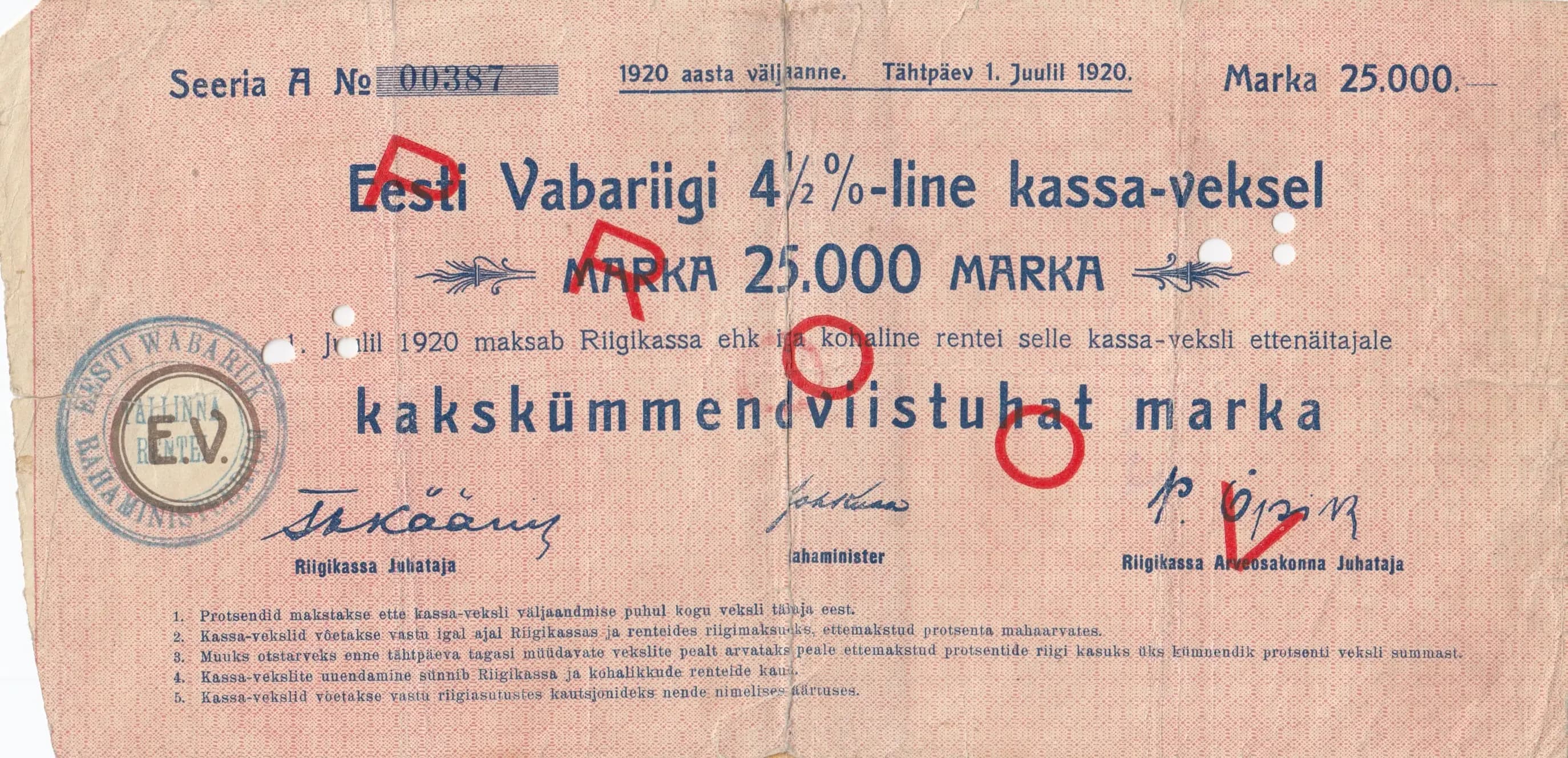
This is a Series B example of Estonia's 25,000 Marka treasury bill from 1920, a significant hyperinflationary-era currency note issued during the young republic's early years. The note exhibits VF condition with visible age-related wear including creasing, fold marks, and yellowing consistent with over a century of storage, yet maintains good legibility of its formal certificate-style design. This particular variety features the characteristic cream/beige paper, blue-black text, and the distinctive E.V. (Eesti Vabariik) official seal marking it as an authentic state treasury instrument.
common. This series of Estonian 1920 treasury bills was issued in substantial quantities as part of the state's financial management strategy during the early independence period. eBay market data shows consistent availability with VF-graded examples regularly trading in the $50-85 USD range, indicating an adequate supply of these notes in collector circulation. The note's status as a government-backed treasury instrument with a definite maturity date, combined with reasonable survival rates due to the formal certificate nature of the piece, places it squarely in the common category despite its historical significance.
This treasury bill was issued during Estonia's critical post-independence period following the 1918 declaration of independence from the Russian Empire. The 5% interest rate and September 1, 1920 maturity date reflect the Estonian Republic's early financial instruments designed to stabilize the newly formed nation's economy during the transitional period between Russian rule and full sovereign establishment. The note's formal legal conditions and multiple authorized signature lines (Head of State Treasury, Finance Minister, and Accounting Department Head) underscore the institutional framework the young republic was establishing to manage its monetary affairs.
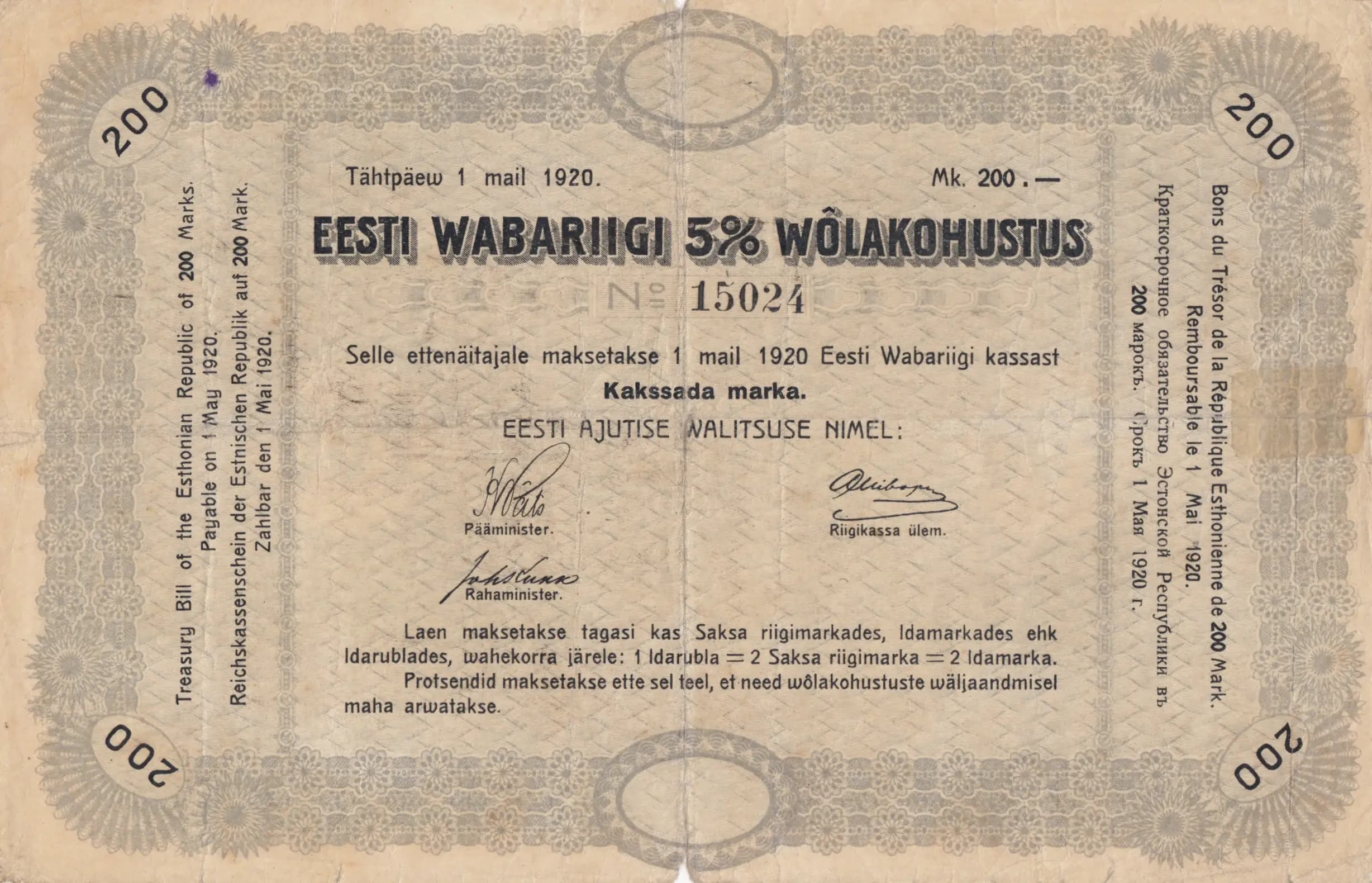
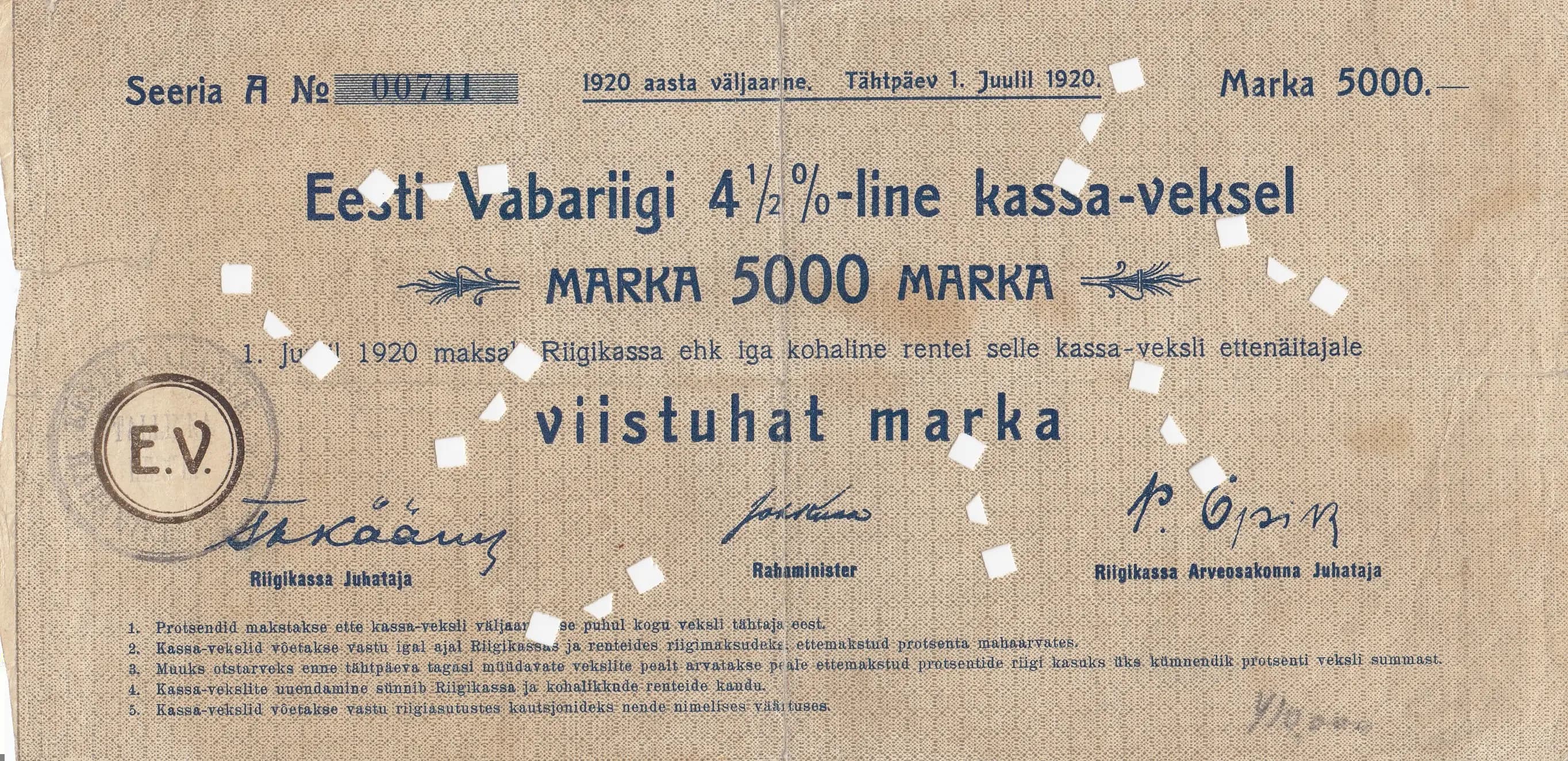
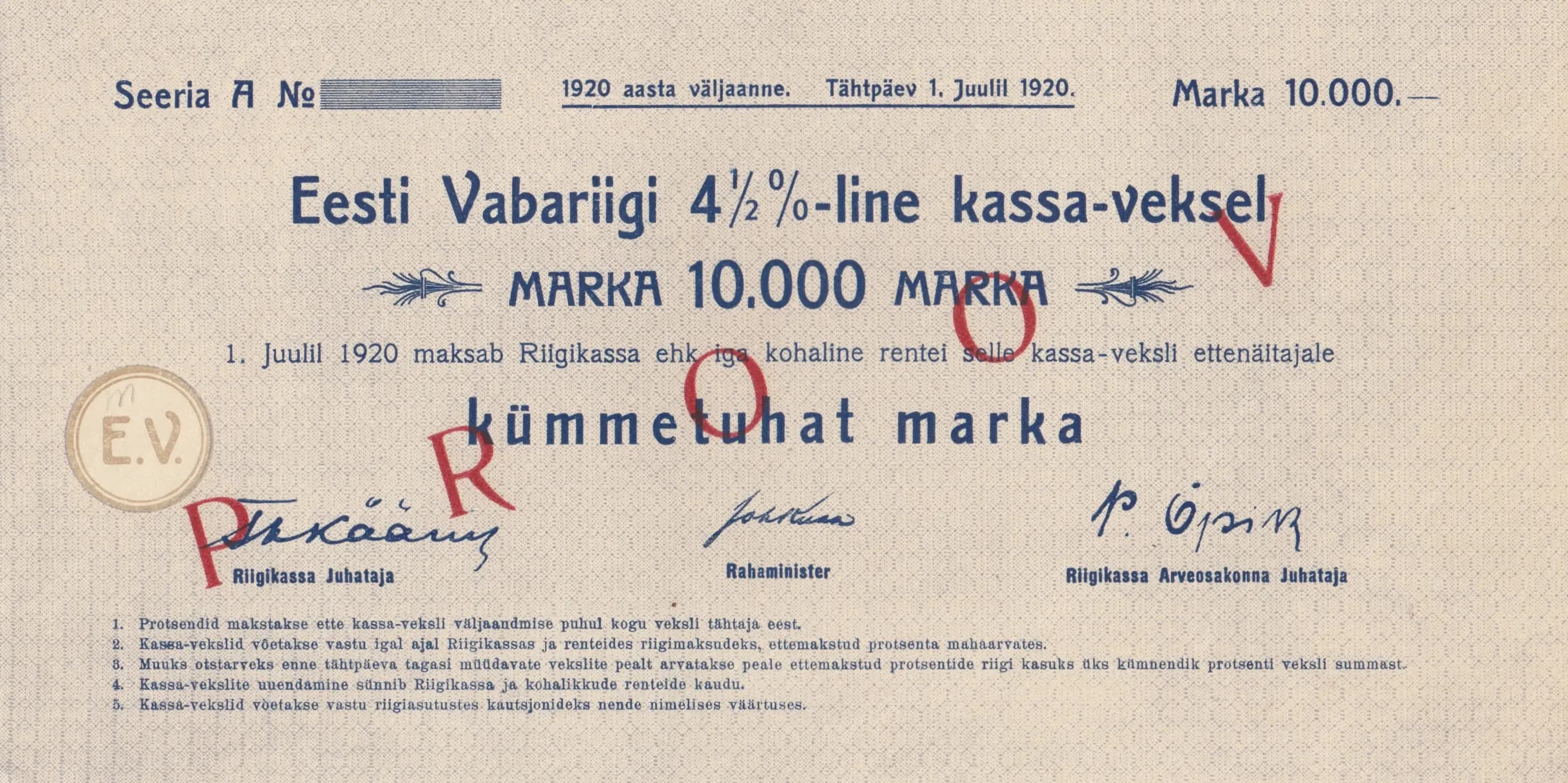
This is a formal treasury bill certificate rather than a traditional banknote, reflecting Estonia's monetary instruments during the hyperinflationary 1920 period. The design features a certificate-style layout printed on cream/beige colored paper with predominantly blue/dark blue text and decorative elements. The front displays the denomination prominently in the upper right, with the title 'Eesti Vabariiqi 5%-line kassa-veksel' (Estonian Republic 5% treasury bill) as the central focal point flanked by decorative flourishes and leaf motifs around the word 'MARKA'. The left side bears an official seal marked 'E.V.' (Eesti Vabariik - Estonian Republic), serving as the primary security feature and authentication mark. The serial number 'Seeria B № 00399' appears in the upper left, establishing this note's specific issue sequence. The document's structure follows a formal legal instrument layout with five numbered conditions listed in smaller print detailing the bill's terms, redemption procedures, and accepted uses. Three signature lines occupy the bottom of the front, representing authorization from three separate government officials. The back side is largely blank, showing only archival markings. The overall design emphasizes the note's function as an official financial instrument and debt obligation of the Estonian state rather than a circulating currency note.
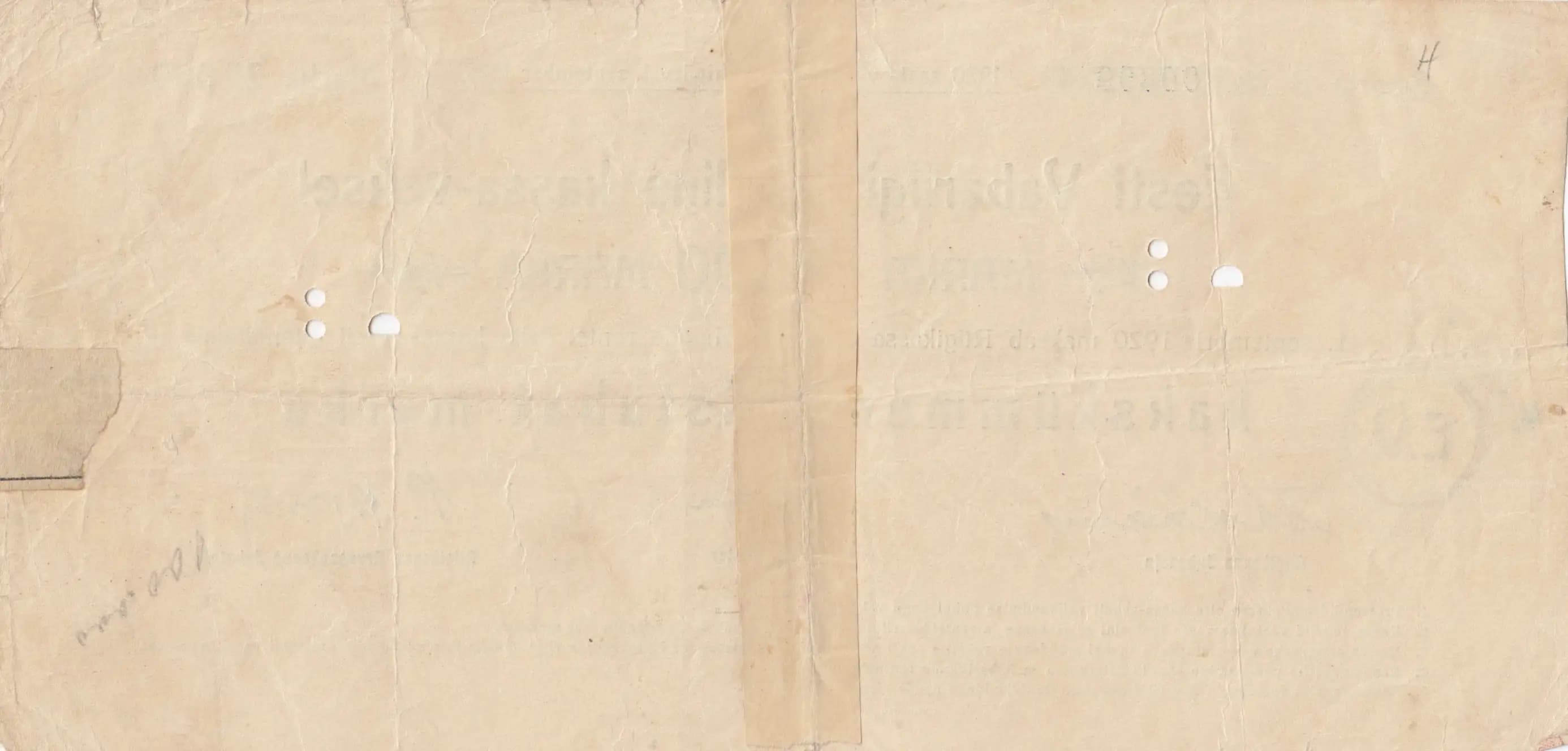
FRONT SIDE: Serial designation: 'Seeria B № 00399' (Series B No. 00399). Issue information: '1920 aasta väljaann 3.' (1920 year issue 3) and 'Tähtpäev 1. september 1920.' (Maturity date September 1, 1920). Denomination: 'Marka 25.000.—' (25,000 Marks) and 'MARKA 25,000 MARKA'. Title: 'Eesti Vabariiqi 5%-line kassa-veksel' (Estonian Republic 5% treasury bill). Main redemption clause: '1. septembril 1920 maksab Riigikassas ehk iga kohaline rentei selle kassa-veksli uttenäittajale kakskümmendviistuhat marka' (On September 1, 1920, the State Treasury or any local revenue office will pay twenty-five thousand marks to the bearer of this treasury bill). Signature titles: 'Riigikassa Juhataja' (Head of State Treasury), 'Rahaminister' (Finance Minister), 'Riigikassa Arveosakonna Juhataja' (Head of State Treasury Accounting Department). Terms and conditions: (1) Interest is paid in advance at issuance for the entire maturity period; (2) Treasury bills are accepted at any time at the State Treasury and revenue offices for tax payments, with advance interest deducted; (3) For redemption before maturity, interest and a fee of one-tenth percent of the bill amount are charged; (4) Treasury bills can be endorsed at the State Treasury and local revenue offices; (5) Treasury bills are accepted at state institutions as security for their designated purposes. BACK SIDE: Mostly blank with faint archival markings including partial notation 'kaasaamp[?]' and marking 'H', likely institutional handling or catalog notations.
Letterpress printing on cream/beige colored paper, characteristic of official government financial instruments of the 1920s period. The uniform text impression, consistent ink density, and formal certificate-style layout reflect the professional printing standards employed for Estonian state treasury documents. The design shows no evidence of advanced security printing techniques such as watermarks or security threads visible in the image analysis, relying instead on the official E.V. seal and serial numbering for authentication.
This example is identified as Series B (Seeria B) with serial number 00399, representing one of the catalog varieties for Pick P-38J. The catalog data references variations including P-38A (noted with orange coloring in the external reference), indicating color variations exist across the series. This particular note's cream/beige coloring with blue-black text aligns with the standard Series B gray-colored variety noted in the external catalog reference. The specific series designation (B) and relatively early serial number (00399) suggest this note comes from the initial printings of the 1920 issue 3 release.