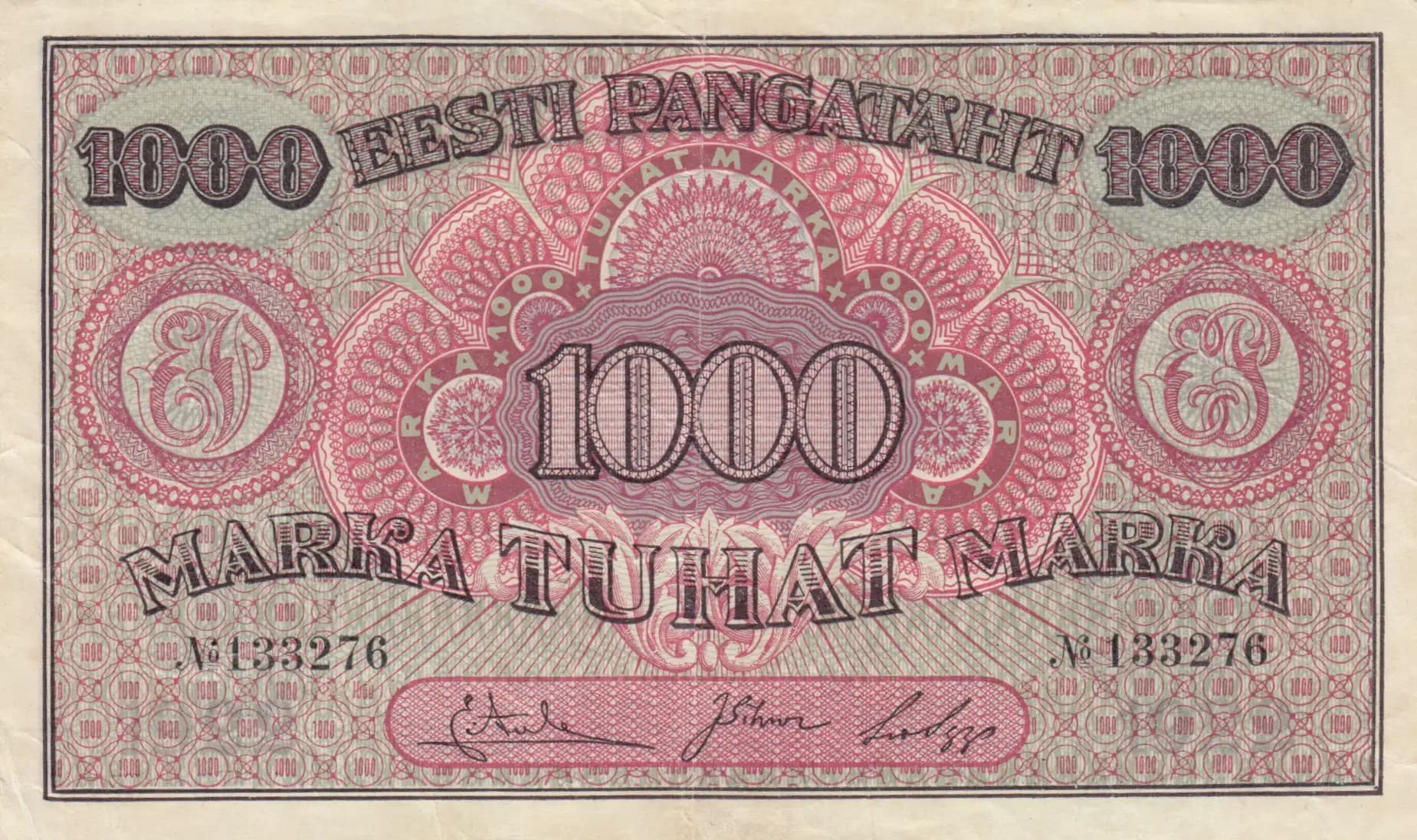
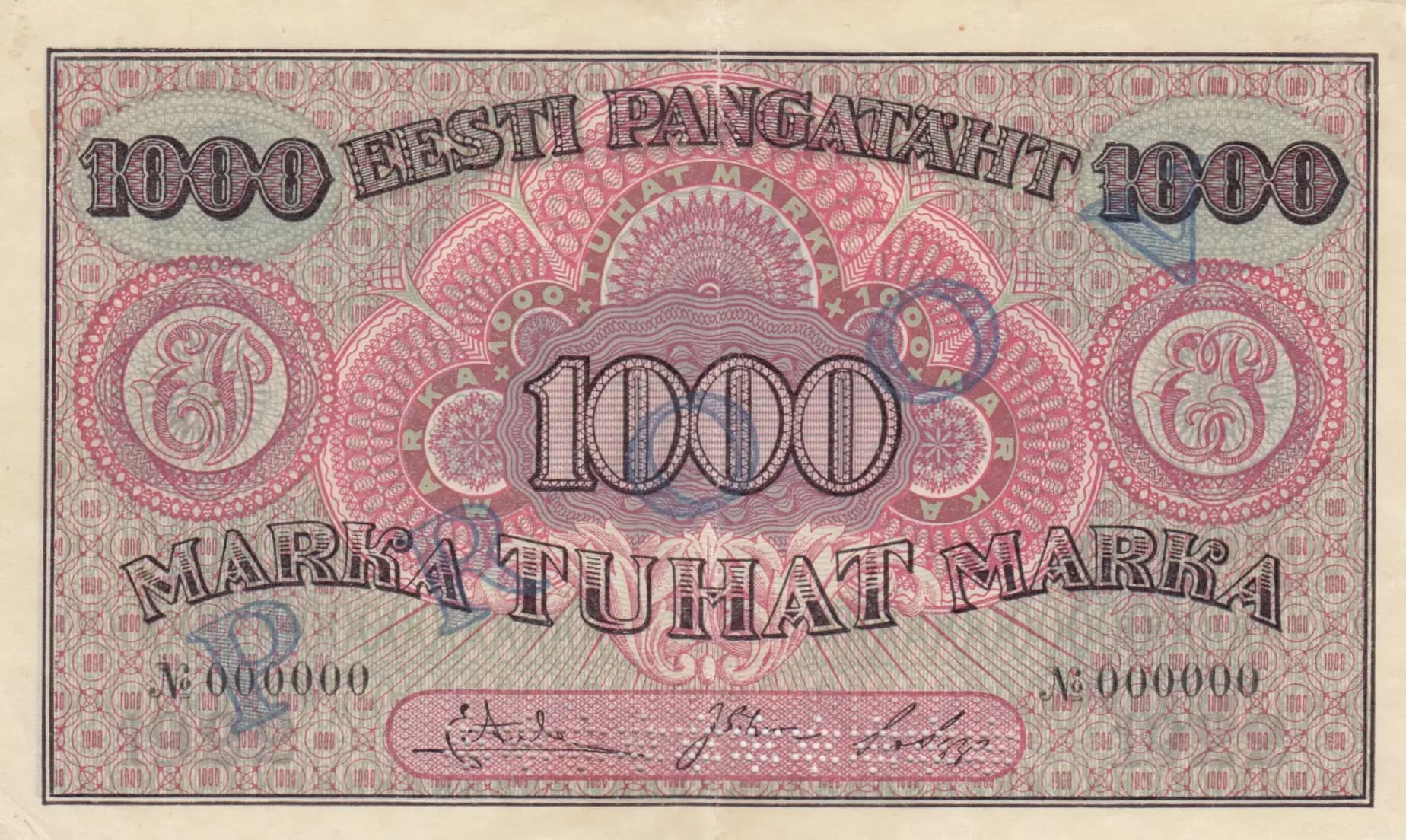
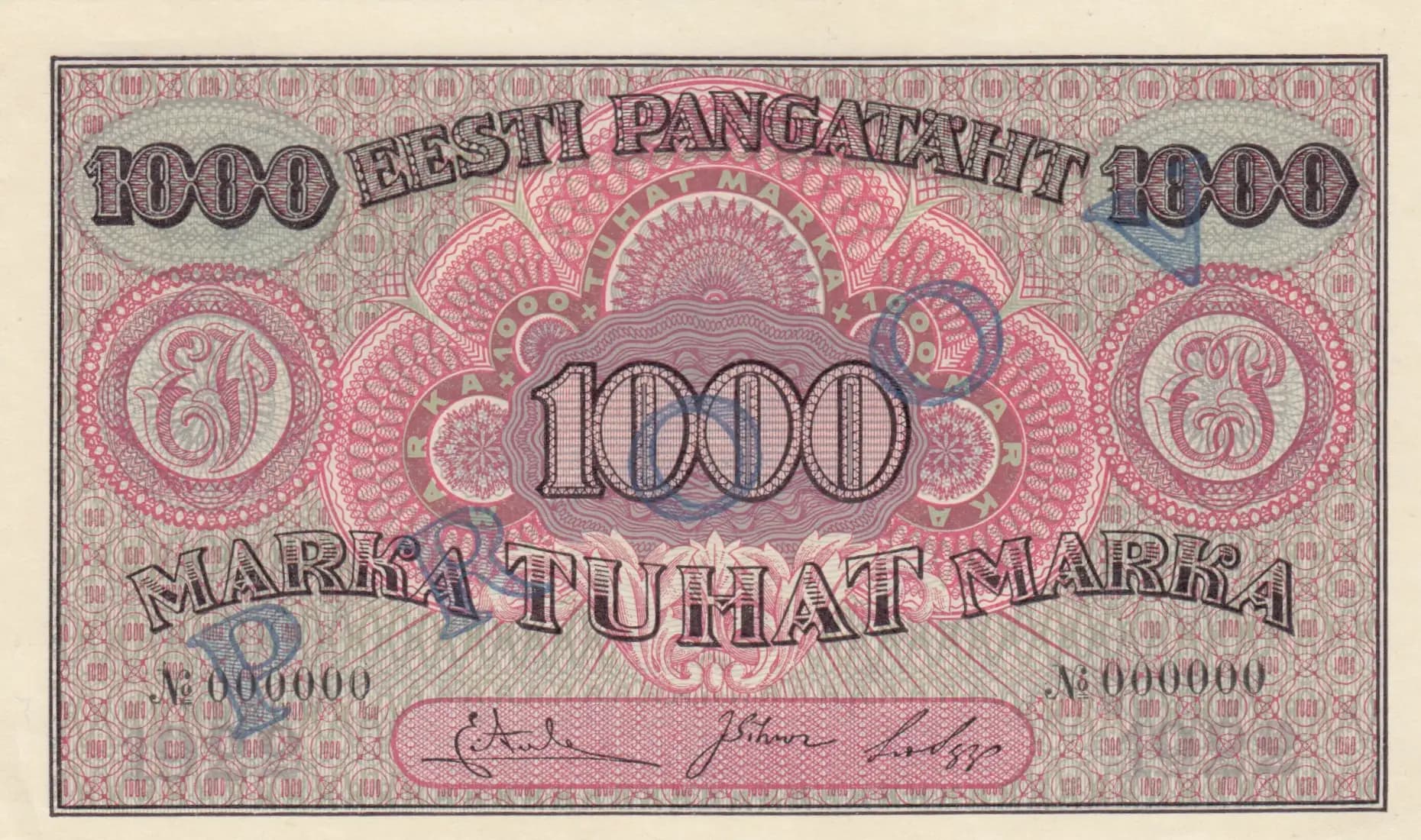
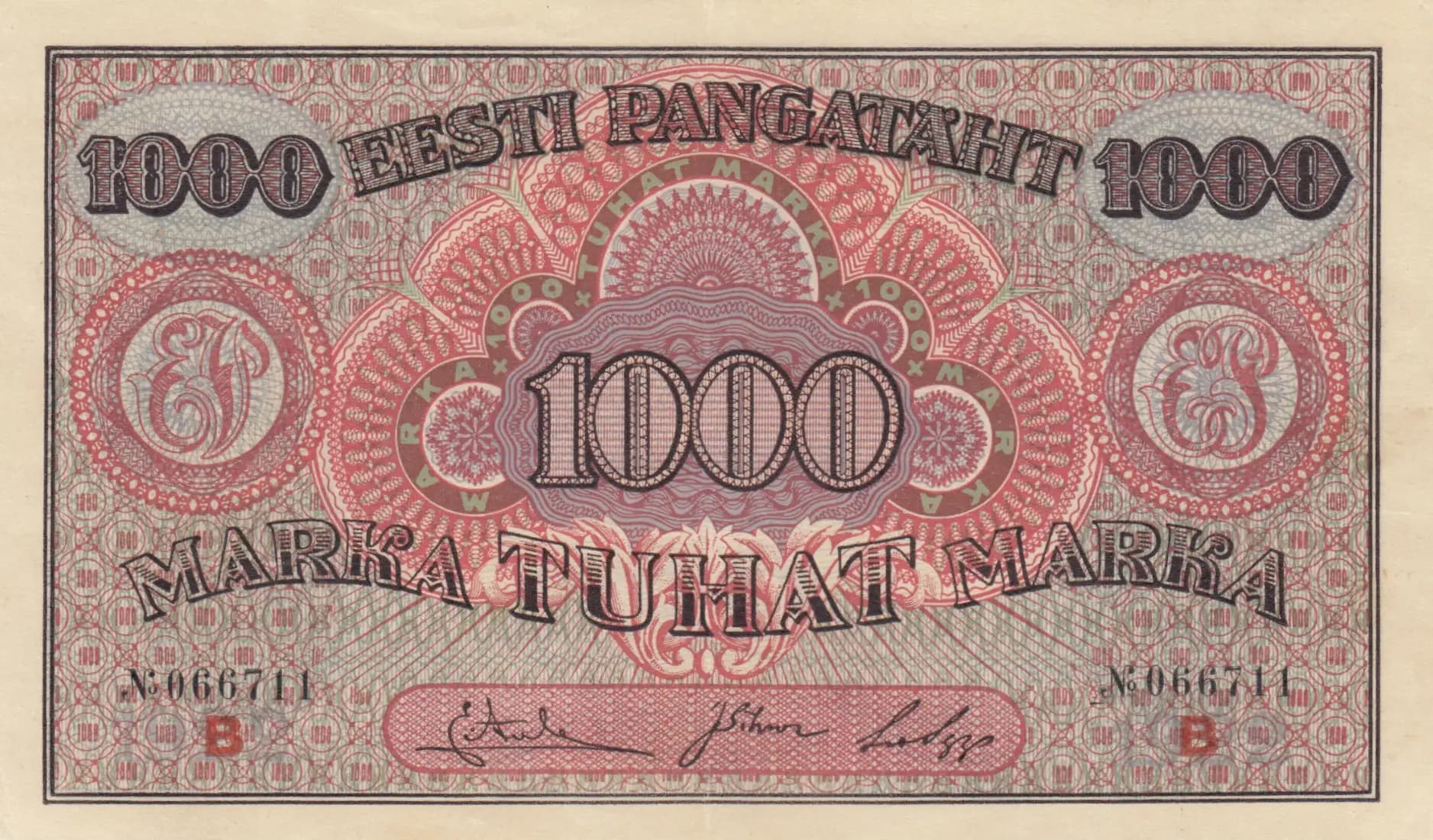
1000 marka 1922 specimen
“serie D”
Market Prices
About This Note
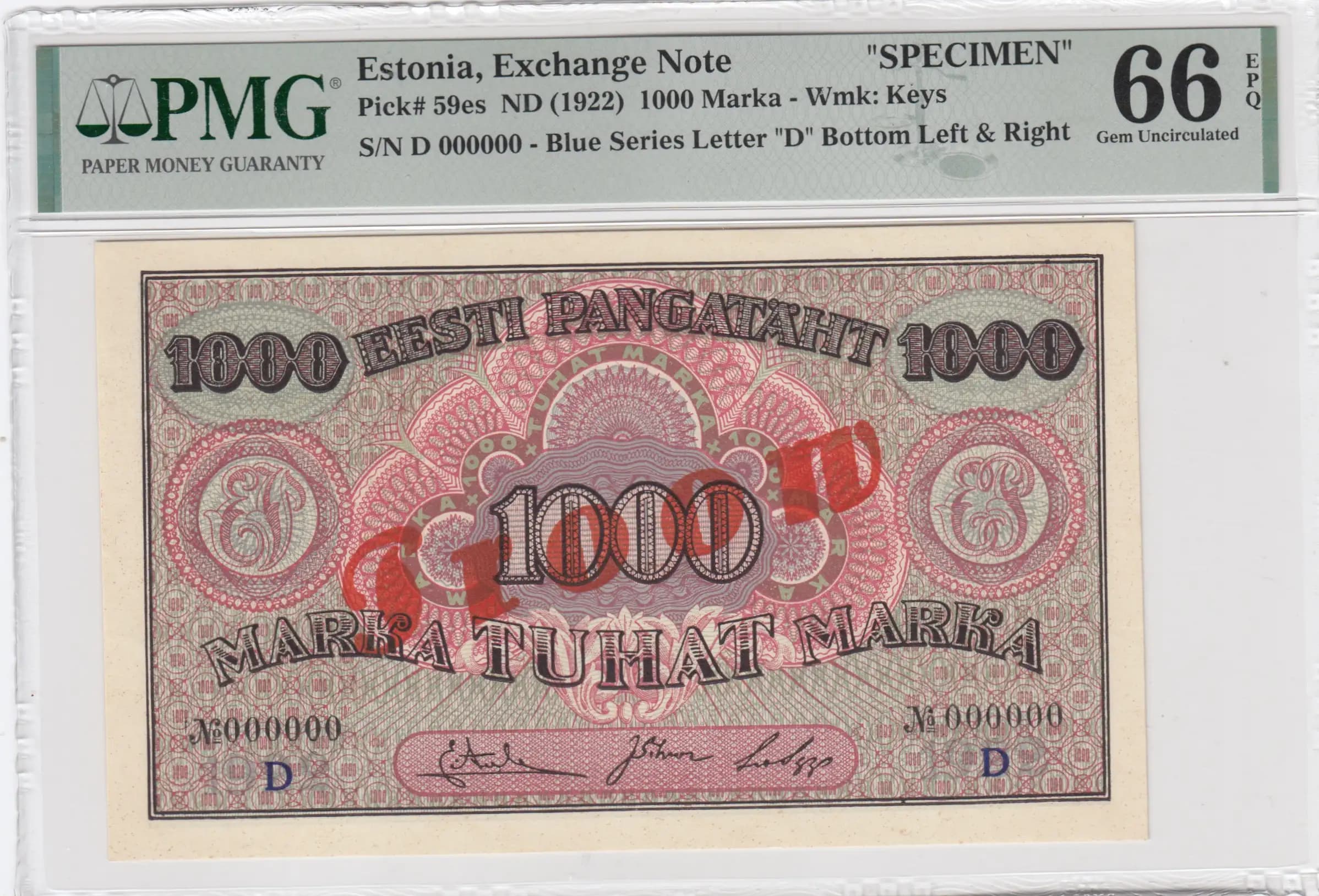
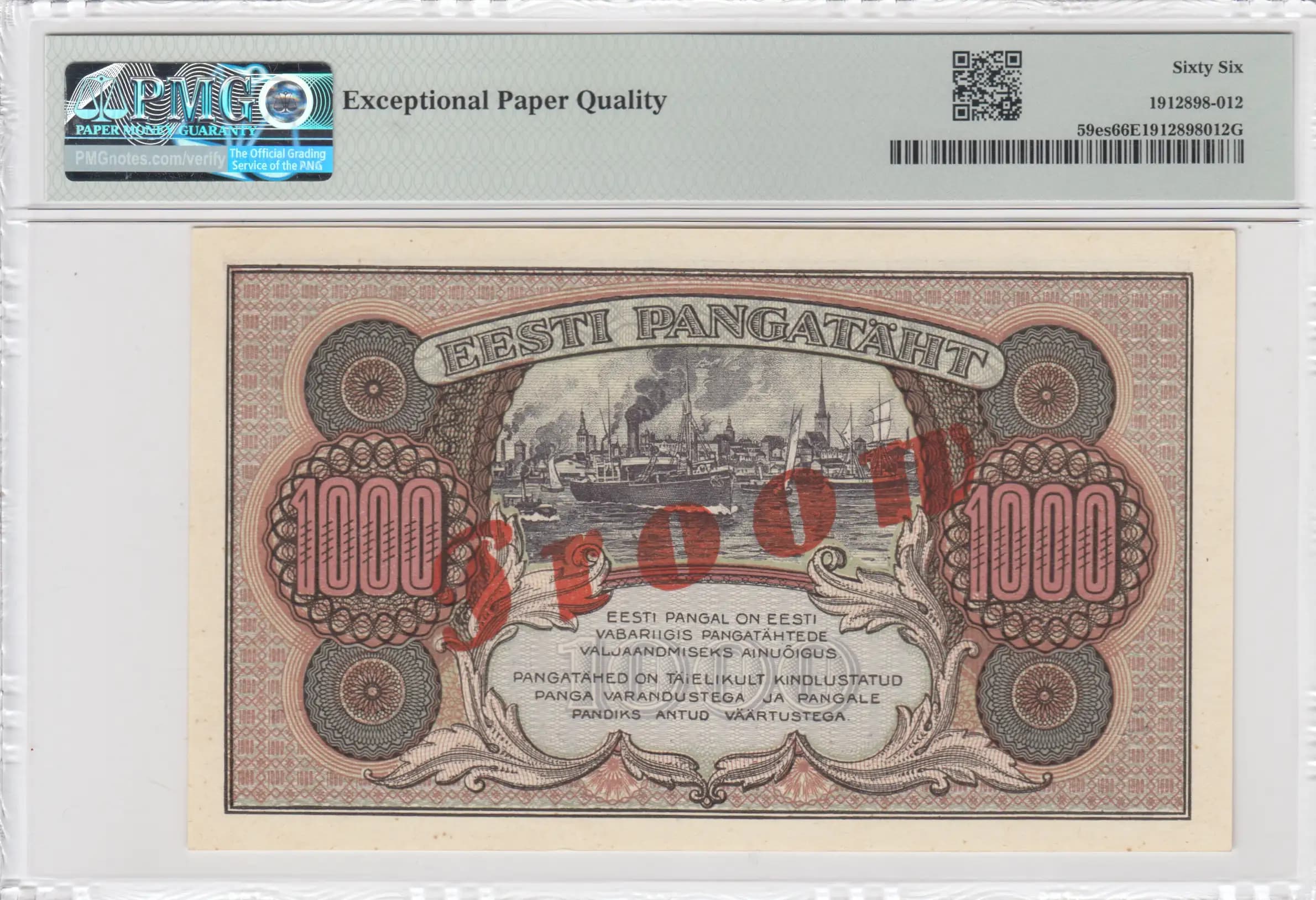
This is a PMG 66 EPQ (Gem Uncirculated) specimen of Estonia's 1000 Marka from 1922, featuring an exceptional state of preservation with no visible wear or handling. The note displays the characteristic red/pink and green color scheme with intricate ornamental designs and a striking reverse vignette depicting the Port of Tallinn's waterfront industrial cityscape. As a specimen note with serial number D 000000, this represents a particularly desirable example for Estonian numismatic collectors, combining historical significance with pristine condition.
Common. The 1000 Marka 1922 is readily available in the market at moderate price points, with eBay transactions showing circulation in the $79–$150 range for standard circulated to uncirculated examples, and catalog values from 2016 listing UNC specimens at $1500. The PMG population data shows multiple cataloged variants (P-59a, P-59c, P-59e) suggesting adequate surviving population. Specimen notes command collector premiums, but this denomination and issue year were printed in sufficient quantities that even high-grade examples remain obtainable without extreme scarcity.
Issued by the Treasury of Estonia (Eesti Vabariigi) in 1922, during the early years of the newly independent Estonian Republic following World War I, this banknote reflects the nation's establishment of sovereign currency. The reverse vignette featuring the Port of Tallinn (Reval) commemorates Estonia's important Baltic maritime and commercial center, symbolizing the country's economic aspirations during its independence period. The prominent inscription on the reverse affirming the Estonian Bank's sole right to issue banknotes underscores the fledgling nation's assertion of financial sovereignty.
The obverse features a classical ornate design with red/pink and green underprints, centered around large denomination numerals '1000' positioned prominently in opposing corners within circular ornamental frames. The design incorporates fine guilloche patterns and radiating sunburst elements creating visual security depth. The reverse presents an engraved landscape vignette depicting the Port of Tallinn, rendered in green and gray tones with detailed architectural elements including multiple church spires and industrial structures along the waterfront, framed within an ornamental cartouche containing the legal inscription. The specimen marking appears prominently across both sides in red overprint, with the series letter 'D' and serial number clearly visible. No portraits are depicted; instead, the note relies entirely on decorative symbolism and civic imagery celebrating Estonian independence and commercial vitality.
FRONT: 'EESTI PANGATAHT' (Estonian banknote), '1000 MARKA TUHAT MARKA' (1000 Marka thousand marka - denomination declaration), 'D' (series letter), 'No 000000' (specimen serial number), 'SPECIMEN' (specimen overprint). BACK: 'EESTI PANGATAHT' (Estonian banknote), '1000' (denomination, appears twice in ornate frames), 'EESTI PANGAL ON EESTI VABARIIGIVS PANGATAHTEDE VÄLJAANDMISEKS AINUÕIGUS. PANGATAHED ON TAGATUD PANGA VARADEJAANDMISEKS JA PANGALE PANDIKS ANTUD VÄÄRTUSTEAG' (The Estonian Bank has the sole right to issue Estonian banknotes. Banknotes are secured by the bank's assets and valuables pledged to the bank).
The note was produced using intaglio (copperplate) engraving, evidenced by the fine line work visible in the Port of Tallinn vignette, the intricate guilloche background patterns, and the dimensional quality of the ornamental designs. The color printing employed multicolor offset or letterpress for the red/pink and green underprints applied to the engraved base design. This dual-technique approach—combining deep intaglio engraving with chromatic underlays—was standard for high-security banknote production of the 1922 era.
This note is catalogued as Pick P-59es (the 's' suffix indicates specimen status). The visual analysis confirms series letter 'D' with specimen serial number 000000, characteristic of specimen production runs. The watermark consists of light and dark keys (without serial letter), consistent with the catalog notation for this Pick number. The catalog references three known variants for the base P-59 number (P-59a, P-59c, P-59e), and this specimen represents a distinct production variant marked for non-circulation distribution, making it catalogically distinct from regular issue examples despite sharing the same base denomination and year.