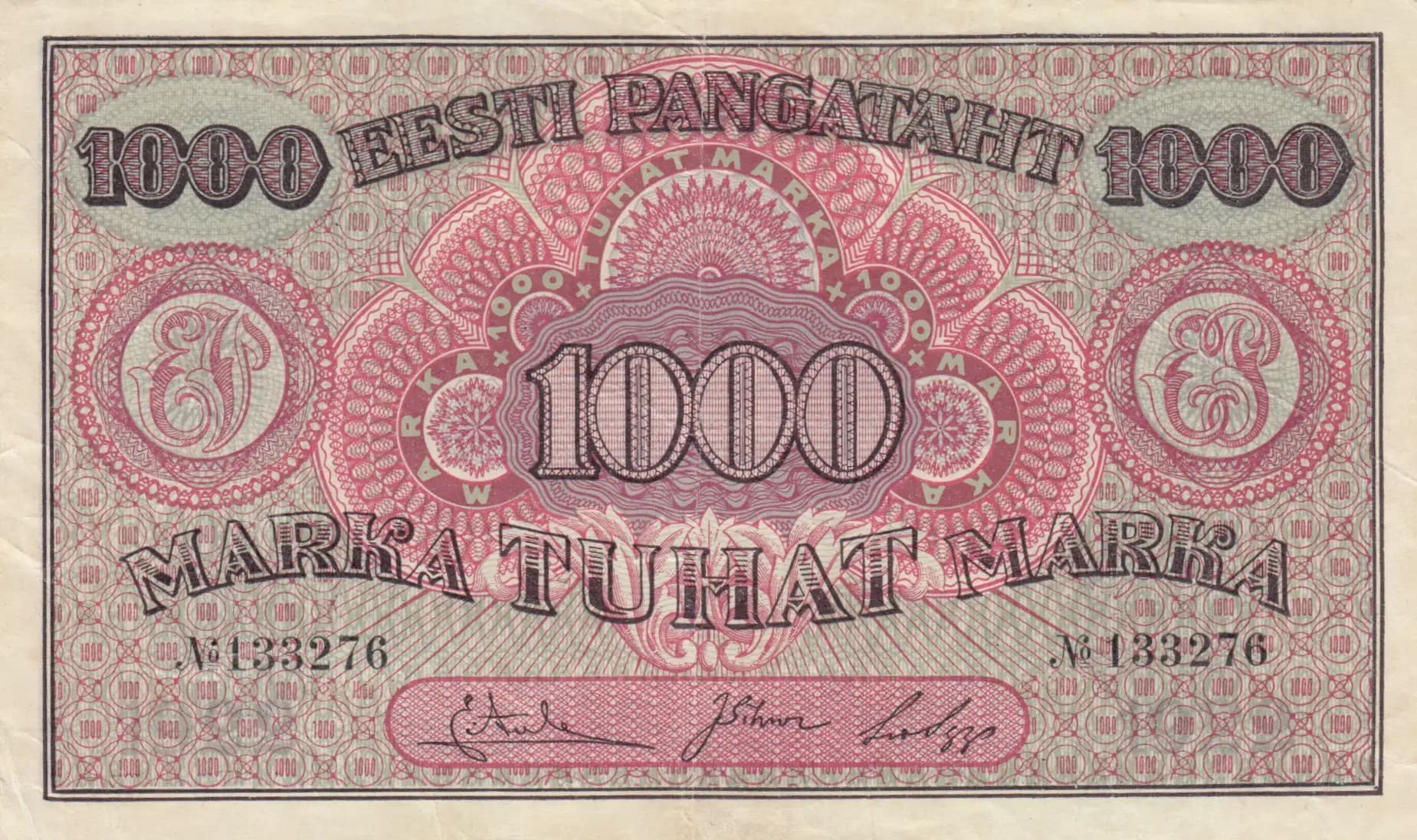
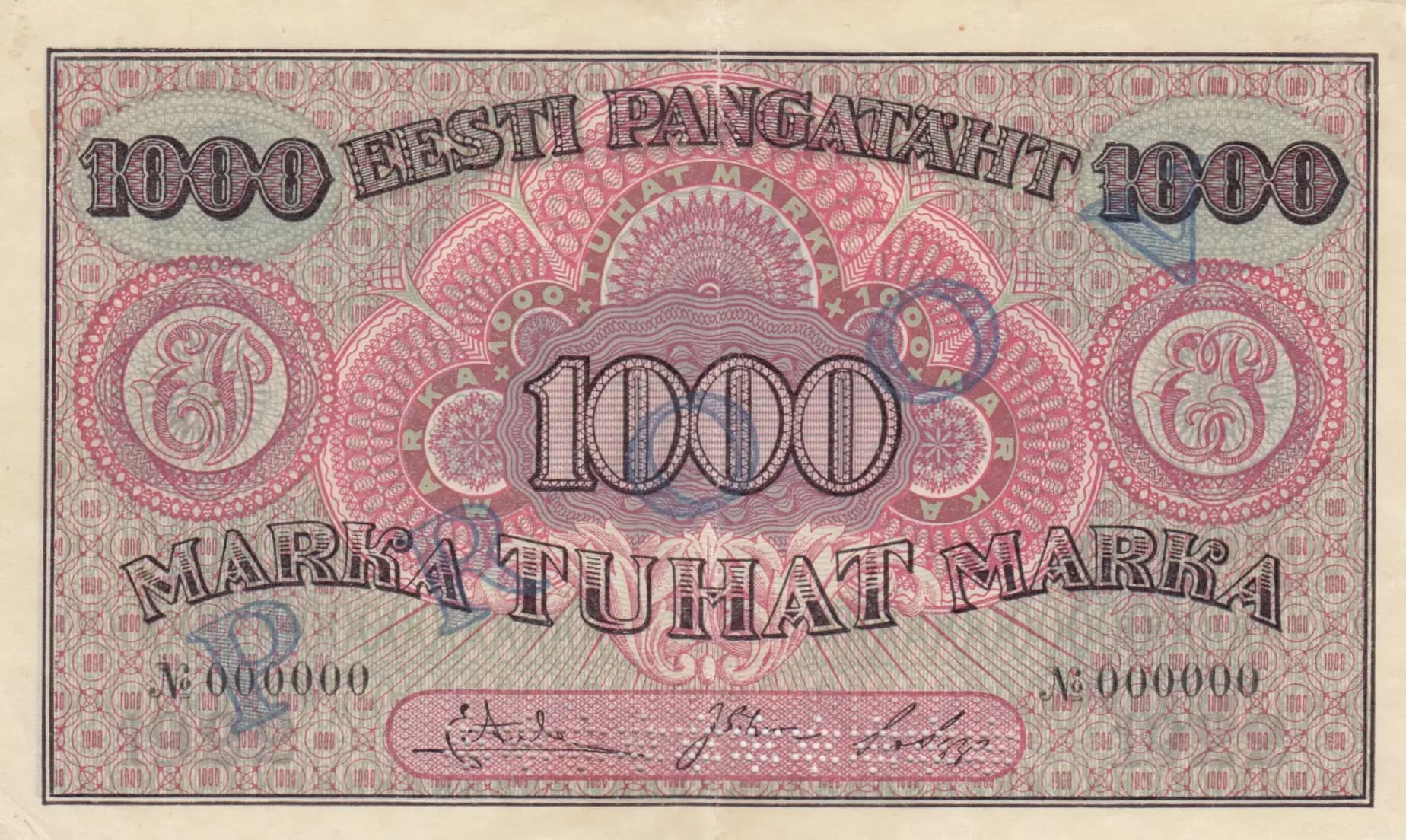
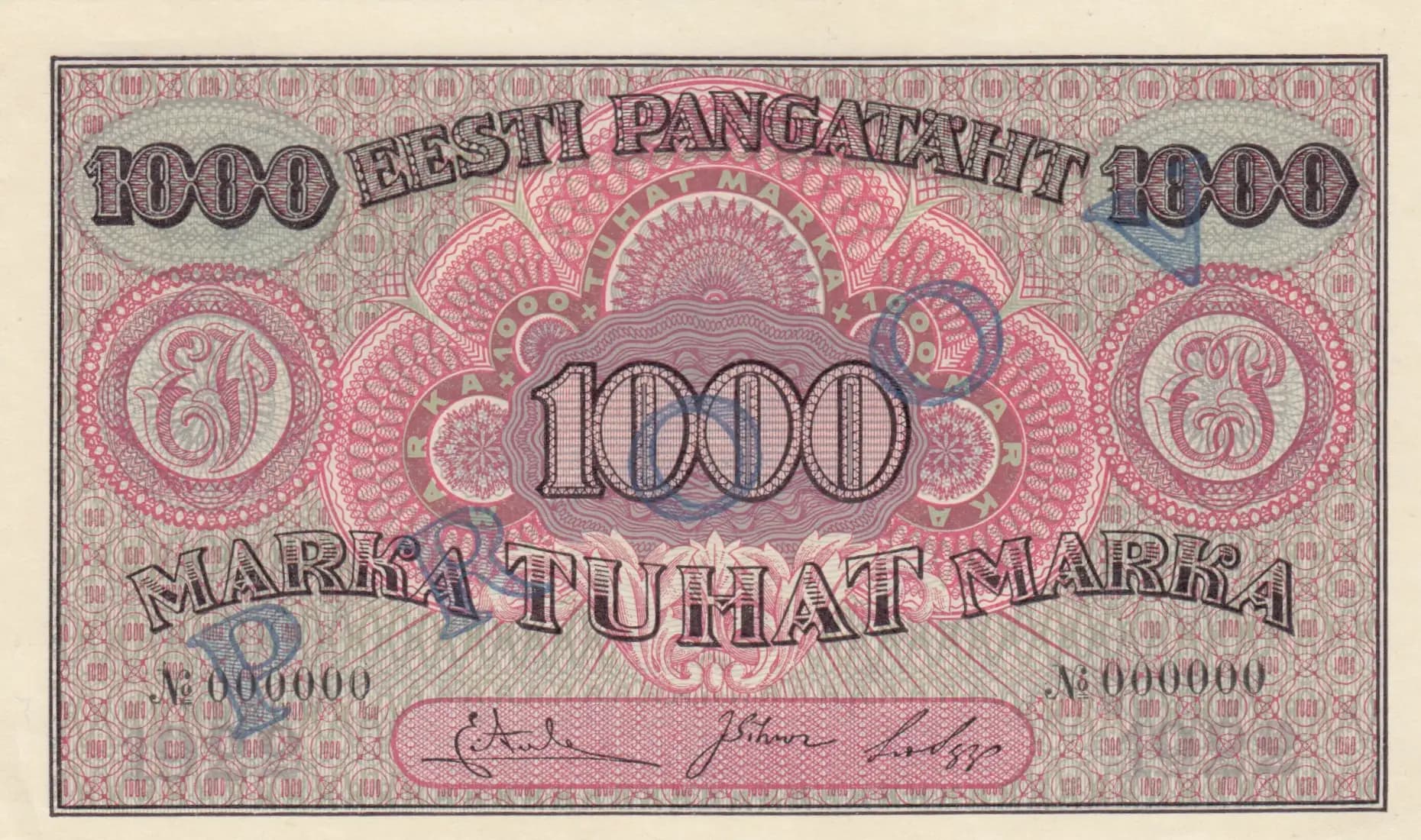
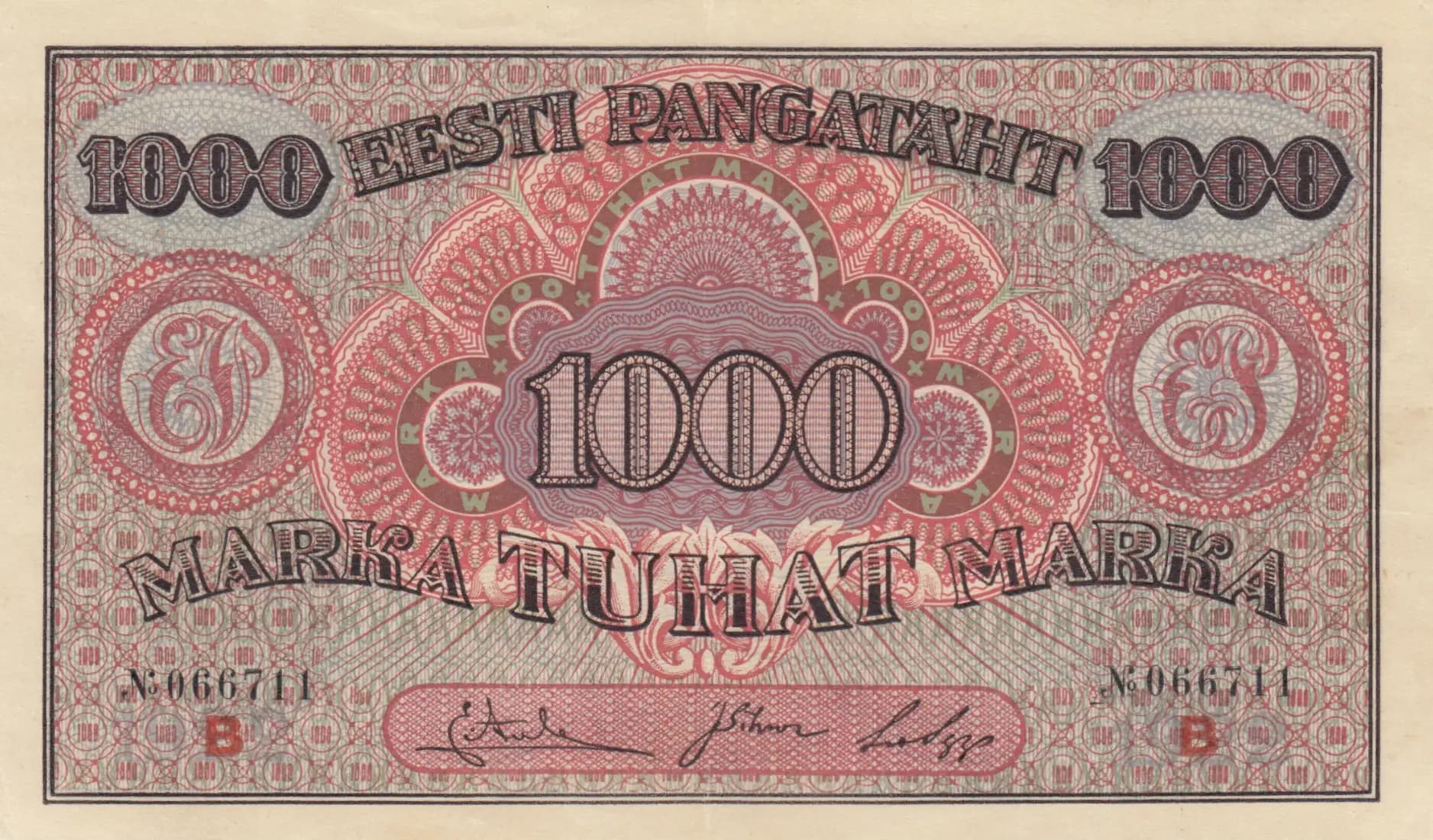
1000 marka 1927
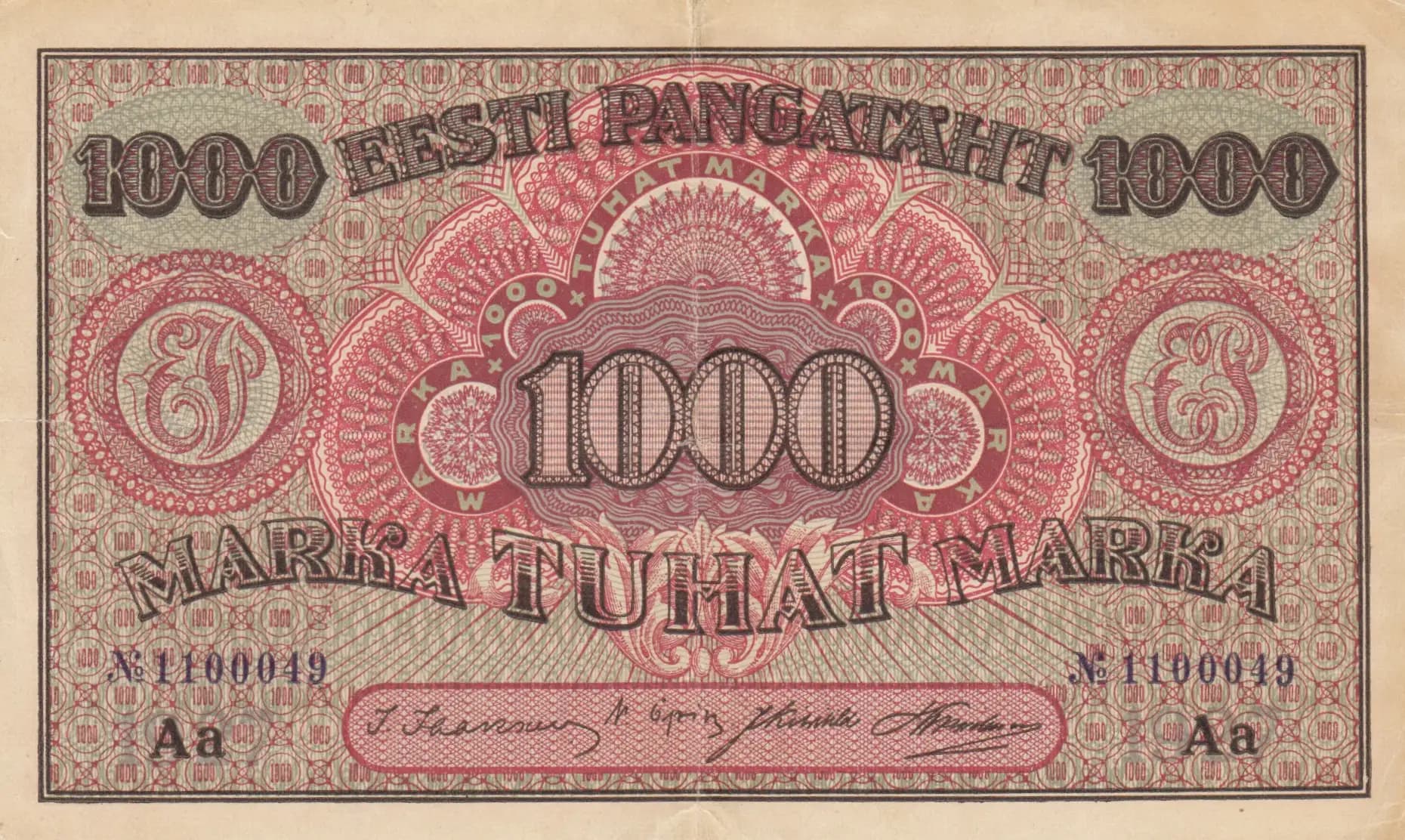
“serie Aa”
Market Prices
About This Note
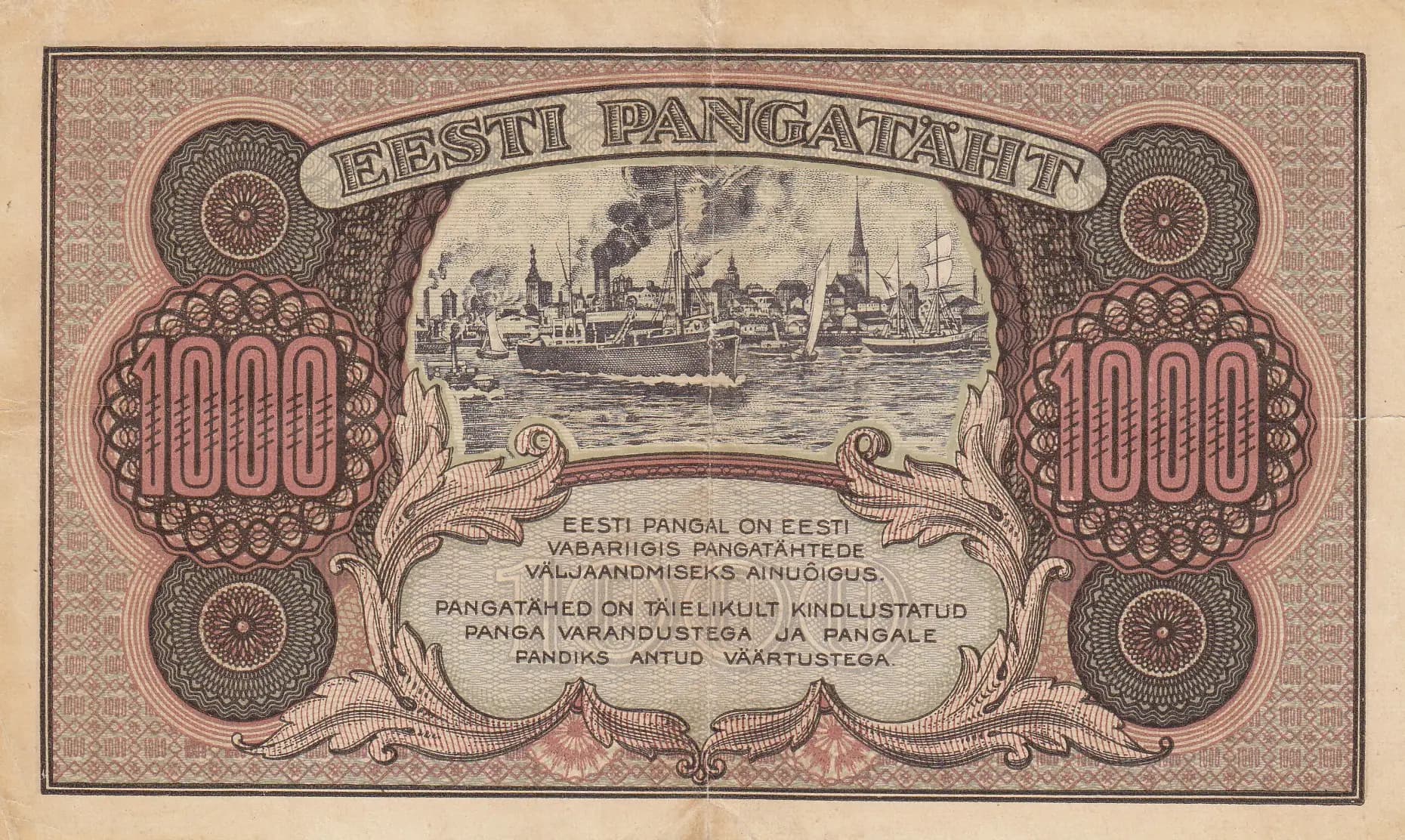
This 1927 Estonian 1000 marka note (Pick P-59f, series Aa) presents an excellent example of interwar Estonian currency with characteristic Art Deco styling in pink, red, and tan tones. The front features an ornate circular sunburst medallion design, while the reverse depicts a detailed vignette of a steamship in Tallinn Harbor—a symbolic representation of Estonia's maritime commerce during the independence period. In VF condition with aged but intact paper and no significant tears or creases, this note represents a well-preserved artifact of the short-lived Estonian marka era (1918-1927).
Common. The eBay price data shows typical market values for this note in VF condition ranging from approximately $80-$82 USD, with catalog values (2016) at $800 VF. The ready availability of examples at moderate market prices and the existence of multiple cataloged variants (P-59a, P-59c, P-59e, P-59f) within the PMG population reports indicate this was a standard-circulation issue with substantial print runs. No evidence of rarity in the available data.
The 1000 marka denomination was issued during Estonia's first period of independence (1918-1940), following the country's declaration of sovereignty after World War I. The reverse vignette of Tallinn's port with church spires reflects the importance of maritime trade to the newly independent nation's economy. The 1927 date and circulation of this note coincide with Estonia's relative economic stability during the late 1920s, before the Great Depression and subsequent Soviet occupation would bring an end to the independent Estonian currency system.
This banknote exemplifies the neoclassical-Art Deco aesthetic favored by interwar European central banks. The obverse centers on an elaborate geometric sunburst medallion in a circular frame, flanked by corner numerals within radiating flower-like ornamental circles—a design element repeated on the reverse. The reverse's primary vignette depicts the Port of Tallinn (Reval), featuring a multi-stacked steamship representative of early 20th-century maritime commerce, set within a detailed harbor scene with visible church spires and waterfront buildings that identify the location as Estonia's capital. The overall color scheme of rose-pink, red, tan, and black creates a warm, dignified impression appropriate to sovereign currency. Fine line engraving throughout the design provides both aesthetic appeal and security against counterfeiting.
FRONT: 'EESTI PANGATÄHT' (Estonian banknote) arcs across the top; '1000' and 'MARKA' denote the denomination; 'TUHAT MARKA' (Thousand marks) appears below the central design; Serial designation 'Aa' with individual serial number 'E100049' visible at bottom. BACK: 'EESTI PANGAHT' (Estonian Bank) arcs across the top; '1000' repeated in decorative corner medallions; Central cartouche contains: 'EESTI PANGAL ON E.E.S.T.I VABARIIGIS PANGATAHTEDE VÄLJAAMDEMISEKS AINUÕIGUS' (The Estonian Bank has the exclusive right to issue banknotes in the Estonian Republic) and 'PANGATÄHED ON TAIELIKULT KINDLUSSTATUID PANGA VARANDUSTEGA JA PANGALE PANDIKS ANTUD VÄÄRTUSTEQA' (Banknotes are fully secured by the bank's assets and values pledged to the bank).
Intaglio (copperplate engraving) printing on a single-color base with multicolor underprinting. The intricate geometric patterns, fine linework, and detailed vignette are characteristic of high-quality intaglio security printing employed by European central bank note printers of the 1920s. The layered color effect (pink/red overprinting on tan/beige base) indicates sequential multicolor printing passes, a standard technique for the period that provided both aesthetic and security advantages.
This note is identified as Pick P-59f variant with series designation 'Aa', printed in 1927. The serial number prefix 'E' and the 'Aa' series letter are consistent with standard catalog variety designations for this pick number. The PMG population report confirms at least three other variants (P-59a, P-59c, P-59e) exist for the base 1000 marka 1927 denomination, all sharing the same 'Keys' watermark feature. The specific 'Aa' series notation places this within the documented range of regular circulation variants.