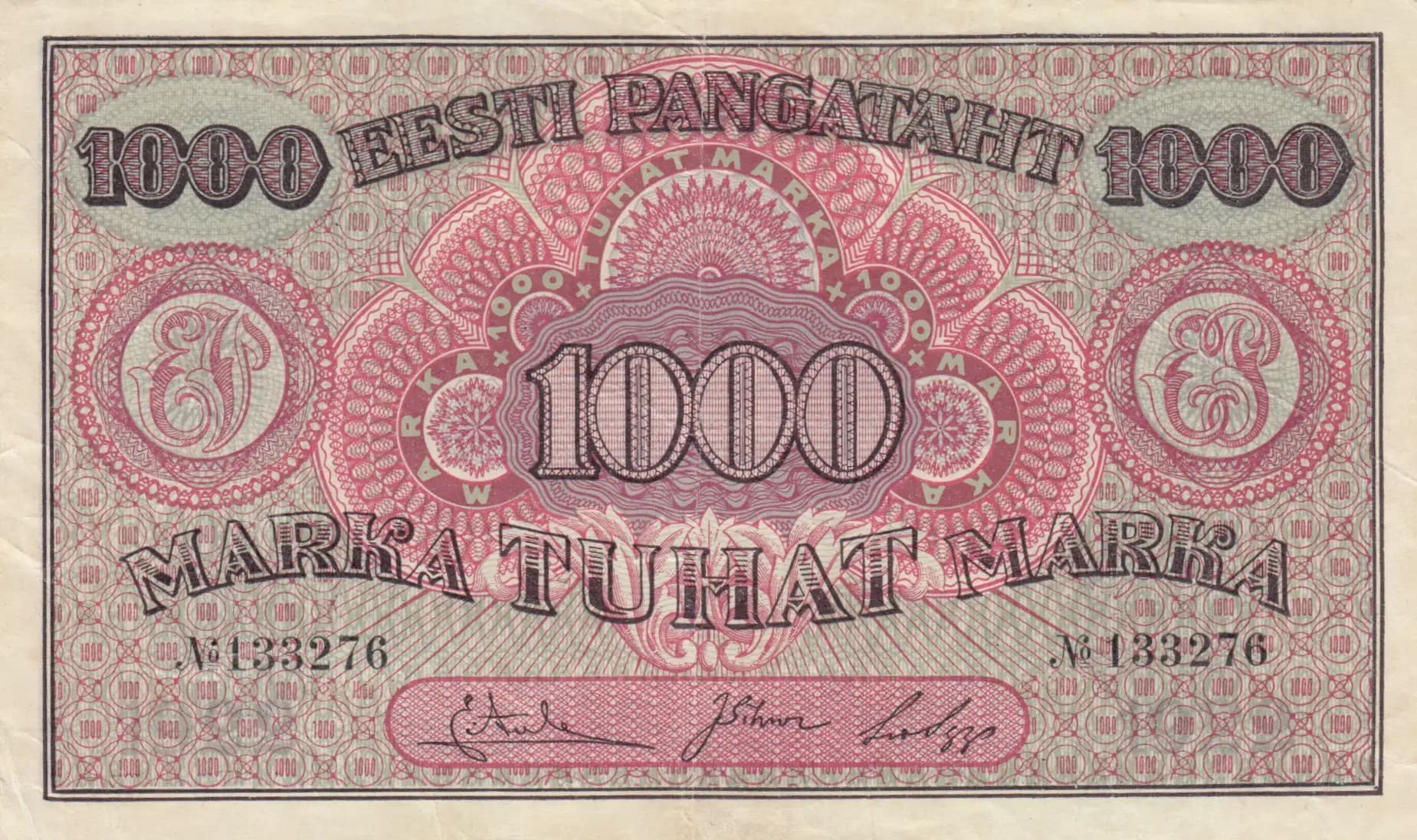
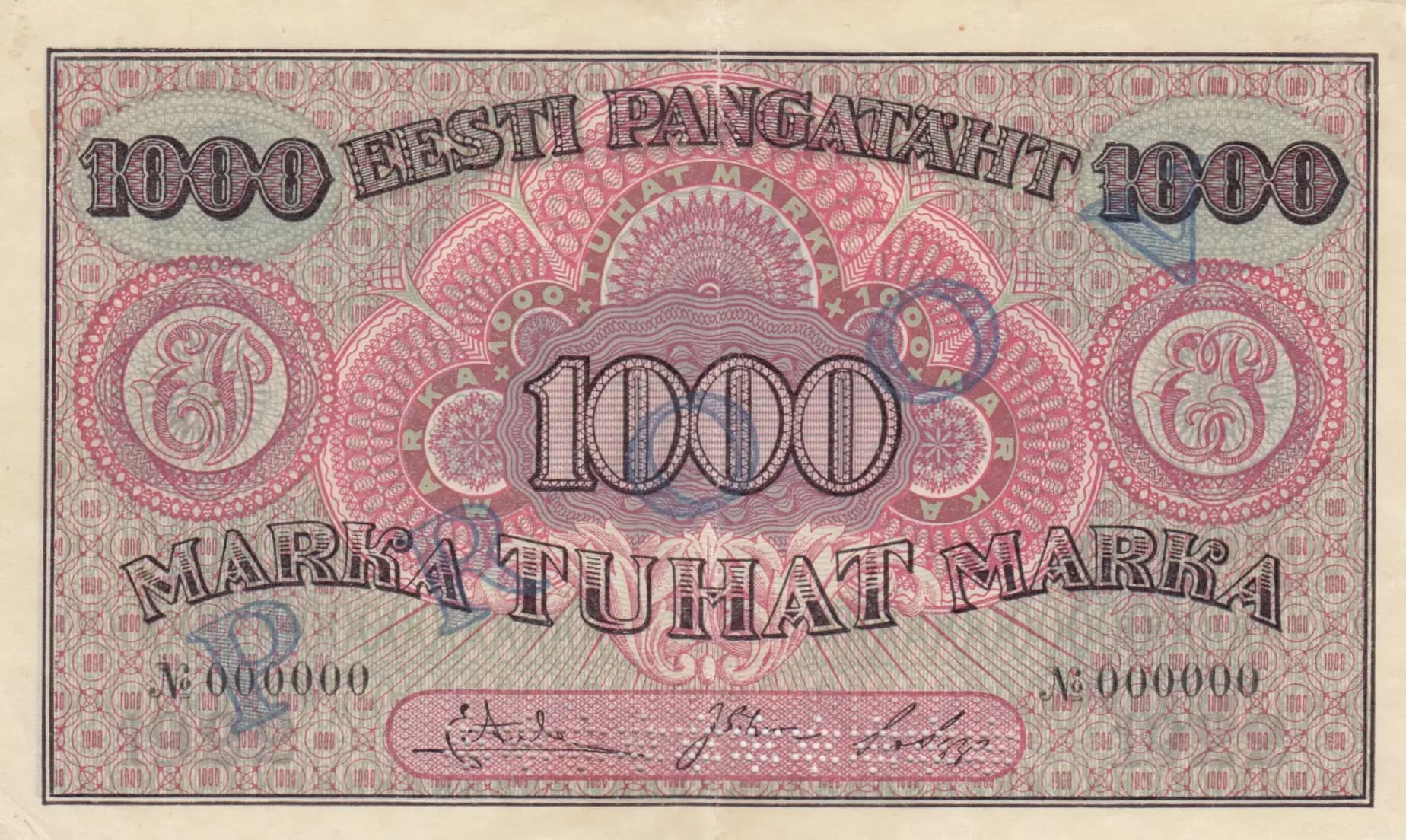
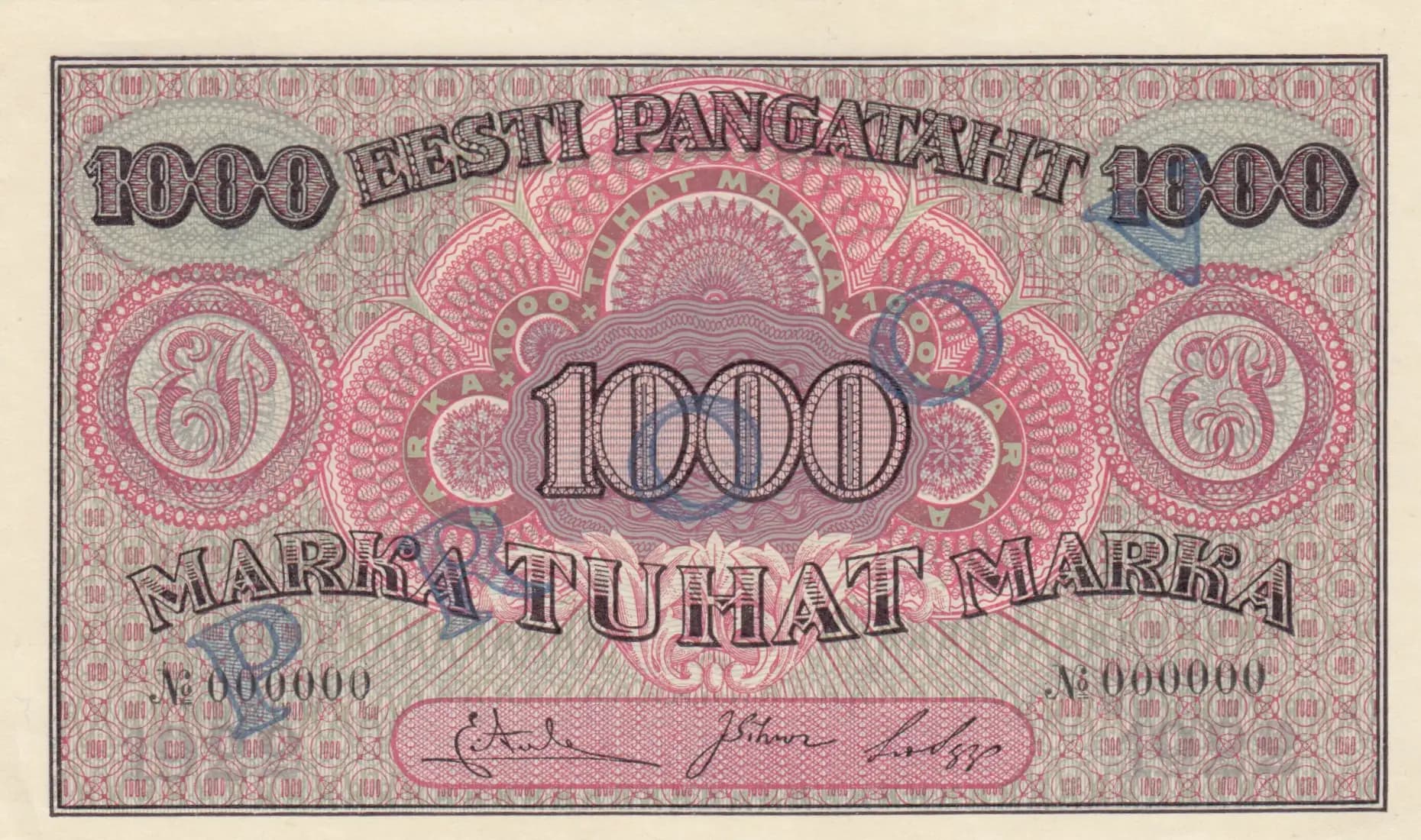
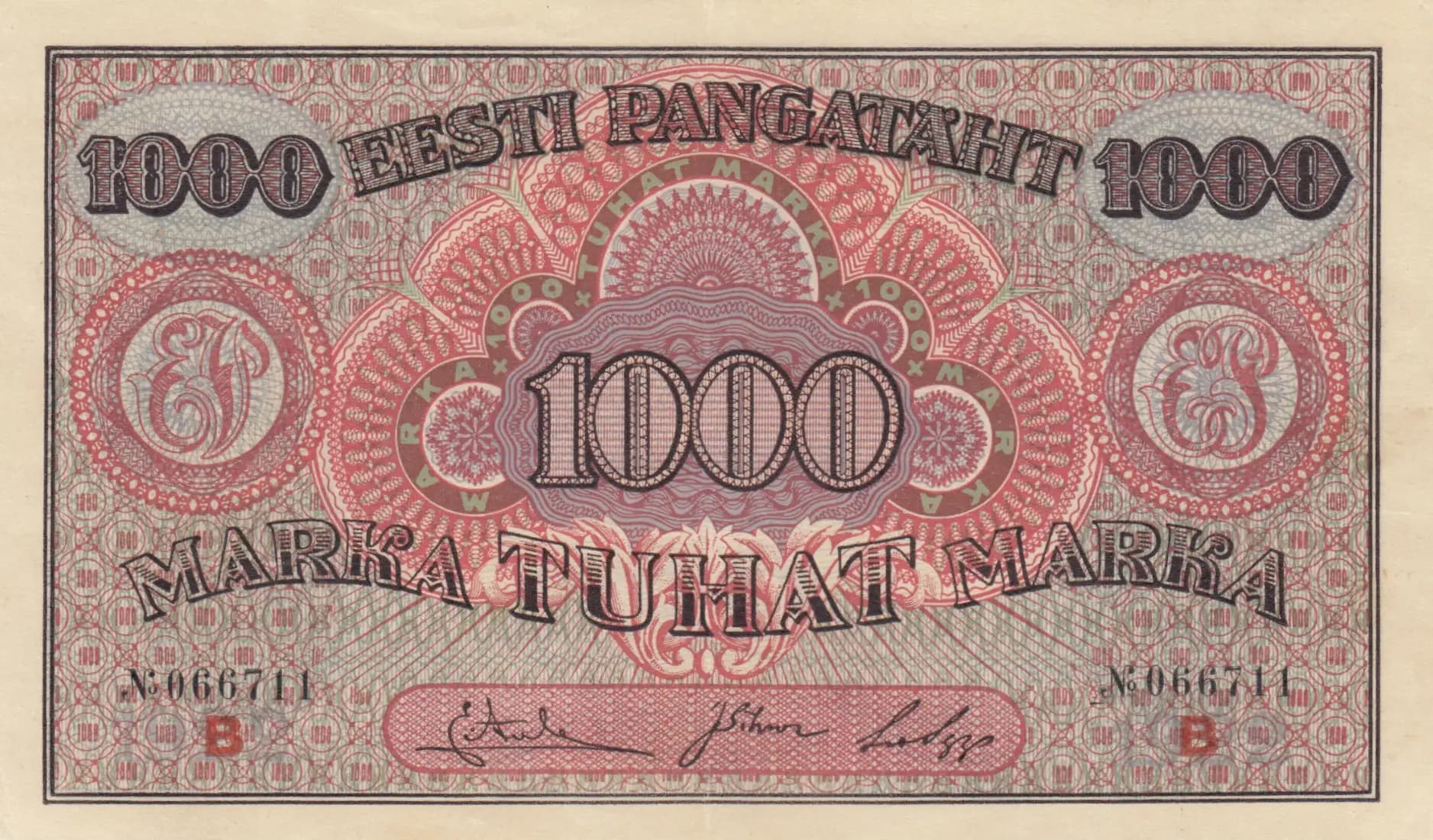
1000 marka 1922
“serie B black”
Market Prices
About This Note
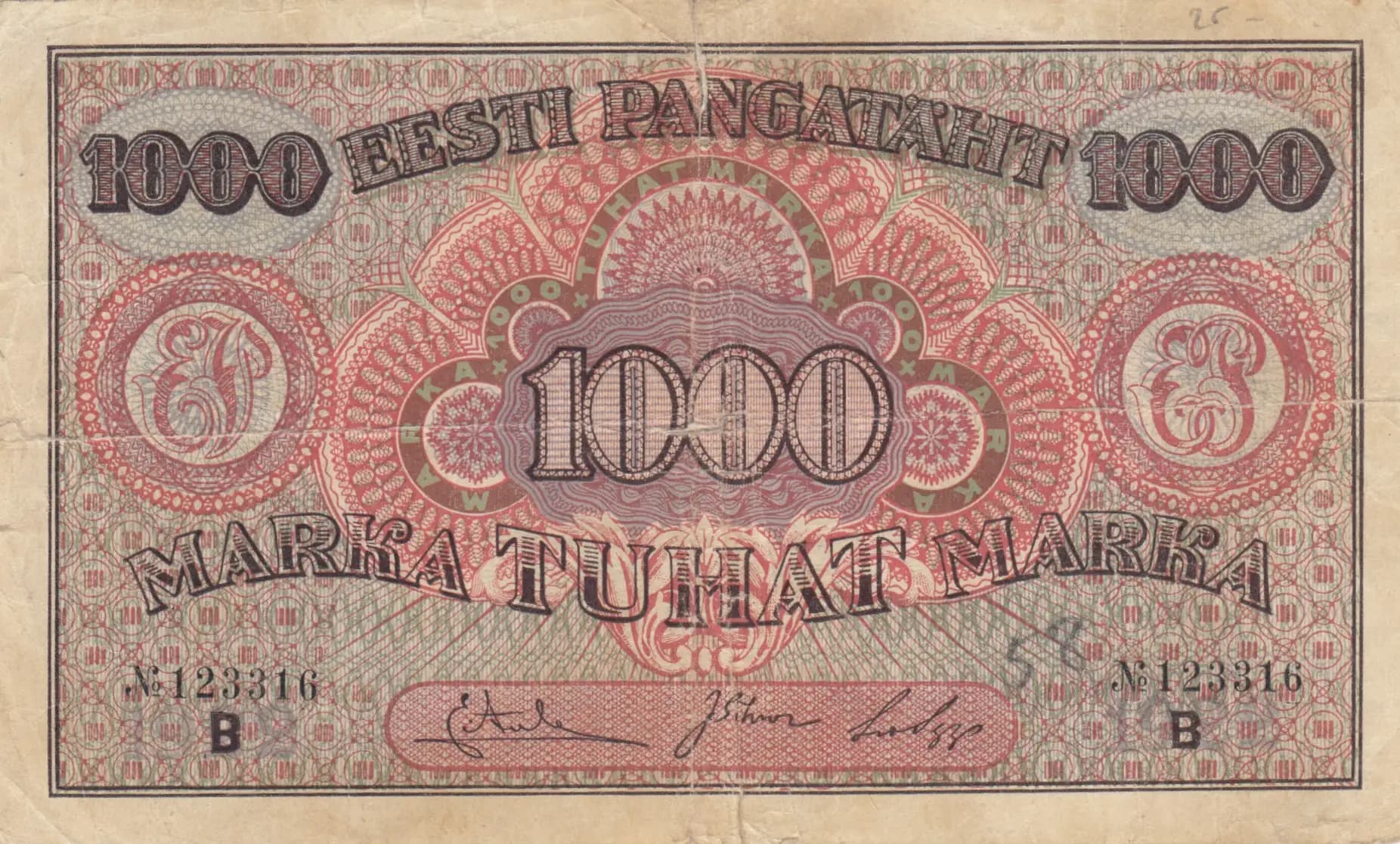
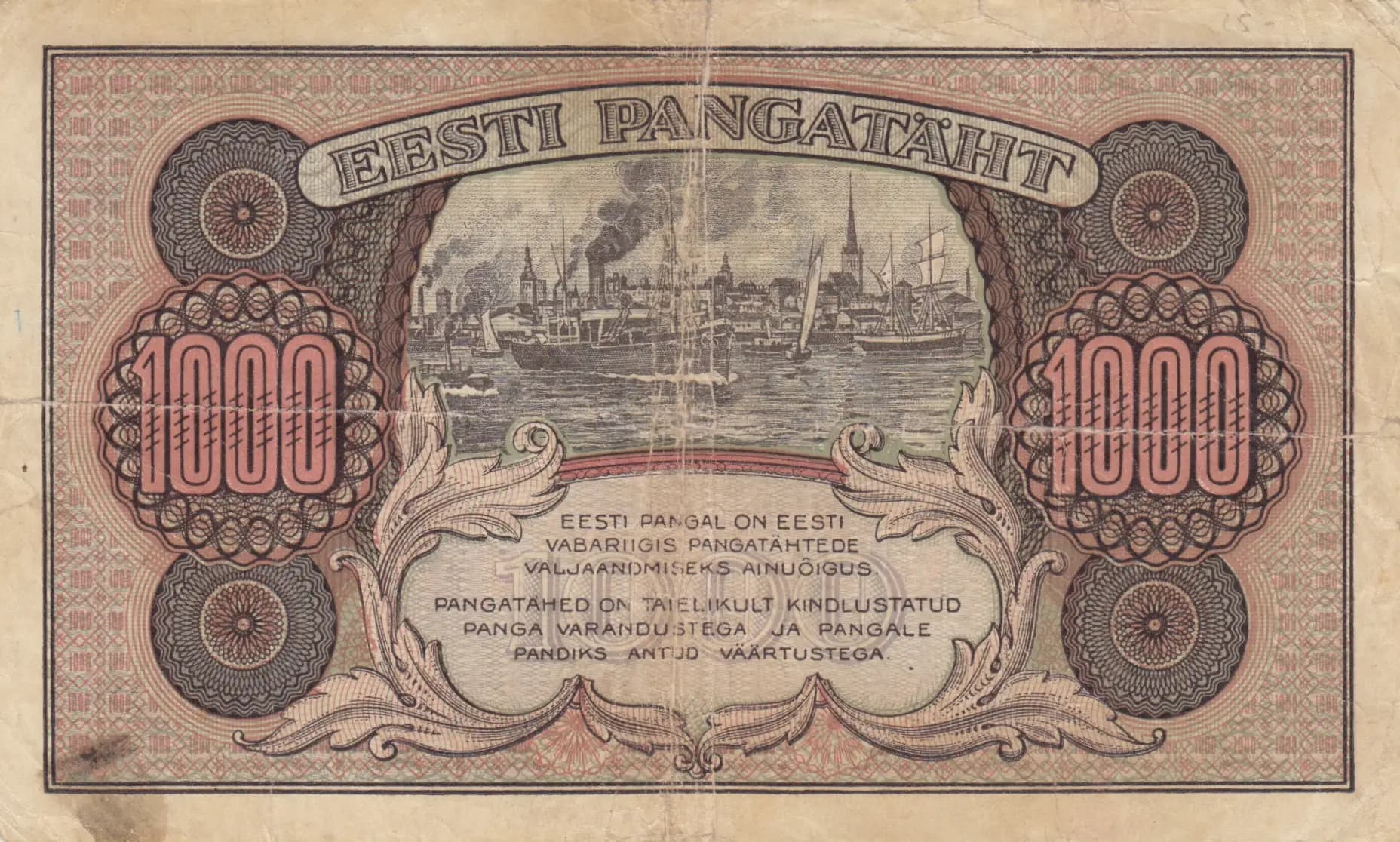
This 1922 Estonian 1000 Marka note (Pick P-59d) is a striking example of early Estonian currency featuring red and black ornamental designs with elaborate geometric and floral patterns. The note displays a prominent vertical center fold, foxing, and age-related discoloration consistent with its Fair condition grade, yet the intricate vignette of Tallinn harbor on the reverse remains visually compelling. The serial letter 'B' and fine security printing showcase the Treasury of Estonia's efforts to establish credible national currency during the republic's formative years.
Common. The eBay market data shows circulation prices ranging from $9-$177 USD for various conditions and unknowns, with Fair-condition comparable notes in the lower-to-mid range ($45-$79 for circulated examples). The 2016 catalog value for VG grade is $400 USD, indicating that while collectible, this is a widely available note. The 1000 Marka denomination from 1922 saw substantial print runs sufficient to meet Estonia's monetary needs during the early republic period. The Pick-59 series (with variants a, c, d, e catalogued) represents standard-issue currency rather than a limited emergency or short-run series.
Issued in 1922 during Estonia's early independence (1918-1940), this banknote reflects the newly sovereign nation's effort to establish a stable monetary system following the Russian Revolution and German occupation. The harbor vignette depicting Tallinn (Reval) celebrates Estonia's most important Baltic port and economic center, symbolizing the nation's maritime heritage and commercial aspirations. The text 'Eesti Vabariigi' (Estonian Republic) and security language emphasize state sovereignty and the Bank of Estonia's role in backing the currency with national assets.
This ornate design exemplifies early 20th-century European banknote security printing. The obverse features an elaborate decorative composition dominated by large circular rosette medallions in all four corners, geometric interlocking circle patterns providing the background security element, and complex filigree ornamentation throughout. The reverse presents an engraved vignette of Tallinn (Reval) harbor—the historical name for Estonia's capital—showing a detailed maritime cityscape with prominent church spires characteristic of the Old Town, sailing vessels in the harbor, and coastal architecture rendered in fine engraving technique. The color scheme of red, black, and cream/beige on lilac and green underprint creates visual depth and complexity intended to prevent counterfeiting. No portraits appear on this denomination, consistent with many early Estonian issues.
FRONT: 'EESTI PANGATÄHT' (Estonian Banknote) arches across the top; 'MARKA TÜÜMÄRKA' (Mark Currency) appears in the center; denomination '1000' is repeated in corners and center; serial number 123316 with letter 'B' visible in lower sections. BACK: 'EESTI PANGATÄHT' (Estonian Banknote) arches across the top; denomination '1000' appears in ornamental frames on both sides; full text reads 'EESTI PANGAL ON EESTI VABARIIGIS PANGATÄHTEDE VÄLJAAMNDMIEKS AINUOIGUS. PANGATÄHED ON TAIELIGKULT KINDLUSTATUD PANGA VARANDUSEGA JA PANGALE PANDIKS ANTIJD VAARTUSTEGA' translating to 'The Bank of Estonia has the sole right to issue banknotes in the Estonian Republic. Banknotes are fully secured by the bank's assets and with values pledged to the bank.'
Intaglio (engraving and steel plate printing) for the fine line work, vignettes, and security patterns; offset lithography for the colored background underprints (lilac and green). The fine geometric patterning, ornamental complexity, and detailed harbor vignette indicate professional security printing typical of state-issued currency. The note was likely produced by a established European security printer, possibly Watérlow & Sons or similar firm specializing in Eastern European currency during the 1920s, though specific printer attribution for this Pick variety would require archival research.
This note is identified as Pick P-59d, serial letter B (black), representing one of several catalogued varieties of the 1922 1000 Marka. The PMG population report confirms at least three additional variants (P-59a, P-59c, P-59e), all bearing the key watermark. Varieties within this Pick number likely correspond to different printing periods, security features revisions, or signature combinations during 1922. The serial number 123316 with letter prefix 'B' in black ink is characteristic of this variety designation. No overprints are visible on this example.