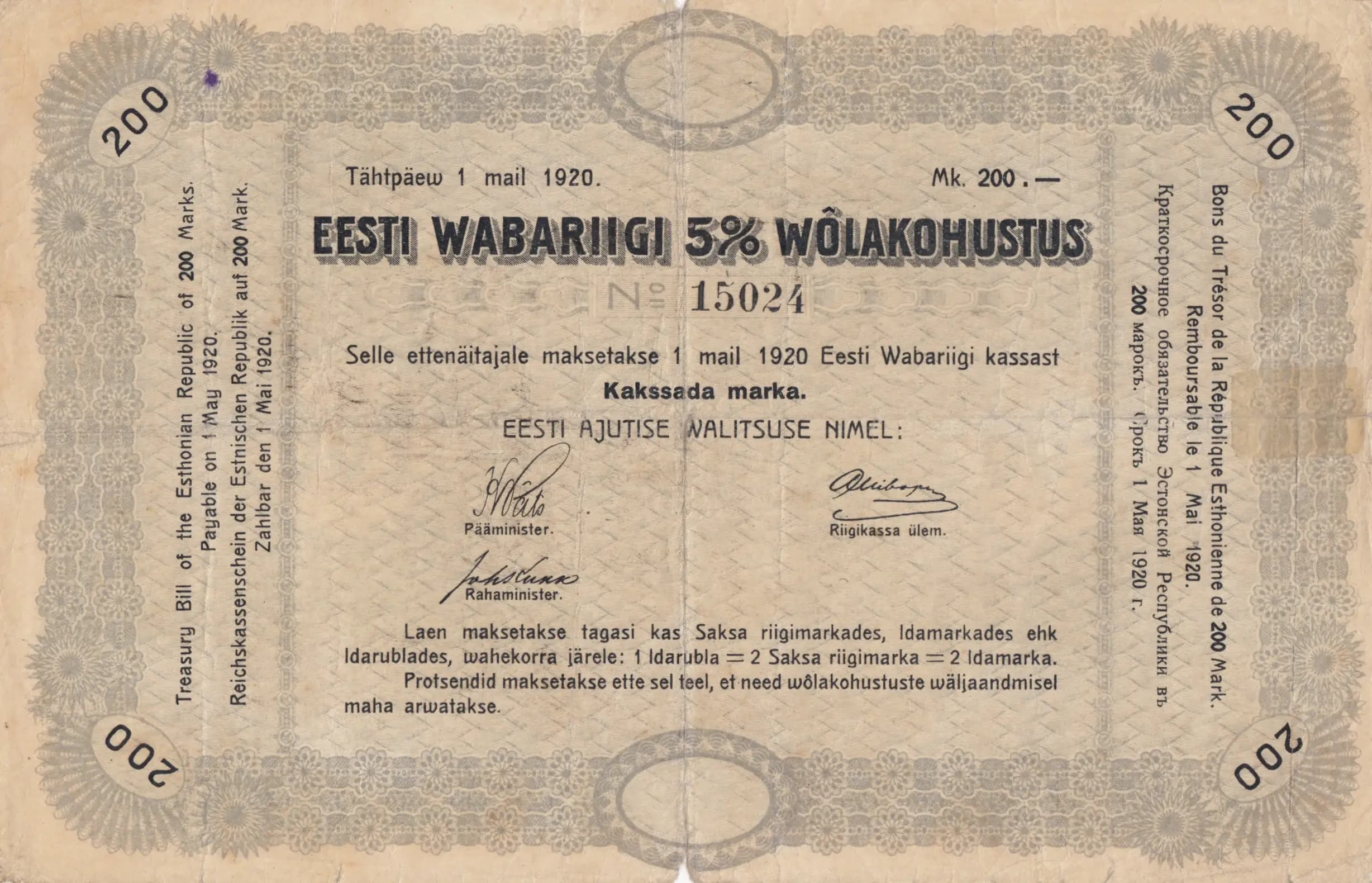
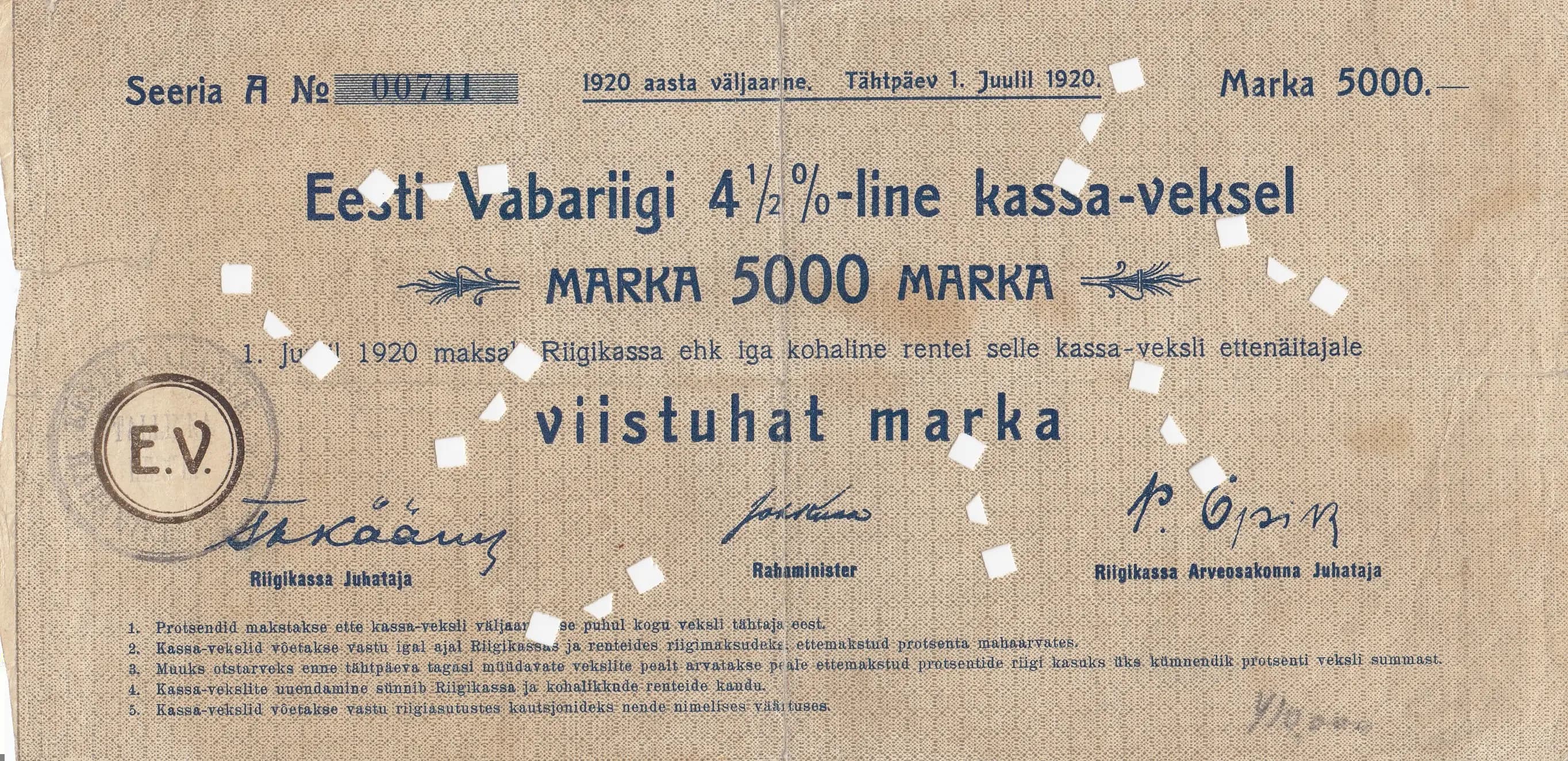
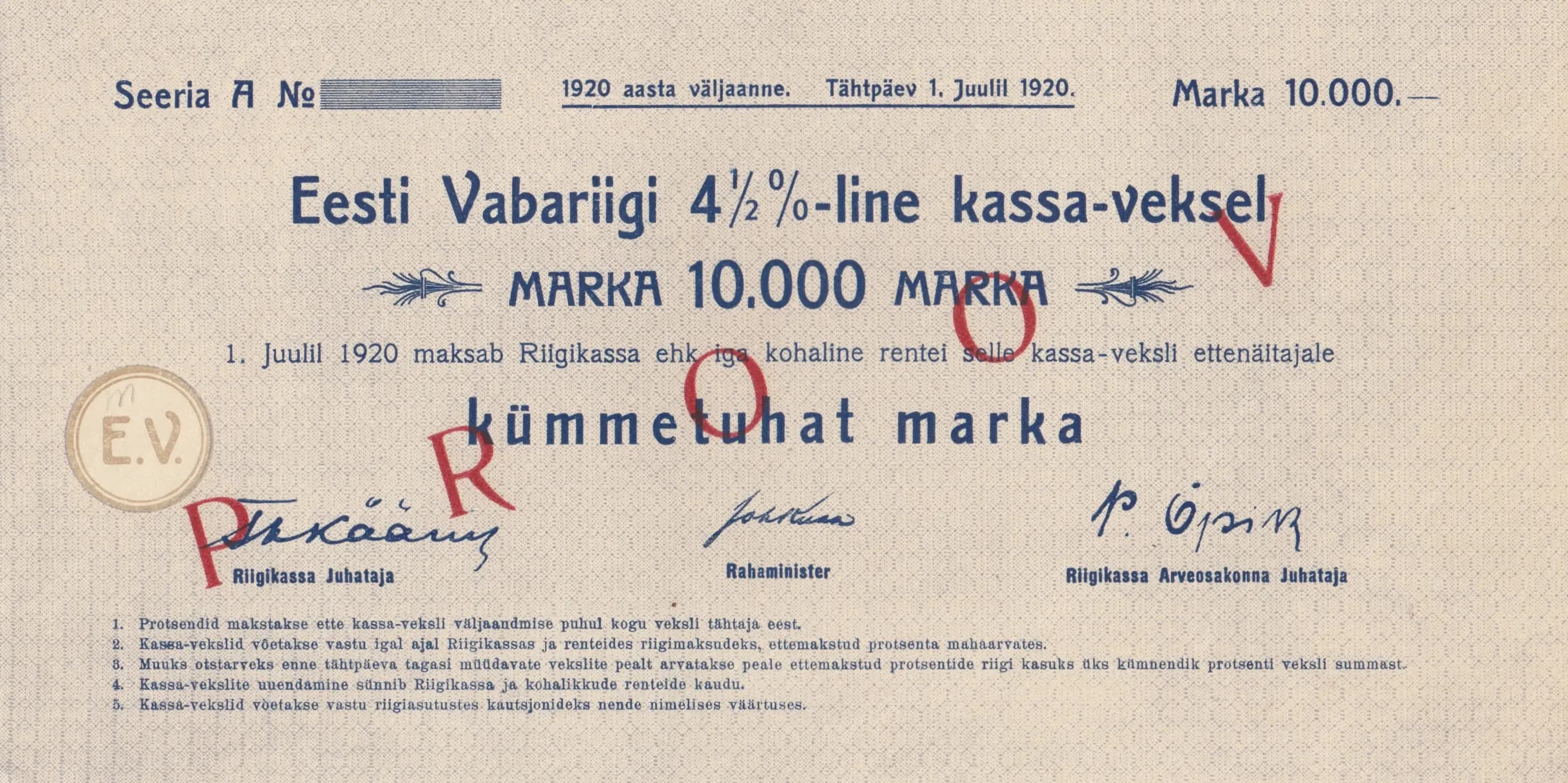
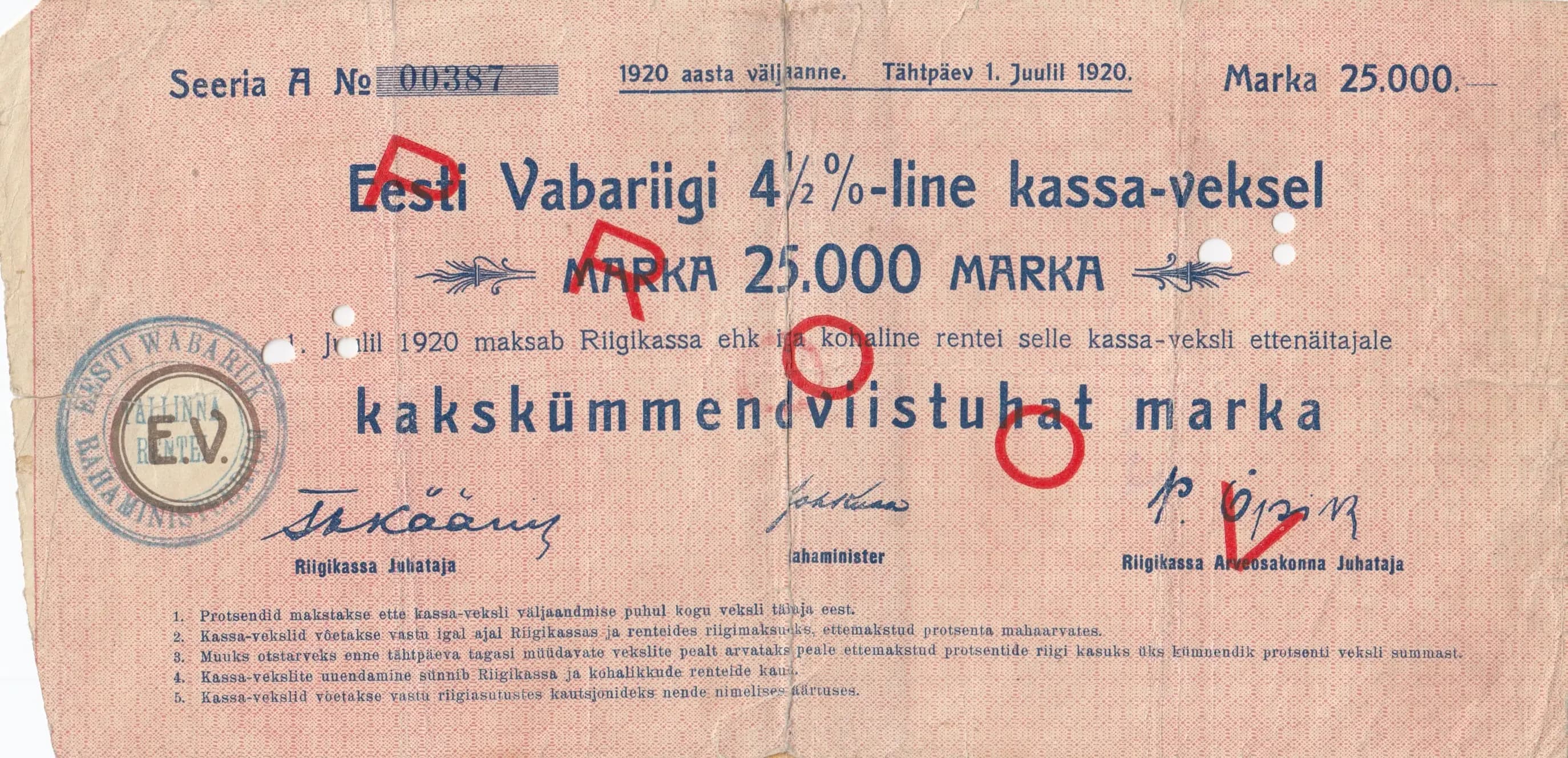
1000 marka 1920
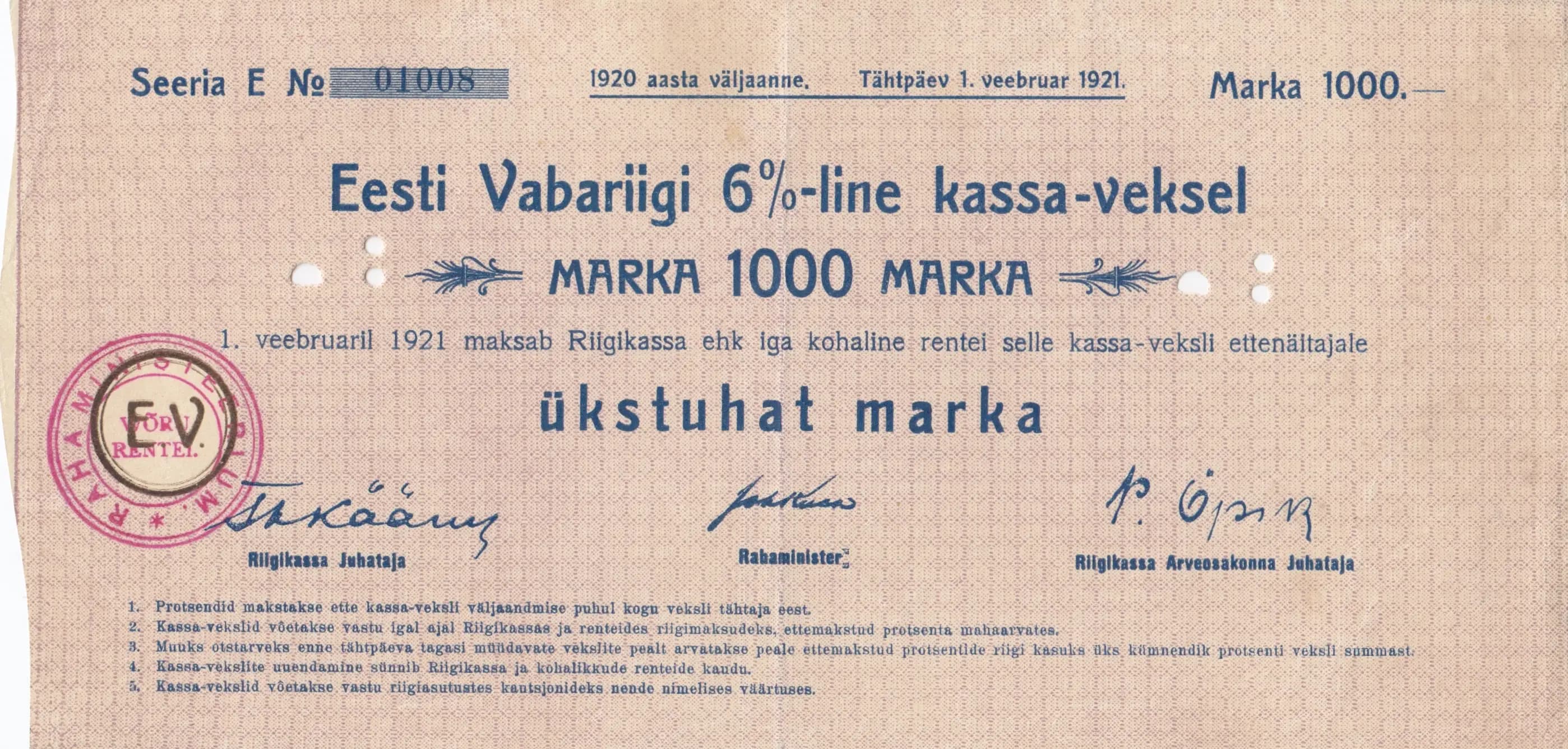
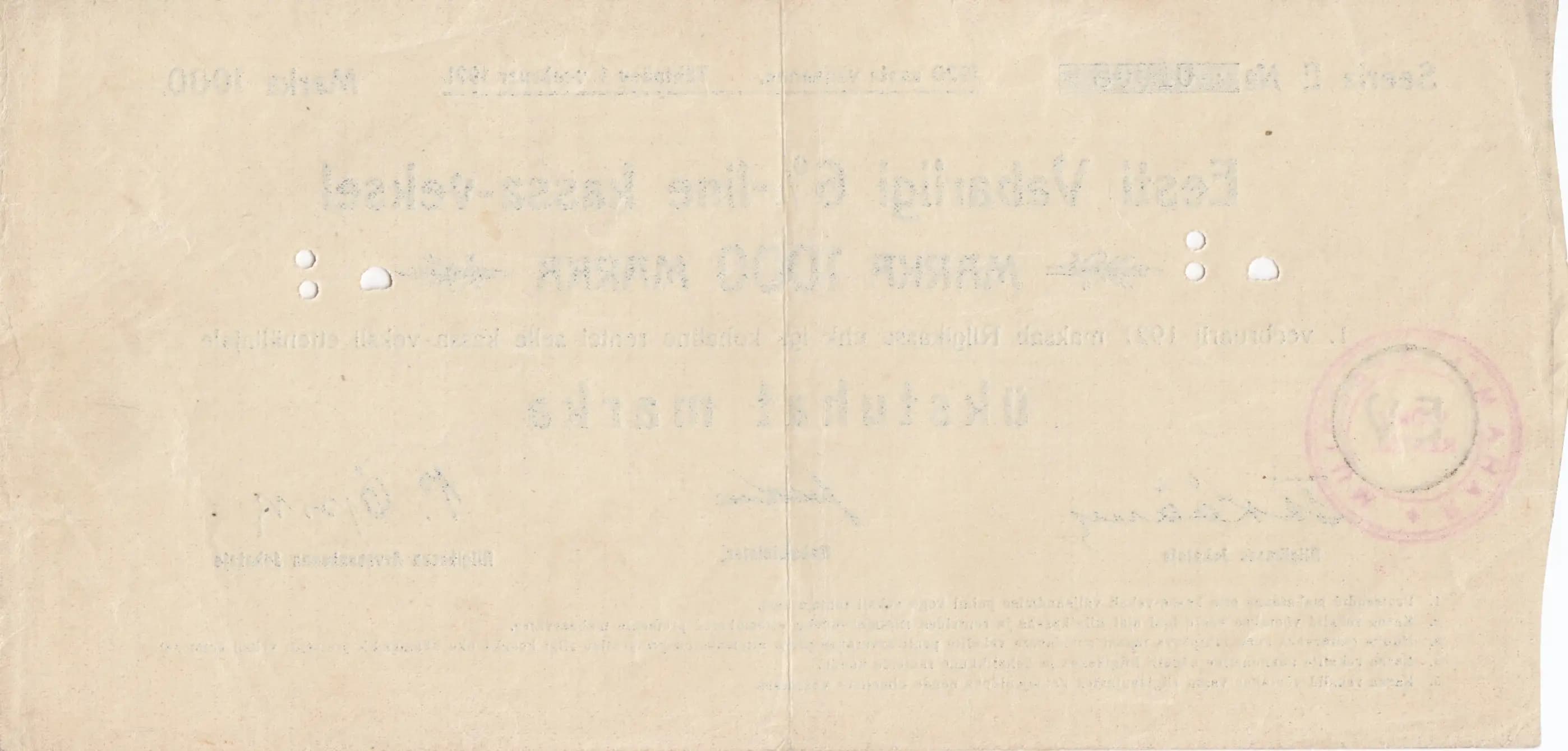
“serie E”
Market Prices
About This Note
This is an Estonian 1000 marka treasury bill (kassa-veksel) from 1920, a 6% interest-bearing short-term government security due February 1, 1921. The note presents in VF condition with significant age-related yellowing, foxing, and a visible center fold, yet the front remains clearly legible with its formal administrative layout, official red seal, and complete signature lines. Series E №01008 represents a scarce surviving example of Estonia's early post-independence fiscal instruments, issued during the critical period of establishing the new Estonian Republic's financial infrastructure.
Common. This note represents a standard issue of a treasury bill with significant surviving examples in the market. eBay price tracking data for related Estonian 1920-era banknotes shows VF-graded examples trading in the $54.90 to $82.00 USD range, with many lower-priced examples (under $20) also available, indicating robust market supply. While any 1920s Estonian banknote has inherent scarcity due to age, the 1000 marka denomination was part of a regular fiscal program of the young Estonian Republic and does not appear in specialized catalogs as a rare variety. The series E designation with serial number €01008 is within a normal production range and shows no indicators of being from a limited printing or special issue. The note's condition (VF with visible wear and deterioration) is typical for notes of this age and does not elevate its rarity status.
Issued just months after Estonia declared independence in February 1918, this 1920 treasury bill reflects the young nation's need to finance its operations and consolidate its currency. The note's designation as a 6% interest-bearing security and the specific conditions printed on the reverse (accepting it for state tax payments and allowing early redemption with deductions) illustrate the practical economic mechanisms through which Estonia's government managed its finances during the turbulent post-WWI period. The formal Estonian-language inscriptions and the multiple signature lines from Treasury officials underscore the legitimacy and governmental authority the nascent Estonian state was working to establish.
This treasury bill employs a formal, document-style design typical of government financial securities of the period. The front features a centered, text-heavy layout emphasizing its official character as a state financial instrument rather than a circulating banknote. The primary design elements include: (1) Administrative header with series designation (Seeria E) and serial number (№01008), reflecting the methodical record-keeping of the Estonian state treasury; (2) A large, ornate red circular seal/stamp on the left side marked 'FOR RENTEL' (presumably indicating acceptance at revenue offices), featuring an ornamental border that serves as a security feature and mark of governmental authority; (3) Decorative floral flourishes flanking the word 'MARKA,' providing minimal aesthetic relief in an otherwise utilitarian design; (4) Multiple signature lines for authorized officials (Head of State Treasury, Finance Minister, and Head of Accounting Department), each with blank spaces for handwritten authorization; (5) Five numbered conditions and terms printed at the bottom of the front, specifying the bill's redemption terms, interest payment mechanism, and acceptable uses. The reverse appears largely blank or printed with faint text now illegible due to age. The note contains no portrait imagery, reflecting its nature as a treasury bill rather than a currency note, and no specific named landmarks. The design emphasizes legibility and administrative clarity over artistic decoration.
FRONT SIDE: Series and Serial: 'Seeria E №01008' (Series E No. 01008). Issue Information: '1920 aasta väljaanne. Tähipäev 1. veebruar 1921.' (1920 issue. Due date 1 February 1921). Denomination: 'Marka 1000' and 'ükstuhat marka' (1000 Marks / one thousand marks). Title: 'Eesti Vabariiigi 6%-line kassa-veksel' (Estonian Republic 6% interest-bearing treasury bill). Payment Promise: '1. veebruaril 1921 maksab Riigikassa ehk iga kohaliine rentei selle kassa-veksli ettenäitajale' (On 1 February 1921 the State Treasury or any local revenue office will pay to the bearer of this treasury bill). Signature Lines: 'Riigikassa Juhataja' (Head of State Treasury), 'Rahaminister' (Finance Minister), 'Riigikassa Arveosäkonna Juhataja' (Head of State Treasury Accounting Department). Terms and Conditions (5 numbered points): (1) 'Protsendid maksikase ette kassa-veksli väljaandmise puhul kogu veksli tähtajani eest' (Interest is paid in advance at the time of the treasury bill issue for the entire term of the bill). (2) 'Kassa-vekslid võetakse vastu igal ajal Riigikassas ja renteides riigimaksuudeks, ettemaksustud protsentidega mahaarvatutes' (Treasury bills are accepted at any time at the State Treasury and revenue offices for payment of state taxes, with the advance interest deducted). (3) 'Muuks otstarveks enne tähtpäeva tagasi müüdavate vekslite pealt arvatakse peale ettemaksustud protsendide riigi kasule kümnendik protsendil veksli summast' (For other purposes, bills sold back before the due date will have deducted from them the prepaid interest and one-tenth of a percent to the state for each one percent of the bill amount). (4) 'Kassa-vekslid pandanud siiani Riigikassas ja kohalikunde renteide kaudu' (Treasury bills have been issued through the State Treasury and local revenue offices). (5) 'Kassa-vekslid võetakse vastu riigisustutuuste kantsjondideks neile nimelises väärtuises' (Treasury bills are accepted as securities for state institutions at their nominal value). BACK SIDE: Text largely illegible due to age and condition; a red circular seal impression is visible in the lower right area.
This note was produced using letterpress (relief) printing, evidenced by the crisp, bold impression of the text and the clear definition of the ornamental floral elements and circular seal stamp visible in the visual analysis. The even distribution of ink and the sharp edges of the printed characters are characteristic of quality letterpress work from the 1920 period. The red seal and overprinting appear to have been applied via stamp or secondary press work, a common practice for adding official authentication marks to government securities. No specific printer name is identified in the available catalog data, though the work quality suggests it was produced by a European security printer contracted by the Estonian state during its early period of financial institution-building. The deterioration pattern visible on the reverse (where text has faded dramatically) suggests the printing inks used were period-standard formulations susceptible to age-related fading.
Specific variety identified: Series E, Serial Number €01008. The visual analysis confirms this is part of the regular 1000 marka 1920 issue (Pick P-38Q). The series designation 'Seeria E' should be documented as a distinguishing characteristic, though the catalog data does not indicate whether multiple series were issued. The red seal marked 'FOR RENTEL' appears to be a standard security feature of the issue rather than a variety marker. The note's structure as a 6% interest-bearing treasury bill with a due date of February 1, 1921 is consistent with the cataloging designation. No errors, special overprints, or design variations from the standard type are apparent in the visual analysis. The back of the note shows faint printing that cannot be reliably read due to condition, but this deterioration appears consistent with age rather than indicating a distinct reverse variety.