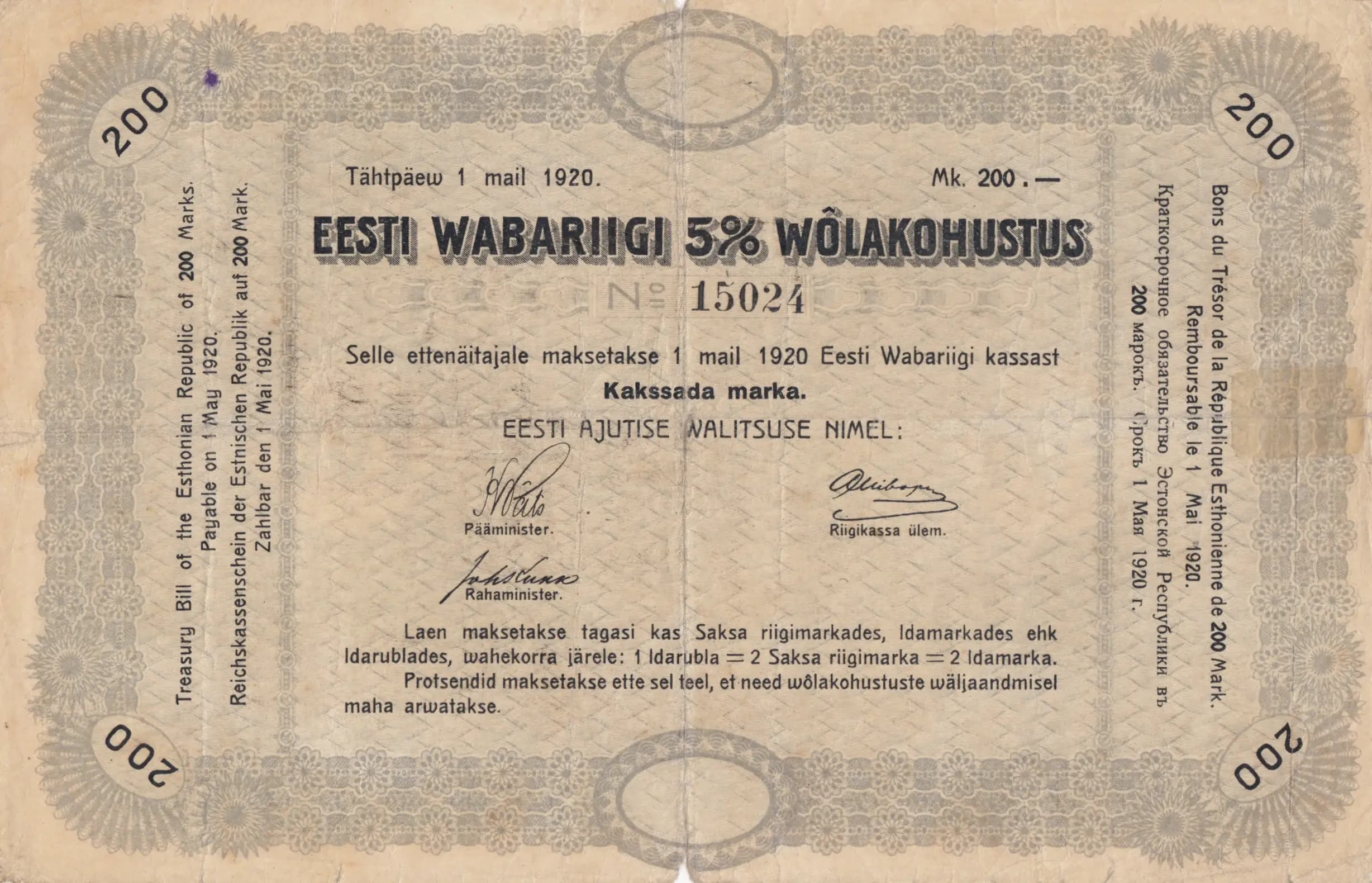
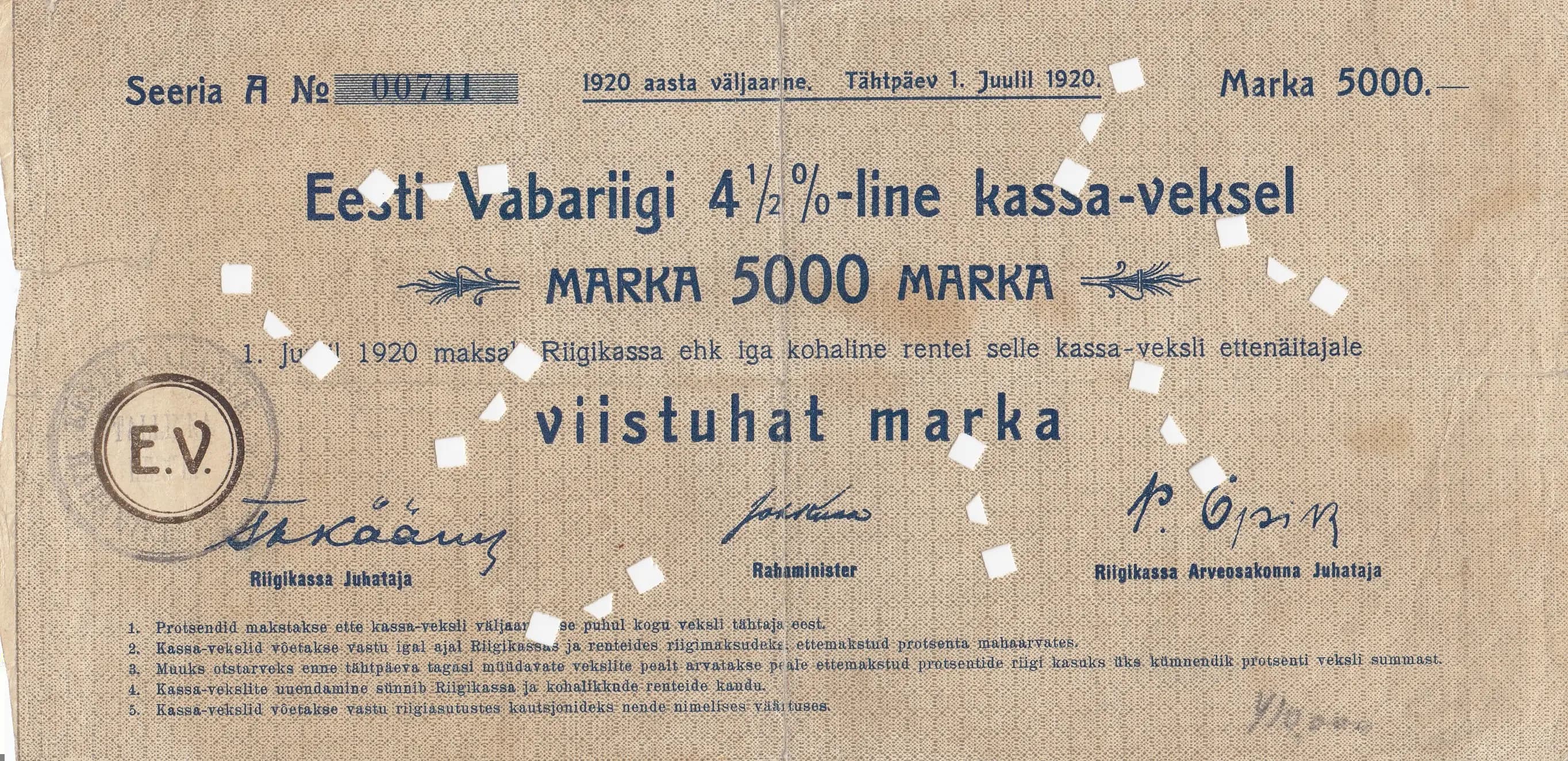
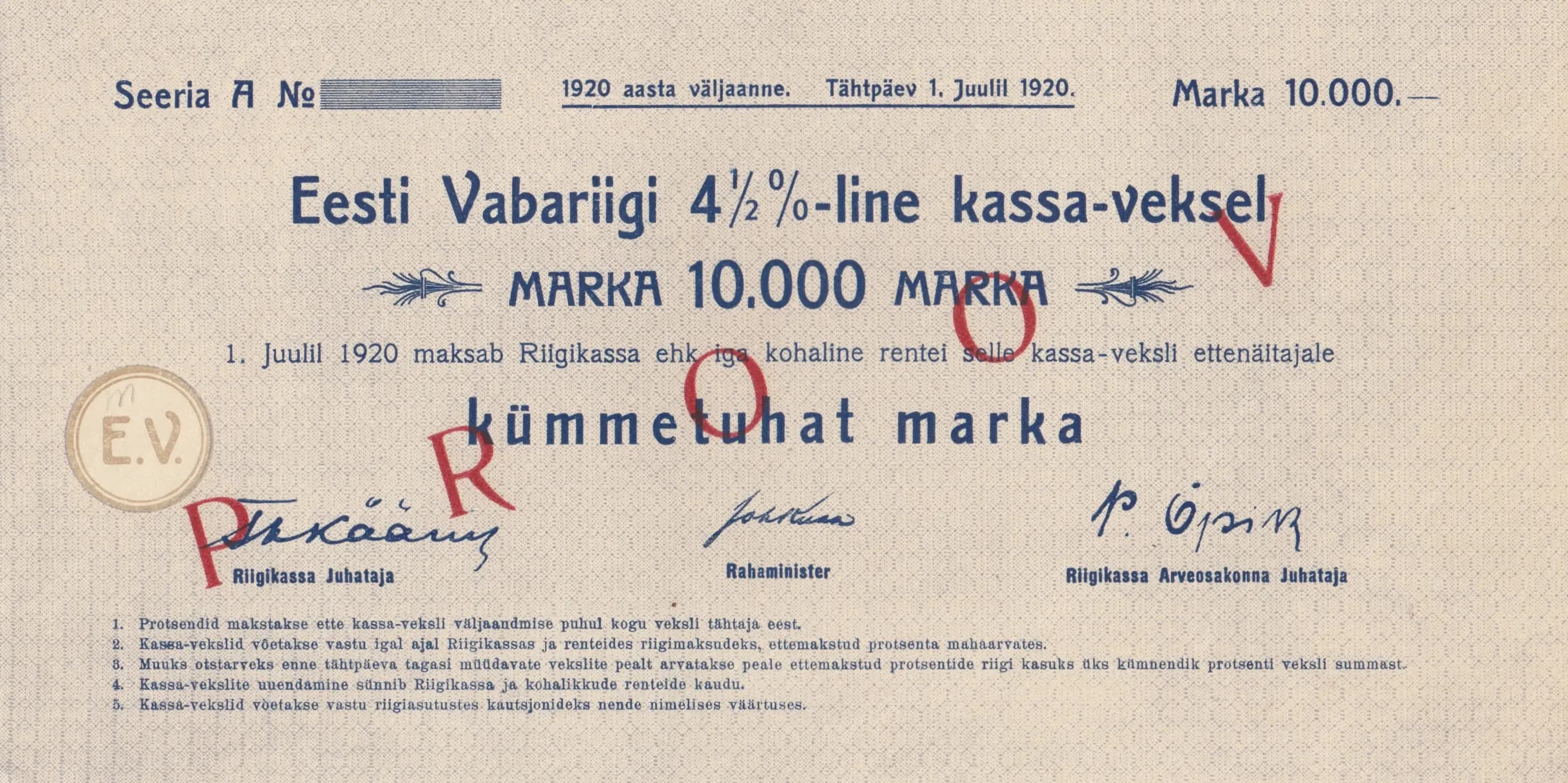
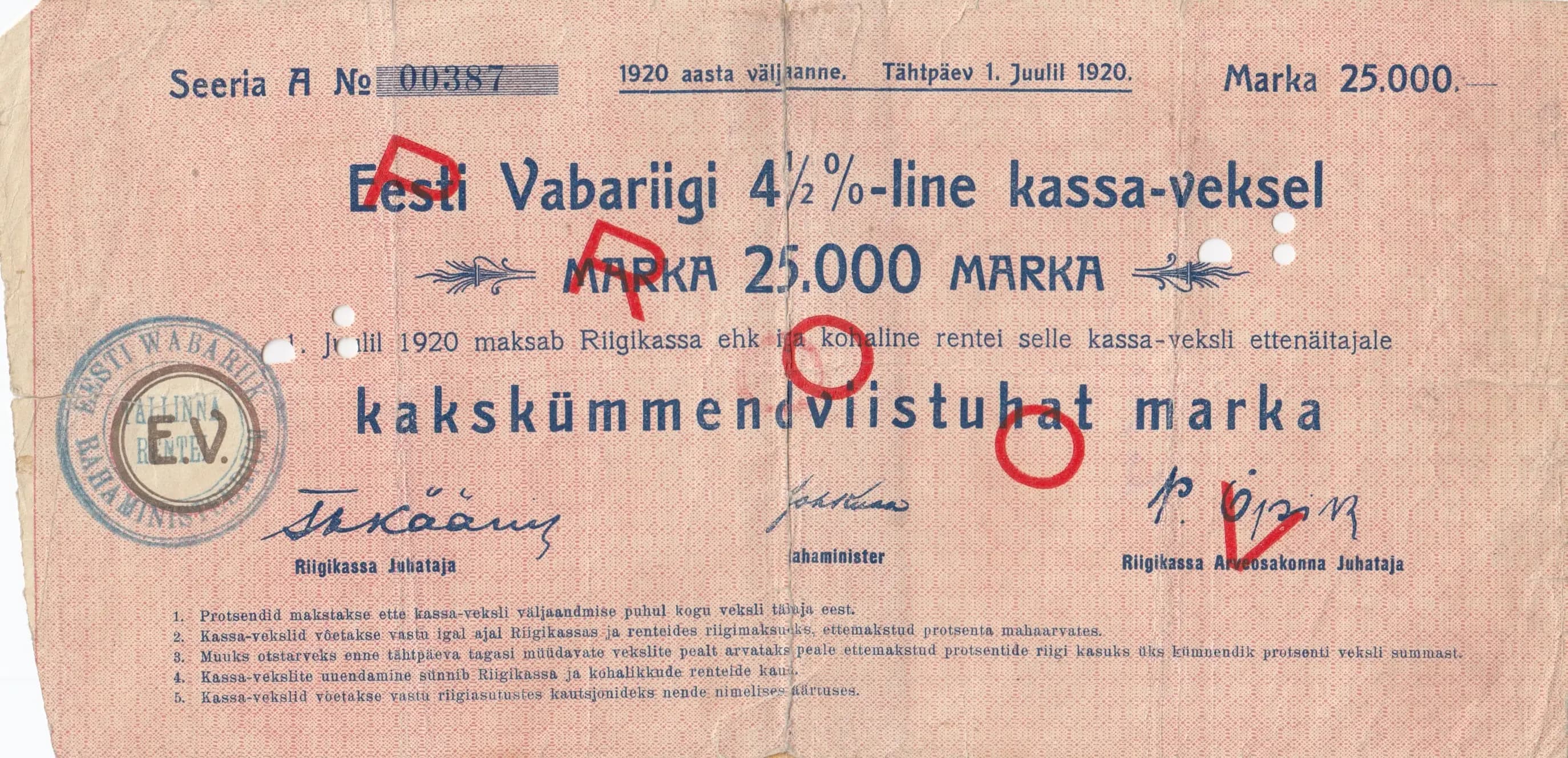
1000 marka 1920
“serie B”
Market Prices
About This Note
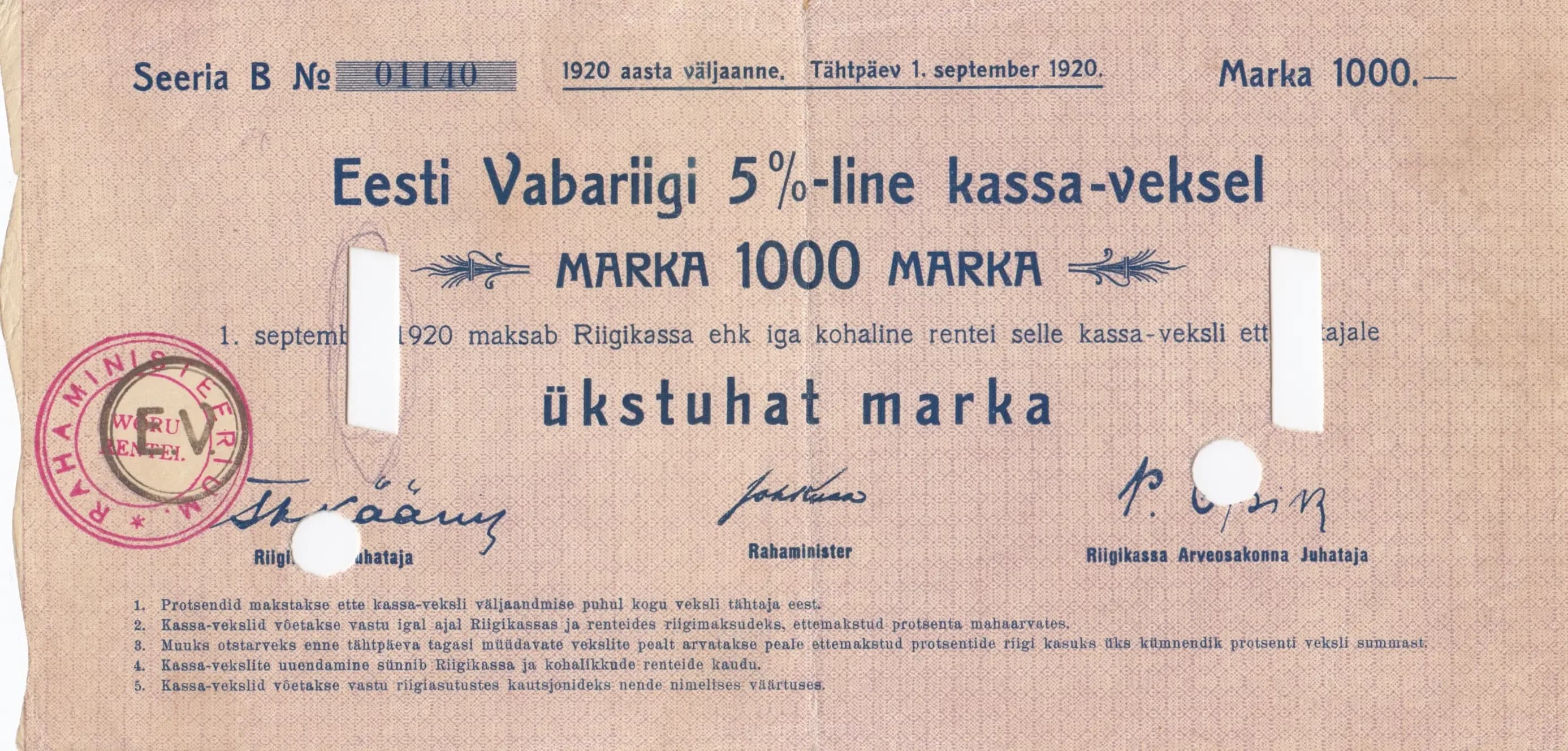
This is an Estonian Republic 1000 Marka cash bill (kassa-veksel) from 1920, graded VF, representing a fascinating example of Estonia's early monetary independence. The document is actually a government treasury note rather than a traditional banknote, featuring administrative text, terms and conditions, and official signatures on a tan-colored paper stock with archival preservation markings. Series B No. 01140 carries historical significance as part of the Estonian state's first financial instruments following independence from Russia in 1918.
Common. This denomination and series appear regularly in the secondary market, with eBay sales data showing VF-graded examples consistently priced in the $54.90–$82.00 USD range, indicating steady supply and moderate collector demand. The 1920 issuance was a substantial government offering during Estonia's early independence period, resulting in large print runs. While historically significant, these notes are not scarce in numismatic terms.
This 1000 Marka cash bill was issued on May 1, 1920, by the newly independent Estonian Republic as a 5% interest-bearing treasury instrument maturing September 1, 1920. The note represents Estonia's early monetary policy during a critical period of nation-building, when the young Baltic state needed to establish financial credibility and raise funds. The terms printed on the note—detailing interest payments, acceptance at state treasuries, and use as collateral—reflect the formal financial mechanisms the Estonian government employed during the immediate post-independence period.
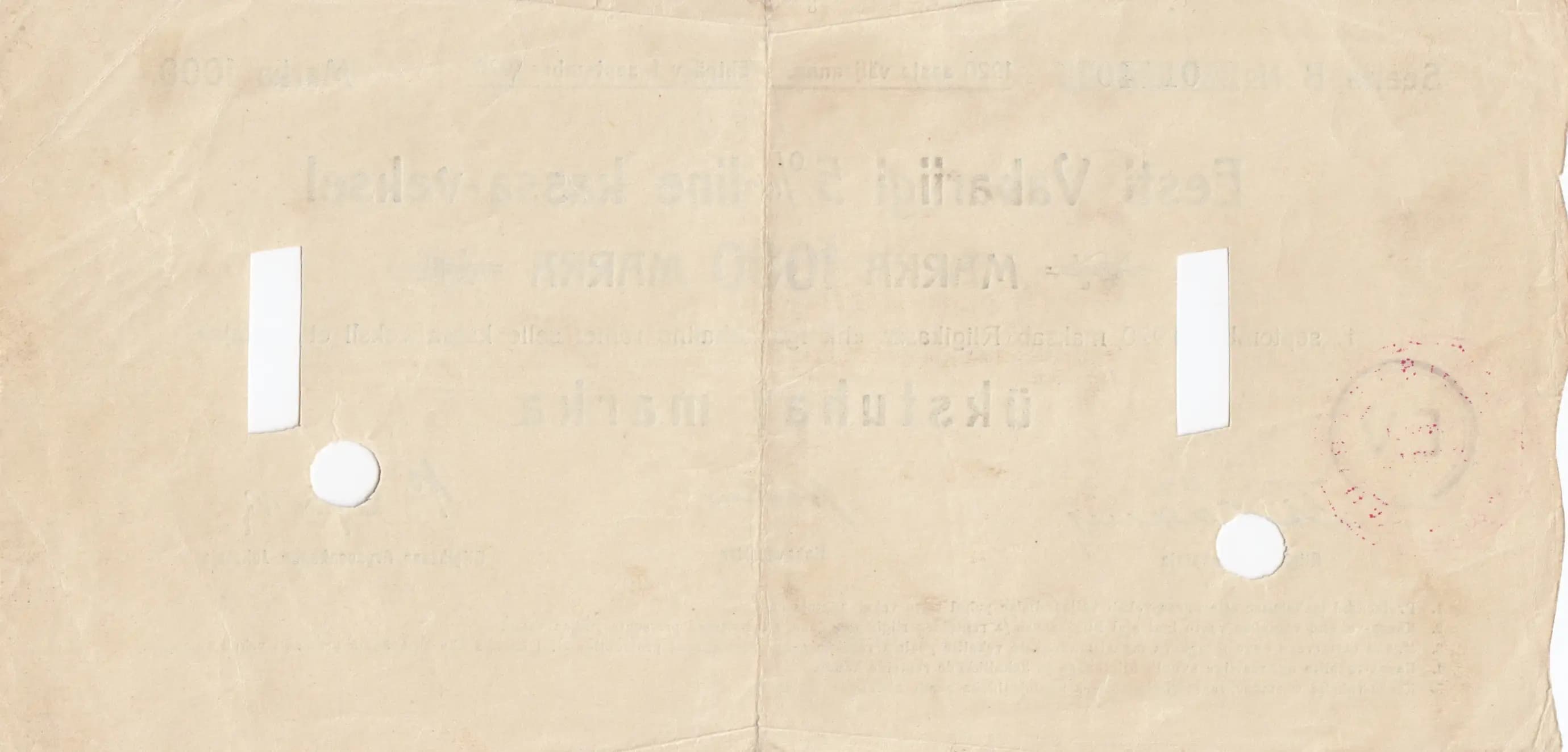
This document is a government-issued treasury note (kassa-veksel) rather than a circulating banknote. The front features a formal administrative layout typical of early 20th-century financial instruments, with the denomination and issue information prominently displayed in Estonian. A circular official government seal or stamp in red ink appears on the left side, serving as the primary security and authentication element. The note is printed in dark blue/navy text on a tan/beige paper stock, with numbered reference points (1-5) corresponding to detailed terms and conditions below. Three signature lines at the bottom represent authorization by high-ranking state financial officials. The reverse side is predominantly blank except for faint watermarked or embossed text. The overall design reflects the austere, formal aesthetic of early Estonian state finances rather than the decorative elements typical of circulation banknotes.
FRONT SIDE: Title: 'Estonian Republic 5% Cash Bill' (Eesti Vabariigi 5%-line kassa-veksel); Denomination: 'Marka 1000.—' and 'One thousand marka' (ukstuhat marka); Series and Number: 'Series B No. 01140' (Seeria B № 01140); Issue Information: '1920 edition. Due date September 1, 1920.' (1920 aasta väljäanne. Tähtpäev 1. september 1920.); Terms and Conditions: '1. Interest is paid in advance upon issuance of the cash bill for the entire duration of the bill.' '2. The cash bill is accepted at any time at the State Treasury and state revenue offices, advance payments credited as interest.' '3. For other purposes before the due date, sold bills are calculated with interest paid to the state treasury at one-tenth of one percent of the bill amount.' '4. In case of loss of the cash bill in state treasury and local revenue offices records.' '5. The cash bill is accepted at state institutions as security at its nominal value.'; Signatories: 'State Accountant' (Riigi arhataja); 'Minister of Finance' (Rahaminister); 'Head of State Treasury Accounting Department' (Riigikaasa Arveosakonna Juhataja). BACK SIDE: Faint embossed or watermarked text present but not clearly legible in the image.
This note was printed using letterpress printing technology, as evidenced by the crisp, uniform impression of text and the official seal. The printing technique is characteristic of early 20th-century government securities and treasury documents. The faint embossing or watermarking visible on the reverse suggests additional security features were incorporated into the paper itself. The specific Estonian printing authority for this issue has not been definitively identified from the visual analysis, though it was produced under the authority of the Estonian State Treasury (Riigikassa).
This note is identified as Pick P-38G, representing a specific variant of the 1000 Marka denomination. The notation indicates this is a gray-colored version; Pick reference P-38A exists in orange color. This example is Series B, No. 01140, with the May 1, 1920 issue date and September 1, 1920 maturity date. The catalog reference to 'serie B' in the collector notes confirms this is a specifically identified series variant. PMG population reports indicate only one variant has been catalogued for the base P-38 pick number, though multiple color varieties exist.