100 marka 1919
Market Prices
About This Note
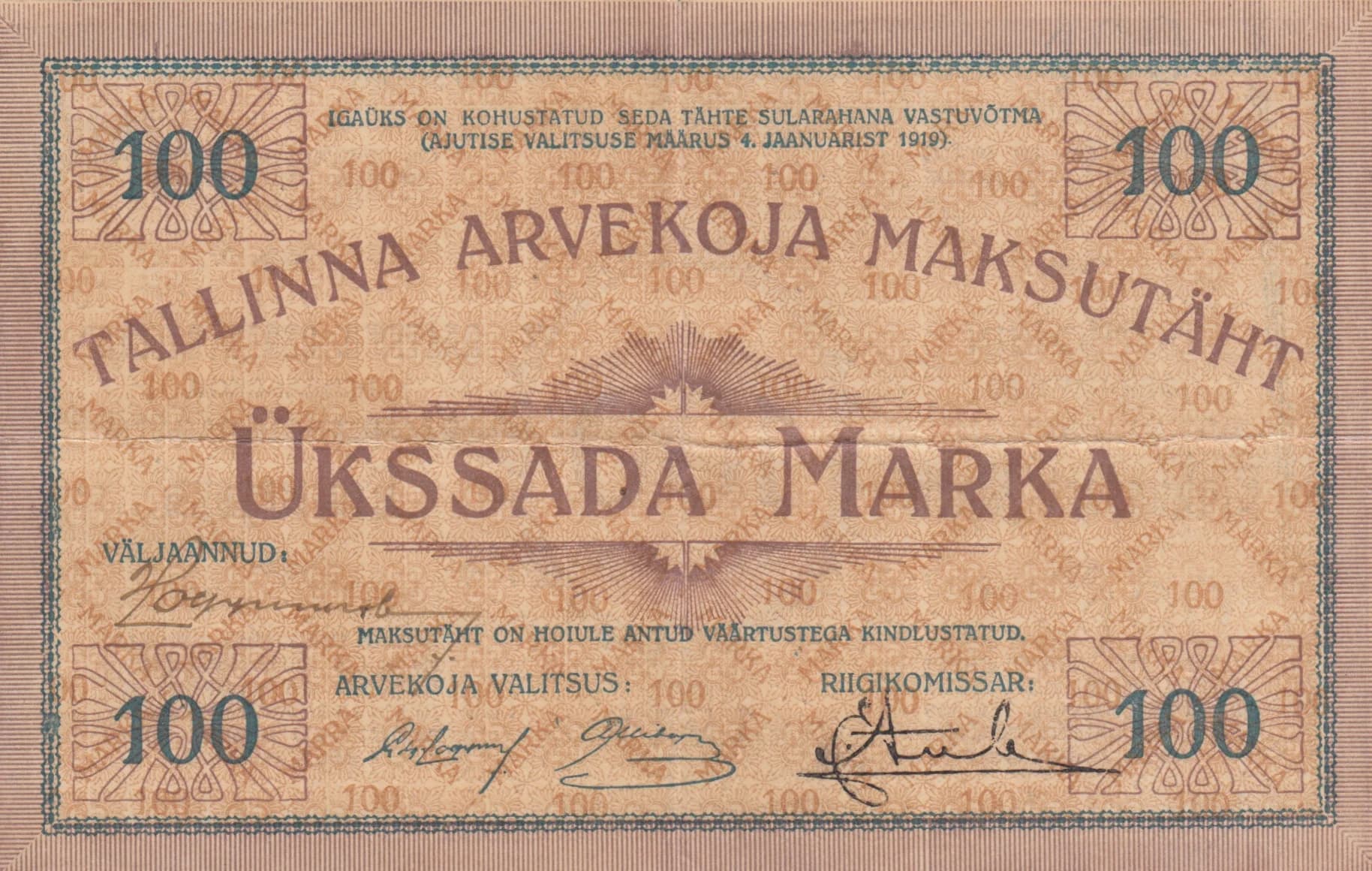
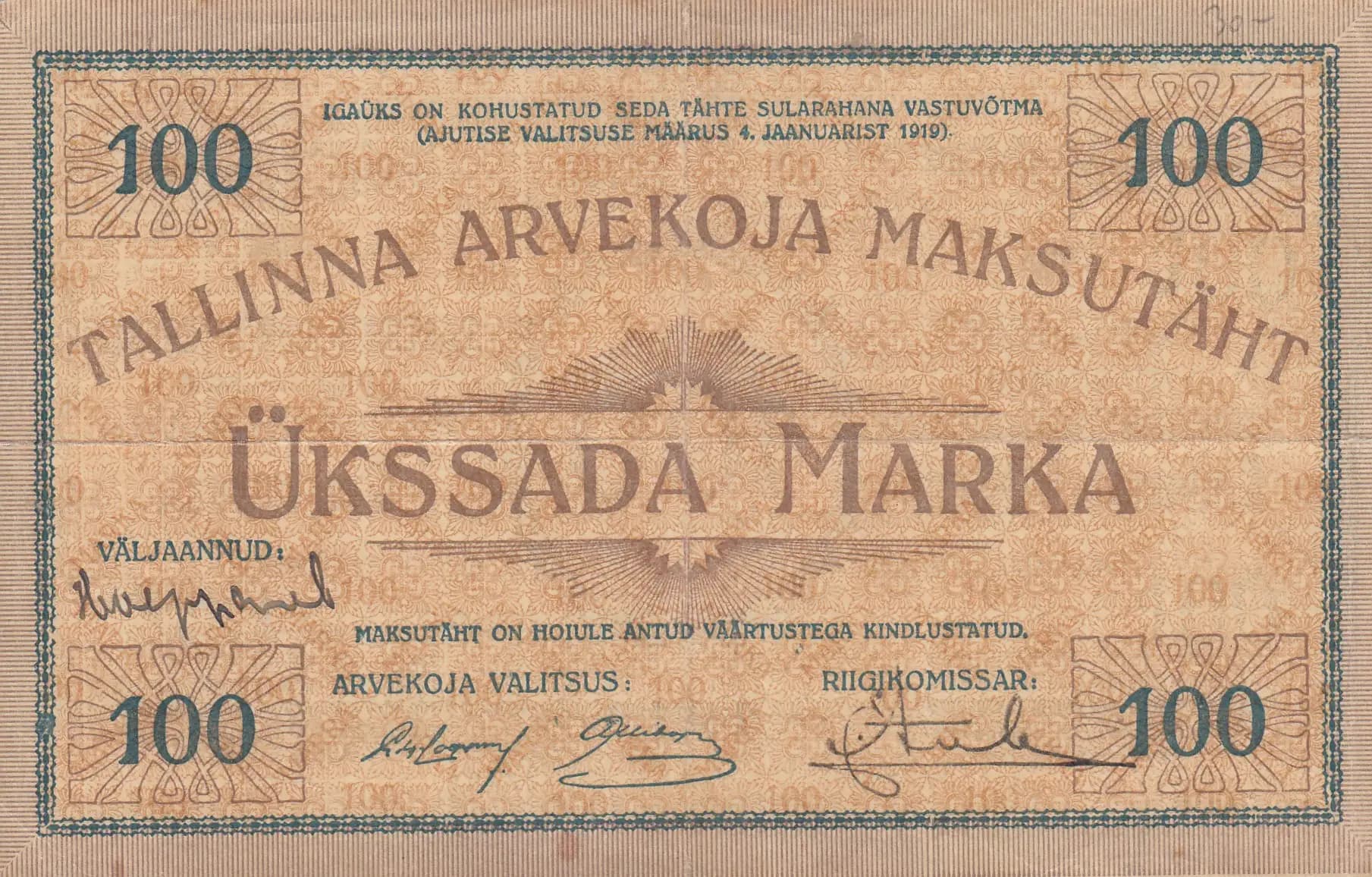
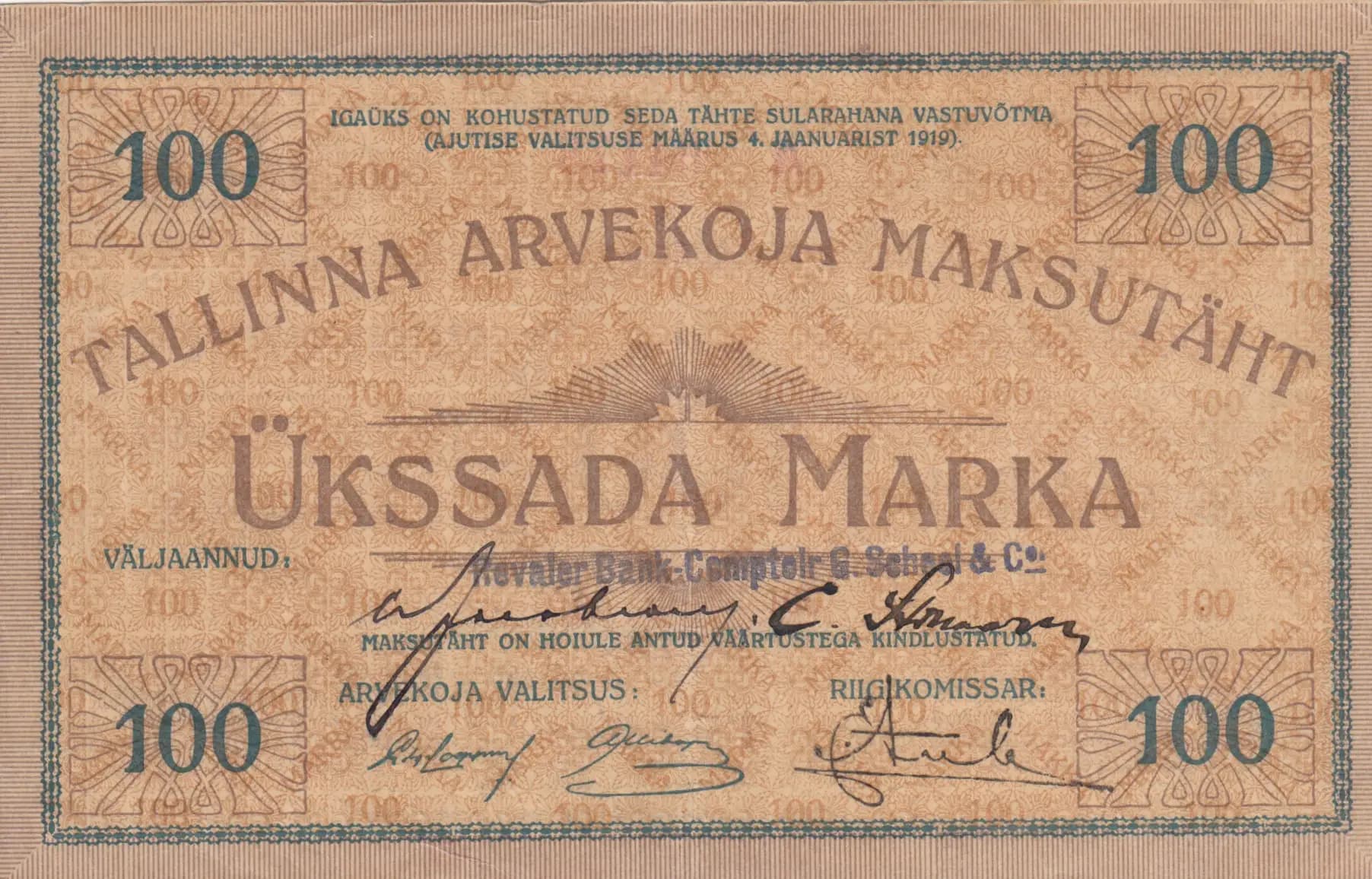
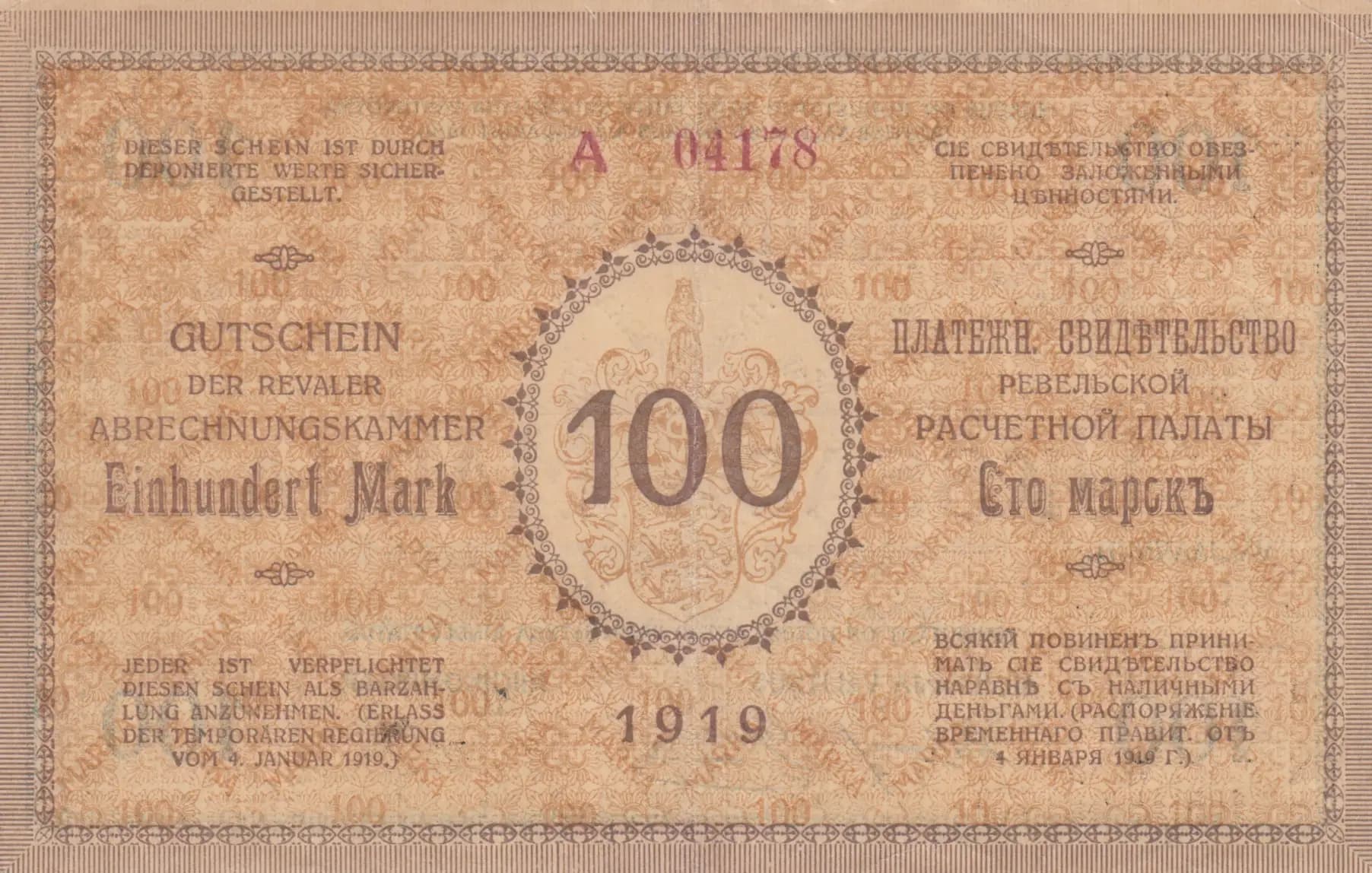
This 100 marka note from Estonia's 1919 Tallinna Arvekoda (Tallinn Accounting Chamber) is a historically significant early Estonian currency issue featuring bilingual German and Russian text reflecting the transitional period following Estonian independence. The note displays characteristic aged tan-beige coloration with fine decorative line work, corner ornaments, and a distinctive sunburst design, and is graded VF with clear signatures and legible inscriptions on both sides. This transitional emergency currency is notable for its multilingual text representing the complex geopolitical situation of newly independent Estonia under provisional governance.
Common. While this is an early Estonian currency from a significant historical period, the eBay market data shows prices ranging from approximately $45-$275, with multiple sales in the $50-$120 range for VF-XF specimens. The 2016 catalog value for EF of $1,350 suggests some numismatic interest, but the active eBay market with numerous listed examples in various conditions indicates adequate supply. The note was part of regular circulation of the Tallinna Arvekoda issue and no evidence suggests an exceptionally limited print run or subsequent rarity.
This 100 marka note was issued on January 4, 1919, by the Tallinna Arvekoda under Estonia's Provisional Government decree, representing the nation's first independent currency during its emergence from Russian and German occupation following World War I. The bilingual German-Russian text inscriptions visible on the reverse reflect Estonia's position transitioning from the Russian Empire, while the Estonian language text on the obverse asserts the new nation's sovereignty and obligation to accept the currency as legal tender. The notation that the marks are secured by deposited values demonstrates the financial caution of Estonia's provisional authorities in establishing credibility for their newly-issued currency during this volatile period.
The 100 marka banknote features a classically austere design typical of early 20th century emergency currency, employing fine decorative line work and geometric ornamental patterns rather than figurative elements. Both sides utilize a tan-beige background with dark brown and dark blue/teal ornamental borders and corner designs incorporating the denomination '100' in decorative frames. The obverse features a prominent sunburst radiating pattern above the central text 'TALLINNA ARVEKOJA MAKS' and 'ÜKSSADA MARKA' (100 marks in Estonian), with multiple signature lines for authentication by officials of the Accounting Chamber Administration and State Commissioner. The reverse presents the denomination '100' within an ornamental oval frame, with '1919' printed below and surrounded by extensive legal text in German (upper sections) and Russian (lower sections), reflecting the multilingual necessity of the period. Serial number A 04178 appears on the reverse. The overall design emphasizes geometric security through intricate line patterns and ornamental framework rather than portraiture, consistent with provisional government currency practices.
FRONT SIDE: 'TALLINNA ARVEKOJA MAKS' (Tallinn Accounting Chamber Mark) / 'ÜKSSADA MARKA' (One hundred marks) / 'IGAUKS ON KOHUSTATUD SEDA TÄHTE SULARAHANA VASTUVÕTMA (AJUTISE VALITSUSE MÄÄRUS 4. JAANUARIST 1919)' (Everyone in Estonia is obligated to accept this note as cash [Provisional Government decree of January 4, 1919]) / 'VÄLJAANNUD:' (Issued by:) / 'MAKS KÄART ON HOIULE ANTUD NÄARTUSTEGA KINDLUSTATUID' (The mark note is held in custody secured by bonds) / 'ARVEKOJA VALITSUS:' (Accounting Chamber Administration:) / 'RIIGIKOMISAR:' (State Commissioner:). BACK SIDE: 'GUTSCHEIN DER REVALER ABRECHNUNGSKAMMER Einhundert Mark' (Voucher of the Reval Settlement Chamber One hundred marks) / 'DIESER SCHEIN IST DURCH DEPONIERTE WERTE SICHER-GESTELLT' (This note is secured by deposited values) / 'JEDER IST VERPFLICHTET DIESEN SCHEIN ALS BARZAH-LUNG ANZUNEHMEN. (ERLASS DER TEMPORÄREN REGIERUNG VOM 4. JANUAR 1919.)' (Everyone is obligated to accept this note as payment. [Decree of the Provisional Government of January 4, 1919.]) / 'ПЛАТЕЖН. СВИДЕТЕЛЬСТВО РЕВЕЛЬСКОЙ РАСЧЕТНОЙ ПАЛАТЫ СТО Марскъ' (Payment certificate of the Revel Settlement Chamber One hundred marks) / 'СИЕ СВИДЕТЕЛЬСТВО ОБЕСПЕЧЕНО ЗАЛОЖЕННЫМИ ЦЕННОСТЯМИ' (This certificate is secured by pledged valuables) / 'ВСЯКИЙ ПОВИНЕН ПРИНЯТЬ СИЕ СВИДЕТЕЛЬСТВО НАРЯДЬ СЪ НАЛИЧНЫМИ ДЕНЬГАМИ. (РАСПОРЯЖЕНИЕ ВРЕМЕННОГО ПРАВИТ. ОТ 4 ЯНВАРЯ 1919 Г.)' (Every person is obliged to accept this certificate as equal to cash money. [Order of the Provisional Government of January 4, 1919.]). Serial number: A 04178.
Letterpress (typographic) printing with fine line engraving elements, characteristic of early 20th century banknote production. The fine decorative line patterns, ornamental borders, and the clarity of the multi-language text blocks suggest a combination of engraved vignettes for the decorative elements with typographic composition for the text sections. The aging characteristics and ink penetration visible in the VF condition are consistent with period-appropriate letterpress technology and paper stock used by European security printers of 1919.
This specimen is variety P-A3b per Pick catalog classification. The serial number A 04178 indicates this is from the standard issue. The note displays handwritten signatures in black ink, typical of the authentication method for this issue. No overprints or significant varieties are apparent from the visual analysis, though variants may exist in signature combinations and serial number prefixes among other examples of this same Pick number designation.